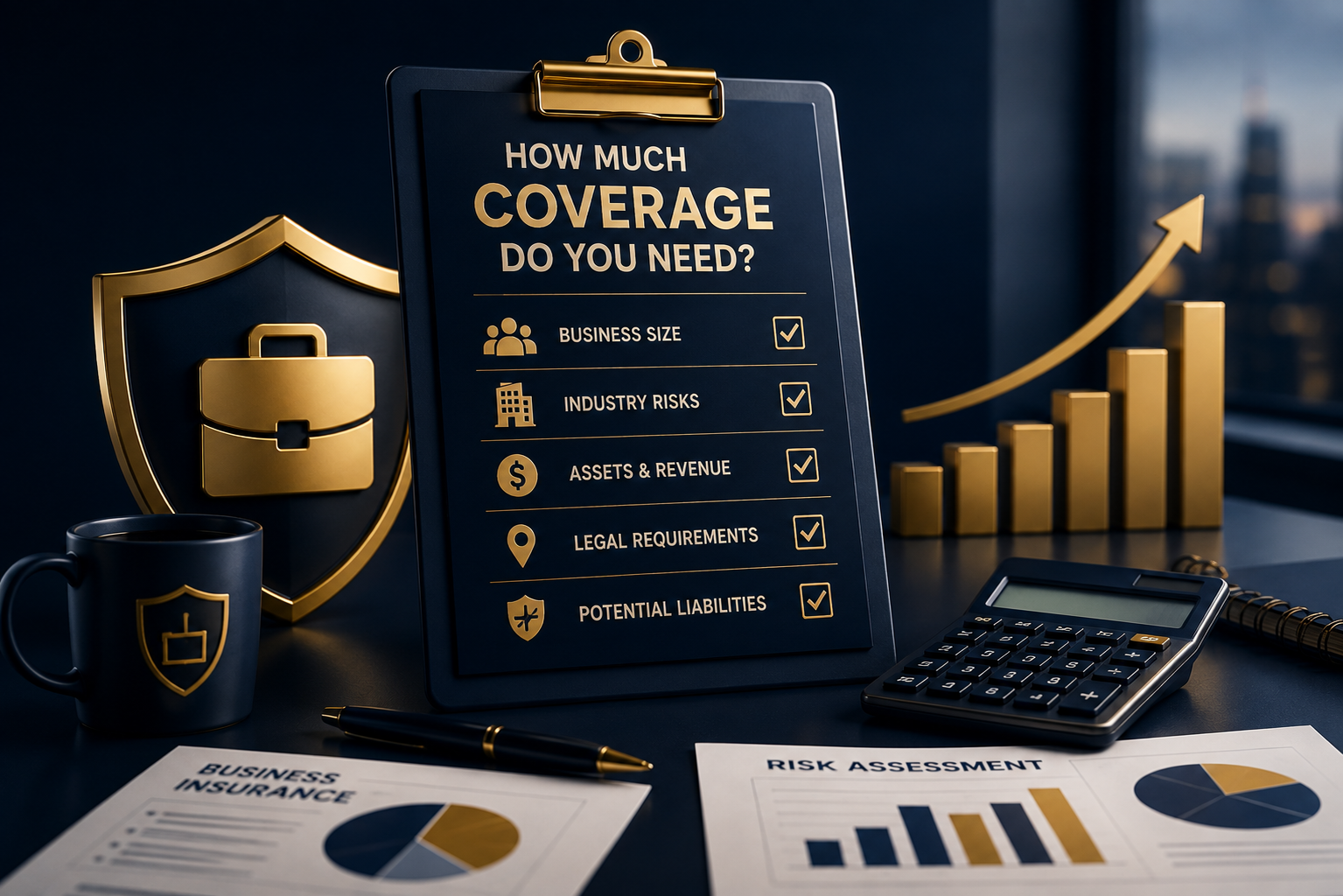
The amount of business insurance you need depends on the losses your company could realistically face. A small consulting firm, restaurant, retailer, contractor, and manufacturer can require very different limits and policies. Start by evaluating liability exposure, property replacement costs, employees, vehicles, revenue, cyber risk, contracts, and state requirements. Then choose limits high enough to protect the business from financially serious losses while using deductibles the company can realistically afford.
Key Takeaways
- There is no universal business insurance limit that works for every company.
- Liability limits should reflect realistic lawsuit exposure, contractual requirements, and the value of business assets you are trying to protect.
- Commercial property limits should generally be based on the cost to repair or replace insured property under the policy’s valuation method—not simply what you originally paid for it.
- Workers’ compensation and commercial auto requirements vary by state and business circumstances.
- Coverage should be reviewed as revenue, payroll, property, locations, vehicles, employees, contracts, products, and technology risks change.
There Is No Single Business Insurance Amount Everyone Needs
Business insurance does not work like selecting one coverage amount and assuming every risk is handled.
A company might simultaneously need:
- General liability insurance.
- Commercial property insurance.
- Business income coverage.
- Workers’ compensation.
- Commercial auto insurance.
- Professional liability insurance.
- Cyber insurance.
- Commercial umbrella or excess liability coverage.
Each policy can have its own limits, deductibles, exclusions, sublimits, and coverage triggers.
A useful question is: What events could create a loss large enough to seriously disrupt or threaten the business, and which insurance policies would respond to those losses?
Start With a Business Risk Inventory
Before choosing policy limits, identify what your company could lose.
| Business Exposure | Potential Loss | Coverage to Review |
|---|---|---|
| Customers and the public | Injury or property damage lawsuits. | General liability. |
| Buildings and equipment | Fire, theft, wind, or another covered property loss. | Commercial property. |
| Revenue | Lost income after a covered shutdown. | Business income or interruption coverage. |
| Employees | Work-related injury or occupational illness. | Workers’ compensation. |
| Vehicles | Bodily injury, property damage, and vehicle damage. | Commercial auto. |
| Professional services | Claims alleging errors, omissions, or negligence. | Professional liability. |
| Technology and data | Data breach, cyberattack, ransomware, or system interruption. | Cyber insurance. |
How Much General Liability Coverage Do You Need?
General liability limits should reflect the size and severity of third-party claims the business could face.
Factors to consider include:
- Customer traffic.
- Work performed at customer locations.
- Products sold or distributed.
- Property belonging to clients or other third parties.
- Industry lawsuit exposure.
- Commercial lease requirements.
- Customer contract requirements.
- The amount of business assets potentially exposed after an uninsured judgment.
Commercial general liability policies commonly use multiple limits rather than one number.
These can include:
- Each occurrence limit: The maximum applicable amount for a particular covered occurrence.
- General aggregate limit: The maximum applicable amount for certain covered claims during the policy period.
- Products-completed operations aggregate: A separate aggregate for certain product and completed-work claims.
- Sublimits: Lower limits that can apply to particular coverages.
Do not choose a liability limit solely because it is the least expensive option. A low limit can leave the business responsible for the remainder of a large judgment.
A Liability Limit Example
Suppose a covered liability claim results in an eligible $1.6 million loss and the applicable underlying policy provides a $1 million limit.
$1,600,000 covered loss − $1,000,000 liability limit = $600,000 potential excess exposure
If no other applicable coverage exists, the business could remain financially responsible for eligible amounts above the policy limit.
An appropriately structured commercial umbrella or excess liability policy may provide additional protection above qualifying underlying insurance.
This is a simplified example. Actual coverage depends on policy wording, defense costs, limits, underlying insurance, exclusions, and applicable law.
When Do You Need Commercial Umbrella Insurance?
Commercial umbrella or excess liability coverage can be useful when the potential severity of a lawsuit exceeds the limits available under primary insurance.
It can deserve consideration when a business has:
- Significant public or customer traffic.
- Large commercial vehicles.
- Work performed at third-party locations.
- Products with meaningful injury potential.
- A substantial asset base.
- Contracts requiring high liability limits.
- Liability losses that could realistically exceed underlying coverage.
Umbrella coverage is not simply an extra bucket of money for every policy. It generally applies above specified underlying liability coverage and contains its own terms and exclusions.
How Much Commercial Property Insurance Do You Need?
Commercial property coverage should be based on what it would cost to repair or replace covered business property according to the valuation method in your policy.
Consider the value of:
- Buildings.
- Tenant improvements.
- Machinery.
- Furniture.
- Computers.
- Inventory.
- Tools.
- Fixtures.
- Other business personal property.
The price you originally paid for equipment may not equal its current replacement cost.
Inflation, supply shortages, specialized machinery, shipping costs, and changes in construction expenses can all affect how much insurance is needed today.
Do Not Confuse Market Value With Replacement Cost
A building’s market value is not necessarily the amount required to rebuild it after a total covered loss.
Commercial property limits should reflect the valuation method required by the policy rather than simply the property’s sale price.
Land value, local real estate conditions, demolition expenses, construction materials, labor, and building-code requirements can make rebuilding cost substantially different from market value.
Replacement Cost vs. Actual Cash Value
| Valuation Method | General Approach | Coverage Impact |
|---|---|---|
| Replacement cost | Generally reflects replacing covered property with property of comparable kind and quality, subject to policy terms. | Can provide stronger protection against depreciation. |
| Actual cash value | Generally incorporates depreciation or another policy-defined valuation adjustment. | Claim payments can be lower for older property. |
How Much Business Income Coverage Do You Need?
Property damage is only part of the financial risk after a serious loss.
If a fire or other covered event shuts down operations, the company may lose revenue while continuing to owe expenses.
Business income coverage should be evaluated using factors such as:
- Expected revenue.
- Net income.
- Continuing payroll.
- Rent or mortgage obligations.
- Utilities and other continuing expenses.
- Temporary relocation costs.
- Expected time needed to repair or rebuild.
- Extra expenses required to continue operations.
Businesses should not assume they can rebuild and resume operations within a few weeks.
Permits, contractor availability, specialized replacement equipment, supply chains, building-code requirements, and other delays can extend the restoration period.
A Business Income Example
Suppose a business generates an average of $100,000 in monthly revenue and expects a severe covered property loss could disrupt operations for six months.
Six months of revenue would equal:
$100,000 × 6 months = $600,000 in gross revenue during the hypothetical interruption period
That does not automatically mean the business needs exactly $600,000 of business income insurance.
Actual coverage calculations can consider net income, continuing operating expenses, payroll decisions, extra expenses, policy formulas, restoration periods, and other factors.
The example illustrates why business interruption limits should be based on financial records and realistic shutdown scenarios rather than an arbitrary round number.
How Much Workers’ Compensation Coverage Do You Need?
Workers’ compensation is different from many optional commercial insurance decisions because requirements are heavily influenced by state law.
State rules can determine:
- Which employers must carry coverage.
- Which employees or owners can be exempt.
- How benefits are calculated.
- Whether insurance must be purchased from particular markets or systems.
- Penalties for failing to maintain required coverage.
Do not rely on a general statement such as “workers’ compensation is required once you have X employees.” Employee thresholds and exemptions vary among states.
Verify the rules that apply where your employees work.
How Much Commercial Auto Insurance Do You Need?
Commercial auto liability limits should reflect both state legal requirements and the potential severity of business vehicle accidents.
Important factors include:
- Vehicle size and type.
- Number of vehicles.
- Who drives them.
- Annual mileage.
- Delivery operations.
- Passenger transportation.
- Goods or equipment transported.
- Interstate operations.
- Contractual insurance requirements.
A severe commercial vehicle accident involving multiple injuries can produce liability far beyond minimum legal requirements.
State minimums should therefore be viewed as legal floors rather than automatic recommendations for sufficient protection.
Do You Need Hired and Non-Owned Auto Coverage?
A business can have auto exposure without owning any vehicles.
Hired and non-owned auto coverage can be important if employees:
- Drive personal vehicles for company errands.
- Rent cars for business travel.
- Use temporarily hired vehicles.
This coverage generally addresses certain business liability arising from vehicles the company uses but does not own.
It does not necessarily provide physical damage coverage for the employee’s personal car or replace the vehicle owner’s personal insurance.
How Much Professional Liability Insurance Do You Need?
Professional liability coverage should reflect the financial harm a client could plausibly allege resulted from your services.
Consider:
- Average project size.
- Largest client engagement.
- Type of advice or services provided.
- Potential downstream financial consequences of an error.
- Client contract requirements.
- Industry expectations.
- Defense costs.
A consultant working on a $20,000 engagement can still face a claim much larger than the project fee if the client alleges the mistake caused a major financial loss.
This is why professional liability limits should not automatically equal annual fees or the value of the largest contract.
Claims-Made Policies Need Special Attention
Professional liability and some cyber, management liability, and other commercial policies are commonly written on a claims-made basis.
With claims-made coverage, the policy period, retroactive date, and timing of claim reporting can be critical.
A business changing insurers should review:
- Retroactive date.
- Prior acts coverage.
- Extended reporting options.
- Reporting requirements.
- Potential gaps between old and new policies.
Buying a high limit does not help if a claim falls outside the policy’s coverage period because coverage continuity was handled incorrectly.
How Much Cyber Insurance Do You Need?
Cyber limits should reflect both the volume and sensitivity of information the business handles and how dependent the company is on technology.
Consider:
- Number of customer or employee records.
- Payment-card activity.
- Personally identifiable information.
- Health or financial information.
- Cloud services.
- Dependence on email and computer systems.
- Potential cyber business interruption.
- Data restoration expenses.
- Notification and forensic costs.
- Ransomware and cyber extortion exposure.
- Vendor and supply-chain dependencies.
A business with little stored customer data can still suffer a major financial loss if ransomware shuts down operations for several days or weeks.
Cyber risk should therefore be evaluated beyond the simple question of how many customer records are stored.
Do Contracts Determine How Much Insurance You Need?
Often, yes.
Commercial contracts frequently specify minimum insurance requirements.
Examples include:
- General liability limits.
- Commercial auto limits.
- Professional liability limits.
- Cyber liability limits.
- Workers’ compensation requirements.
- Additional insured status.
- Waiver of subrogation.
- Primary and noncontributory requirements.
Leases, construction agreements, vendor contracts, and professional-service agreements commonly contain insurance clauses.
Meeting contractual minimums is important, but those limits may still be lower than the business’s true financial exposure.
How Deductibles Affect the Amount of Coverage You Need
A deductible does not normally reduce the stated policy limit in the same way as simply purchasing less coverage, but it determines how much loss the business must absorb itself under the applicable policy.
Higher deductibles can reduce premiums, but they increase the amount the company must fund after a covered event.
Suppose a business experiences a $40,000 covered commercial property loss.
| Deductible | Simplified Potential Insurer Payment |
|---|---|
| $1,000 | $39,000 |
| $5,000 | $35,000 |
| $10,000 | $30,000 |
These simplified figures assume the full loss is otherwise covered and below the policy limit.
A deductible should generally be high enough to make economic sense but low enough that the company could comfortably pay it immediately after a loss.
How Much Insurance Does a Home-Based Business Need?
Home-based businesses can still have significant commercial exposure.
Homeowners or renters policies can contain limited coverage or exclusions for business property and liability.
A home-based company should consider:
- Business equipment value.
- Inventory stored at home.
- Customers visiting the premises.
- Professional liability.
- Cyber exposure.
- Business vehicle use.
- Loss of business income.
Depending on the operation, coverage may be provided through a personal-policy endorsement, a home-business policy, a Business Owner’s Policy, or separate commercial insurance.
How Much Insurance Does an LLC Need?
An LLC does not eliminate the need for insurance.
The business can still face:
- Lawsuits against the company.
- Property losses.
- Employee injuries.
- Commercial auto accidents.
- Professional claims.
- Cyber losses.
- Business interruption.
The legal entity can help separate certain business and personal liabilities when properly maintained, but insurance helps fund eligible losses.
An LLC should determine coverage needs using the same risk-based approach as other businesses.
A Practical Small-Business Coverage Example
Consider a hypothetical small manufacturer with:
- $1 million in annual revenue.
- Ten employees.
- $400,000 of machinery and inventory.
- A leased facility.
- Two company vehicles.
- Products shipped to customers.
- Customer and employee information stored electronically.
The business might analyze coverage this way:
| Exposure | Coverage Question |
|---|---|
| Customer or product liability | Could a serious injury claim exceed primary liability limits? |
| Machinery and inventory | Would the property limit cover current replacement costs? |
| Operations | How long could the business remain closed after a major covered property loss? |
| Employees | What workers’ compensation requirements apply in the state? |
| Vehicles | Are auto limits adequate for a severe multi-vehicle accident? |
| Technology | Could the company absorb breach-response and cyber interruption costs without insurance? |
The business should then compare its answers with actual policy limits, deductibles, exclusions, and contract requirements.
How to Calculate Business Insurance Needs Step by Step
- Inventory your assets. List buildings, equipment, inventory, computers, tools, and other property that would need replacement.
- Identify liability scenarios. Consider customer injuries, product claims, vehicle accidents, professional mistakes, and other lawsuits.
- Estimate shutdown exposure. Determine how long the business could operate without its normal location, equipment, or revenue.
- Review employees. Confirm applicable workers’ compensation and employment-related exposures.
- Review vehicles. Identify owned, hired, rented, and employee-owned vehicles used for business.
- Evaluate professional risk. Determine how much financial harm clients could allege from errors or omissions.
- Evaluate cyber risk. Consider both data exposure and operational dependence on technology.
- Read contracts. Note insurance limits, additional insured requirements, and other obligations.
- Choose affordable deductibles. Make sure the business could absorb them after a loss.
- Compare the largest realistic losses with your limits. Consider umbrella or excess coverage when primary liability limits appear inadequate.
When Should Business Insurance Limits Be Increased?
Insurance should be reviewed whenever business operations materially change.
Potential reasons to increase or revise coverage include:
- Revenue grows significantly.
- Payroll increases.
- The company hires more employees.
- New vehicles are purchased.
- New locations open.
- Expensive machinery or inventory is added.
- The company starts selling new products.
- New professional services are offered.
- A large customer requires higher limits.
- Cyber or data exposure increases.
- Construction and equipment replacement costs increase substantially.
Common Business Insurance Limit Mistakes
- Choosing state minimums as the target: A legal minimum can be much lower than a severe real-world loss.
- Insuring property for purchase price: Current replacement cost can be very different.
- Ignoring business income: Repairing property does not replace months of lost revenue automatically.
- Relying on an LLC instead of insurance: Entity structure does not fund covered losses.
- Ignoring contract requirements: Inadequate insurance can create both uninsured risk and contractual problems.
- Choosing deductibles the company cannot fund: A policy can become difficult to use if the deductible creates a cash-flow crisis.
- Ignoring cyber exposure: Small businesses can still suffer costly technology disruptions.
- Failing to update limits: Growth can make insurance that was adequate several years ago insufficient today.
Questions to Ask Before Choosing Coverage Limits
- What is the largest liability claim my business could reasonably face?
- What do my contracts require?
- What would it cost to replace all major business property today?
- How long could operations be interrupted after a serious loss?
- Could my company afford the deductible tomorrow?
- Are state workers’ compensation and auto requirements satisfied?
- Could a professional mistake create a large financial claim?
- What would a cyber shutdown cost per day or week?
- Are important losses subject to sublimits?
- Would umbrella or excess liability materially reduce a major uninsured exposure?
Frequently Asked Questions
The Bottom Line
The right amount of business insurance is enough to protect the company against losses that could materially damage its finances or threaten its ability to continue operating. That usually requires several different policies and limits rather than one universal amount.
Evaluate liability lawsuits, property replacement costs, lost income, employees, commercial vehicles, professional services, cyber exposure, and contractual obligations separately. Then compare each risk with the limits and deductibles in your insurance program.
Legal minimums and contract requirements are important starting points, but they should not automatically be treated as sufficient protection. Review coverage regularly as the business grows, property values change, revenue increases, employees are added, and new risks develop.
Sources
- U.S. Small Business Administration, Business Insurance guidance.
- National Association of Insurance Commissioners, Commercial Insurance and Small Business Insurance consumer resources.
- U.S. Department of Labor, Workers’ Compensation resources.
- Federal Trade Commission, Cybersecurity for Small Business guidance.
- State Departments of Insurance, motor vehicle agencies, and workers’ compensation authorities for state-specific insurance requirements.