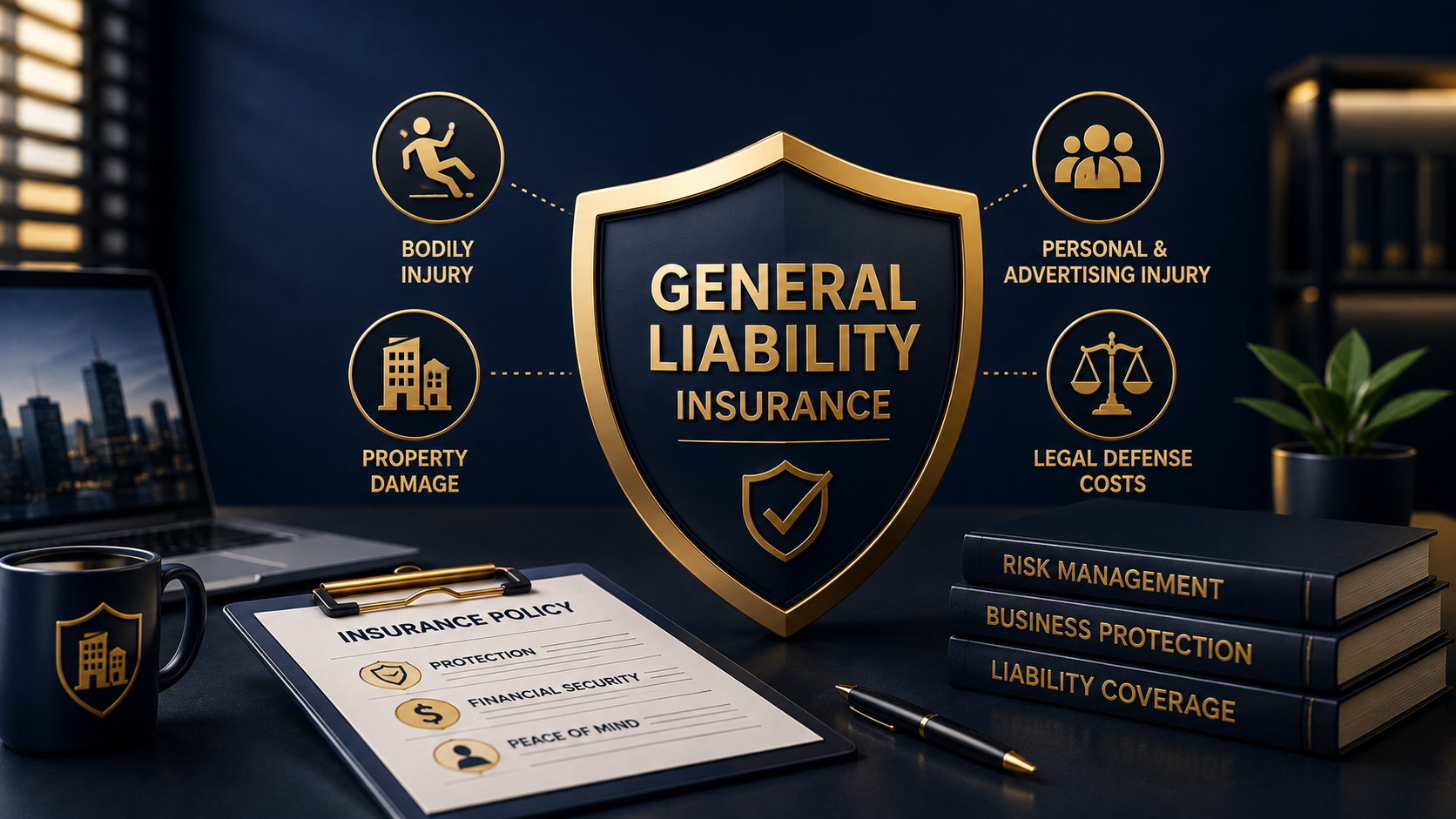
General liability insurance helps protect a business against certain third-party claims involving bodily injury, property damage, and personal or advertising injury. It can also help pay eligible legal defense costs, settlements, and judgments when a claim is covered. However, general liability does not protect against every business risk. Employee injuries, professional mistakes, commercial vehicle accidents, cyber incidents, and damage to your own property generally require different insurance.
Key Takeaways
- General liability insurance primarily protects against certain claims made by customers, vendors, landlords, and other third parties.
- Coverage commonly includes bodily injury, property damage, and qualifying personal or advertising injury claims.
- Legal defense expenses can be an important part of general liability protection, even when a business ultimately disputes liability.
- Workers’ compensation, professional liability, commercial auto, cyber insurance, and commercial property coverage address different risks.
- Policy limits, exclusions, endorsements, deductibles, additional insured requirements, and contract language can materially change the protection a business actually receives.
What Is General Liability Insurance?
General liability insurance is a form of commercial insurance designed to protect businesses from certain liability claims made by people or organizations outside the company.
It is commonly called:
- Commercial general liability insurance.
- CGL insurance.
- Business liability insurance.
- General liability coverage.
The policy can respond when a covered business activity allegedly causes injury, damages someone else’s property, or results in another covered liability claim.
For example, imagine a customer enters a retail shop, slips on a wet floor, fractures an arm, and alleges the business failed to maintain a safe premises.
If the claim falls within the policy’s terms, general liability insurance can potentially help pay eligible defense expenses and damages up to applicable limits.
What Does General Liability Insurance Cover?
A commercial general liability policy typically organizes protection around several major categories of liability.
| Coverage Area | What It Can Address | Example |
|---|---|---|
| Bodily injury | Certain injuries suffered by customers or other third parties. | A visitor slips inside your office and is injured. |
| Property damage | Certain damage your business causes to property belonging to someone else. | A contractor accidentally damages a customer’s flooring while performing covered work. |
| Personal injury | Certain covered offenses defined by the policy. | A qualifying claim involving libel, slander, or another covered offense. |
| Advertising injury | Certain claims connected with covered advertising activities. | A qualifying claim alleges your advertisement violated another party’s covered rights. |
| Legal defense | Defense expenses for qualifying lawsuits or claims. | The insurer appoints or pays eligible defense counsel for a covered lawsuit. |
Bodily Injury Coverage
Bodily injury liability is one of the most recognizable parts of a general liability policy.
It can help when someone outside the business alleges that company negligence caused a physical injury.
Examples can include:
- A customer slips on a wet floor.
- A visitor trips over equipment at an office.
- A contractor’s work accidentally injures a third party.
- A customer is injured by falling merchandise.
- A qualifying product-related incident causes bodily injury.
A covered claim can potentially involve medical-related damages, lost income claimed by the injured party, pain and suffering where legally recoverable, legal defense expenses, settlements, or judgments.
The exact protection depends on the policy language and applicable law.
Third-Party Property Damage Coverage
General liability can also cover certain claims alleging that your business damaged someone else’s property.
Imagine a contractor working inside a client’s building accidentally damages an expensive interior fixture.
If the circumstances fall within the policy, general liability could potentially respond to the third-party property damage claim.
Other examples can include:
- A cleaning company damages a customer’s furniture.
- A contractor damages part of a customer’s building.
- An employee accidentally damages third-party property during covered business operations.
Damage to property owned by your own company is different. That generally falls under commercial property insurance rather than general liability.
Personal and Advertising Injury Coverage
General liability insurance can include protection for certain offenses that do not involve physical injuries.
Depending on the policy, covered personal and advertising injury offenses can include certain claims involving:
- Libel.
- Slander.
- Certain privacy-related offenses.
- Certain wrongful eviction or entry allegations.
- Other offenses specifically defined by the policy.
Advertising-related intellectual property disputes can be particularly complicated. Businesses should not assume that a general liability policy provides broad coverage for every copyright, trademark, patent, or advertising dispute.
Policy exclusions and definitions determine what protection exists.
Does General Liability Cover Legal Defense Costs?
One of the most valuable features of liability insurance can be the insurer’s duty to defend qualifying claims.
Even a lawsuit the business believes is baseless can be expensive to defend.
Defense costs can include:
- Attorney fees.
- Court-related expenses.
- Expert witness costs where covered.
- Investigation expenses.
- Other eligible defense costs.
How defense costs interact with policy limits depends on the insurance contract.
In some policies or coverage forms, certain defense expenses may be handled outside the liability limit. Other arrangements can reduce the amount remaining for settlements or judgments.
Always check the actual policy rather than assuming all defense structures are identical.
What Is Products-Completed Operations Coverage?
General liability policies commonly include protection for certain bodily injury or property damage claims arising from products or completed work.
This exposure can continue after the customer leaves your premises or after your work is completed.
For example:
- A product sold by a business allegedly causes injury after purchase.
- Completed contractor work allegedly causes later property damage.
- A completed installation allegedly causes a covered third-party injury.
Products-completed operations coverage is particularly important for contractors, manufacturers, distributors, retailers, and businesses whose work can create liability after completion.
Product recall expenses, however, should not automatically be assumed to be covered by ordinary product liability protection.
Does General Liability Cover Damage to Rented Premises?
General liability policies can provide limited protection for certain damage to premises rented by the insured, subject to policy terms and separate limits.
This can be relevant for businesses leasing:
- Retail storefronts.
- Offices.
- Warehouses.
- Commercial suites.
- Other rented locations.
Commercial lease requirements can go beyond what the standard general liability policy provides.
A business that leases property should compare its insurance with the lease’s requirements for liability, property, additional insured status, waivers, and other provisions.
What Does General Liability Insurance Not Cover?
General liability is foundational coverage, but many major business risks require separate insurance.
| Exposure | Generally Not the Main Role of General Liability | Coverage to Consider |
|---|---|---|
| Employee work injuries | General liability generally does not replace workers’ compensation. | Workers’ compensation. |
| Professional mistakes | Errors or negligent professional services generally require different protection. | Professional liability / E&O. |
| Business vehicle accidents | Commercial auto exposures generally require auto coverage. | Commercial auto. |
| Damage to your own property | Liability coverage primarily addresses claims from others. | Commercial property. |
| Cyber incidents | Broad cyber protection is generally not provided by standard CGL alone. | Cyber insurance. |
| Employment lawsuits | Many employment-related claims require separate coverage. | Employment Practices Liability Insurance. |
Does General Liability Cover Employee Injuries?
Generally, work-related employee injuries are handled through workers’ compensation rather than general liability insurance.
Workers’ compensation laws vary by state and can determine:
- Which employers must carry coverage.
- Which workers are covered.
- Which owners may qualify for exemptions.
- What benefits are available.
- How claims are administered.
A business should verify current workers’ compensation requirements in each state where employees work rather than relying on a single nationwide employee threshold.
Does General Liability Cover Professional Mistakes?
Generally, no. A business that provides professional advice or services can need professional liability insurance, commonly called errors and omissions or E&O insurance.
Consider a technology consultant who recommends a system configuration and the client later alleges that the recommendation caused a major financial loss.
That type of professional-service allegation may fall outside ordinary general liability coverage.
Businesses that commonly evaluate professional liability include:
- Consultants.
- Accountants.
- Technology companies.
- Architects and engineers.
- Real estate professionals.
- Other businesses whose advice or specialized services can cause client financial harm.
Does General Liability Cover Commercial Auto Accidents?
Business vehicle liability generally requires a commercial auto policy rather than ordinary general liability insurance.
A company-owned delivery vehicle, service truck, or other commercial vehicle can create substantial bodily injury and property damage exposure.
A commercial auto policy can provide selected coverages such as:
- Bodily injury liability.
- Property damage liability.
- Collision.
- Comprehensive.
- Uninsured or underinsured motorist protection where applicable.
- Other state-specific benefits.
Businesses whose employees drive personal or rented vehicles for work should also consider whether hired and non-owned auto coverage is appropriate.
Does General Liability Cover Cyberattacks or Data Breaches?
Businesses should not assume that standard general liability provides comprehensive protection against modern cyber risks.
Cyber insurance can provide specialized coverage for certain expenses involving:
- Data breach response.
- Notification costs.
- Forensic investigations.
- Data restoration.
- Cyber business interruption.
- Cyber extortion.
- Third-party privacy liability.
Cyber policies differ significantly, so companies that store customer data, process payments, use cloud systems, or rely heavily on computer networks should evaluate the coverage separately.
How General Liability Policy Limits Work
Commercial general liability policies commonly contain several separate limits.
Typical limit categories can include:
- Each occurrence limit: The applicable maximum for a single covered occurrence.
- General aggregate limit: The applicable maximum for certain covered losses during the policy period.
- Products-completed operations aggregate: A separate aggregate for eligible products and completed-work claims.
- Personal and advertising injury limit: A limit applying to eligible claims in that coverage category.
- Damage to premises rented to you: A separate limit can apply to qualifying losses.
A declarations page shows the specific limits purchased for the policy.
Each Occurrence vs. Aggregate Limits
The distinction between an occurrence limit and an aggregate limit is important.
Suppose a hypothetical liability policy includes:
- A $1 million each-occurrence limit.
- A $2 million general aggregate limit.
The occurrence limit can restrict how much the insurer pays for an individual covered event, while the aggregate can restrict applicable payments across multiple covered claims during the policy period.
For example, several significant claims during one year can use part of the aggregate even when no single claim reaches the occurrence limit.
This example illustrates the mechanics only. Exact limits and how they apply depend on the policy.
A Practical Liability Limit Example
Imagine a business faces an eligible covered claim totaling $1.35 million while its applicable occurrence limit is $1 million.
$1,350,000 covered loss − $1,000,000 policy limit = $350,000 potential excess exposure
If no additional applicable insurance exists, the business could remain responsible for amounts above the liability limit.
Commercial umbrella or excess liability coverage can provide additional limits above qualifying underlying policies, subject to its own terms.
How Much General Liability Insurance Do You Need?
There is no universal liability limit that is automatically appropriate for every small business.
Consider:
- How many customers visit your premises.
- Whether employees work at customer locations.
- The severity of possible bodily injury claims.
- The value of third-party property you work around.
- Whether your products can cause injury or property damage.
- Contractual insurance requirements.
- Lease requirements.
- Your company’s financial assets.
- Whether an umbrella policy is economically appropriate.
A commonly available limit should not automatically be treated as a recommendation. The right amount depends on the company’s actual exposure.
Who Needs General Liability Insurance?
General liability insurance can be useful for many types of businesses because third-party injury and property damage risks exist in numerous industries.
Examples include:
- Retail stores.
- Restaurants.
- Contractors.
- Cleaning companies.
- Landscapers.
- Consultants.
- Technology companies.
- Photographers.
- Real estate businesses.
- Home-based businesses.
- Wholesalers and distributors.
Even a business with no storefront can face liability if employees visit customer locations, attend events, rent office space, sell products, or work around third-party property.
Is General Liability Insurance Legally Required?
There is no single federal rule requiring every U.S. business to carry general liability insurance.
However, a business may effectively be required to maintain it because of:
- A commercial lease.
- A customer contract.
- A construction agreement.
- Vendor requirements.
- Licensing rules in certain occupations or jurisdictions.
- A lender or other commercial agreement.
State and local requirements can vary. Businesses should check applicable licensing agencies, contract terms, and state insurance requirements rather than assuming a nationwide rule applies.
What Is an Additional Insured?
Commercial contracts frequently require one party to add another party as an additional insured on a general liability policy.
For example:
- A landlord may require additional insured status on a tenant’s liability policy.
- A general contractor may require subcontractors to provide additional insured protection.
- A customer may require a vendor to add the customer to qualifying coverage.
Additional insured status provides protection only within the scope of the policy and applicable endorsement.
It does not automatically provide every right or coverage available to the named insured.
What Is a Certificate of Insurance?
A Certificate of Insurance, commonly called a COI, summarizes certain information about insurance policies in force when the certificate is issued.
It commonly shows information such as:
- Named insured.
- Insurance carrier.
- Policy period.
- Types of insurance.
- Policy limits.
A certificate generally does not create coverage that is absent from the actual policy.
If a contract requires additional insured status or another endorsement, verify that the required endorsement has actually been issued rather than relying on the COI alone.
General Liability vs. Business Owner’s Policy
General liability is one type of business insurance. A Business Owner’s Policy, or BOP, packages multiple coverages together for eligible businesses.
| Feature | General Liability | Business Owner’s Policy |
|---|---|---|
| Liability coverage | Yes, subject to policy terms. | Commonly included. |
| Commercial property | Generally not the purpose of standalone general liability. | Commonly included. |
| Business income | Generally not included as ordinary GL protection. | Commonly included in eligible BOP structures. |
A BOP can be convenient for businesses needing both liability and property protection, but it still does not automatically include workers’ compensation, commercial auto, professional liability, or every cyber exposure.
General Liability vs. Professional Liability
| Question | General Liability | Professional Liability |
|---|---|---|
| Primary risk | Certain bodily injury and property damage claims. | Certain professional errors, omissions, and negligence claims. |
| Typical example | Customer slips in your office. | Client alleges your professional advice caused financial loss. |
| Can a company need both? | Yes. | Yes. |
How Much Does General Liability Insurance Cost?
Premiums vary substantially by company because insurers evaluate the particular liability exposure.
Pricing factors can include:
- Industry.
- Business operations.
- Location.
- Revenue.
- Payroll.
- Customer traffic.
- Products and completed operations exposure.
- Coverage limits.
- Deductibles where applicable.
- Previous claims.
- Risk-management practices.
A consultant working remotely can have a very different liability profile from a roofing contractor, restaurant, manufacturer, or retail store.
Generic premium averages therefore should not be treated as quotes for an individual business.
A Practical General Liability Claim Example
Suppose a hypothetical retail business has qualifying general liability coverage.
A customer slips in the store, suffers a serious injury, and files a lawsuit seeking damages.
The insurer determines that the claim falls within the policy’s coverage.
Potential covered expenses could include:
- Attorney fees and eligible defense expenses.
- Investigation costs.
- A covered settlement.
- A covered court judgment if the case proceeds to trial.
If the eligible damages remain within the applicable limit, the insurer can pay according to the contract.
If the covered loss exceeds the available limit, the company can face uninsured exposure unless another applicable policy, such as commercial umbrella coverage, responds.
How to Compare General Liability Policies
- Compare equivalent limits. Do not compare premiums from policies providing materially different protection.
- Review each occurrence and aggregate limits. Understand how much protection applies to one claim and across the policy period.
- Review products-completed operations coverage. This can be critical for contractors and product businesses.
- Check exclusions. Identify operations, products, services, or claims that may fall outside coverage.
- Review defense provisions. Understand how legal expenses interact with policy limits.
- Check additional insured requirements. Make sure contracts can be satisfied with available endorsements.
- Review contractual liability provisions. Do not assume every obligation accepted under a contract is insured.
- Confirm the correct business operations are described. Material changes in operations should be disclosed to the insurer.
- Consider excess coverage. Evaluate whether potential severe claims justify commercial umbrella or excess limits.
When Should You Review General Liability Coverage?
Business operations rarely remain completely unchanged.
Review coverage when:
- Revenue grows significantly.
- You open a new location.
- You begin working in new states.
- You sign a major client contract.
- You begin selling new products.
- You change the services you provide.
- You hire employees who work at customer locations.
- You take on larger projects.
- Your landlord changes insurance requirements.
- Your claims history changes.
A policy that adequately protected a small startup may no longer fit the same company after substantial growth.
Common General Liability Insurance Mistakes
- Assuming general liability covers everything: Many major commercial risks require separate insurance.
- Choosing limits only to reduce premiums: A severe lawsuit can exceed a low liability limit.
- Ignoring aggregate limits: Multiple claims can reduce the coverage remaining during the policy year.
- Ignoring contract requirements: Clients and landlords can require specific limits and endorsements.
- Confusing a COI with an endorsement: A certificate generally does not create additional insured coverage by itself.
- Assuming an LLC replaces insurance: Legal structure and liability insurance address different problems.
- Failing to update business operations: New services or products can create risks not contemplated when the policy was purchased.
Frequently Asked Questions
The Bottom Line
General liability insurance is a foundational business policy that can protect against certain third-party bodily injury, property damage, and personal or advertising injury claims. It can also provide valuable legal defense protection when a covered lawsuit arises.
Its biggest limitation is that it does not cover every commercial risk. Employee injuries, professional mistakes, company vehicle accidents, cyber incidents, employment lawsuits, and damage to your own business property generally require other insurance.
Choose coverage by examining the severity of realistic liability claims, contractual requirements, policy limits, aggregate limits, exclusions, and endorsements. As the business grows or changes operations, review the policy to make sure the protection still matches the risks the company actually faces.
Sources
- U.S. Small Business Administration, Business Insurance guidance.
- National Association of Insurance Commissioners, Commercial Insurance and Small Business Insurance consumer resources.
- U.S. Department of Labor, Workers’ Compensation resources.
- State Departments of Insurance for commercial insurance licensing, consumer guidance, and state-specific requirements.