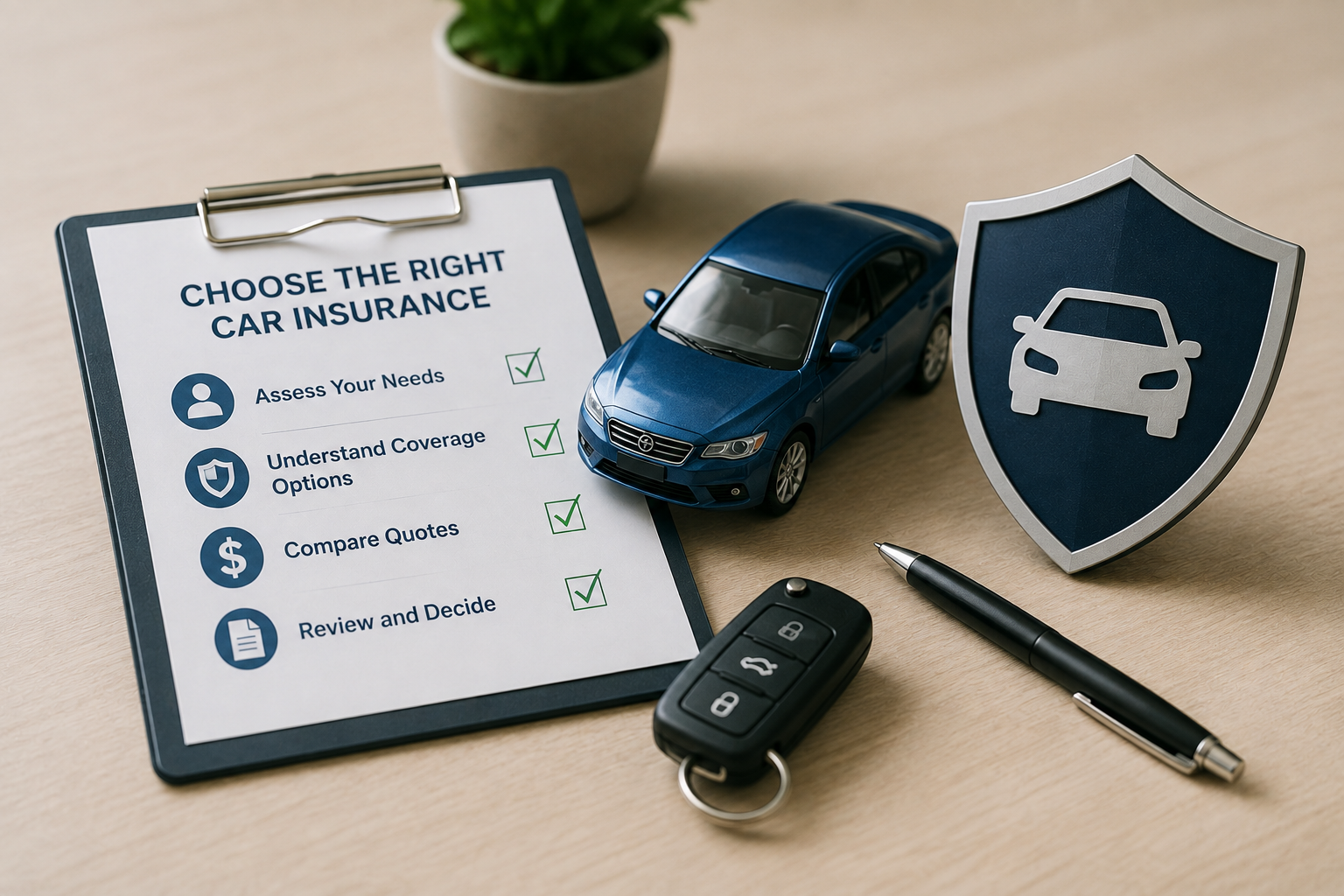
Choosing the right car insurance coverage starts with your state’s requirements, but the legal minimum is only the beginning. You also need to consider how much liability risk you can afford, the value of your vehicle, whether you have a loan or lease, your deductible, and protection against uninsured drivers or accident-related medical expenses. The best combination depends on your finances, vehicle, policy options, and state rules.
Key Takeaways
- Start by confirming the current minimum auto insurance requirements in your state.
- Consider liability limits above the legal minimum if a serious accident could expose your savings, income, or other assets.
- Collision and comprehensive coverage protect your own vehicle and may be required by a lender or lessor.
- Choose deductibles you could realistically afford after an unexpected claim.
- Compare quotes using the same limits, deductibles, drivers, vehicles, and optional coverages before comparing price.
Start With Your State’s Car Insurance Requirements
Auto insurance requirements are established at the state level, so there is no single minimum policy that applies to every U.S. driver. Most states require drivers to maintain at least some form of auto insurance or financial responsibility, but the required coverages and minimum limits vary.
Depending on the state, required protection may include bodily injury liability, property damage liability, uninsured or underinsured motorist coverage, personal injury protection, or another form of coverage.
Before choosing a policy, verify the current requirements with your state insurance department or another official state authority. A requirement you see for one state should not be assumed to apply in another.
Important: A state minimum is a legal threshold. It is not necessarily the amount of coverage that provides enough financial protection for your situation.
Understand What Each Type of Coverage Does
Car insurance is made up of separate coverages that protect against different financial risks. Understanding the purpose of each coverage makes it easier to decide where you need more protection and where you may be comfortable accepting more risk yourself.
| Coverage | What It Generally Protects | When It May Matter Most |
|---|---|---|
| Liability | Covered injuries or property damage you cause to other people. | When you could face substantial financial responsibility after an at-fault accident. |
| Collision | Covered collision damage to your own vehicle. | When repairing or replacing your vehicle yourself would create a financial burden. |
| Comprehensive | Many covered non-collision losses such as theft, hail, fire, vandalism, or animal impacts. | When theft, weather, vandalism, or other non-collision losses could significantly affect you financially. |
| Uninsured/Underinsured Motorist | Certain covered losses caused by drivers who have no insurance or insufficient insurance. | When the responsible driver cannot provide enough insurance to address a covered loss. |
| PIP/Medical Payments | Certain medical or injury-related expenses after an accident. | When state rules or your financial situation make additional accident-related medical protection relevant. |
The most important distinction is who or what a coverage protects. Liability coverage primarily addresses financial responsibility to other people, while collision and comprehensive coverage protect your own insured vehicle.
Choose Liability Limits Carefully
Liability insurance is one of the most important parts of an auto policy because it can protect you against covered financial responsibility for injuries or property damage you cause to others.
Liability limits establish the maximum amount available under that portion of the policy, subject to the policy terms. If a covered accident causes damages above an applicable limit, the policy does not automatically expand to pay the difference.
When choosing limits, consider how much financial responsibility you could realistically absorb if a severe accident exceeded your insurance. Your income, savings, assets, and overall financial situation can all be relevant.
Liability Limit Example
Suppose a hypothetical covered accident creates $80,000 of liability for property damage and the applicable property damage limit on the policy is $50,000.
The policy would generally remain subject to its $50,000 limit. The remaining amount could become your responsibility depending on the circumstances and applicable law.
This is why choosing only the lowest amount legally permitted and choosing a limit that matches your financial exposure are two different decisions.
Decide Whether Collision Coverage Makes Sense
Collision coverage helps pay for covered damage to your own vehicle caused by a collision. It commonly applies when your vehicle hits another vehicle, strikes an object, or experiences another covered collision loss.
Collision coverage is generally optional under state insurance laws, but a lender or leasing company may require it while it has a financial interest in the vehicle.
Collision may be especially useful when:
- Your vehicle still has substantial value.
- You could not comfortably replace the vehicle yourself.
- A major repair would create a significant financial problem.
- A lender or lessor requires physical damage coverage.
For an older vehicle you own outright, compare the vehicle’s current value with the cost of collision coverage and your deductible. As a vehicle’s value declines, the financial tradeoff can change.
Consider Comprehensive Coverage Separately
Comprehensive coverage protects your insured vehicle against many covered losses that are not collisions. Depending on the policy, these can include theft, hail, fire, vandalism, flooding, falling objects, and contact with an animal.
Because comprehensive addresses different risks from collision, the two coverages should not automatically be treated as one decision. Someone who parks outdoors in an area with frequent storms, theft, or animal collisions may evaluate comprehensive coverage differently from collision coverage.
Comprehensive coverage commonly has its own deductible and, like collision, may be required by a lender or lessor.
Review Uninsured and Underinsured Motorist Coverage
Uninsured motorist coverage can provide protection when a responsible driver does not have applicable insurance. Underinsured motorist coverage can apply when the responsible driver’s available insurance is not enough to address a qualifying covered loss.
The available forms of this protection and whether they are required, optional, or subject to rejection rules vary by state. Depending on the state and policy, coverage may address bodily injury, property damage, or both.
Do not assume your liability insurance replaces uninsured or underinsured motorist protection. They are designed to address different financial risks.
Evaluate PIP and Medical Payments Coverage
Personal injury protection, commonly called PIP, and medical payments coverage can help with certain medical or injury-related costs after an accident.
Medical payments coverage generally helps pay qualifying medical expenses for covered occupants. PIP can provide broader benefits in jurisdictions where it applies and may cover additional injury-related costs depending on state law and policy terms.
Requirements and availability are not uniform nationwide. Review your state’s rules, your existing health insurance, and the actual benefits offered before deciding how much medical-related auto coverage makes sense.
Choose a Deductible You Could Afford Tomorrow
Collision and comprehensive coverage commonly include deductibles. A higher deductible generally reduces the premium for that coverage because you agree to absorb more of a covered loss yourself.
The tradeoff is straightforward: a lower premium today can mean a larger out-of-pocket expense after an accident, theft, storm, or other covered event.
Deductible Example
Suppose a covered collision causes $5,000 in damage and your deductible is $1,000.
$5,000 covered damage − $1,000 deductible = $4,000 potential insurance payment.
In this simplified hypothetical example, you would absorb $1,000 of the covered loss. A deductible should therefore be chosen based on what you could realistically pay unexpectedly, not simply which option creates the lowest premium.
Match Physical Damage Coverage to Your Vehicle’s Value
Vehicle value is particularly important when deciding whether to carry collision and comprehensive coverage on a car you own outright.
As the vehicle becomes less valuable, compare the cost of the coverage and the deductible with the amount of protection the policy could realistically provide after a covered total loss.
Vehicle Value Example
Suppose you own a paid-off vehicle worth a hypothetical $6,000 and carry a $1,000 deductible. The deductible represents a meaningful portion of the vehicle’s value.
That does not automatically mean you should drop coverage, but it does mean the premium, deductible, vehicle value, and your ability to replace the car should be compared together.
Liability coverage should be evaluated separately. Driving an inexpensive vehicle does not eliminate the possibility of causing expensive injuries or property damage to someone else.
Check Your Loan or Lease Agreement
If your vehicle is financed or leased, the lender or lessor has a financial interest in it and may require collision and comprehensive coverage.
Your agreement may also restrict the deductible options you can choose or contain other insurance requirements. Review the contract before reducing or removing physical damage coverage.
Paying off the loan removes the lender’s financial interest, but it does not automatically mean physical damage coverage is no longer useful. Your ability to repair or replace the vehicle remains an important consideration.
Do Not Assume “Full Coverage” Means Everything Is Covered
“Full coverage” is an informal phrase commonly used to describe a policy containing liability, collision, and comprehensive coverage. It is not the name of a standardized policy that covers every possible loss.
Two policies described as full coverage can have very different liability limits, deductibles, uninsured motorist protection, medical coverage, rental benefits, exclusions, and endorsements.
Compare what the policy actually contains instead of relying on the label.
Consider Optional Coverage Based on Your Actual Needs
Insurers may offer optional coverages such as rental reimbursement, towing, roadside-related benefits, or other endorsements. These additions can be useful, but not every option is necessary for every driver.
For example, rental reimbursement may be more valuable if you depend on one vehicle for commuting and would have difficulty paying for a temporary replacement after a covered loss.
Before adding optional protection, check the cost, benefit limits, waiting periods or conditions, and whether another membership or policy already provides similar protection.
Compare Car Insurance Quotes on an Apples-to-Apples Basis
A cheaper quote is not necessarily a better value if it provides less coverage. One insurer’s quote may use lower liability limits, a higher deductible, or fewer optional protections than another insurer’s quote.
Keep the major variables consistent when requesting quotes:
- Bodily injury liability limits.
- Property damage liability limits.
- Collision coverage and deductible.
- Comprehensive coverage and deductible.
- Uninsured and underinsured motorist coverage.
- PIP or medical payments coverage when applicable.
- Rental, towing, and other optional coverages.
- Drivers and vehicles included on the policy.
- Vehicle use and other information used to calculate the quote.
Once the policies are reasonably comparable, the premium becomes a much more meaningful way to evaluate your options.
Comparison shortcut: If one quote is significantly cheaper, check the coverage limits and deductibles before assuming the insurer simply offers a better deal.
Review Your Declarations Page
The declarations page provides a summary of important information about your auto policy. It generally identifies the insured, covered vehicles, policy period, coverage types, limits, and other key policy details.
If you have an auto loan, the lender may also be listed as a loss payee or lienholder.
Review the declarations page when buying or renewing coverage. Make sure the vehicles, drivers, limits, deductibles, and other details match what you intended to insure.
Common Mistakes When Choosing Coverage
Buying Only the Minimum Without Considering the Risk
The minimum satisfies a legal requirement. It does not automatically protect you against the financial consequences of a severe accident.
Choosing a Deductible Based Only on Premium
A high deductible may reduce the premium but can create a cash-flow problem if you need to file a claim unexpectedly.
Dropping Collision or Comprehensive Too Early
Before removing physical damage coverage, consider the vehicle’s value and whether you could comfortably replace it without insurance.
Comparing Quotes With Different Coverage
A lower quote may simply provide lower limits, higher deductibles, or fewer benefits. Compare equivalent coverage whenever possible.
Failing to Review Coverage After Major Changes
A move, different vehicle, new household driver, paid-off loan, or change in how you use the vehicle can be a good reason to review your policy again.
Frequently Asked Questions
The Bottom Line
The right car insurance coverage is not simply the cheapest policy or the policy with the longest list of benefits. It is a combination that satisfies your state’s requirements while protecting you against financial risks you would have difficulty handling yourself.
Pay particular attention to liability limits, your vehicle’s value, collision and comprehensive coverage, uninsured or underinsured motorist protection, medical-related coverage, and deductibles. If your car is financed or leased, include the lender’s requirements in the decision.
When shopping, compare equivalent policies rather than choosing based on premium alone. Then review your declarations page to confirm that the final policy matches what you intended to buy.
Sources
- National Association of Insurance Commissioners, Auto Insurance, 2025.
- National Association of Insurance Commissioners, Consumer Auto, accessed 2026.
- National Association of Insurance Commissioners, A Shopping Tool for Auto Insurance, accessed 2026.
- National Association of Insurance Commissioners, Does Your Vehicle Have the Right Protection? Best Practices for Buying Auto Insurance, 2020.