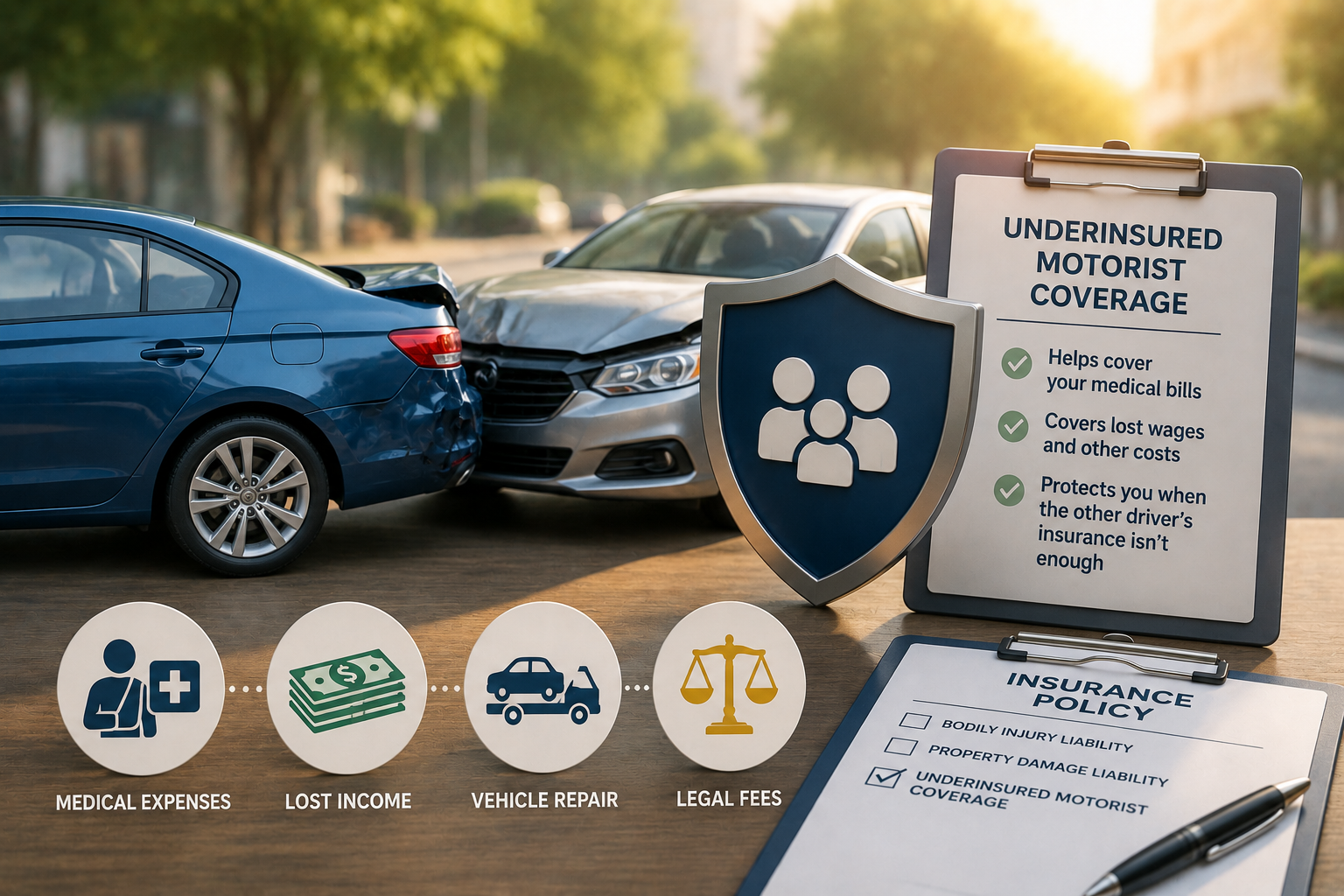
DIRECT ANSWER. Underinsured motorist (UIM) coverage can help pay covered losses when another driver is legally at fault, has liability insurance, but does not have enough liability coverage to fully pay your damages. Depending on your state and policy, UIM may apply to bodily injury and sometimes property damage. Coverage is subject to your UIM limits, policy terms, and state law, so the amount available is not necessarily the full amount of your remaining loss.
Key Takeaways
- UIM coverage is designed for accidents caused by drivers who have liability insurance but not enough to cover eligible damages.
- It differs from uninsured motorist coverage, which generally addresses accidents involving drivers who have no applicable liability insurance.
- UIM commonly addresses bodily injury, while property damage protection depends more heavily on the state and policy.
- Your UIM policy limit does not automatically equal the amount an insurer will pay after a claim.
- Requirements, available limits, claim calculations, and rejection rules vary by state.
How Does Underinsured Motorist Coverage Work?
Auto liability insurance carried by the driver who caused an accident is generally the first source of compensation for injuries or property damage for which that driver is legally responsible. Problems arise when the driver’s liability limit is lower than the amount of the covered loss.
Underinsured motorist coverage is intended to address that gap. If you qualify for coverage, you typically make the UIM portion of the claim under your own auto policy after establishing that the at-fault driver’s available insurance is insufficient.
That does not mean UIM automatically pays every dollar left over. The insurer will consider covered damages, the applicable UIM limit, amounts available from the at-fault driver, policy provisions, and state law when determining what is payable.
What Can Underinsured Motorist Coverage Pay For?
The answer depends on which UIM protections are included in your policy. Bodily injury protection is a common form of underinsured motorist coverage and may help with eligible losses resulting from injuries to you or other insured people after an accident caused by an underinsured driver.
Underinsured Motorist Bodily Injury
Depending on state law and policy terms, underinsured motorist bodily injury coverage may respond to eligible medical expenses, lost income, and other injury-related damages that exceed what the at-fault driver’s insurance can adequately cover.
Underinsured Motorist Property Damage
Property damage protection is more state- and policy-specific. Where underinsured motorist property damage coverage is available and included, it may help with eligible vehicle or other covered property damage caused by an at-fault driver whose property damage liability insurance is insufficient.
Check the actual coverage listed on your declarations page. Having UIM bodily injury coverage does not necessarily mean your policy also provides underinsured motorist property damage coverage.
UIM vs. Other Auto Insurance Coverages
Underinsured motorist coverage is easy to confuse with uninsured motorist, liability, and collision coverage. Each addresses a different financial risk.
| Coverage | Main Situation | What It Generally Protects |
|---|---|---|
| Underinsured motorist | The at-fault driver has insurance, but the applicable liability limit is insufficient. | You and other insured people for covered losses, subject to state and policy rules. |
| Uninsured motorist | The at-fault driver has no applicable liability insurance; hit-and-run treatment varies by state. | You and other insured people for eligible losses covered by UM. |
| Liability | You are legally responsible for injuring someone or damaging property. | Other people and their property, up to applicable policy limits. |
| Collision | Your insured vehicle is damaged in a covered collision. | Covered physical damage to your vehicle, generally subject to a deductible. |
How UIM Coverage Limits Affect a Claim
Your declarations page should show the UIM limits you purchased. Bodily injury limits may be displayed as split limits, such as one amount applying per person and another per accident, or in another format allowed by the policy and state.
The face amount of the limit should not be treated as a guaranteed claim payment. How the at-fault driver’s insurance interacts with your UIM limit can depend on state law and the wording of your policy.
Hypothetical example:
Assume an injured driver has $80,000 in eligible damages and the at-fault driver’s bodily injury liability coverage can provide no more than $25,000 for that person’s claim. The injured driver also carries UIM coverage. UIM may address some of the uncompensated loss, but it would be incorrect to assume automatically that the UIM insurer owes exactly $55,000. The actual amount depends on the UIM limit, applicable policy provisions, state law, and the insurer’s evaluation of the covered damages. These figures are for illustration only.
Underinsured Motorist Rules Vary by State
There is no single nationwide UIM rule that applies to every personal auto policy. States can differ on whether insurers must provide or offer the coverage, whether consumers can reject it, how available limits relate to liability limits, and how claims are calculated.
Property damage rules can differ as well. A feature available under one state’s auto policies may not work the same way in another state. Your declarations page, policy form, endorsements, and state insurance regulator are better sources for your specific coverage than a general national description.
What to Check Before Choosing UIM Coverage
Choosing a UIM limit is partly a question of how much financial protection you want if someone else causes a serious crash without carrying enough liability insurance. Comparing only the premium can hide important differences in protection.
- Review your limits: Compare your bodily injury liability limits with the UIM limits shown on your declarations page.
- Identify what is included: Determine whether the policy provides bodily injury coverage, property damage coverage, or both.
- Check who qualifies as an insured: Policy definitions can affect coverage for household members, passengers, or other people.
- Ask how claims are calculated: State law and policy language can affect how the other driver’s liability payment interacts with your UIM coverage.
- Check deductibles: A deductible may apply to certain property damage coverage depending on the policy and state.
- Compare equivalent quotes: Keep UIM limits and other coverages consistent when comparing prices from different insurers.
Frequently Asked Questions
The Bottom Line
Underinsured motorist coverage is designed to protect you when another driver causes an accident and carries liability insurance that is insufficient for your eligible losses. It can be especially relevant when injuries are serious and the at-fault driver’s policy limits are reached.
Before choosing or changing UIM coverage, review the limits and coverage types on your declarations page and compare them with your liability protection. Because requirements and claim calculations vary by state, use your policy documents and state insurance regulator to verify how the coverage applies to your situation.
Sources
- National Association of Insurance Commissioners, What Does Auto Insurance Cover?, June 11, 2026.
- National Association of Insurance Commissioners, Auto Insurance, last updated September 26, 2025.
- California Department of Insurance, Automobile Insurance Text Version, accessed August 2026.
- Texas Department of Insurance, What Is Uninsured Motorist Coverage, last updated October 14, 2024.