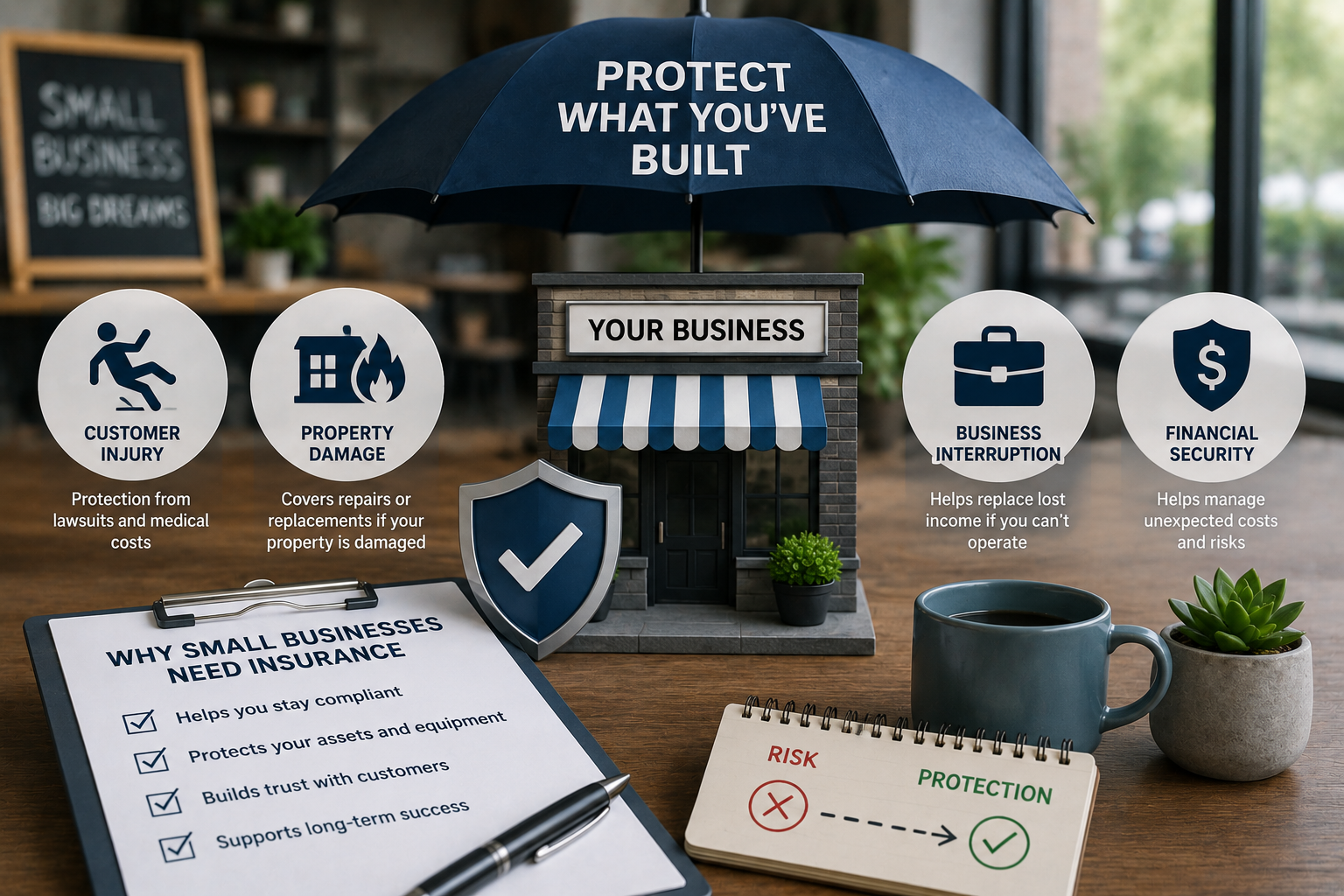
Most small businesses should consider carrying at least some insurance, even when a particular policy is not legally required. The right coverage depends on what the business owns, whether it has employees or vehicles, the services or products it provides, and the losses it could reasonably afford to pay itself. Business insurance is not one universal policy; different coverages protect against different risks.
Key Takeaways
- Business insurance is a category of coverage, not a single policy that fits every company.
- Some insurance may be required by state law, licensing rules, lenders, landlords, or business contracts.
- An LLC or corporation does not eliminate risks such as lawsuits, property losses, employee injuries, or professional mistakes.
- A business owner’s policy can combine several common coverages for eligible businesses but does not address every exposure.
- Business owners should compare limits, deductibles, exclusions, endorsements, and covered causes of loss rather than focusing only on premium.
Why Small Businesses Often Need Insurance
A company does not need hundreds of employees to face a financially serious loss. A customer could be injured on the premises, equipment could be damaged by a covered fire, a company vehicle could be involved in an accident, or a client could allege that professional work caused financial harm.
That makes the insurance decision broader than asking what the law requires. A business owner should also consider whether the company could continue operating after paying a substantial property loss, legal defense bill, settlement, or other unexpected expense from its own funds.
Business structure offers another layer of protection, but it does not replace insurance. An LLC or corporation may protect an owner’s personal assets from certain business liabilities depending on the circumstances and applicable law. The business itself can still own property, incur liabilities, face lawsuits, and experience costly interruptions.
Which Types of Business Insurance May Matter?
Coverage needs depend on the company’s operations. A consultant working primarily from a laptop has different exposures from a restaurant, contractor, retailer, manufacturer, or delivery company.
| Coverage | What It Generally Addresses | Who May Consider It |
|---|---|---|
| General liability | Certain third-party bodily injury, property damage, and personal or advertising injury claims, subject to policy terms. | Businesses that interact with customers, vendors, landlords, or the public. |
| Commercial property | Covered damage to insured buildings, equipment, inventory, furniture, and other business property. | Businesses with physical locations, inventory, tools, or valuable equipment. |
| Business owner’s policy | A package that commonly combines business property, liability, and business interruption or business income coverage. | Small businesses that meet an insurer’s eligibility requirements. |
| Workers’ compensation | Benefits associated with qualifying work-related injuries or illnesses under applicable workers’ compensation rules. | Businesses with employees, depending on state law and applicable exemptions. |
| Professional liability | Certain claims involving professional negligence, errors, omissions, or failure to meet professional obligations. | Consultants and other professional or service-based businesses. |
| Product liability | Certain claims alleging that a product caused bodily injury or other covered harm. | Manufacturers, wholesalers, distributors, and retailers. |
| Commercial auto | Selected liability and physical damage protection for covered business vehicles and uses. | Businesses that own or use vehicles for company operations. |
| Cyber insurance | Certain costs and liabilities associated with covered data breaches, security incidents, and other cyber events. | Businesses that store sensitive data, process payments, or depend heavily on computer systems. |
| Umbrella or excess liability | Additional liability limits above specified underlying policies, subject to the excess policy’s terms. | Businesses that need higher liability limits than their primary policies provide. |
Is Business Insurance Legally Required?
There is no single nationwide rule requiring every small business to purchase the same insurance package. Requirements can depend on the type of coverage, the state, the company’s employees and vehicles, its profession, and the activities it performs.
Workers’ compensation is an important example. State programs generally govern workers’ compensation for employees of private companies, and requirements and exemptions vary. A business with employees should verify its obligations with the appropriate workers’ compensation authority in each relevant state.
Insurance can be required even when a general law does not mandate it. A landlord may require liability coverage as part of a commercial lease, a lender may require insurance on financed property, or a customer may require proof of insurance before signing a contract. Licensing or professional requirements can also apply in some jurisdictions.
What Can Happen Without Business Insurance?
Operating without a particular policy does not remove the underlying risk. It generally means the business is retaining more of that financial exposure itself.
Depending on the event, an uninsured or underinsured company could have to pay for property repairs, replacement equipment, legal defense, settlements, medical costs, or lost operating income from its own resources. The exact exposure depends on the loss and applicable law.
A Hypothetical Example
Consider a hypothetical retail business that leases a storefront and owns $40,000 of inventory, fixtures, and equipment. A fire damages insured property and forces the store to close while repairs are completed. The figures in this example are illustrative only and are not national averages.
If the fire qualifies as a covered cause of loss and the business carries appropriate commercial property and business income coverage, those policies may respond to qualifying losses. Deductibles, limits, waiting periods, exclusions, and other terms still apply. Without applicable coverage, the owner may have to fund property replacement and absorb the interruption in revenue.
When Does a Business Owner’s Policy Make Sense?
A business owner’s policy, commonly called a BOP, packages multiple coverages into one policy. A BOP typically combines several common forms of protection, such as commercial property, general liability, and business interruption or business income coverage, depending on the insurer and policy.
A BOP can be a useful starting point for an eligible small business, but it should not be mistaken for complete protection. Workers’ compensation, commercial auto, professional liability, cyber insurance, and other exposures may require additional policies or endorsements depending on the business.
Check the actual contract. Policies with similar names can have different limits, exclusions, deductibles, endorsements, covered property, and definitions. The policy documents determine how a specific loss is handled.
Do Home-Based Businesses Need Separate Insurance?
Working from home does not mean a homeowners or renters policy automatically provides adequate protection for business activities. Personal policies may provide limited protection for some business property or may exclude certain business-related liability exposures.
A home-based business owner should review the personal policy and disclose the business activities to the insurer or a licensed insurance professional. Depending on the operation, an endorsement, in-home business policy, BOP, professional liability policy, or other commercial coverage may be appropriate.
How Much Business Insurance Do You Need?
There is no single coverage limit that works for every small company. Appropriate limits depend on the size and nature of the exposures the business wants to transfer to an insurer.
Depending on the coverage and insurer, useful factors to review can include:
- The value of buildings, inventory, equipment, tools, and other business property.
- The number of employees and the type of work they perform.
- How often customers, vendors, or members of the public visit the premises.
- The nature of the professional services or products offered.
- Business-owned vehicles and how they are used.
- Contracts that specify minimum insurance limits.
- The amount of revenue that could be affected by a covered shutdown.
- The amount the business could comfortably pay through a deductible or retained loss.
Coverage should also be reconsidered as the company changes. Hiring employees, moving locations, buying expensive equipment, adding vehicles, launching a new service, or signing a major contract can create exposures that were not present when the policy was purchased.
How to Decide Which Business Insurance to Buy
Start with the risks rather than a shopping list of policy names. Consider the accidents, natural disasters, lawsuits, property losses, employee injuries, cyber incidents, and interruptions that could affect the company, then compare coverage that addresses those exposures.
- Identify major exposures. Consider customers, employees, vehicles, property, professional services, products, contracts, technology, and interruptions to operations.
- Check mandatory coverage. Review applicable state requirements along with obligations imposed by licenses, leases, lenders, and customer contracts.
- Estimate what the business could absorb. Pay particular attention to losses that could seriously disrupt cash flow or threaten continued operations.
- Compare more than premiums. Examine limits, deductibles, exclusions, endorsements, covered locations, and the events required to trigger coverage.
- Review the coverage periodically. Insurance purchased for a new company may no longer fit after the operation grows or changes.
Insurance Does Not Cover Every Business Loss
Purchasing insurance does not mean every accident, lawsuit, cyber incident, property loss, or shutdown will be covered. Coverage depends on the policy form, cause of loss, exclusions, limits, deductibles, endorsements, timing, and facts surrounding the claim.
Business interruption coverage illustrates why those details matter. It generally responds to qualifying interruptions resulting from covered events under the policy. A loss caused by an excluded event may be treated differently, and policy requirements can vary by carrier and form.
Insurance should work alongside risk management. Safety procedures, cybersecurity controls, employee training, equipment maintenance, contracts, backups, and emergency planning can reduce risk, but they do not replace appropriate insurance coverage.
Frequently Asked Questions
The Bottom Line
Small businesses do not all need the same insurance, but many face exposures that could be difficult to absorb without coverage. Legal requirements are only one part of the decision. Customer injuries, property losses, professional claims, employee injuries, vehicle accidents, cyber incidents, and interruptions to operations can all create meaningful financial risk.
Identify the losses that could seriously affect the company, check state and contractual requirements, and compare policy limits, deductibles, exclusions, endorsements, and covered causes of loss. Because insurance requirements and policy terms vary, confirm applicable rules with the appropriate state authority and review the actual policy documents before relying on coverage.
Sources
- National Association of Insurance Commissioners, Small Business, accessed August 2026.
- National Association of Insurance Commissioners, Business Interruption and Business Owner Policy, accessed August 2026.
- U.S. Small Business Administration, Get Business Insurance, accessed August 2026.
- U.S. Department of Labor, Workers’ Compensation, accessed August 2026.