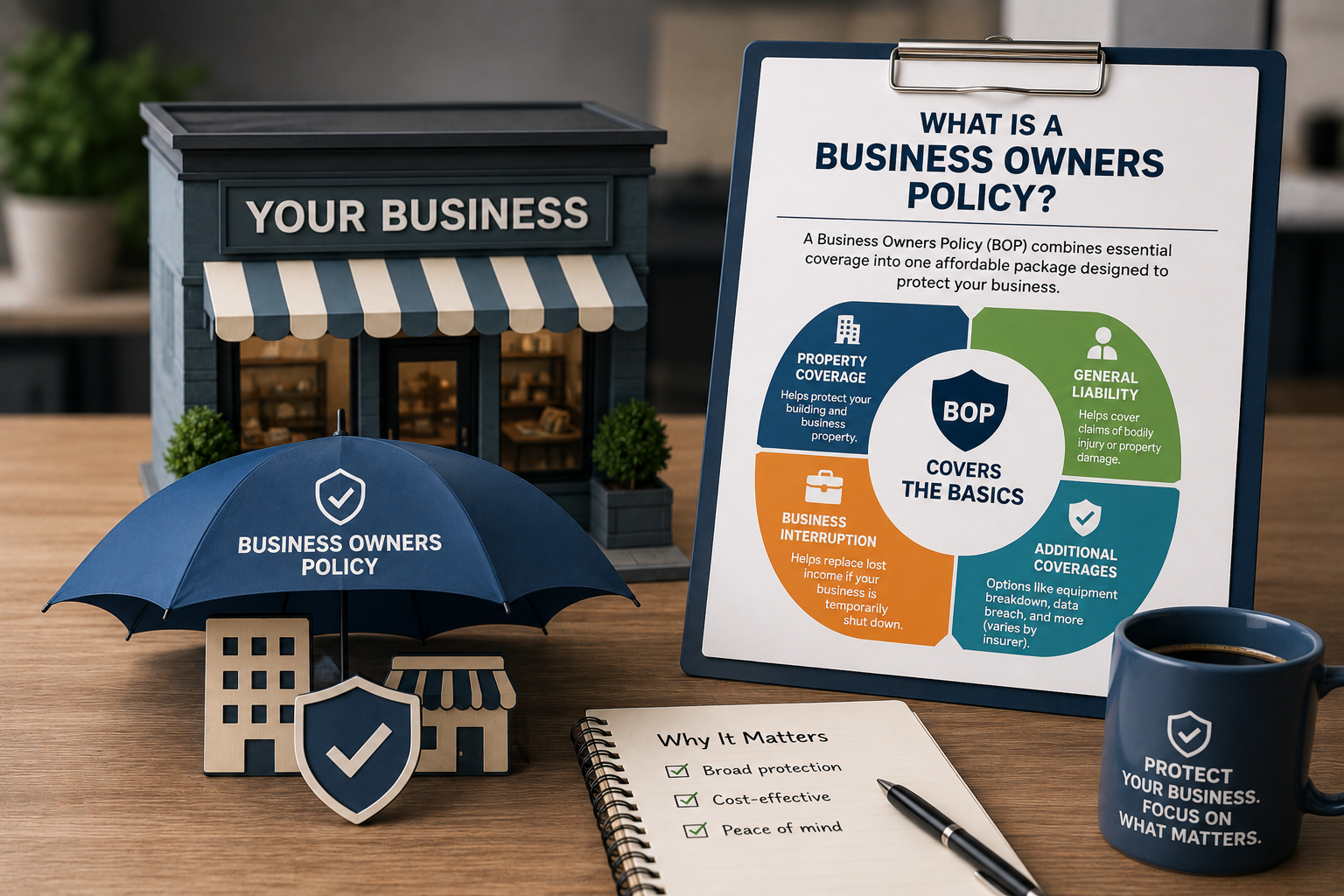
A business owner’s policy, commonly called a BOP, is a package insurance policy designed for eligible businesses. It typically combines commercial property, liability, and business interruption or continuation coverage in one policy. A BOP can simplify insurance for a small business, but it does not cover every risk, and insurers set their own eligibility, coverage, limit, and underwriting requirements.
Key Takeaways
- A business owner’s policy bundles several common commercial insurance coverages into one package.
- A BOP typically includes property, liability, and business interruption or continuation coverage.
- Commercial auto, workers’ compensation, professional liability, health insurance, and disability insurance are generally not included in a standard BOP.
- Not every company qualifies for a BOP; eligibility depends on the insurer and the nature of the business.
- Coverage still depends on limits, deductibles, exclusions, endorsements, and the circumstances of a particular loss.
How Does a Business Owner’s Policy Work?
A BOP combines multiple forms of commercial insurance protection under one policy. Instead of purchasing certain property and liability coverages entirely separately, an eligible business can obtain them as part of a package designed around common small-business exposures.
The National Association of Insurance Commissioners describes a business owner’s policy as a package that typically includes property, business interruption or continuation, and liability insurance. For some small businesses, the package can also cost less than purchasing the component policies separately.
That does not mean every BOP is identical. Insurers can structure coverage differently, offer endorsements for additional exposures, and apply their own underwriting requirements. The policy documents determine the actual coverage.
What Does a Business Owner’s Policy Cover?
The core of a BOP usually involves three broad areas: property, liability, and business income protection. Each addresses a different type of financial exposure.
Commercial Property Coverage
Property coverage can protect insured business property from covered causes of loss. Depending on the policy and business, insured property may include a building, equipment, furniture, inventory, supplies, and other property listed or qualifying under the contract.
Coverage does not apply to every type of damage. The cause of loss, valuation provisions, deductibles, exclusions, property limits, and endorsements can affect how much the insurer pays for a covered claim.
Liability Coverage
The liability portion can address certain third-party claims involving bodily injury, property damage, and other covered liability exposures. One example is a customer alleging an injury after falling at the insured business premises.
Liability coverage is subject to policy definitions, exclusions, limits, and other terms. It should not be assumed to cover every lawsuit or every type of professional or employment-related allegation.
Business Interruption or Business Income Coverage
A BOP commonly includes business interruption or continuation coverage. This protection can help address qualifying lost income and certain continuing expenses when business operations are disrupted because of a covered event that meets the policy’s requirements.
The details matter. Business income coverage can have specific coverage triggers, limits, waiting periods, restoration periods, exclusions, and other conditions. A temporary shutdown does not automatically mean the policy will respond.
| BOP Component | What It Generally Addresses | Important Details to Review |
|---|---|---|
| Commercial property | Covered loss or damage to qualifying insured business property. | Property limits, valuation, covered causes of loss, deductibles, and exclusions. |
| Liability | Certain covered claims involving third-party bodily injury, property damage, and other liability exposures. | Per-occurrence and aggregate limits where applicable, exclusions, and covered operations. |
| Business interruption or income | Qualifying income loss and certain expenses following a covered interruption. | Coverage trigger, limits, restoration period, waiting periods, and exclusions. |
What Does a BOP Usually Not Cover?
One of the easiest mistakes to make is assuming that a BOP is complete business insurance. It is a package, but important exposures commonly require separate policies or additional coverage.
NAIC consumer guidance notes that a BOP typically does not include commercial auto insurance, workers’ compensation, health or disability insurance, or liability insurance for wrongful professional practices.
| Coverage | Typically Part of a Standard BOP? | What to Know |
|---|---|---|
| Commercial property | Generally yes | Coverage depends on insured property, covered causes of loss, limits, and exclusions. |
| Business liability | Generally yes | Not every type of liability claim is covered. |
| Business interruption | Commonly included | A covered event and other policy requirements generally must be satisfied. |
| Commercial auto | Typically no | Business vehicle exposures generally require separate consideration. |
| Workers’ compensation | Typically no | Requirements vary by state and business circumstances. |
| Professional liability | Typically no | Businesses providing professional services may need separate coverage. |
Do not treat this table as a substitute for the policy. Insurers may offer different BOP forms and endorsements. Review the actual contract to determine what your policy includes or excludes.
Who May Qualify for a Business Owner’s Policy?
BOPs are commonly designed for eligible small businesses, but not every company qualifies. Insurers may consider the type of operation, property exposure, business size, claims history, location, revenue, building characteristics, and other underwriting factors.
Eligibility standards vary by insurer. NAIC guidance notes that businesses with unusual or specialized risks may require more customized coverage than a standard BOP provides. It gives factories and jewelry stores as examples of businesses that may need a different insurance approach.
A home-based business or a company with only a few employees may also consider a BOP, depending on eligibility and the exposures involved.
Can a Home-Based Business Use a BOP?
Potentially. Running a company from home does not mean a homeowners or renters policy provides all the protection needed for business property and liability exposures.
A BOP may be one option for an eligible home-based business that needs broader commercial protection. The appropriate solution depends on factors such as business property, whether customers visit the home, the type of services performed, employees, inventory, and other exposures.
Review both policies. A home-based business owner should not assume either the personal policy or a BOP covers an exposure without checking the applicable policy language.
BOP vs. Buying Business Insurance Separately
The main attraction of a BOP is convenience. Several common coverages can be packaged together rather than arranged entirely through separate policies.
NAIC guidance also notes that purchasing a BOP can be less costly for many small businesses than buying individual policies. That does not mean a BOP is automatically the least expensive or most appropriate choice for every company.
| Factor | Business Owner’s Policy | Separate Policies |
|---|---|---|
| Structure | Packages several common coverages together. | Coverages are arranged separately or through other commercial packages. |
| Eligibility | Business must meet the insurer’s BOP requirements. | May provide options for businesses that do not fit BOP underwriting criteria. |
| Customization | Can often be customized with available endorsements. | May allow more specialized coverage arrangements for unusual exposures. |
| Cost | Can be less costly than buying component policies separately for some businesses. | Cost varies according to the policies, limits, insurer, and business exposures. |
How Much Does a Business Owner’s Policy Cost?
There is no single BOP price that applies to all businesses. Commercial insurance pricing depends on the company’s characteristics and the coverage selected.
Depending on the insurer and coverage, pricing can consider factors such as the type of business, location, property values, building characteristics, revenue, payroll, claims history, coverage limits, deductibles, and optional endorsements. Not every insurer uses every factor in the same way.
When comparing quotes, look beyond the premium. A lower-priced policy may have different limits, exclusions, deductibles, or endorsements.
A Hypothetical BOP Example
Consider a hypothetical neighborhood bakery that qualifies for a BOP. It leases a storefront and owns $60,000 of ovens, refrigeration equipment, furniture, supplies, and other business property. These figures are illustrative only and are not national averages.
A properly structured BOP could provide property protection for covered damage to qualifying insured equipment, liability protection for certain covered third-party claims, and business income protection if a qualifying covered loss forces the bakery to suspend operations.
The bakery would still need to examine exposures outside the BOP. If it has employees, workers’ compensation requirements may apply under state law. If it owns a delivery van, commercial auto coverage would need separate consideration. The actual insurance arrangement depends on the policies, insurer, state, and business operations.
How to Decide Whether a BOP Is Right for Your Business
Start with the company’s exposures rather than assuming a BOP is automatically the right product. A useful review asks what the business owns, how it operates, who it interacts with, and what could cause a serious financial loss.
- List your business property. Review buildings, equipment, inventory, furniture, supplies, and other assets that may need protection.
- Identify liability exposures. Consider customers, visitors, products, operations, and work performed away from your premises.
- Estimate interruption risk. Consider how a covered property loss could affect revenue and continuing expenses.
- Identify risks outside a standard BOP. Employees, vehicles, professional services, and specialized operations may require additional coverage.
- Check eligibility. Ask whether the business meets the insurer’s BOP underwriting requirements.
- Compare policy details. Review limits, deductibles, exclusions, endorsements, and coverage triggers rather than comparing premiums alone.
- Review coverage as the business changes. New locations, employees, equipment, vehicles, products, or services can change insurance needs.
Important BOP Limitations to Review
A BOP can simplify insurance, but the convenience of a package should not replace a careful policy review. Coverage is still governed by the contract.
- Confirm which property and locations are insured.
- Review property and liability limits.
- Understand deductibles and any applicable waiting periods.
- Read exclusions and definitions that affect coverage.
- Review endorsements that add, restrict, or otherwise modify the policy.
- Check what event must occur before business income coverage applies.
- Identify important exposures that require separate policies.
Do not assume that having a BOP means every business loss will be insured. Coverage depends on the cause of loss, policy provisions, limits, exclusions, endorsements, deductibles, and the facts of the claim.
Frequently Asked Questions
The Bottom Line
A business owner’s policy is a package designed to combine several common commercial coverages for eligible businesses. It typically includes property, liability, and business interruption or continuation protection, making it a convenient starting point for many small companies.
A BOP is not complete protection for every business. Review commercial auto, workers’ compensation, professional liability, cyber, and other specialized exposures separately when relevant. Before choosing a policy, compare limits, deductibles, exclusions, endorsements, eligibility requirements, and the actual coverage terms rather than relying only on the package name or premium.
Sources
- National Association of Insurance Commissioners, Small Business, accessed August 2026.
- National Association of Insurance Commissioners, Glossary of Insurance Terms, accessed August 2026.
- National Association of Insurance Commissioners, What Business Income Loss Coverages Are Out There?, accessed August 2026.