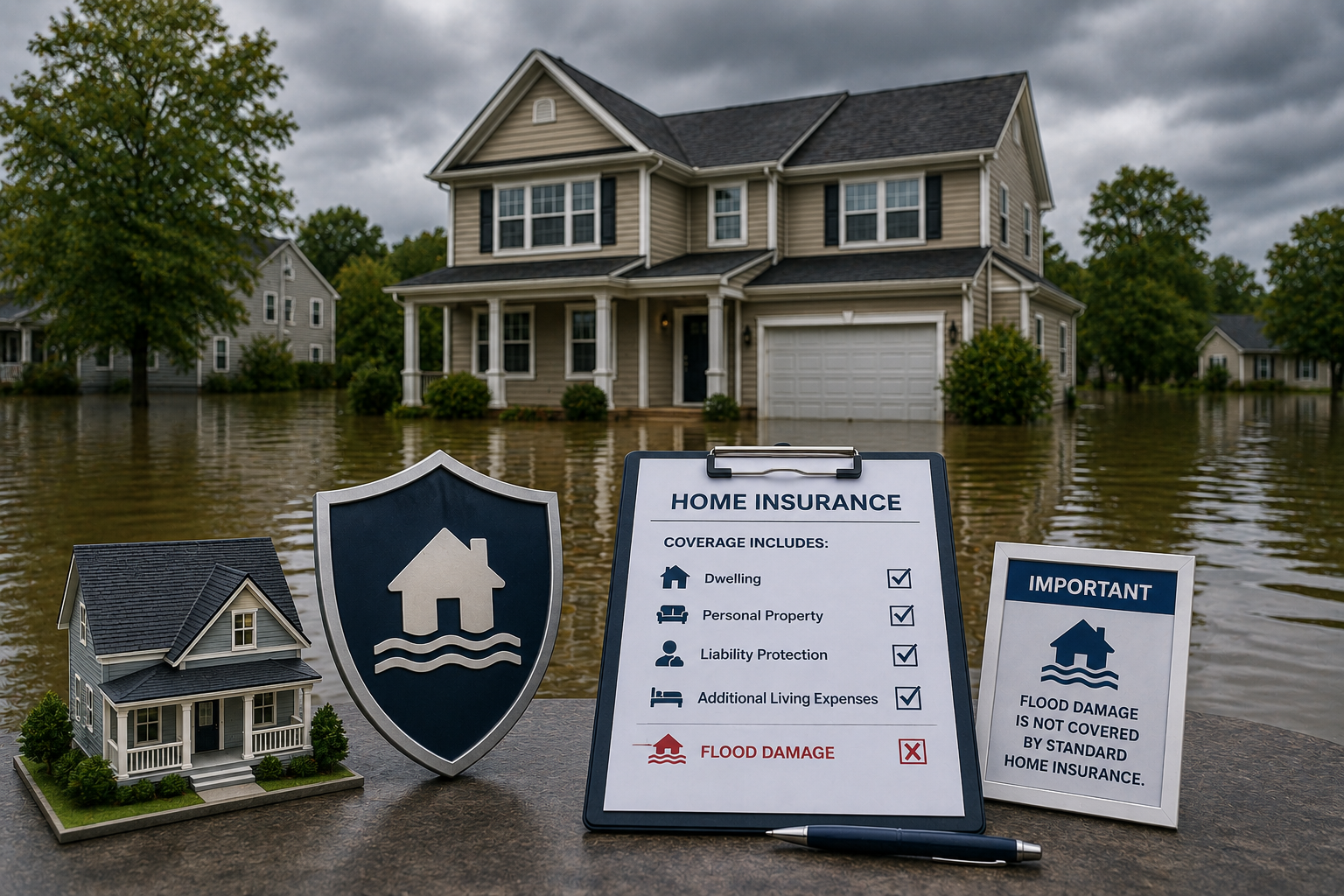
Standard homeowners insurance generally does not cover flood damage caused by rising surface water, overflowing rivers, storm surge, or similar flooding. Homeowners who want protection against those losses typically need separate flood insurance through the National Flood Insurance Program or, where available, a private insurer. Home insurance may still cover other types of water damage, so determining where the water came from is critical.
Key Takeaways
- Most standard homeowners policies exclude damage caused by flooding.
- Separate flood insurance can protect the home and, if purchased, personal belongings against qualifying flood damage.
- Flooding is different from sudden plumbing leaks, burst pipes, or rain entering through storm-created damage.
- NFIP building and contents coverage are separate, and each can have its own deductible.
- Basement coverage is restricted under NFIP policies, particularly for personal belongings.
- Flood insurance can be important even outside designated high-risk flood areas because flood exposure is not limited to coastal or riverfront properties.
Why Doesn’t Homeowners Insurance Cover Flooding?
Flood is generally treated as a separate catastrophe exposure rather than an ordinary homeowners peril. The National Association of Insurance Commissioners states that damage caused by a flood is not covered under a standard homeowners policy.
That exclusion can surprise homeowners because the same policy may cover certain other forms of water damage. The important distinction is often the source and movement of the water.
For example, a burst pipe inside the home may qualify as sudden and accidental water damage under a homeowners policy, subject to its terms. Water rising across normally dry land and entering the home is generally treated as flooding and requires flood insurance.
What Counts as a Flood?
Under the National Flood Insurance Program, a flood generally involves an excess of water on land that is normally dry and affects a qualifying area or multiple properties. Flooding can arise from more situations than a river overflowing its banks.
Potential flood events can include:
- River or stream overflow.
- Flash flooding after heavy rain.
- Storm surge from hurricanes or coastal storms.
- Surface runoff that accumulates and enters homes.
- Flooding associated with rapid snowmelt.
- Certain mudflows associated with flooding, subject to the flood policy’s definition.
| Water Damage Scenario | Standard Home Insurance May Cover It? | Flood Insurance May Be Relevant? |
|---|---|---|
| Burst pipe damages floors and walls | Often, if the loss is sudden and accidental and no exclusion applies. | Generally not the primary coverage. |
| River overflows and water enters the home | Generally no. | Yes, if the loss meets the flood policy’s requirements. |
| Storm surge enters a coastal home | Generally no for the flood portion. | Generally yes, subject to the flood policy. |
| Wind tears off shingles and rain enters | May be covered if wind is insured and creates the opening. | Usually not if the water entered from above through covered storm damage. |
| Surface runoff flows into the first floor | Generally excluded as flood. | Potentially, if it qualifies as a covered flood. |
What Does Flood Insurance Cover?
Flood insurance is designed to cover direct physical losses caused by qualifying flooding. Under the NFIP, homeowners can purchase building coverage, contents coverage, or both.
Building Coverage
NFIP building coverage can protect qualifying parts of the home’s structure and certain permanently installed systems. Covered property can include the foundation, plumbing and electrical systems, furnaces, water heaters, permanently installed cabinets, built-in appliances, and certain other structural components.
Contents Coverage
Contents coverage protects qualifying personal belongings. Examples can include clothing, furniture, electronics, curtains, washers, dryers, portable air conditioners, and certain other household property.
Building and contents coverage are separate under an NFIP policy. Buying flood insurance on the structure does not automatically mean your personal belongings have the same protection. Review both coverage sections before choosing limits.
How Much Coverage Can an NFIP Policy Provide?
For eligible residential homeowners, current NFIP guidance provides up to $250,000 of building coverage and up to $100,000 of contents coverage. Those are federal program limits, not recommendations that every homeowner needs the maximum amount.
A homeowner whose rebuilding or personal-property exposure exceeds NFIP limits may need to explore additional options. Private flood insurers may offer different limits, terms, deductibles, or coverage features depending on the insurer and state.
Compare policies carefully rather than assuming an NFIP policy and a private flood policy are interchangeable. Coverage definitions, waiting periods, loss-settlement provisions, exclusions, and limits can differ.
Flood Insurance Has Important Coverage Limitations
Flood insurance fills a major homeowners coverage gap, but it does not cover every expense associated with a flood.
Under NFIP coverage, examples of property or expenses with restrictions or exclusions can include:
- Currency and certain valuable papers.
- Cars and most self-propelled vehicles.
- Landscaping, fences, decks, patios, swimming pools, and some other outside property.
- Many types of personal property stored in basements.
- Additional living expenses such as temporary housing under the standard NFIP policy.
Do not assume flood insurance works like homeowners insurance. NFIP building and contents coverage have their own definitions, deductibles, restrictions, and settlement provisions.
Does Flood Insurance Cover a Basement?
NFIP basement coverage is limited. A basement is generally treated as an area with its floor below ground level on all sides, and special coverage restrictions apply to property located there.
Certain installed building equipment can qualify for coverage. Examples can include furnaces, water heaters, sump pumps, central air-conditioning equipment, electrical outlets, and similar installed systems when policy requirements are satisfied.
Contents coverage is much more restricted in a basement. NFIP guidance identifies certain appliances, such as qualifying washers, dryers, freezers, and window air conditioners, but ordinary furniture, televisions, and many other belongings stored below ground may not be covered.
A homeowner with a finished basement should therefore review the flood policy carefully rather than assuming expensive flooring, furniture, electronics, or other improvements have the same coverage as property on an upper floor.
Does Home Insurance Cover Sewer Backup?
Sewer and drain backup should not automatically be treated as either ordinary homeowners water damage or flood damage. The cause matters.
Standard homeowners policies often exclude or limit sewer backup unless the homeowner purchased a water-backup endorsement. State regulator guidance also commonly distinguishes sudden internal plumbing losses from flooding and sewer backup.
Under NFIP guidance, sewer backup damage can be covered when the backup is directly caused by a qualifying flood. A backup caused only by a clogged pipe or another non-flood plumbing problem generally would not become an NFIP flood claim simply because water entered the home.
Does Home Insurance Cover Rainwater?
Rainwater coverage depends on how it reaches the insured property.
If a covered windstorm damages a roof and rain enters through the newly created opening, homeowners insurance may cover qualifying interior water damage along with the storm damage, subject to the policy.
If heavy rain accumulates on the ground, creates surface runoff, and then flows into the home, the resulting loss is much more likely to be considered flooding. Standard homeowners insurance generally excludes that type of ground-up water damage.
A useful first question is: where did the water come from? Water entering from above through covered storm damage can be treated very differently from water rising from the ground.
Does Home Insurance Cover Hurricane Flooding?
A hurricane can create both covered homeowners losses and excluded flood losses during the same event.
For example, qualifying wind damage to the roof may be covered under homeowners or separate windstorm insurance, depending on the policy and location. Storm surge that pushes seawater onto normally dry land is generally treated as flooding and requires flood coverage.
This can make hurricane claims complicated because more than one cause may contribute to the property damage. The homeowners, windstorm, and flood policies may each need to evaluate different parts of the loss.
Is Flood Insurance Required?
Flood insurance is not universally required for every homeowner. Mortgage requirements can depend on the location of the property, lender, type of loan, flood-zone designation, and applicable federal requirements.
Properties in certain high-risk flood areas with federally regulated or insured mortgage financing can be subject to flood insurance requirements. A lender may also impose flood insurance requirements in other circumstances.
Not being required to buy flood insurance does not mean the property has no flood risk. FloodSmart emphasizes that flooding can occur away from oceans, rivers, and traditionally high-risk flood zones.
When Should You Buy Flood Insurance?
Flood coverage is generally something to arrange before flooding appears imminent. NFIP policies typically have a 30-day waiting period between purchase and the effective date, although important exceptions can apply, including certain situations involving mortgage transactions and flood-map changes.
Private flood insurers may use different waiting periods. If comparing an NFIP policy with private flood insurance, verify the effective date rather than assuming coverage begins immediately.
Waiting until a major storm is approaching can be too late. Check the policy’s effective date and waiting-period rules before relying on newly purchased flood insurance.
A Hypothetical Flood Insurance Example
Consider a hypothetical homeowner whose property is damaged after several hours of heavy rainfall cause nearby surface water to rise and enter the first floor. The flood causes $80,000 in qualifying building damage and $25,000 in qualifying contents damage. These figures are examples only and are not national averages.
The standard homeowners policy would generally exclude the damage if the water meets the applicable definition of flooding. If the homeowner purchased adequate building and contents flood insurance before the event, the flood policy could address qualifying portions of both losses, subject to separate deductibles, limits, exclusions, and settlement provisions.
If the homeowner purchased only building coverage, the structure might have applicable protection while damaged furniture and other belongings could remain uninsured for the flood.
How to Review Your Flood Protection
Review homeowners and flood coverage together because they are designed to respond to different causes of loss.
- Confirm the flood exclusion in your homeowners policy. Do not assume ordinary home insurance includes flood protection.
- Check your property’s flood risk. Flood maps are useful, but lower-risk zones are not zero-risk zones.
- Compare building and contents needs separately. Make sure your flood protection addresses both if you want both insured.
- Review basement restrictions. Finished basements and stored belongings can have substantial coverage limitations.
- Check sewer-backup coverage. A homeowners water-backup endorsement and flood coverage can address different causes of backup.
- Compare NFIP and private options where available. Review limits, deductibles, exclusions, valuation, waiting periods, and lender requirements.
- Document your belongings. Maintain photographs, videos, receipts, model numbers, and other records that can support a contents claim.
Frequently Asked Questions
The Bottom Line
Standard homeowners insurance generally does not cover flooding from rising surface water, overflowing waterways, storm surge, or similar flood events. Protection against those losses normally requires separate flood insurance through the NFIP or, where available, a private insurer.
Review building and contents coverage separately, understand basement and additional-living-expense limitations, check the policy’s waiting period, and distinguish flooding from plumbing leaks, sewer backup, and rain entering through covered storm damage. The source of the water and the terms of the applicable policies determine which coverage may respond.
Sources
- National Association of Insurance Commissioners, Flood Insurance, updated June 23, 2026.
- National Association of Insurance Commissioners, Flood Insurance Consumer Guidance, accessed August 2026.
- National Flood Insurance Program, Flood Insurance Basics, accessed August 2026.
- National Flood Insurance Program, Buy a Flood Insurance Policy, accessed August 2026.
- National Flood Insurance Program, Start a Claim, accessed August 2026.
- Texas Department of Insurance, Homeowners Insurance FAQs, accessed August 2026.