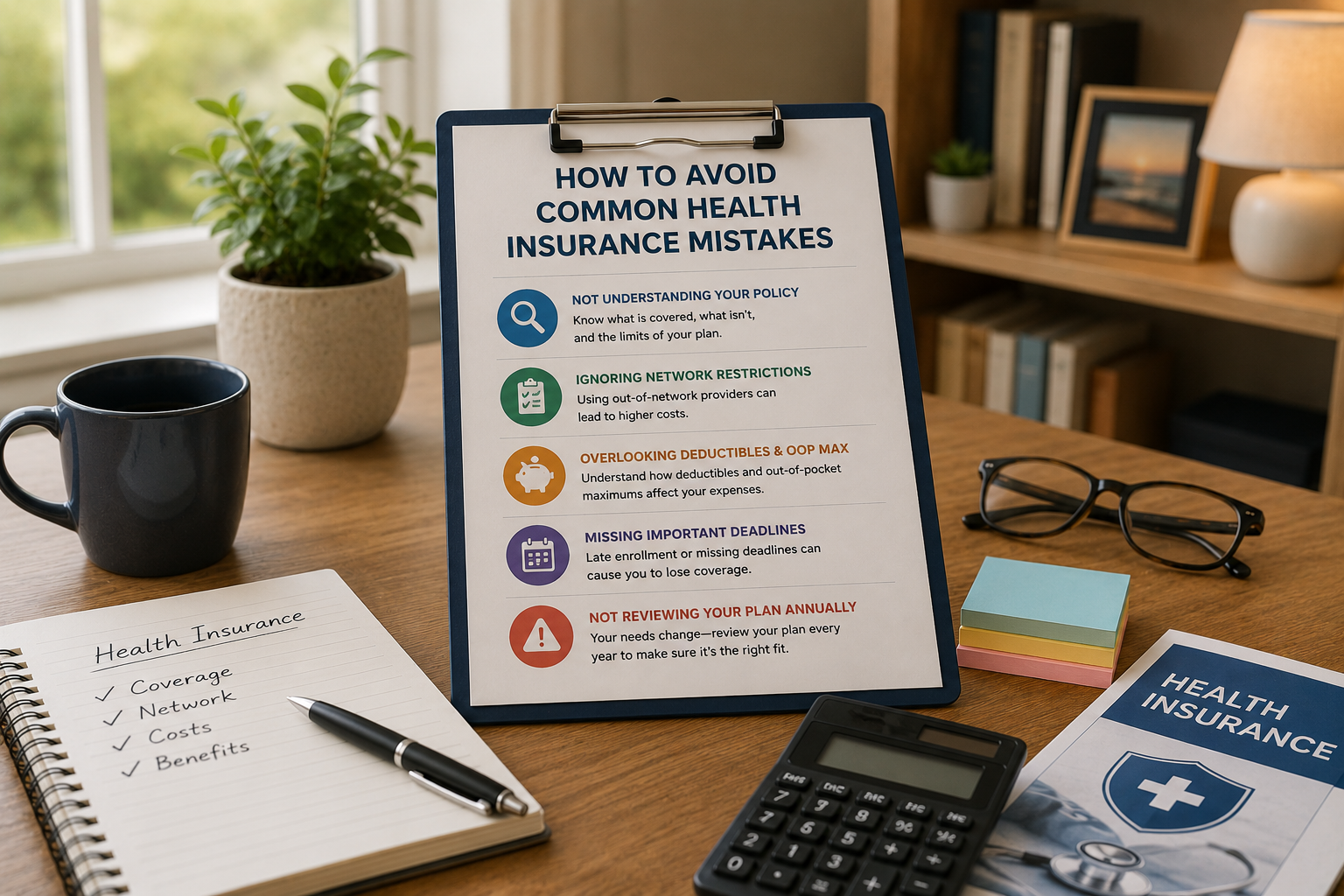
Common health insurance mistakes include choosing a plan based only on its premium, using out-of-network providers without checking coverage, overlooking deductibles and prescription costs, missing prior authorization requirements, and ignoring claim denials. You can reduce costly surprises by reading the Summary of Benefits and Coverage, confirming providers and medications, understanding cost sharing, and knowing how to appeal a denial.
Key Takeaways
- Do not compare plans by monthly premium alone; deductibles, copays, coinsurance, prescriptions, networks, and out-of-pocket limits also affect total cost.
- Verify that important doctors, hospitals, laboratories, pharmacies, and other providers participate in the specific plan network.
- Check prior authorization and referral requirements before scheduled care instead of assuming a covered service is automatically approved.
- Review the current prescription drug formulary for your medications, including tiers and utilization requirements.
- Compare provider bills with your Explanation of Benefits before paying unexpected amounts.
- A denied claim may be appealable, so read the denial notice and act within your plan’s applicable deadlines.
10 Common Health Insurance Mistakes to Avoid
Health insurance mistakes often happen because a consumer focuses on one familiar number or assumes that medical care recommended by a provider will automatically be covered. Health plans instead combine cost-sharing rules, provider networks, benefit limitations, authorization procedures, prescription requirements, and claims processes.
The Summary of Benefits and Coverage, or SBC, is a useful place to begin. CMS requires health insurers and group health plans subject to the SBC rules to use a standardized format that summarizes important benefits, cost sharing, limitations, and coverage examples.
Mistake 1: Choosing a Plan Based Only on the Premium
The premium is what you pay to maintain coverage, but it does not represent your full potential health care spending. A lower-premium plan can have a higher deductible, higher copays or coinsurance, a narrower provider network, or different prescription costs.
Compare at least these elements together:
- Monthly premium.
- Individual and family deductibles.
- Primary care and specialist copays.
- Coinsurance for expensive services.
- Prescription drug cost sharing.
- Out-of-pocket maximum.
- Provider network and out-of-network rules.
Better approach: Compare likely annual costs under several health care scenarios rather than simply picking the plan with the smallest paycheck deduction or monthly premium.
Mistake 2: Confusing the Deductible With Your Maximum Cost
Meeting your deductible does not necessarily mean the plan begins paying 100% of every covered service. HealthCare.gov explains that members commonly continue paying copays or coinsurance after satisfying a deductible.
The out-of-pocket maximum is a different concept. For Marketplace plans, qualifying deductibles, copays, and coinsurance for covered in-network care count toward the applicable annual out-of-pocket limit. Premiums, noncovered services, out-of-network care and services, and certain amounts above an allowed charge generally do not count toward that Marketplace limit.
| Cost | What It Generally Means | Common Mistake |
|---|---|---|
| Premium | Amount paid to maintain health coverage. | Assuming the cheapest premium means the cheapest plan overall. |
| Deductible | Amount paid for certain covered services before the plan starts paying under applicable cost-sharing rules. | Believing all later care becomes free once it is met. |
| Coinsurance | A percentage of an applicable covered service cost paid by the member. | Underestimating its impact on expensive procedures. |
| Out-of-pocket maximum | Annual limit on qualifying cost sharing for covered services under applicable plan rules. | Assuming every health-related dollar counts toward the limit. |
Mistake 3: Not Checking the Provider Network
A network is the group of providers, facilities, and suppliers contracted with a health plan. Choosing the wrong network can affect access to preferred doctors and dramatically change costs.
HealthCare.gov explains that plan types use networks differently. EPOs generally cover services only within the plan’s network except for emergencies. HMOs usually limit coverage to network care except in emergencies. PPOs generally permit out-of-network care at additional cost.
Before enrollment and before significant non-emergency care, check:
- Primary care physicians.
- Specialists.
- Hospitals and outpatient facilities.
- Laboratories.
- Imaging centers.
- Pharmacies.
- Other providers you expect to use regularly.
Do not rely only on a provider’s statement that it “takes” your insurance. Confirm that the provider participates in your exact plan network when network status could materially affect coverage or cost.
Mistake 4: Assuming Every Covered Service Is Automatically Approved
A service can fall within a covered benefit category and still be subject to prior authorization, referral, medical-necessity, network, or other plan requirements.
HealthCare.gov defines prior authorization as approval from a health plan that may be required before a service is received or a prescription is filled. Its consumer guidance also cautions that prior authorization is not necessarily a promise that every resulting cost will ultimately be covered.
Check authorization requirements for scheduled procedures, advanced imaging, specialty drugs, durable medical equipment, therapy, and other services identified in your plan documents.
Mistake 5: Ignoring Prescription Drug Coverage
A plan that includes prescription coverage does not necessarily cover every medication in the same way. The formulary, or drug list, identifies medications the plan covers under its prescription benefit.
If you regularly use prescriptions, verify:
- Whether each medication is on the current formulary.
- Which cost-sharing tier applies.
- Whether a prescription deductible applies.
- Whether prior authorization is required.
- Whether quantity limits or other utilization rules apply.
- Whether particular retail, mail-order, or specialty pharmacies must be used.
Use current plan information. Formularies and related coverage rules can change according to applicable plan terms and regulatory requirements.
Mistake 6: Paying for Preventive Care Without Checking the Rules
Most health plans must cover specified preventive services without cost sharing when applicable requirements are met. HealthCare.gov notes that qualifying preventive services are generally provided without a copay or coinsurance when received from an in-network provider, even before the deductible is met, although coverage can vary and $0 cost is not guaranteed in every situation.
A preventive visit can also involve services that are diagnostic or otherwise outside the no-cost preventive benefit. If you receive a bill you did not expect, compare the services billed with the plan’s preventive-care rules rather than assuming either the provider or insurer must be wrong.
Mistake 7: Not Reading the Summary of Benefits and Coverage
The SBC is designed to make health plans easier to compare. CMS explains that it uses a standardized format and summarizes covered benefits, cost-sharing provisions, limitations, exceptions, and standardized coverage examples.
Skipping it can cause you to overlook information that matters more than the plan’s marketing description.
Use the SBC to compare:
- Deductibles.
- Out-of-pocket limits.
- Office visit costs.
- Hospital and outpatient cost sharing.
- Prescription benefits.
- Major exclusions and limitations.
- Standardized coverage examples.
For detailed questions, continue into the full policy, evidence of coverage, certificate, Summary Plan Description, or other applicable plan documents.
Mistake 8: Treating the Explanation of Benefits Like a Bill
An Explanation of Benefits, or EOB, is not a medical bill. CMS explains that it shows how your health plan processed a claim and can include total provider charges, allowed charges, the amount paid by the insurer, and the amount shown as your responsibility.
Compare the EOB with the provider’s bill before paying. Look for:
- Correct patient and provider information.
- Correct dates of service.
- Provider charges.
- Allowed charges.
- Insurance payment.
- Deductible, copay, and coinsurance amounts.
- Claim codes or explanations for denied or reduced amounts.
Mistake 9: Assuming a Claim Denial Is Final
Health plans can deny claims for many reasons, including eligibility issues, benefit exclusions, missing information, authorization problems, or medical-necessity determinations. Depending on the type of coverage and denial, you may have internal appeal and external review rights.
For private-sector employer health plans subject to the ERISA claims rules described by the U.S. Department of Labor, participants generally have at least 180 days to appeal a denied health claim. Other types of coverage can follow different timelines and procedures, so the denial notice and governing plan documents should be checked immediately.
Keep copies of the denial, medical records, authorization records, bills, EOBs, correspondence, and other information that could support the appeal.
Appeal deadlines can be strict. Do not assume every plan gives you the same amount of time. Follow the instructions and deadline in your actual denial notice and plan documents.
Mistake 10: Never Reviewing the Plan After Enrollment
A plan that fit your needs one year may be less suitable later. Your prescriptions, physicians, anticipated procedures, family coverage needs, and financial situation can change. Plan premiums, networks, benefits, and cost-sharing arrangements can also change according to applicable rules.
At renewal or open enrollment, review the current materials rather than automatically keeping the previous choice.
- Recheck premiums and deductibles.
- Recheck the out-of-pocket maximum.
- Confirm provider participation.
- Review medications on the current formulary.
- Review prescription tiers and restrictions.
- Look for changed authorization or referral requirements.
- Consider major medical care you reasonably expect during the next plan year.
How Health Insurance Costs Can Add Up
Consider a hypothetical health plan with a $2,000 deductible and 20% coinsurance for a particular covered in-network service after the deductible. Assume the member has already satisfied the deductible and the plan’s allowed amount for a later covered service is $5,000.
If 20% coinsurance applies, the member’s hypothetical coinsurance would be $1,000, subject to the plan’s out-of-pocket limit and any other applicable provisions. These figures are illustrative only and are not national averages or recommendations.
The example shows why focusing only on premium or deductible can be misleading. Network status, allowed amounts, coinsurance, and accumulated annual spending can all matter when a large claim occurs.
How to Avoid Health Insurance Mistakes Before Getting Care
- Read the current SBC. Identify deductibles, major cost-sharing provisions, and coverage limitations.
- Verify network status. Confirm the relevant physician, facility, laboratory, imaging center, or other provider with the plan.
- Check authorization requirements. Determine whether prior approval or a referral is required.
- Review the benefit. Confirm how the service is covered and which deductible, copay, or coinsurance applies.
- Check prescription rules. Verify the drug list, tier, authorization requirements, and pharmacy restrictions for important medications.
- Keep records. Save authorization numbers, estimates, plan messages, and relevant correspondence.
- Use the plan documents for the final answer. General explanations cannot replace the specific provisions of your coverage.
What to Check After Receiving Medical Care
- Read the EOB. Confirm how the insurer processed each claim.
- Compare the provider bill. Make sure it corresponds with the amount the EOB says may be your responsibility.
- Investigate denials. Read claim codes and explanations instead of immediately assuming the service is permanently excluded.
- Check deductible and out-of-pocket totals. Confirm qualifying amounts were credited correctly under the plan.
- Ask about unexpected network charges. Determine what caused the charge and whether applicable federal or state protections affect the bill.
- Appeal when appropriate. Follow the denial notice and plan procedures before the applicable deadline expires.
Frequently Asked Questions
The Bottom Line
Avoiding health insurance mistakes starts with looking beyond the monthly premium. Review the deductible, copays, coinsurance, out-of-pocket maximum, provider network, prescription formulary, authorization requirements, exclusions, and likely medical needs before choosing or renewing a plan.
After enrollment, continue checking the plan before major non-emergency care, compare bills with EOBs, and do not assume a denial is automatically final. Coverage details and procedures vary by plan, coverage type, and applicable law, so your current SBC, full plan documents, notices, and denial letters should guide specific decisions.
Sources
- Centers for Medicare & Medicaid Services, Summary of Benefits and Coverage (SBC) and Uniform Glossary, updated March 13, 2026.
- Centers for Medicare & Medicaid Services, How to Read a Health Insurance Explanation of Benefits, August 25, 2026.
- HealthCare.gov, Health Insurance Plan & Network Types: HMOs, PPOs, and More, accessed August 2026.
- HealthCare.gov, Preventive Health Services, accessed August 2026.
- HealthCare.gov, Prior Authorization, accessed August 2026.
- HealthCare.gov, Drug List, accessed August 2026.
- U.S. Department of Labor, Filing a Claim for Your Health Benefits, accessed August 2026.