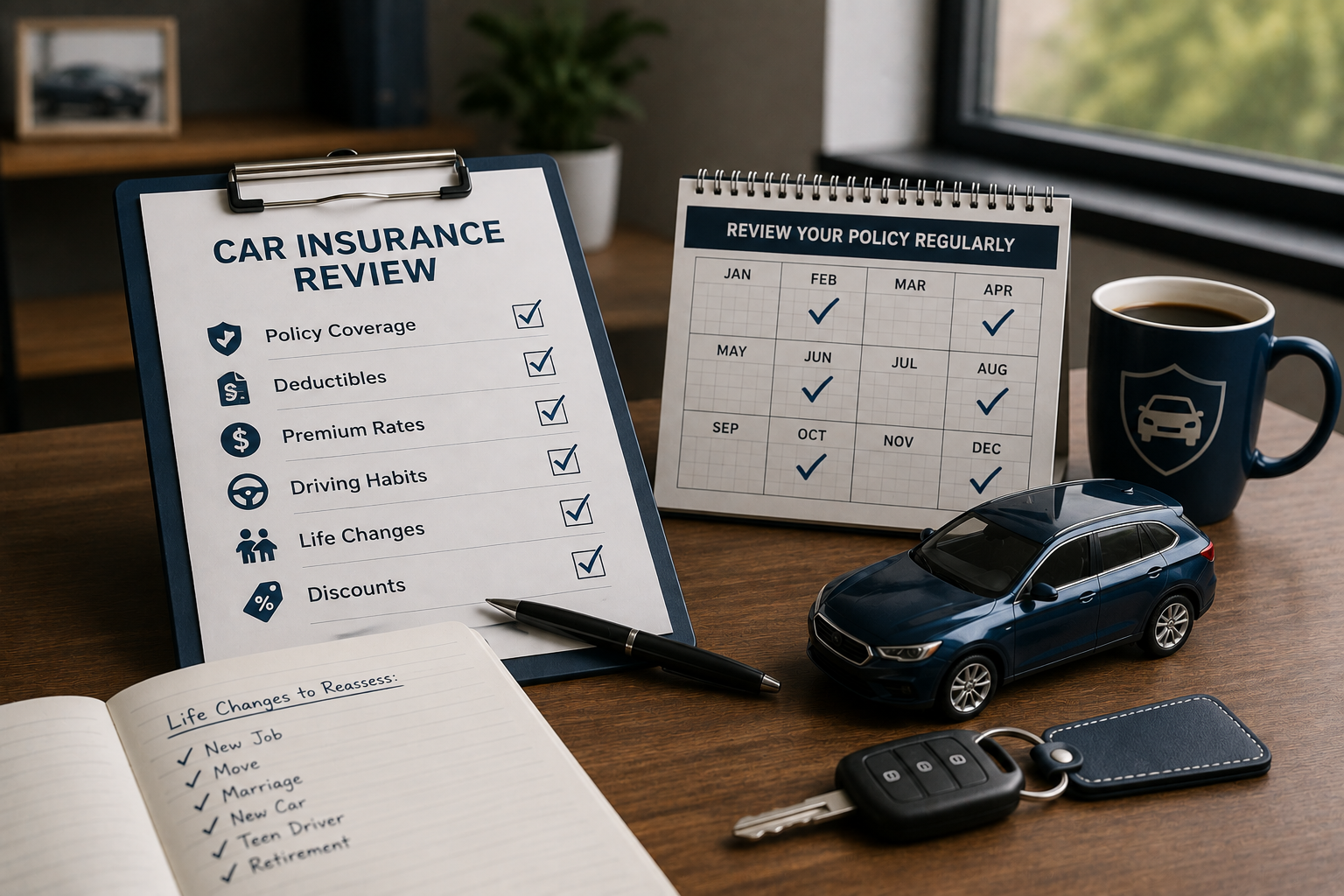
You should generally review your car insurance at least once a year and whenever something important changes in your household, vehicle, driving habits, or finances. Your renewal period is a convenient time to check coverage limits, deductibles, drivers, vehicle information, discounts, mileage, and optional coverages. You should also review the policy sooner after events such as buying or selling a car, paying off an auto loan, adding a teen driver, moving, changing how much you drive, or experiencing a major financial change.
Key Takeaways
- Review your auto insurance at least annually, preferably before or around renewal.
- Do not wait for renewal if you add or remove a driver, buy or sell a vehicle, move, pay off a car loan, or substantially change your annual mileage.
- Check liability limits and deductibles rather than focusing only on whether the premium increased.
- Older or paid-off vehicles may justify reconsidering collision and comprehensive coverage, depending on vehicle value and your ability to absorb a loss.
- Review available discounts and compare equivalent quotes periodically because your current insurer may no longer offer the best combination of price and coverage.
How Often Should You Check Your Car Insurance?
A good baseline is to review your car insurance once every year. You do not necessarily need to replace your insurer or change coverage annually, but you should verify that the policy still matches your situation.
Your insurance needs can change even when you continue driving the same vehicle. Income can increase, debts can decrease, children can begin driving, annual mileage can fall, vehicles can depreciate, and new discounts can become available.
The policy itself can also change at renewal. Premiums, discounts, coverage options, endorsements, deductibles, and other policy terms can differ from the prior term.
Simple rule: Review the policy every year, but review it immediately whenever something changes that could affect who drives, what you drive, where you live, how much you drive, or how much financial risk you can comfortably absorb.
Review Your Policy Before Every Renewal
Renewal is one of the easiest times to perform a complete insurance checkup because the insurer provides updated policy and premium information for the next term.
Before allowing the policy to renew, confirm:
- The vehicles listed on the policy are correct.
- All household drivers who should be disclosed are properly listed.
- Your garaging address is accurate.
- Estimated annual mileage remains reasonable.
- Liability limits still fit your financial exposure.
- Collision and comprehensive deductibles are amounts you could afford after a loss.
- Any lienholder information is current.
- Discounts you qualify for are reflected.
- Optional coverages still provide value for your situation.
Do not judge the renewal only by whether the total premium increased. A useful review also asks whether the coverage itself is still appropriate.
Review Your Insurance When You Buy or Replace a Car
A vehicle change is one of the most important times to review your insurance. Different vehicles can have substantially different repair costs, theft exposure, safety features, replacement values, and insurance rates.
A newer or more valuable vehicle can make collision and comprehensive coverage more important. If the vehicle is financed or leased, the lender or lessor may also require specified physical damage coverage and deductibles.
Before purchasing a vehicle, getting an insurance quote can also help you understand the true ongoing cost of ownership rather than discovering the premium after the transaction is complete.
Review Coverage After Paying Off Your Car Loan
Paying off a vehicle is another natural review point. If your lender required collision and comprehensive coverage, those contractual requirements may no longer apply once the loan has been satisfied.
That does not mean you should automatically remove physical damage coverage. Instead, compare the vehicle’s current value, collision and comprehensive premiums, deductibles, and your ability to repair or replace the vehicle yourself.
You should also ask the insurer to remove the former lienholder information when appropriate so the policy accurately reflects ownership.
Review the Policy When a Driver Is Added or Removed
Changes in household drivers can affect both coverage and premium. Do not wait until the next annual review if someone begins regularly driving an insured vehicle.
Common situations include:
- A teenager becomes licensed.
- A spouse or partner joins the household.
- An adult child moves back home.
- A household member stops driving.
- A listed driver moves permanently to another residence.
- A driver obtains their own vehicle and insurance.
Insurer and state rules differ regarding household drivers, permissive use, exclusions, and required disclosure, so inform the insurer rather than simply assuming a driver is automatically covered.
Review Your Insurance After Moving
Your address can affect your car insurance because insurers consider geographic risk and where the vehicle is principally garaged.
Moving can change exposure to traffic, theft, vandalism, weather, repair costs, and other factors used in insurance pricing where permitted.
Moving to another state is particularly important because states establish different insurance requirements. Coverage that satisfied legal requirements in one state may not match the requirements or available policy structure in another.
Do not postpone an address update: The insurer should have accurate information about where the vehicle is principally garaged. Contact the company when you move instead of waiting until the next renewal.
Review Coverage When Your Mileage Changes
A substantial change in annual mileage is another reason to review the policy. Someone who begins working from home may drive far less than when commuting every weekday. Someone who takes a new job with a long commute may experience the opposite change.
Mileage can change after:
- Starting or ending remote work.
- Changing jobs.
- Retiring.
- Moving closer to work.
- Beginning a longer commute.
- Changing which vehicle is used most frequently.
Ask the insurer whether your updated usage changes the premium or eligibility for any mileage-related program or discount.
Review Liability Limits as Your Finances Change
Liability insurance helps protect against covered claims involving bodily injury or property damage for which you are legally responsible.
State minimum requirements are a legal starting point, not necessarily the amount that provides appropriate financial protection for every household.
Review liability limits when your financial circumstances change materially, including when you:
- Increase your income.
- Accumulate substantial savings or investments.
- Buy a home.
- Build significant home equity.
- Acquire other meaningful assets.
- Add a personal umbrella policy or consider purchasing one.
The value of your own vehicle should not determine your liability limit. An older, inexpensive car can still be involved in an accident causing serious injuries or expensive property damage to other people.
Review Collision and Comprehensive as Your Car Ages
Collision and comprehensive deserve periodic review because the insured vehicle normally depreciates over time.
As market value falls, the maximum financial benefit from physical damage coverage can become smaller. The coverage can eventually cost enough relative to the vehicle’s value and deductible that self-insuring the car becomes worth considering.
| Question | Why It Matters |
|---|---|
| What is the car worth now? | Physical damage settlements are constrained by vehicle value and policy terms. |
| What do collision and comprehensive cost separately? | You need the actual cost of the coverages being evaluated rather than the total policy premium. |
| What are the deductibles? | The deductible reduces the amount payable on a covered loss. |
| Could you replace the vehicle yourself? | Dropping coverage means accepting more of the financial risk personally. |
If a lender still requires collision and comprehensive, verify the loan agreement before reducing or removing them.
Review Your Deductibles When Your Savings Change
Collision and comprehensive deductibles determine how much of a covered physical damage loss you generally absorb yourself.
Higher deductibles can reduce premium, but they also increase your financial responsibility after a claim.
Simple Deductible Example
Suppose an otherwise covered collision causes $6,000 in damage and your applicable collision deductible is $1,000.
$6,000 covered loss − $1,000 deductible = $5,000 simplified potential insurance payment.
If your emergency savings have increased significantly, you may decide a larger deductible is manageable in exchange for potential premium savings. If your savings have fallen, a deductible you selected years ago may now create too much financial pressure after a claim.
Check Your Discounts During Every Review
Discount eligibility can change over time. Some discounts may be added automatically, while others may require you to provide updated information or enroll in a program.
Depending on the insurer and state, ask about potential savings related to:
- Multiple vehicles.
- Bundling multiple policies.
- Eligible vehicle safety or anti-theft equipment.
- Student-related qualifications.
- Driver education or defensive-driving programs where available.
- Mileage or usage changes.
- Other insurer-specific discounts.
A discount should not be the only reason to keep an unsuitable policy, but checking eligibility can reduce the cost of coverage you already need.
How Often Should You Shop Around for Car Insurance?
An annual policy review is also a reasonable opportunity to compare prices from other insurers. You do not necessarily need to switch companies each year, but comparison shopping can show whether your current premium remains competitive.
For a meaningful comparison, request equivalent coverage rather than comparing only the final premium.
| Keep Consistent | Why |
|---|---|
| Liability limits | Lower limits can make one quote look artificially cheaper. |
| Collision and comprehensive deductibles | Higher deductibles transfer more loss to you. |
| Uninsured or underinsured motorist coverage | Coverage differences can materially affect protection. |
| Optional coverages | Rental, roadside, and other options can affect both premium and benefits. |
Also consider insurer licensing, service, complaint information, and your experience with the company rather than choosing solely on the lowest quote.
What to Review on Your Declarations Page
The declarations page is a useful starting point because it summarizes important details about the policy.
Check:
- Your name and address.
- Policy effective and expiration dates.
- Year, make, model, and VIN for each vehicle.
- Drivers or other insured information shown.
- Coverage types.
- Liability and other coverage limits.
- Collision and comprehensive deductibles.
- Premium.
- Discounts or rating information shown.
- Lienholder information when applicable.
The declarations page is a summary rather than the entire contract. Review the policy forms and endorsements when you need to understand exactly what is covered, excluded, or limited.
Car Insurance Review Schedule
| When | What to Review |
|---|---|
| At least once a year | Complete policy review, limits, deductibles, discounts, vehicle information, drivers, and comparison quotes. |
| Before renewal | Premium changes, renewal terms, discounts, and competing quotes. |
| After buying or selling a car | Vehicle details, physical damage coverage, lender requirements, and deductibles. |
| After adding or removing a driver | Driver listing, household disclosure, discounts, and coverage. |
| After moving | Garaging address, state requirements, rating information, and insurer availability. |
| After paying off a loan | Lienholder information and whether collision or comprehensive still fits your needs. |
| After a major financial change | Liability limits, deductibles, umbrella coverage, and ability to self-insure smaller risks. |
Common Car Insurance Review Mistakes
Only Looking at the Premium
A cheaper policy can have lower limits, higher deductibles, or fewer protections. Compare equivalent coverage before deciding which policy offers better value.
Waiting Until Renewal to Report Important Changes
Changes such as a new vehicle, new household driver, or new address should generally be reported promptly rather than held until your next annual review.
Keeping the Same Deductible Without Reconsidering It
The deductible that made sense five years ago may no longer fit your current savings, vehicle value, or premium.
Never Reconsidering Physical Damage Coverage
Collision and comprehensive can remain unchanged for years while the car depreciates substantially. Periodically compare the vehicle’s current value with the cost and deductible of each coverage.
Assuming the Current Insurer Is Automatically Cheapest
Insurance pricing varies among companies. Periodic comparison shopping can show whether another insurer offers a more attractive price for comparable protection.
Frequently Asked Questions
The Bottom Line
Review your car insurance at least once a year and whenever an important change occurs. Renewal is a convenient annual checkpoint, but buying or selling a vehicle, adding a driver, moving, paying off a loan, changing your mileage, or experiencing a major financial change should trigger an earlier review.
Check more than the premium. Review your liability limits, collision and comprehensive coverage, deductibles, uninsured or underinsured motorist protection, drivers, vehicles, mileage, lienholder information, and discounts.
Periodically comparing equivalent quotes can also help you determine whether your current insurer still offers a competitive combination of price and protection. The goal is not to change insurance every year—it is to make sure the policy you are paying for still matches the risks you need it to cover.
Sources
- National Association of Insurance Commissioners, Is it Time to Review Your Policies?, consumer guidance.
- National Association of Insurance Commissioners, Does Your Vehicle Have the Right Protection? Best Practices for Buying Auto Insurance.
- National Association of Insurance Commissioners, Comparing Online Auto Insurance Quotes.
- National Association of Insurance Commissioners, Consumer Auto Insurance resources, accessed August 2026.
- National Association of Insurance Commissioners, Auto Insurance, Insurance Topics, updated September 26, 2025.