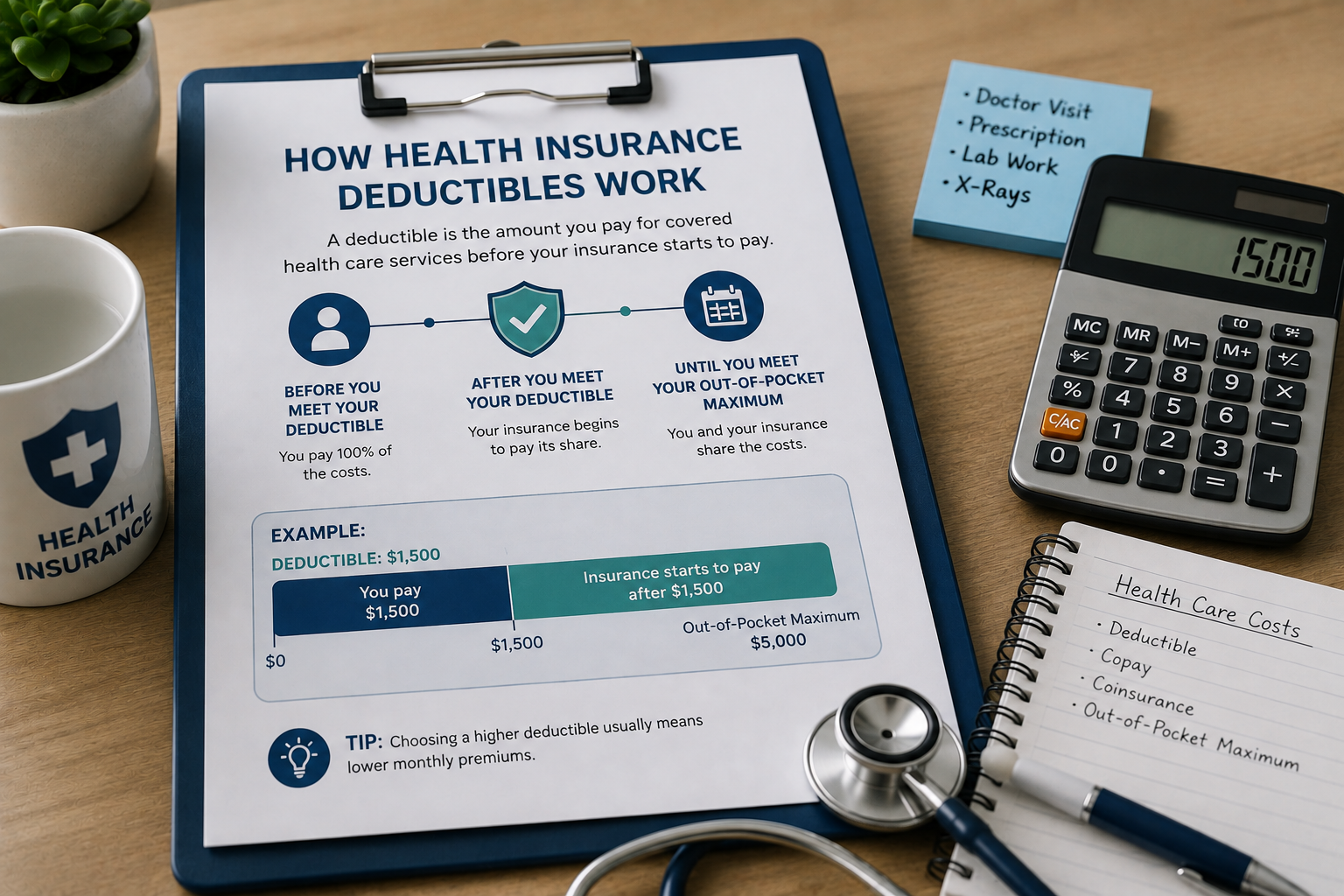
Choosing a health insurance deductible means deciding how much financial responsibility you are comfortable taking on before your plan begins sharing certain covered medical costs. A higher deductible can come with a lower monthly premium, while a lower deductible can make medical expenses more predictable but may require a higher premium. The best choice depends on more than one number. Your expected health care use, prescription needs, savings, family size, coinsurance, out-of-pocket maximum, provider network, employer contributions, and HSA eligibility can all affect which plan provides the best overall value.
Key Takeaways
- Do not choose a deductible based only on whether the number looks high or low.
- Plans with lower monthly premiums generally have higher deductibles, while higher-premium plans often have lower deductibles.
- Compare estimated total yearly costs, including premiums, deductibles, copayments, coinsurance, and prescription costs.
- A higher deductible can be easier to manage if you have substantial emergency savings and expect relatively little medical care.
- A lower deductible can be attractive if you expect frequent appointments, expensive prescriptions, therapy, surgery, pregnancy-related care, or other substantial medical use.
- The out-of-pocket maximum can be more important than the deductible during a very expensive medical year.
- Check which services are covered before the deductible. Some plans provide office visits, prescriptions, or other benefits before it is met.
- Marketplace cost-sharing reductions can significantly lower deductibles for eligible consumers who choose a Silver plan.
- A plan described as having a high deductible is not automatically HSA-qualified. IRS requirements must be satisfied.
- Your best deductible is one that balances affordable premiums with medical costs you could realistically pay if you needed care unexpectedly.
What Is a Health Insurance Deductible?
A health insurance deductible is the amount you generally pay for certain covered services before your insurer begins sharing those costs according to the plan.
For example, if your plan has a $2,000 deductible, you may pay the allowed cost of deductible-applicable medical services until $2,000 has accumulated toward that deductible.
After the deductible is met, the plan may begin sharing additional covered costs through copayments or coinsurance.
Some services can be covered before the deductible, so the deductible does not necessarily determine what you pay for every medical service.
The Main Trade-Off: Premium vs. Deductible
Health insurance plans commonly involve a trade-off between what you pay every month and what you may need to pay when you receive medical care.
| Plan Pattern | Monthly Premium | Deductible |
|---|---|---|
| Lower-premium plan | Often lower. | Often higher. |
| Higher-premium plan | Often higher. | Often lower. |
This relationship is common but not absolute. Two plans with similar premiums can have different deductibles, copayments, coinsurance, networks, prescription coverage, and out-of-pocket limits.
That is why comparing only the deductible can produce a misleading result.
Start With Your Expected Medical Use
One of the most useful questions is how much medical care you realistically expect your household to use during the upcoming plan year.
Consider whether you expect:
- Only preventive visits.
- Occasional primary care visits.
- Frequent specialist appointments.
- Regular laboratory work or imaging.
- Physical, occupational, or behavioral health therapy.
- Ongoing treatment for a chronic condition.
- Regular prescription medications.
- Pregnancy or childbirth-related care.
- A planned procedure or surgery.
- Other predictable high-cost medical services.
Someone expecting little care may place greater value on saving money through lower premiums. Someone expecting substantial medical use may benefit from paying more each month in exchange for lower cost sharing.
When a Higher Deductible May Make Sense
A higher deductible can be reasonable when the premium savings are meaningful and you can comfortably absorb more medical costs if something unexpected happens.
A higher deductible may be attractive if you:
- Generally use little medical care.
- Do not take expensive ongoing prescriptions.
- Have enough savings to handle a large bill.
- Value reducing monthly insurance premiums.
- Have access to an employer HSA contribution.
- Are eligible for an HSA-qualified plan and value HSA tax advantages.
- Understand that an unexpected accident or illness could still require significant upfront spending.
The key question: Could you pay the deductible if you had a major medical event in January, before you had time to save additional money during the year?
When a Lower Deductible May Make Sense
A lower deductible may be worth a higher monthly premium when you expect to use a substantial amount of medical care or want more predictable expenses.
It may be attractive if you:
- Expect frequent medical visits.
- Manage an ongoing health condition.
- Use expensive medications.
- Expect pregnancy or childbirth.
- Anticipate surgery or another major procedure.
- Have children who use medical care frequently.
- Prefer paying more predictable costs through monthly premiums.
- Would have difficulty paying a large deductible unexpectedly.
Compare Annual Premiums Before Comparing Deductibles
Start by converting the monthly premium difference into an annual amount.
Premium and Deductible Example
Plan A: $350 monthly premium and $5,000 deductible.
Plan B: $500 monthly premium and $2,000 deductible.
Plan A annual premium: $350 × 12 = $4,200.
Plan B annual premium: $500 × 12 = $6,000.
Annual premium difference = $1,800.
Plan B costs $1,800 more each year in premiums but lowers the deductible by $3,000. Whether that trade-off is worthwhile depends on how much care you actually use and what happens after each deductible is met. This example is hypothetical.
Do Not Stop at the Deductible
Meeting a deductible does not necessarily mean your health plan starts paying 100% of all covered medical bills.
You may continue paying copayments or coinsurance.
When comparing plans, ask:
- What coinsurance applies after the deductible?
- Do office visits use copayments?
- What will I pay for hospital care?
- How are emergency services handled?
- What do specialist visits cost?
- How are prescriptions treated?
- What is the out-of-pocket maximum?
The Out-of-Pocket Maximum Can Matter More Than the Deductible
The out-of-pocket maximum is the most you generally pay during a plan year for covered in-network services that count toward the limit.
After qualifying spending reaches that amount, the plan generally pays 100% of covered benefits for the remainder of the plan year.
| 2026 Marketplace Coverage | Maximum Permitted Out-of-Pocket Limit |
|---|---|
| Individual | $10,600 |
| Family | $21,200 |
Individual plans can have limits below these maximum amounts.
When comparing protection against a major illness, accident, or surgery, the difference between two plans’ out-of-pocket maximums can sometimes matter more than the difference between their deductibles.
Compare a Low-Use Year and a High-Use Year
A useful way to compare health plans is to imagine at least two scenarios.
| Scenario | Costs to Compare |
|---|---|
| Low-use year | Annual premiums plus likely routine visits, prescriptions, and other expected expenses. |
| High-use year | Annual premiums plus potentially reaching most or all of the out-of-pocket maximum. |
This can show whether a plan saves money only when you remain healthy or continues to provide acceptable protection if you have an expensive year.
Calculate Your Maximum Potential Annual Exposure
A simple comparison for an extremely expensive covered in-network year is:
Annual premiums + applicable out-of-pocket maximum = simplified high-use annual exposure
High-Use Comparison Example
Plan A: $4,800 annual premium + $8,500 out-of-pocket maximum = $13,300 simplified total.
Plan B: $6,600 annual premium + $5,500 out-of-pocket maximum = $12,100 simplified total.
Even though Plan B has a higher premium, it could provide lower simplified financial exposure in an extremely high-use year. Actual costs depend on covered services and plan rules.
Check What the Plan Covers Before the Deductible
Two plans with the same deductible can provide very different day-to-day benefits.
Some plans require the deductible before most non-preventive services. Others may provide copayment-based benefits before the deductible.
Check whether the deductible applies to:
- Primary care visits.
- Specialist visits.
- Urgent care.
- Mental health visits.
- Physical therapy.
- Generic prescriptions.
- Brand-name prescriptions.
- Laboratory tests.
- Imaging.
- Other services you expect to use regularly.
HealthCare.gov also offers Marketplace “easy pricing” plans in some areas, which standardize certain cost-sharing features within a metal category and provide copayment-based coverage for specified services before the deductible.
Preventive Care Can Be Covered Before the Deductible
Do not assume that a high deductible means every health service will require a large payment.
Marketplace health plans cover qualifying preventive benefits without cost sharing when applicable requirements are met, even before the deductible is satisfied.
A service performed for diagnostic purposes can be treated differently from a qualifying preventive service, however.
Prescription Drug Costs Can Change the Decision
Prescription coverage deserves special attention when comparing deductibles.
A plan can have:
- A combined medical and prescription deductible.
- A separate prescription drug deductible.
- Copayments for some drug tiers before a deductible.
- Coinsurance for specialty medications.
- Different costs at preferred and non-preferred pharmacies.
If you take medication regularly, compare the actual formulary and prescription cost-sharing structure rather than assuming the plan with the lower medical deductible is automatically better.
Consider Your Emergency Savings
A high deductible is easier to tolerate on paper than when a medical bill actually arrives.
Before choosing a high-deductible plan, compare the deductible with money you could access without taking on high-interest debt or compromising essential household expenses.
Example: A $6,000 deductible may save money over a year for someone who rarely uses care, but it can still be financially unsuitable if that person has only $1,000 available for an unexpected medical expense.
How Family Deductibles Affect the Choice
Family health plans can have both individual and family deductible amounts.
The way individual family members’ spending triggers coverage can vary based on plan structure.
When comparing family plans, determine:
- The individual deductible.
- The family deductible.
- How one family member’s spending affects their coverage.
- How expenses accumulate toward the family amount.
- The individual out-of-pocket maximum.
- The family out-of-pocket maximum.
This becomes particularly important when one family member uses significantly more care than everyone else.
Marketplace Metal Levels and Deductibles
Marketplace plans are grouped into Bronze, Silver, Gold, and Platinum categories. Catastrophic coverage is also available to certain eligible consumers.
Metal categories describe how costs are generally divided between the consumer and insurer. They do not measure the quality of medical care.
| Category | General Cost Pattern |
|---|---|
| Bronze | Often lower premiums with higher consumer cost sharing. |
| Silver | Generally moderate premiums and cost sharing; required to receive income-based cost-sharing reductions. |
| Gold | Often higher premiums with lower consumer cost sharing. |
| Platinum | Generally higher premiums and lower cost sharing where offered. |
| Catastrophic | Generally lower premiums with very high deductibles and eligibility restrictions. |
Plans within the same category can still have different deductibles and other features.
Check Whether You Qualify for Cost-Sharing Reductions
Marketplace consumers who qualify for cost-sharing reductions can receive lower deductibles, copayments, coinsurance, and out-of-pocket maximums.
Income-based cost-sharing reductions are available only when an eligible consumer selects a Silver Marketplace plan.
Important comparison: If you qualify for cost-sharing reductions, compare the actual deductible shown for your eligible Silver plan before choosing a Bronze plan simply because the Bronze premium is lower.
Should You Choose an HSA-Qualified High-Deductible Health Plan?
Some high-deductible health plans qualify individuals to contribute to a Health Savings Account, or HSA, when all applicable eligibility requirements are satisfied.
An HSA can provide federal tax advantages for qualified medical expenses, and unused HSA money generally remains available from year to year.
However, a plan does not become HSA-qualified simply because its deductible seems high.
| 2026 HSA-Qualified HDHP Requirement | Self-Only | Family |
|---|---|---|
| Minimum annual deductible | $1,700 | $3,400 |
| Maximum HDHP out-of-pocket expenses | $8,500 | $17,000 |
| HSA contribution limit | $4,400 | $8,750 |
Other eligibility rules apply, so confirm that the specific plan is HSA-qualified and that your other coverage does not prevent HSA eligibility.
Employer HSA Contributions Can Change the Math
If your employer contributes money to an HSA, include that contribution when comparing plans.
Employer HSA Example
Suppose a high-deductible plan has a deductible that is $2,000 higher than another plan, but the employer contributes $1,500 to your HSA.
The employer contribution effectively offsets a substantial portion of that additional potential deductible exposure, although premiums, coinsurance, and other plan differences must still be considered.
Do Not Choose a Deductible Without Checking the Network
A low deductible does not automatically make a plan a good value if your doctors, hospitals, specialists, or medications are difficult to access under the plan.
Compare:
- Primary care physicians.
- Specialists.
- Hospitals.
- Mental health providers.
- Therapy providers.
- Laboratories and imaging centers.
- Pharmacy networks.
- Prescription formularies.
Network differences can easily outweigh an attractive deductible if they force you to change important providers or incur greater out-of-network expenses.
Use the Summary of Benefits and Coverage
The Summary of Benefits and Coverage, or SBC, provides standardized information that can help you compare competing health plans.
Use it to compare:
- Overall deductible.
- Family deductible.
- Separate prescription deductibles.
- Services covered before the deductible.
- Primary care costs.
- Specialist costs.
- Hospital coinsurance.
- Prescription costs.
- Out-of-pocket maximum.
- Coverage examples.
A Practical Deductible Selection Framework
- Calculate annual premiums. Multiply each monthly premium by 12.
- List expected medical care. Include appointments, prescriptions, therapy, planned procedures, and chronic-condition care.
- Compare deductible structures. Check medical, pharmacy, individual, and family deductibles.
- Identify services covered before the deductible. This can substantially affect routine medical spending.
- Check coinsurance after the deductible. Do not assume meeting the deductible makes care free.
- Compare out-of-pocket maximums. Evaluate your financial exposure during an expensive medical year.
- Check prescriptions. Compare drug tiers, formularies, and pharmacy deductibles.
- Check networks. Make sure important doctors and hospitals are accessible.
- Include employer contributions. HSA or other employer funding can materially change the comparison.
- Check Marketplace savings. If eligible for cost-sharing reductions, compare Silver plans carefully.
- Test your cash reserves. Ask whether you could pay the deductible immediately after an unexpected accident or illness.
- Compare total expected costs. Choose the plan that provides an acceptable combination of monthly affordability and financial protection.
Common Deductible Selection Mistakes
Choosing the Lowest Deductible Automatically
A lower deductible can come with substantially higher monthly premiums. Someone who rarely uses medical care could spend considerably more overall for protection they seldom use.
Choosing the Highest Deductible Just to Lower the Premium
Premium savings do not help much if an unexpected medical event produces a deductible you cannot afford without borrowing.
Ignoring Coinsurance
Two plans with identical deductibles can have very different costs after the deductible because their coinsurance rates differ.
Ignoring the Out-of-Pocket Maximum
The out-of-pocket maximum can determine your financial exposure during a major medical year and should always be compared with the deductible.
Ignoring Prescription Coverage
Regular medications can make pharmacy deductibles, formulary tiers, and specialty-drug coinsurance more important than the general medical deductible.
Assuming Every High-Deductible Plan Is HSA-Eligible
HSA eligibility requires the health plan and individual to satisfy specific federal requirements. A deductible that simply looks high is not enough.
Ignoring Cost-Sharing Reductions
Marketplace consumers who qualify for cost-sharing reductions can receive significantly lower deductibles and other cost sharing, but the income-based savings generally require choosing a Silver plan.
Ignoring Cash-Flow Risk
A mathematically attractive high-deductible plan may still be a poor fit if you cannot handle a large medical expense early in the plan year.
Frequently Asked Questions
The Bottom Line
The best health insurance deductible is not necessarily the lowest or highest deductible available. It is the deductible that fits your expected medical needs, monthly budget, available savings, and tolerance for unexpected medical expenses when considered together with the rest of the plan.
Start by comparing annual premiums. Then review deductibles, services covered before the deductible, prescription benefits, copayments, coinsurance, provider networks, and out-of-pocket maximums. Test each plan against both a routine medical year and a high-cost year.
A higher deductible can make sense when you expect limited medical use, receive meaningful premium savings, and have enough cash available to absorb a large bill. A lower deductible can be worth the extra premium when you expect frequent care or want more predictable expenses.
If you shop through the Marketplace, also check whether you qualify for cost-sharing reductions before selecting a plan. If you are considering an HSA, confirm that the specific health plan and your personal coverage situation satisfy federal HSA eligibility requirements.
Sources
- HealthCare.gov, Deductible Glossary, accessed August 2026.
- HealthCare.gov, Your Total Costs for Health Care: Premium, Deductible, and Out-of-Pocket Costs, accessed August 2026.
- HealthCare.gov, Premium Glossary, accessed August 2026.
- HealthCare.gov, Out-of-Pocket Maximum/Limit, accessed August 2026.
- HealthCare.gov, Health Plan Categories: Bronze, Silver, Gold & Platinum, accessed August 2026.
- HealthCare.gov, Cost-Sharing Reductions, accessed August 2026.
- HealthCare.gov, How to Pick a Health Insurance Plan, accessed August 2026.
- HealthCare.gov, Catastrophic Health Plans, accessed August 2026.
- Internal Revenue Service, Revenue Procedure 2025-19, 2026 HSA and High Deductible Health Plan Limits.