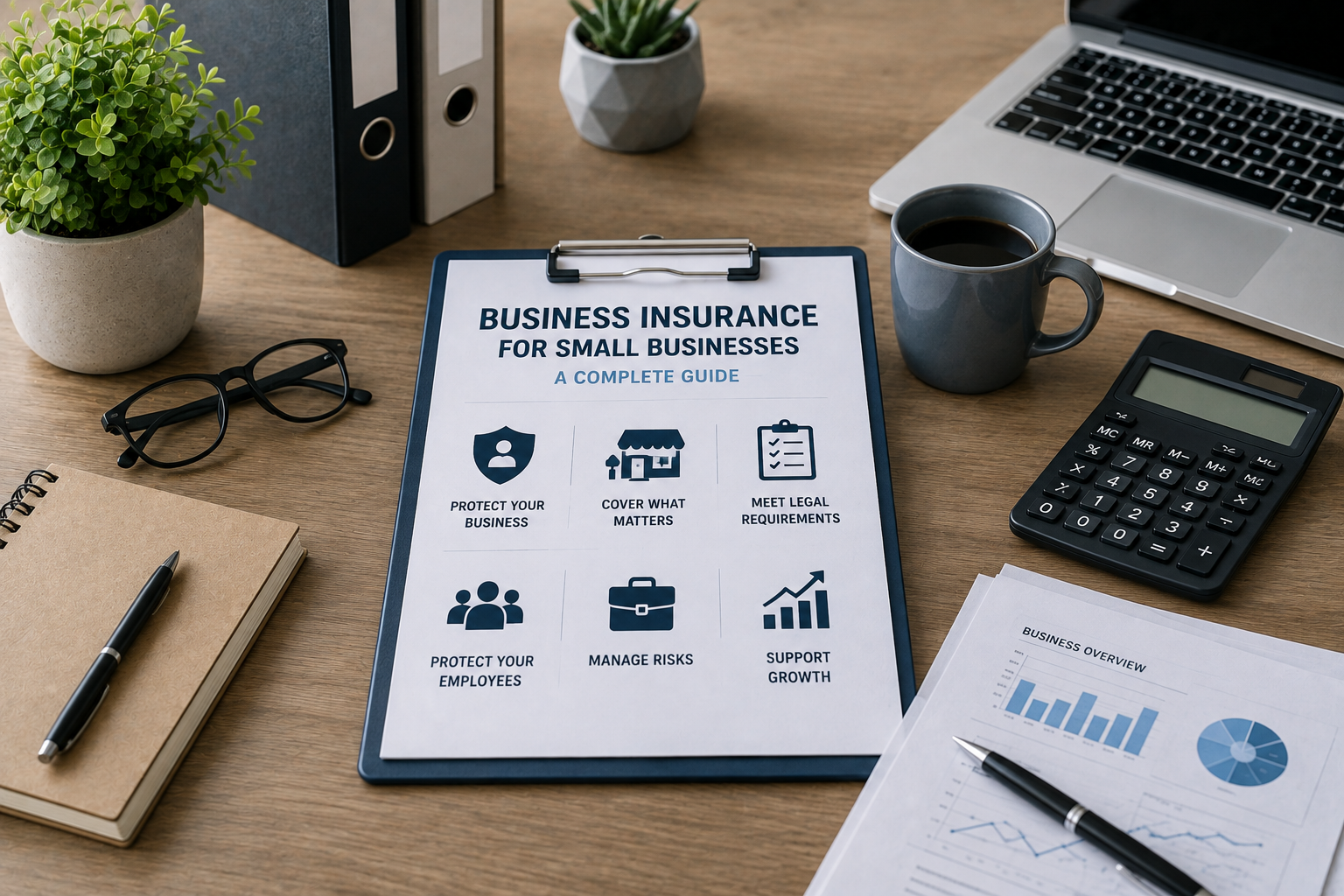
Business insurance helps small businesses transfer financial risks that could otherwise threaten their cash flow, assets, operations, or ability to survive a lawsuit or disaster. There is no single policy that protects every business against every risk. A small retailer, construction contractor, consultant, restaurant, technology company, and home-based business can all need different combinations of liability, property, workers’ compensation, commercial auto, professional liability, cyber, business income, and other coverage. The right insurance program begins with identifying the losses your business could not comfortably pay on its own.
Key Takeaways
- Small businesses rarely need exactly the same insurance package because coverage should match the company’s actual operations and risks.
- General liability can protect against certain third-party bodily injury, property damage, and personal or advertising injury claims.
- Commercial property insurance can protect buildings, equipment, inventory, furniture, and other insured property from covered causes of loss.
- A Business Owner’s Policy, or BOP, commonly combines property, general liability, and business income coverage for eligible businesses.
- Workers’ compensation rules are primarily state-based and coverage is mandatory for most employers, subject to state-specific thresholds and exemptions.
- Business-owned vehicles generally require commercial auto coverage rather than relying on personal auto insurance.
- Professional service businesses should evaluate professional liability or errors and omissions coverage because general liability does not ordinarily replace it.
- Businesses that store customer, employee, financial, health, or other sensitive data should evaluate cyber insurance.
- Standard commercial property insurance should not be assumed to cover flood damage; separate flood coverage may be necessary.
- Insurance requirements can come from state law, lenders, landlords, professional licensing rules, customers, and contracts.
- Coverage limits, deductibles, exclusions, endorsements, valuation methods, and insurer quality matter just as much as premium.
- Review business insurance at least around renewal and after major changes in employees, revenue, property, vehicles, services, contracts, or locations.
What Is Business Insurance?
Business insurance is a broad term for policies designed to protect companies against financial losses associated with their operations.
Depending on the policy, insurance can help pay for covered losses involving:
- Customer injuries.
- Damage to someone else’s property.
- Lawsuits and legal defense expenses.
- Fire or other covered property damage.
- Stolen business property.
- Lost income after certain covered property losses.
- Employee work-related injuries.
- Vehicle accidents.
- Professional mistakes or alleged negligence.
- Cyberattacks and data breaches.
- Employment-related claims.
- Other risks specifically insured by the policy.
Insurance does not make every business loss covered. Each policy contains limits, deductibles, conditions, definitions, and exclusions that determine when protection applies.
Why Small Businesses Need Insurance
A large corporation may have substantial cash reserves, specialized legal teams, and geographically diversified operations. A small business often has far less ability to absorb an unexpected six-figure loss.
Consider how your business would respond if:
- A customer suffered a serious injury on your property.
- A fire destroyed inventory and equipment.
- A major customer alleged that your professional advice caused a financial loss.
- An employee was seriously injured at work.
- A company vehicle caused a major accident.
- A ransomware attack shut down operations.
- A storm caused your business to close for weeks.
- A defective product injured a customer.
SBA guidance offers a useful general principle: insure against risks your business could not comfortably pay for on its own.
Does an LLC Mean You Do Not Need Business Insurance?
No. Forming a limited liability company or corporation and purchasing insurance address different risks.
A business entity can provide certain legal separation between the company and its owners, but it does not prevent the business itself from being sued, losing property, suffering a cyberattack, experiencing a vehicle accident, or having an employee injured.
Insurance can help provide money for covered losses even when the company has been structured properly.
The Main Types of Small Business Insurance
| Coverage | Primary Risk Addressed |
|---|---|
| General liability | Certain third-party bodily injury, property damage, and personal or advertising injury claims. |
| Commercial property | Covered damage to business buildings, equipment, inventory, furniture, and other insured property. |
| Business income | Certain income losses and continuing expenses after a covered interruption. |
| Workers’ compensation | Work-related employee injuries and illnesses under applicable state law. |
| Commercial auto | Vehicle liability and optional physical damage for business vehicles. |
| Professional liability / E&O | Claims alleging professional errors, negligence, or failure to provide promised services. |
| Cyber insurance | Data breaches, cyber incidents, recovery costs, and certain third-party cyber liabilities. |
| Product liability | Claims arising from allegedly defective products that cause injury or damage. |
| Employment practices liability | Certain employment-related claims such as discrimination, harassment, or wrongful termination allegations. |
| Umbrella / excess liability | Additional liability limits above eligible underlying policies, subject to policy terms. |
General Liability Insurance
General liability insurance is one of the most common foundational coverages for small businesses.
Depending on the policy and claim, it can help address allegations involving:
- Bodily injury to customers or other third parties.
- Damage to someone else’s property.
- Certain personal and advertising injuries.
- Covered medical payments.
- Legal defense expenses associated with covered claims.
General Liability Example
A customer slips on a wet floor inside a store, suffers an injury, and alleges that the business failed to maintain safe premises. A general liability policy may respond to a covered bodily injury claim, including qualifying defense and settlement costs, subject to the policy.
General liability normally should not be treated as a substitute for workers’ compensation, commercial auto, professional liability, or cyber insurance.
Commercial Property Insurance
Commercial property insurance protects insured business property against covered causes of loss.
Property that may be insured includes:
- Buildings owned by the business.
- Tenant improvements.
- Furniture.
- Computers and electronics.
- Machinery.
- Tools and equipment.
- Inventory and stock.
- Fixtures.
- Other covered business personal property.
Coverage depends on the causes of loss included in the policy. Fire, certain wind losses, theft, vandalism, and other events may be covered depending on the form, while exclusions and special limits can apply.
Commercial Property Insurance Does Not Cover Every Disaster
Do not assume that purchasing commercial property insurance automatically protects against every natural disaster.
Flood damage is commonly outside standard commercial property coverage and may require separate flood insurance. Earthquake and earth movement protection can also require separate coverage or an endorsement.
Businesses should evaluate local catastrophe exposures based on the property’s actual location rather than assuming a standard policy is sufficient.
Business Interruption or Business Income Insurance
Repairing damaged property is only part of recovering from a major loss. A business can also lose revenue while operations are interrupted.
Business interruption insurance, also called business income insurance, can help replace certain lost income and continuing expenses when operations are suspended because of a covered event that satisfies the policy’s requirements.
Depending on the policy, covered amounts can include qualifying:
- Lost business income.
- Rent or lease payments.
- Employee payroll.
- Taxes.
- Loan payments.
- Extra costs of operating temporarily elsewhere.
- Other continuing expenses.
Important: Business income coverage commonly depends on a covered cause of loss and applicable policy trigger. A general decline in revenue does not automatically qualify as a covered interruption.
What Is a Business Owner’s Policy?
A Business Owner’s Policy, commonly called a BOP, packages several major small business coverages into one policy.
A typical BOP can combine:
- General liability.
- Commercial property.
- Business income or business interruption coverage.
For qualifying businesses, NAIC notes that purchasing a BOP can be less costly than buying individual policies separately.
Eligibility depends on the insurer, industry, revenue, property characteristics, business size, and underwriting rules. High-risk or specialized operations may need a commercial package policy or separate policies instead.
What a BOP Usually Does Not Automatically Include
A BOP can provide a strong foundation, but it is not complete protection for every company.
Separate coverage may still be needed for:
- Workers’ compensation.
- Commercial auto.
- Professional liability.
- Cyber insurance.
- Employment practices liability.
- Flood.
- Earthquake.
- Umbrella or excess liability.
- Other specialized industry risks.
Workers’ Compensation Insurance
Workers’ compensation provides benefits for employees who experience qualifying work-related injuries or illnesses.
Benefits typically can include:
- Medical expenses.
- Rehabilitation costs.
- A portion of lost wages.
- Death or funeral benefits in qualifying cases.
Workers’ compensation laws are primarily administered by states. NAIC reports that coverage is mandatory for most employers in every state except Texas, but employee-count thresholds, exemptions, owner treatment, permitted self-insurance, and other requirements vary.
A business should check the rules of every state in which employees work rather than relying on a national assumption.
Commercial Auto Insurance
Vehicles owned or regularly operated for business create a separate liability exposure that should not simply be assumed to fall under general liability or a personal auto policy.
Commercial auto policies can include coverage such as:
- Bodily injury liability.
- Property damage liability.
- Collision.
- Comprehensive.
- Uninsured or underinsured motorist coverage where applicable.
- Medical payments or personal injury protection where applicable.
State financial-responsibility requirements apply to business vehicles just as they do to other vehicles, but commercial contracts and the severity of business-use liability can justify limits above statutory minimums.
What if Employees Drive Their Own Cars for Business?
A business can still face liability when employees use personal vehicles for company errands or work activities.
Businesses with this exposure should ask about hired and non-owned auto liability coverage and should establish clear driver and insurance requirements.
Professional Liability or Errors and Omissions Insurance
Businesses that provide professional advice or specialized services should evaluate professional liability insurance, often called errors and omissions or E&O coverage.
Claims can involve allegations that the business:
- Made a professional error.
- Provided negligent advice.
- Failed to perform agreed services properly.
- Failed to meet an applicable professional standard.
- Caused a client financial loss through a covered professional act or omission.
Consultants, accountants, technology firms, architects, insurance professionals, healthcare providers, and many other service businesses may have significant professional liability exposures.
Check the claims-made provisions: Many professional liability policies operate on a claims-made basis, making retroactive dates, reporting periods, prior acts, and extended reporting options particularly important.
Product Liability Insurance
Businesses that manufacture, distribute, wholesale, or sell products can face lawsuits alleging that a defective product caused bodily injury or property damage.
Product liability protection may be included within some general liability arrangements or structured separately depending on the business, insurer, and exposure.
Manufacturers and sellers should pay particular attention to products-completed operations limits, exclusions, geographic restrictions, and contractual requirements.
Cyber Insurance
Cyber risk is not limited to large technology companies. Small businesses can be targets of ransomware, phishing, fraudulent transfers, data theft, credential attacks, and vendor-related breaches.
FTC guidance distinguishes between first-party and third-party cyber protection.
| Cyber Coverage | Examples of Costs It May Address |
|---|---|
| First-party | Data restoration, forensic services, notification costs, business interruption, crisis management, and other insured response expenses. |
| Third-party | Certain lawsuits, regulatory inquiries, settlements, defense expenses, and claims brought by affected third parties. |
Policy definitions vary substantially. Review ransomware, social engineering, funds transfer fraud, dependent business interruption, regulatory coverage, vendor incidents, breach response, sublimits, and security requirements carefully.
Employment Practices Liability Insurance
Hiring employees creates risks beyond workers’ compensation.
Employment practices liability insurance, or EPLI, can provide protection for certain claims alleging issues such as:
- Discrimination.
- Harassment.
- Wrongful termination.
- Retaliation.
- Other covered employment practices.
Coverage varies significantly, particularly for wage-and-hour matters, which may be excluded or subject to limited defense coverage.
Commercial Umbrella and Excess Liability Insurance
A severe liability claim can exceed the limits of an underlying general liability or commercial auto policy.
Commercial umbrella or excess liability insurance can provide additional limits above qualifying underlying coverage, subject to its own terms, exclusions, attachment points, and underlying insurance requirements.
Liability Limit Example
Assume a covered liability loss is hypothetically $1.8 million and an underlying policy provides $1 million of applicable coverage.
If a properly structured umbrella or excess policy applies above that underlying coverage, it may respond to part or all of the remaining covered loss, subject to its limits and terms. This example is illustrative only.
Flood Insurance for Small Businesses
Businesses should not assume their ordinary commercial property policy covers flooding.
The National Flood Insurance Program offers commercial flood protection for qualifying building and contents exposures.
Commercial flood coverage can protect qualifying:
- Building structures and foundations.
- Electrical and plumbing systems.
- HVAC equipment.
- Furniture.
- Machinery and equipment.
- Inventory and stock.
- Other covered business contents.
NFIP building and contents coverage are separate and have separate limits and deductibles. NFIP commercial coverage also does not cover business interruption or loss of use, making broader disaster planning important.
Insurance for a Home-Based Small Business
Running a company from home does not eliminate business exposures.
NAIC warns that homeowners or renters insurance is rarely adequate for all of the unique risks of a home-based business.
A home-based entrepreneur should evaluate coverage for:
- Business equipment.
- Inventory.
- Customer injuries at the home.
- Professional liability.
- Cyber risks.
- Business interruption.
- Other liabilities created by the operation.
Options can include a homeowners endorsement for limited exposures, an in-home business policy, or a BOP depending on the size and nature of the operation.
Is Business Insurance Required by Law?
Some business insurance is legally required, but requirements depend on the coverage, state, profession, employees, vehicles, and business structure.
Common examples include workers’ compensation requirements for many employers and auto financial-responsibility requirements for vehicles.
Certain licensed professions can also face specialized insurance requirements under state law or professional regulations.
General liability insurance is not universally required by one nationwide law for every small business, but it can effectively become mandatory through contracts or leases.
Insurance Can Be Required by Contracts
Even when state law does not require a particular policy, another party may require it before doing business with you.
Insurance requirements can come from:
- Commercial landlords.
- Banks and lenders.
- General contractors.
- Government contracts.
- Large customers.
- Vendors.
- Franchisors.
- Professional associations.
Contracts can specify minimum limits, required endorsements, additional insured status, waiver of subrogation, primary and noncontributory wording, or other insurance conditions.
How Much Business Insurance Does a Small Business Need?
There is no universal liability limit or property amount that is right for every small business.
Consider:
- Maximum realistic liability severity.
- Value of buildings and property.
- Cost to replace equipment and inventory.
- Annual revenue.
- Payroll.
- Number of customers and visitors.
- Number and type of vehicles.
- Data handled by the business.
- Professional services provided.
- Contractual insurance requirements.
- Lender and lease requirements.
- How much risk the company could financially retain.
How to Choose Property Insurance Limits
Do not automatically insure business property for its accounting book value or resale value.
Property policies can use different valuation approaches, including replacement cost or actual cash value.
Replacement cost can be significantly higher than depreciated accounting value, particularly for specialized equipment or buildings affected by construction inflation.
Underinsurance can be expensive: A policy can contain coinsurance requirements, sublimits, valuation conditions, or other provisions that affect payment when insured values are inadequate.
How Business Insurance Deductibles Work
A deductible is the amount of a covered loss the business generally retains before applicable insurance payment.
Higher deductibles can reduce premiums because the business retains more loss.
Deductible Example
Assume covered property damage is hypothetically $25,000 and the applicable deductible is $2,500.
In a simplified example, the insurer could pay $22,500 and the business would retain $2,500, assuming the entire remaining loss is covered and no other provisions affect payment.
Choose a deductible based on the amount your business could comfortably pay immediately after a loss, not solely on the premium discount.
What Determines Small Business Insurance Costs?
Premiums can depend on factors such as:
- Industry.
- Location.
- Revenue or sales.
- Payroll.
- Employee classifications.
- Property value and construction.
- Number and type of vehicles.
- Driver records.
- Number of customers.
- Professional services.
- Claims history.
- Coverage limits.
- Deductibles.
- Safety and loss-control programs.
- Insurer underwriting appetite.
Two companies with the same revenue can therefore pay very different premiums if one operates a low-risk office while the other performs hazardous physical work.
How to Lower Small Business Insurance Costs
- Compare multiple insurers. Pricing and underwriting appetite can differ significantly.
- Compare equivalent coverage. Do not mistake lower limits or broader exclusions for genuine savings.
- Consider a BOP. Packaging eligible coverage can sometimes cost less than purchasing it separately.
- Ask for deductible alternatives. Compare premium savings with the additional risk retained.
- Improve workplace safety. Reducing injuries can help control workers’ compensation losses.
- Manage drivers carefully. Review driving records, vehicle maintenance, training, and accident history.
- Improve property protection. Fire protection, alarms, maintenance, security, and other controls can reduce losses.
- Strengthen cybersecurity. MFA, backups, employee training, patching, and access controls can reduce cyber risk.
- Keep exposure data accurate. Update payroll, sales, vehicles, employees, property, and operations.
- Review loss history. Find recurring claims and correct the underlying causes.
- Ask about credits and discounts. Available savings vary by insurer, industry, and state.
How to Shop for Small Business Insurance
- List your major risks. Identify people, property, vehicles, data, professional services, and catastrophe exposures.
- Identify legal requirements. Check state workers’ compensation, vehicle, licensing, and other applicable rules.
- Review contracts. Collect leases, lending agreements, and customer contracts containing insurance requirements.
- Calculate property values. Estimate what buildings, inventory, equipment, and other property would cost to replace appropriately.
- Prepare exposure information. Insurers may ask about revenue, payroll, employees, vehicles, property, subcontractors, locations, and prior claims.
- Use licensed insurance professionals. Verify licensing through the appropriate state insurance department when necessary.
- Request comparable quotes. Keep limits, deductibles, and major terms as similar as possible.
- Read exclusions and endorsements. Coverage differences can be more important than premium differences.
- Evaluate insurer quality. Consider financial strength, claims service, industry expertise, and loss-control support.
- Review the final policy. Confirm that the issued policy matches what you intended to purchase.
Questions to Ask Before Buying a Policy
- What losses does this policy cover?
- What are the most important exclusions?
- What is the deductible?
- What are the per-occurrence and aggregate limits?
- Are defense costs inside or outside the liability limit?
- Does the policy use replacement cost or actual cash value?
- Are there special sublimits?
- Is coverage occurrence-based or claims-made?
- Is a retroactive date involved?
- What happens if I add a location, employee, vehicle, or service?
- Does the policy satisfy my lease or client contract?
- What claims-reporting deadlines apply?
- Are subcontractors covered or excluded?
- Are cyber, flood, earthquake, or professional risks excluded?
- What coverage is available through endorsements?
Occurrence vs. Claims-Made Coverage
Understanding the coverage trigger is particularly important when comparing liability policies.
| Policy Type | General Concept |
|---|---|
| Occurrence | Generally focuses on whether the covered event occurred during the policy period, subject to the policy terms. |
| Claims-made | Generally requires a claim to be made during the applicable policy or reporting period and can include a retroactive date. |
Professional liability, cyber, and employment practices policies are often written on claims-made forms. Businesses should understand the consequences before replacing or canceling them.
Certificates of Insurance
Customers, landlords, lenders, and contractors may request a certificate of insurance as evidence that a business has certain policies and limits.
A certificate summarizes insurance information but does not itself replace the actual policy or automatically modify coverage.
If a contract requires additional insured status or another endorsement, confirm that the actual policy endorsement has been issued rather than relying only on a certificate.
When Should a Small Business Review Its Insurance?
Review coverage around each renewal and whenever the company changes materially.
Review insurance after:
- Hiring employees.
- Significant payroll changes.
- Opening or closing a location.
- Buying expensive equipment.
- Adding vehicles or drivers.
- Launching a new product.
- Starting a new service.
- Expanding into another state.
- Signing a large customer contract.
- Increasing inventory substantially.
- Changing business premises.
- Beginning to collect sensitive customer information.
- Experiencing a significant claim.
Common Small Business Insurance Mistakes
Assuming an LLC Replaces Insurance
An LLC can provide legal separation but does not pay property losses, legal defense expenses, workers’ compensation benefits, cyber recovery expenses, or covered vehicle claims.
Buying Only General Liability
General liability is valuable but does not automatically replace professional liability, commercial auto, workers’ compensation, cyber, or property insurance.
Choosing the Cheapest Quote
A cheaper quote can contain lower limits, higher deductibles, more exclusions, narrower definitions, or weaker business income protection.
Ignoring Flood Risk
Standard commercial property coverage should not be assumed to cover flooding. Businesses in both high- and lower-risk areas should evaluate flood exposure.
Underinsuring Property
Inflation, equipment prices, construction costs, and inventory growth can make old property limits inadequate.
Ignoring Business Income Exposure
Replacing damaged equipment does not necessarily replace the revenue lost while the business is closed.
Ignoring Cyber Risk Because the Business Is Small
FTC guidance specifically warns that cybercriminals target businesses of all sizes. Small companies can have fewer resources available for incident response and recovery.
Not Updating the Insurer After Business Changes
New operations, vehicles, locations, products, or employees can create exposures that were never considered when the original policy was written.
Canceling Claims-Made Coverage Without Planning
Canceling or replacing professional liability, cyber, or another claims-made policy without reviewing retroactive dates and extended reporting options can create gaps for claims reported later.
Frequently Asked Questions
The Bottom Line
Small business insurance works best when it is built around the risks that could seriously damage the company rather than purchased as a generic package. General liability and commercial property can form a foundation for many businesses, and eligible companies may obtain both through a Business Owner’s Policy that also includes business income coverage.
Additional protection may be necessary for employees, vehicles, professional services, cyber incidents, products, employment practices, floods, catastrophic liability, and other specialized exposures. Legal requirements are state- and situation-specific, while landlords, lenders, clients, and professional contracts can impose additional insurance requirements.
When comparing policies, evaluate more than premium. Compare limits, deductibles, exclusions, endorsements, valuation methods, claims-made provisions, insurer service, and whether the policy actually satisfies your contractual obligations.
Finally, treat insurance as an ongoing part of risk management. A policy that matched your business two years ago may no longer be appropriate after adding employees, vehicles, locations, equipment, products, customers, or sensitive data. Review coverage regularly so protection grows and changes with the business.
Sources
- U.S. Small Business Administration, Business Insurance Guidance, accessed August 2026.
- National Association of Insurance Commissioners, Small Business Insurance Consumer Guidance, accessed August 2026.
- National Association of Insurance Commissioners, Business Interruption and Business Owner Policy, last updated June 25, 2026.
- National Association of Insurance Commissioners, Workers’ Compensation Insurance, last updated January 21, 2026.
- U.S. Department of Labor, State Workers’ Compensation Officials, accessed August 2026.
- Federal Trade Commission, Cybersecurity for Small Business and Cyber Insurance Guidance, accessed August 2026.
- National Flood Insurance Program, Protecting Businesses with Flood Insurance, November 2024.
- National Flood Insurance Program, Commercial Flood Insurance Coverage Guidance, accessed August 2026.