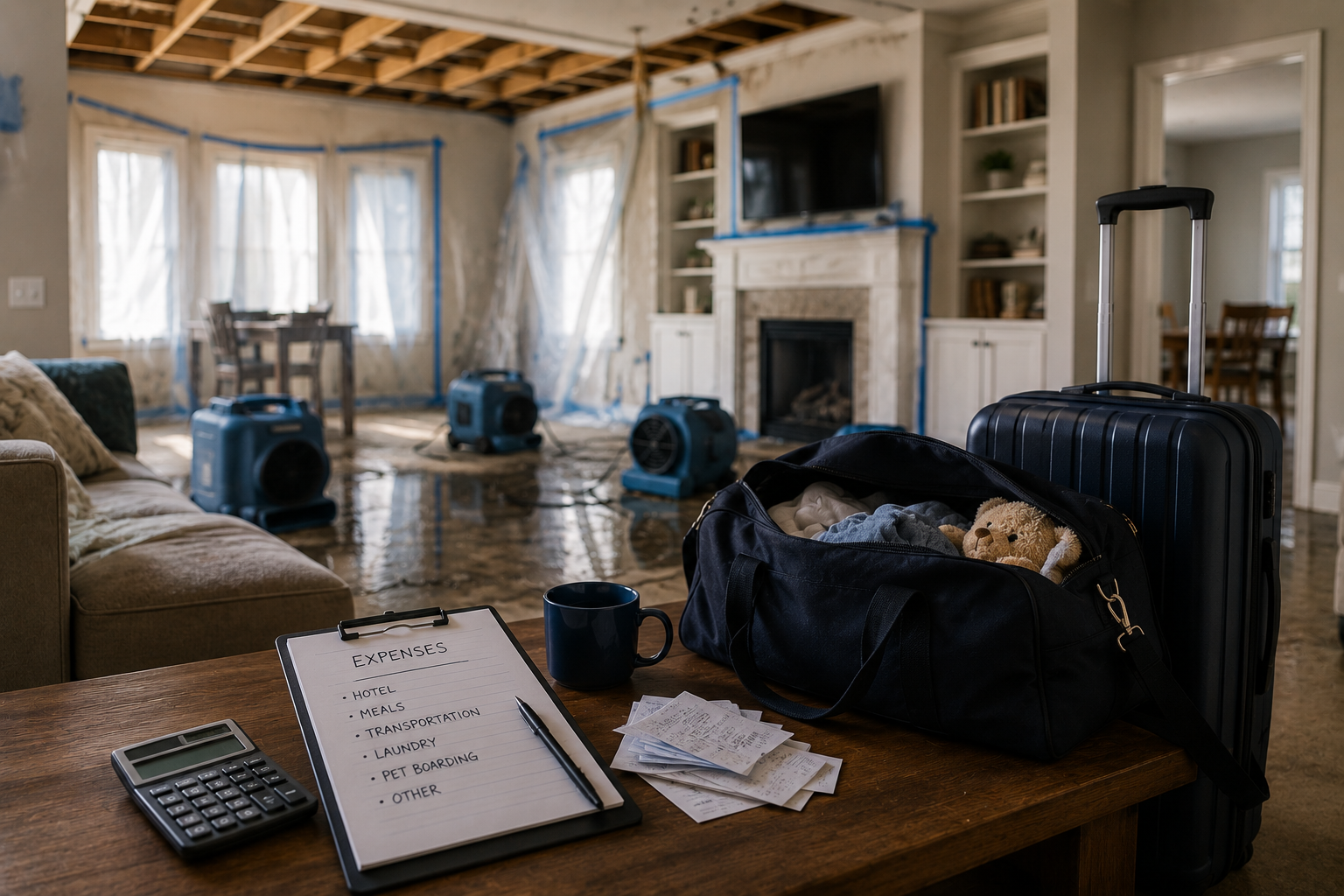
Additional Living Expenses coverage, commonly called ALE, can help pay the extra costs of maintaining your household when a covered loss makes your home temporarily unlivable. It is usually part of the Loss of Use section of a homeowners, renters, or condo insurance policy. ALE can help with temporary housing, increased meal costs, storage, additional transportation, and certain other necessary expenses. However, it does not simply pay every bill you have while displaced. Coverage generally focuses on reasonable costs above your normal living expenses and is subject to policy limits, time restrictions, covered-loss requirements, and documentation rules.
Key Takeaways
- Additional Living Expenses coverage is commonly part of the Loss of Use section of a homeowners policy.
- ALE generally applies when a covered loss makes your home unfit or unsafe to live in.
- It can help pay for temporary housing, increased meal costs, storage, furniture rental, additional transportation, and certain relocation expenses.
- ALE normally pays additional costs above your usual living expenses rather than paying every household bill.
- Your regular mortgage payment generally remains your responsibility even while you are displaced.
- Costs usually need to be reasonable and necessary for maintaining approximately your normal standard of living.
- Policies can impose a dollar limit, a time limit, or both.
- The Loss of Use limit is separate from your dwelling and personal property claim, although the policy may calculate the limit as a percentage of another coverage.
- Keep receipts, invoices, leases, mileage records, and other documentation for displacement expenses.
- Fair Rental Value is related to Loss of Use but generally addresses lost rental income rather than your own additional household expenses.
- Some policies can provide limited Loss of Use benefits when a civil authority prevents access because of a covered peril, subject to specific policy language.
- Standard homeowners insurance generally excludes flood damage, and NFIP flood policies do not pay ALE.
- Earthquake-related ALE depends on separate earthquake insurance or an applicable endorsement because standard homeowners insurance generally excludes direct earthquake damage.
- ALE stops when the applicable policy limit or covered period ends, so understand both before committing to long-term temporary housing.
What Does Additional Living Expenses Coverage Mean?
Additional Living Expenses coverage helps pay reasonable and necessary increases in living costs when you cannot occupy your home because of a covered loss.
NAIC describes ALE as coverage for expenses beyond your normal living costs while your home is unlivable. The purpose is generally to allow your household to maintain, as nearly as practical, its normal standard of living while the damaged home is repaired or rebuilt.
ALE may become important after events such as a covered:
- House fire.
- Wildfire.
- Windstorm.
- Covered water loss.
- Smoke damage.
- Lightning loss.
- Severe covered storm damage.
- Other insured causes that make the residence uninhabitable.
The event must generally fall within the policy’s covered causes of loss. Simply wanting to leave the home temporarily does not create an ALE claim.
Loss of Use vs. Additional Living Expenses
Loss of Use is the broader insurance category. Additional Living Expenses is usually one part of Loss of Use coverage.
Depending on the policy, Loss of Use can address several situations, including your additional expenses while displaced, lost rental value when part of the insured property was rented to someone else, and limited situations in which government or civil authority prevents access to the home.
| Term | General Purpose |
|---|---|
| Loss of Use | Broad coverage category addressing certain financial consequences of being unable to use the insured residence after a covered loss. |
| Additional Living Expenses | Helps pay reasonable increases in your household’s living expenses while you are displaced. |
| Fair Rental Value | Can address qualifying lost rental value when a part of the insured residence normally rented to others becomes uninhabitable because of a covered loss. |
When Does ALE Coverage Apply?
A typical ALE claim requires more than property damage alone.
Generally, you need:
- A covered cause of loss. The damage must generally result from a peril insured by your policy.
- An inability to occupy the home. The residence must generally be unfit, unsafe, or otherwise unavailable for normal occupancy under the coverage terms.
- Additional expenses. You must actually incur reasonable costs beyond your ordinary living expenses.
- Documentation. Receipts and other records are commonly required to support reimbursement.
Damage does not automatically equal displacement: If a covered loss damages only a small part of your home and you can reasonably continue living there, ALE may not apply merely because repairs are inconvenient.
What Does Additional Living Expenses Insurance Cover?
The exact list varies by policy and circumstances, but state insurance regulators identify several common categories of ALE expenses.
Temporary Housing
ALE can help pay reasonable temporary housing costs when you cannot stay in your insured home.
Temporary housing can include:
- Hotels.
- Motels.
- Short-term apartments.
- Rental homes.
- Other appropriate temporary accommodations.
The insurer may consider your household size, location, pets, accessibility needs, school or work location, and normal standard of living when evaluating whether temporary housing costs are reasonable.
Additional Food Costs
If your temporary housing has no kitchen, restaurant meals can cost more than preparing meals at home.
ALE can potentially pay the reasonable increase above your normal food expense rather than the entire restaurant bill.
Extra Transportation
Temporary housing may be farther from work, school, childcare, or other routine destinations.
California insurance guidance identifies additional transportation to and from work or school as an example of a potentially eligible ALE expense.
Moving and Storage
Necessary relocation and storage expenses can qualify when property must be moved while the home is repaired or rebuilt.
Furniture Rental
If your temporary residence is unfurnished, reasonable furniture rental costs can potentially fall under ALE.
Temporary Utility Setup
Certain telephone, internet, or utility installation costs at a temporary residence can be eligible depending on policy terms and necessity.
Laundry and Other Necessary Services
If your normal laundry facilities are unavailable, reasonable incremental laundry expenses may qualify. Other household services can also be considered when they are necessary because of displacement and represent additional costs.
Examples of Expenses ALE May Cover
| Expense | Potential ALE Treatment |
|---|---|
| Hotel or temporary rental | Can be covered when reasonable and necessary because the home is uninhabitable from a covered loss. |
| Increased restaurant costs | The increase above ordinary food spending can potentially qualify. |
| Extra commuting costs | Additional transportation resulting from temporary relocation can potentially qualify. |
| Storage | Necessary storage resulting from displacement can potentially qualify. |
| Furniture rental | May qualify when temporary housing reasonably requires rented furnishings. |
| Utility installation | Certain additional setup costs at temporary housing can potentially qualify. |
How Are Additional Living Expenses Calculated?
One of the biggest misconceptions about ALE is that the insurer simply pays all of your living expenses after a covered disaster.
Instead, ALE generally focuses on the increase caused by displacement.
Potential ALE = Reasonable temporary living expenses − Normal expenses you would otherwise have incurred or expenses you avoided
Illustrative Food-Cost Example
Suppose a household normally spends approximately $900 per month on groceries.
After a covered fire, the family stays in a hotel without a kitchen and reasonably spends $1,700 on meals during a comparable period.
$1,700 − $900 = $800 hypothetical additional food cost.
The insurer may evaluate the $800 increase rather than treating all $1,700 as additional living expense. Actual claim calculations depend on the facts and policy.
Does ALE Pay Your Mortgage?
Generally, no. Your normal mortgage payment is an expense you would have had even if the covered loss had never occurred.
NAIC specifically explains that while ALE may help pay for temporary housing, the homeowner generally remains responsible for the regular mortgage payment.
This can create a significant cash-flow issue because a displaced homeowner may temporarily have both a mortgage payment and temporary housing costs.
What Expenses Does ALE Usually Not Pay?
ALE generally should not be expected to pay:
- Your normal mortgage payment.
- Normal expenses you would have paid even without the loss.
- Unreasonable upgrades to a substantially higher standard of living.
- Expenses unrelated to the displacement.
- Costs after the ALE dollar limit has been exhausted.
- Costs after the applicable covered period has ended.
- Displacement resulting solely from an excluded peril unless another policy provides applicable coverage.
- Temporary living expenses under a standard NFIP flood policy.
- Unsupported expenses when the policy reasonably requires documentation.
How Much Additional Living Expenses Coverage Do You Have?
There is no single nationwide ALE limit.
Some homeowners policies express Loss of Use coverage as a percentage of the dwelling limit. California’s consumer guide, for example, says Coverage D is normally limited to 20% of Coverage A in policies described by that guide. Other policies can use different percentages or dollar limits.
Illustrative Limit Example
Assume a hypothetical homeowners policy has $400,000 of dwelling coverage and a Loss of Use limit equal to 20% of that amount.
$400,000 × 20% = $80,000 hypothetical Loss of Use limit.
This is only an illustration. Your policy may provide a different percentage, a fixed dollar amount, different terms for renters or condo coverage, or special rules established by state law.
Do not assume 20% applies to you: Policy structures and state requirements differ. Check the Loss of Use amount shown on your declarations page and read the applicable coverage form.
How Long Does ALE Coverage Last?
ALE is temporary coverage. It is not intended to pay indefinite living expenses.
NAIC notes that some policies have time limitations in addition to dollar limits.
The covered period can depend on:
- The policy language.
- Your remaining ALE limit.
- The reasonable amount of time required to repair or rebuild.
- Whether you permanently relocate instead.
- State insurance laws.
- Special disaster-related rules or extensions.
For example, California currently provides special ALE protections for qualifying residential property claims following declared states of emergency, including minimum time protections and potential extensions in specified circumstances. Those California rules should not be treated as nationwide requirements.
Can ALE Run Out Before Your Home Is Repaired?
Yes. A dollar limit can be exhausted even if the repairs are still unfinished.
This is especially important after large catastrophes, when housing shortages, construction delays, labor shortages, permitting delays, or supply-chain problems can extend displacement.
Ask your adjuster for the remaining ALE balance periodically and track your own expenses so you can estimate how long the coverage may last.
Does ALE Pay for a Hotel?
Hotel bills are one of the most common ALE expenses.
If a covered fire makes your home uninhabitable and you reasonably need a hotel, ALE can generally help pay the temporary lodging cost subject to the policy’s limits and requirements.
For longer displacement, the insurer may prefer or approve a short-term rental because it can be more practical and economical than an extended hotel stay.
Can You Choose Any Temporary Rental?
ALE is generally intended to allow you to maintain approximately your normal standard of living, not create a substantially higher one at the insurer’s expense.
A family that normally lives in a three-bedroom suburban home may have a reasonable basis for seeking temporary housing suitable for the same household. That does not necessarily mean the insurer must pay for a luxury property far beyond the family’s normal circumstances.
For longer rentals, discuss the property and lease terms with the adjuster before signing whenever practical.
What if You Stay With Family or Friends?
ALE generally reimburses expenses you actually incur.
Wisconsin insurance guidance notes that if you temporarily stay with a friend or relative and incur no additional expenses, there may be no ALE payment for housing because no additional housing expense was incurred.
If you do pay reasonable rent or contribute to additional expenses, discuss documentation requirements with the adjuster.
Does ALE Cover Pet Boarding?
Pet-related displacement costs can depend on the policy and circumstances.
If your pet normally lives with you but your reasonable temporary accommodation cannot accept animals, additional boarding costs may be considered as part of the displacement claim by some insurers.
Ask the adjuster before assuming pet boarding is covered, and keep invoices if the expense is approved or appears necessary.
Does ALE Cover Food?
It can cover additional food costs caused by displacement.
If you normally spend $250 per week feeding your household at home but temporary hotel living reasonably increases that amount, the insurer may evaluate the difference between your normal expense and the higher displacement expense.
Keep both current receipts and, when possible, records showing your ordinary spending pattern.
What Is Fair Rental Value Coverage?
Fair Rental Value generally applies when part of an insured residence is rented to others and a covered loss makes that portion uninhabitable.
California insurance guidance describes Fair Rental Value as payment for the fair rental value of the rented portion while it cannot be occupied because of a covered loss, reduced by expenses that do not continue during the period of uninhabitability.
It is therefore different from ALE used to pay your own additional living costs.
What About Mandatory Evacuations?
Some homeowners policies include limited Loss of Use protection when a civil authority prohibits access to the insured residence because of conditions related to a covered peril.
The trigger, geographic relationship to the damage, covered peril requirement, and length of coverage are policy-specific and can also be affected by state law.
Do not assume every evacuation automatically creates ALE coverage. Contact the insurer and ask whether the civil-authority or prohibited-use provision applies.
Does Flood Insurance Cover Additional Living Expenses?
The National Flood Insurance Program does not cover Additional Living Expenses.
NFIP coverage can insure qualifying direct physical flood damage to the building and contents, but temporary housing and additional living expenses while the building is repaired or cannot be occupied are excluded.
This can be a major financial gap because standard homeowners policies also generally exclude direct flood damage.
Important: Do not assume buying an NFIP flood policy means hotel or temporary-rental costs will be reimbursed after a flood. NFIP specifically excludes ALE and loss of use.
Does Earthquake Insurance Include ALE?
Standard homeowners insurance generally excludes direct earthquake damage, so ordinary homeowners ALE should not automatically be expected to apply when the displacement results solely from an excluded earthquake.
Separate earthquake insurance can include its own Loss of Use or ALE protection.
For example, California Earthquake Authority policies currently offer ALE coverage for temporary and extra living costs, with available limits that depend on the policy selected. Earthquake products differ by state and insurer.
Do Renters Insurance Policies Have ALE?
Many renters insurance policies include Additional Living Expenses or Loss of Use coverage.
If a covered fire makes your rented apartment uninhabitable, renters ALE can help with qualifying temporary housing, meals, and other additional expenses while the residence is repaired.
Limits and time periods still apply, so renters should check the Loss of Use amount shown in their own policy.
Does Condo Insurance Have Loss of Use Coverage?
Condo unit-owner policies can also provide Loss of Use protection when a covered loss makes the insured unit uninhabitable.
Coverage can become more complicated when damage involves both the condo association’s master policy and the unit owner’s policy. The cause of loss, building responsibility, master-policy deductible, and unit-owner policy provisions can all matter.
How Does the ALE Claims Process Work?
- Report the covered property loss. Notify the insurer promptly.
- Explain why the home cannot be occupied. The adjuster may inspect the property or rely on fire, safety, or repair information.
- Confirm your ALE limit. Ask for both the dollar limit and any applicable time limitation.
- Discuss temporary housing. Coordinate longer leases or unusually expensive arrangements before committing whenever practical.
- Track normal and additional expenses. This helps establish the incremental cost caused by displacement.
- Keep receipts. Save hotel invoices, rent receipts, meal receipts, storage bills, transportation records, and utility setup charges.
- Submit expenses regularly. Do not necessarily wait until the home is completely repaired before seeking reimbursement.
- Monitor the remaining balance. Long repairs can consume a large ALE limit.
Do Insurance Companies Pay ALE in Advance?
Claims practices and state requirements vary.
Some insurers can advance money for immediate temporary housing and other urgent displacement expenses rather than requiring the policyholder to finance everything personally and wait for reimbursement.
California, for example, has specific advance-payment protections for qualifying wildfire and declared-disaster claims. These requirements are state-specific and should not be assumed to apply nationwide.
If you cannot afford hotel or rental costs while waiting for reimbursement, ask the adjuster immediately whether an ALE advance or direct-billing arrangement is available.
What Records Should You Keep?
- Hotel invoices.
- Temporary lease agreements.
- Rent payment records.
- Restaurant and grocery receipts.
- Storage invoices.
- Moving expenses.
- Furniture rental bills.
- Utility installation charges.
- Laundry receipts.
- Transportation or mileage records.
- Pet boarding bills if relevant.
- Records showing ordinary pre-loss expenses when needed.
- Emails and written communications with the adjuster.
- Records showing ALE payments already received and the remaining coverage balance.
Common ALE Claim Mistakes
Assuming Every Living Expense Is Covered
ALE generally pays reasonable additional expenses caused by displacement, not every bill your household incurs.
Failing to Keep Receipts
NAIC and state regulators repeatedly advise policyholders to keep receipts because the insurer may need documentation before reimbursing expenses.
Signing an Expensive Long-Term Lease Without Coordination
A temporary rental may be necessary, but discuss major commitments with the adjuster so you understand what amount the insurer considers reasonable and how much ALE remains.
Ignoring the ALE Limit
Expensive temporary housing can consume a fixed ALE limit quickly.
Assuming Flood Displacement Is Covered
NFIP flood insurance does not pay ALE, and standard homeowners policies generally exclude direct flood damage.
Assuming a Mandatory Evacuation Automatically Qualifies
Civil-authority coverage has specific conditions and time limits. Ask the insurer whether the evacuation meets your policy’s trigger.
Confusing Fair Rental Value With ALE
ALE addresses your additional household costs. Fair Rental Value generally relates to qualifying rental income you lose because insured rental space cannot be occupied.
ALE Claim Checklist
- Confirm that the underlying property damage is caused by a covered peril.
- Ask whether the insurer considers the residence uninhabitable.
- Find the Loss of Use or ALE limit on your policy.
- Ask about any time limit.
- Ask whether civil-authority coverage applies if you were evacuated.
- Discuss reasonable temporary housing with the adjuster.
- Ask whether an advance payment is available.
- Save every displacement-related receipt.
- Keep evidence of your normal living expenses.
- Track additional food and transportation costs separately.
- Document storage, moving, furniture, utility, laundry, and other qualifying costs.
- Submit expenses regularly.
- Track the amount of ALE already paid.
- Ask for the remaining balance periodically.
- Contact your state insurance department if you cannot resolve a significant coverage or claim-handling dispute.
Frequently Asked Questions
The Bottom Line
Additional Living Expenses coverage helps protect your household budget when a covered loss makes your home temporarily unlivable. It can pay qualifying temporary housing, increased food costs, relocation and storage expenses, additional transportation, furniture rental, temporary utility setup, and other reasonable costs caused by displacement.
ALE does not normally pay every household bill. Your regular mortgage and other expenses you would have incurred anyway generally remain your responsibility, while the insurer focuses on the reasonable increase caused by the covered loss.
Understand both the dollar limit and time limit before choosing temporary housing, particularly after a major catastrophe that could produce a long rebuilding period. Keep detailed receipts and ask your adjuster how much ALE has been paid and how much remains.
Finally, the underlying cause of displacement matters. Standard homeowners Loss of Use generally requires a covered loss. NFIP flood insurance specifically excludes ALE, while earthquake-related temporary living expenses generally depend on applicable separate earthquake coverage. Your actual insurance policy and state law determine the final result.
Sources
- National Association of Insurance Commissioners, What Are Additional Living Expenses and How Can Insurance Help?, January 13, 2025.
- National Association of Insurance Commissioners, Consumer Homeowners Insurance Guidance, accessed August 2026.
- National Association of Insurance Commissioners, Homeowners Insurance Topics, accessed August 2026.
- California Department of Insurance, Residential Insurance: Homeowners and Renters, accessed August 2026.
- California Department of Insurance, Residential Property Claims Guide, accessed August 2026.
- California Department of Insurance, Insurance Coverage for Additional Living Expenses if the Home Is Not Habitable Due to a Wildfire, accessed August 2026.
- Wisconsin Office of the Commissioner of Insurance, Additional Living Expenses, accessed August 2026.
- South Carolina Department of Insurance, Types of Coverage in a Homeowner’s Insurance Policy, accessed August 2026.
- National Flood Insurance Program, Flood Insurance Policy Terms and Coverage, accessed August 2026.
- California Department of Insurance, Earthquake Insurance, accessed August 2026.