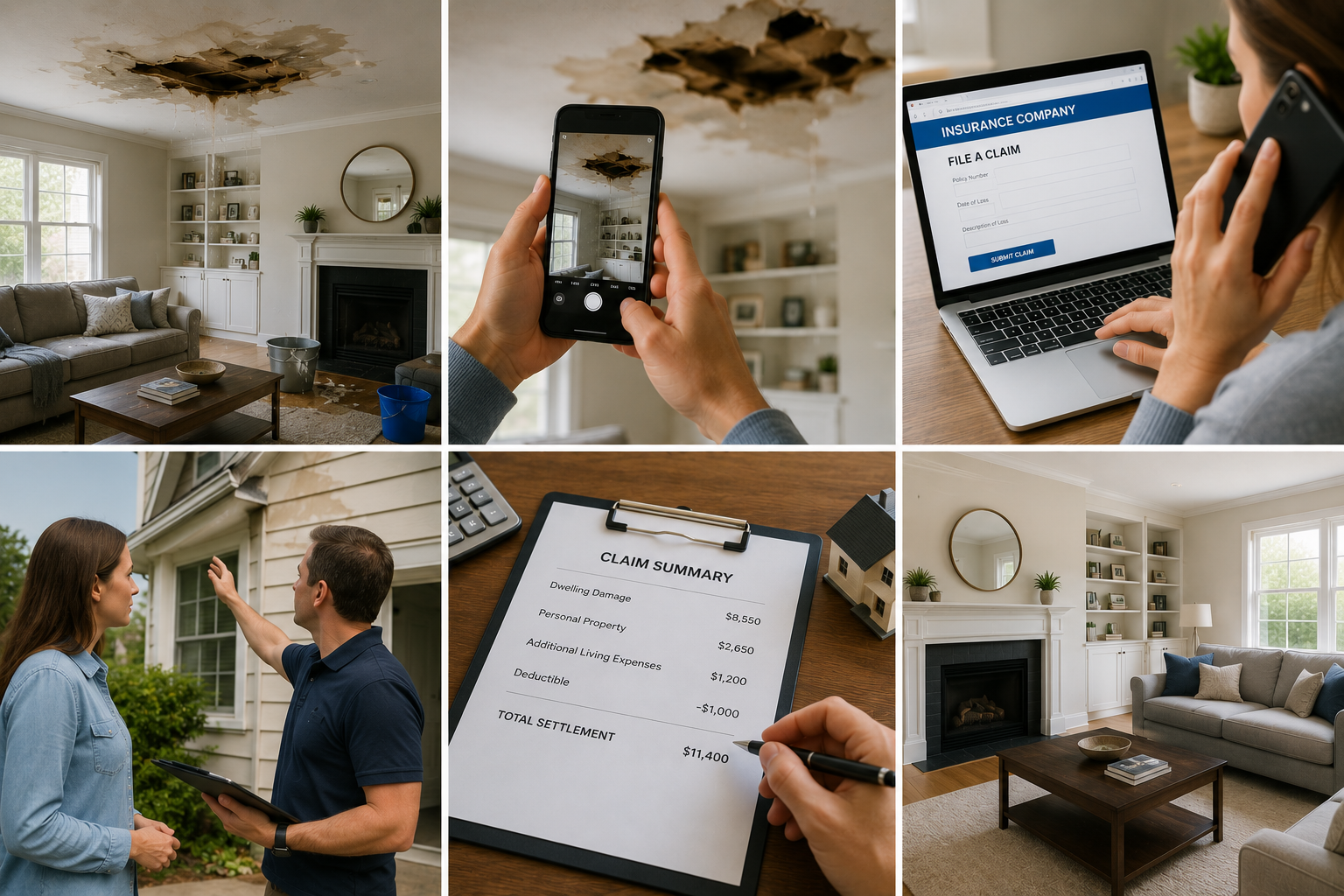
Filing a home insurance claim involves more than calling your insurer and waiting for a check. After a fire, storm, theft, sudden water loss, or another potentially covered event, you generally need to protect the property from additional damage, document what happened, notify the insurance company, cooperate with the adjuster, provide requested records, review repair estimates, understand how your deductible and valuation provisions affect payment, and track any additional costs that arise during repairs. A well-documented claim can make it easier to identify covered damage, explain disagreements, and request additional payment when legitimate covered costs are discovered later.
Key Takeaways
- Address immediate safety risks before worrying about the insurance claim.
- Take reasonable steps to prevent additional damage when you can do so safely.
- Photograph and video damage before cleanup or permanent repairs whenever possible.
- Notify your insurer promptly because reporting requirements and deadlines vary by policy and state.
- Keep a written claim log with your claim number, adjuster information, dates, calls, emails, estimates, and payments.
- Do not automatically throw away damaged property before the insurer has had a reasonable opportunity to inspect it.
- Save receipts for temporary repairs, emergency services, replacement purchases, and Additional Living Expenses.
- Your insurer may ask you to submit a formal proof of loss.
- An adjuster investigates the cause and extent of damage and evaluates what the policy may cover.
- Your deductible is generally your share of an applicable covered property loss.
- Replacement cost and actual cash value can produce different initial claim payments.
- Replacement-cost claims may involve recoverable depreciation that is paid later after repair or replacement requirements are satisfied.
- A contractor estimate that exceeds the insurer’s estimate can sometimes support a supplemental payment when covered differences are documented.
- Structural claim checks can include your mortgage lender because it has a financial interest in the property.
- If a covered loss makes the home uninhabitable, Loss of Use coverage may provide Additional Living Expenses.
- A claim denial and a disagreement over the amount of a covered loss are different issues and may require different approaches.
When Should You File a Home Insurance Claim?
Not every property problem automatically requires an insurance claim.
Before deciding what to do, consider:
- What caused the damage.
- Whether that cause appears covered by your policy.
- How extensive the damage appears to be.
- Your applicable deductible.
- Whether hidden damage may exist.
- Whether liability to another person is involved.
- Whether the property is safe to occupy.
- Whether immediate professional mitigation is necessary.
NAIC advises consumers to know their deductible before reporting relatively minor property damage because a small repair may cost less than or only slightly more than the deductible.
Do not delay a serious loss merely to calculate the final repair cost: Fire, major water damage, theft, structural damage, liability incidents, and other substantial losses can require prompt notice and immediate action even when the total cost is not yet known.
Step 1: Protect People First
Your first priority after property damage is safety.
Depending on the incident, you may need to:
- Leave the home.
- Call the fire department.
- Call police after burglary, theft, or vandalism.
- Call emergency medical services.
- Shut off water when safe.
- Avoid damaged electrical equipment.
- Stay away from unstable ceilings, walls, or roofs.
- Follow evacuation or safety orders.
Do not enter a dangerous structure simply to collect photographs or retrieve belongings for the insurance claim.
Step 2: Prevent Additional Damage
Home insurance policies generally expect policyholders to take reasonable steps to protect damaged property from additional loss.
Examples of reasonable temporary protection can include:
- Covering a damaged roof with a tarp.
- Boarding broken windows.
- Securing a damaged door.
- Stopping a water supply.
- Moving unaffected belongings away from water.
- Removing standing water when safe and appropriate.
- Taking other reasonable emergency measures to prevent deterioration of the loss.
California insurance guidance specifically recommends temporary repairs to prevent additional damage and advises consumers to save receipts for reasonable materials used to protect the property.
Avoid unnecessary permanent repairs before inspection: Texas and California regulators advise consumers to limit early work to necessary temporary protection when practical so the insurer can inspect the original damage before permanent reconstruction changes the evidence.
Step 3: Photograph and Video the Damage
Document the condition of the property before cleanup and permanent repairs whenever it is safe to do so.
Useful photographs can include:
- Wide views of every affected room.
- Close-ups of damaged walls, floors, ceilings, and finishes.
- Damaged personal property.
- Exterior storm or fire damage.
- Visible roof damage from a safe location.
- Water staining and moisture-related damage.
- Damaged appliances.
- Broken windows and doors.
- Temporary repairs.
- Possible sources or causes of the damage.
Video can be especially helpful because it records the overall relationship between rooms and damaged areas.
Step 4: Create a Damage Inventory
If personal belongings are damaged or destroyed, create an itemized inventory.
For each item, record as much as possible:
- Item description.
- Brand.
- Model.
- Approximate age.
- Original purchase price if known.
- Current replacement price.
- Serial number when available.
- Photographs.
- Receipts or purchase records.
- Condition before the loss when relevant.
NAIC recommends maintaining a home inventory before a disaster, but if your records were destroyed, you can reconstruct the list from memory, family photographs, online retailer accounts, credit card records, bank statements, emails, and other purchase history.
Step 5: Contact Your Insurance Company
Notify the insurer promptly once immediate safety and property-protection issues are addressed.
You may be able to file through:
- The insurer’s claims phone number.
- Your insurance agent.
- The insurer’s website.
- The insurer’s mobile application.
Be ready to provide:
- Your name.
- Property address.
- Policy number if available.
- Date and approximate time of the incident.
- A description of what happened.
- Areas damaged.
- Whether the home is habitable.
- Emergency repairs already completed.
- Current contact information.
- Police or fire report information when applicable.
Questions to Ask When You Open the Claim
- What is my claim number?
- Who is my adjuster?
- What is my deductible?
- Is a special wind, hurricane, or other deductible involved?
- What documentation do you need from me?
- Will an adjuster inspect the property?
- Should I obtain contractor estimates now?
- May I dispose of damaged property?
- How should emergency mitigation bills be submitted?
- Does Loss of Use coverage apply if the home cannot be occupied?
- Do you require a proof of loss?
- What deadlines should I know about?
Step 6: Keep a Claim Log
A detailed claim log becomes especially valuable when a claim lasts for weeks or months.
Record:
- Claim number.
- Adjuster’s name and contact information.
- Date of every conversation.
- Who you spoke with.
- Important statements or decisions.
- Documents requested.
- Documents submitted.
- Inspection dates.
- Payments received.
- Estimates submitted.
- Deadlines.
- Questions that remain unresolved.
California’s claims guidance specifically recommends keeping a log of telephone calls and correspondence and retaining copies of documents exchanged with the insurer.
Step 7: Meet With the Insurance Adjuster
The insurance company generally assigns a claim adjuster to investigate and evaluate the loss.
The adjuster may:
- Inspect damaged areas.
- Take photographs.
- Measure rooms and damaged materials.
- Ask how the loss occurred.
- Review personal property damage.
- Review contractor estimates.
- Evaluate Loss of Use expenses.
- Request additional documentation.
- Prepare or obtain a repair estimate.
Texas regulators recommend being present for the inspection when possible and note that having your contractor there can be useful for discussing repair estimates and technical issues.
Walk through the property with the adjuster: Point out damaged rooms, ceilings, floors, cabinets, personal property, exterior surfaces, and other affected areas rather than assuming every item will be noticed automatically.
What Is a Proof of Loss?
A proof of loss is a formal statement submitted to the insurer regarding a claimed loss.
California’s claims guide describes proof of loss as a formal statement intended to provide information the insurer needs to determine the extent of its liability.
Depending on the claim, the form may request information about:
- Date of loss.
- Cause of loss.
- Property damaged.
- Amount claimed.
- Ownership interests.
- Other insurance.
- Personal property inventory.
- Supporting estimates and documentation.
Do not ignore a proof-of-loss request. Ask about the applicable deadline and request clarification if you do not understand what information is required.
Step 8: Understand Your Deductible
Your deductible is generally the portion of an applicable covered property loss that you are responsible for.
Illustrative Deductible Example
Assume a covered repair estimate is $20,000 and your deductible is $2,500.
A simplified covered amount after the deductible would be $17,500 before considering depreciation, limits, prior payments, exclusions, or other policy provisions.
You generally do not pay the deductible to the insurance company. It is reflected in the settlement or becomes part of what you pay toward repairs.
Check for Percentage Deductibles
Some homeowners policies use percentage deductibles for particular causes such as hurricanes, named storms, wind, hail, or earthquakes.
Illustrative Percentage Deductible
Suppose the applicable dwelling coverage amount is $500,000 and a hypothetical storm deductible is 2%.
$500,000 × 2% = $10,000 deductible. Actual percentage deductibles and calculation rules vary by policy and state.
Step 9: Get Repair Estimates
The insurer’s adjuster can prepare an estimate, but you may also obtain estimates from qualified contractors.
A useful contractor estimate should describe:
- Repair scope.
- Measurements.
- Materials.
- Labor.
- Demolition.
- Debris removal.
- Required trades.
- Building-code work when applicable.
- Taxes, permits, or other legitimate project costs where applicable.
Do not assume the contractor’s total will automatically be paid simply because it is higher than the insurer’s estimate. The insurer generally evaluates whether each difference represents covered repair work and reasonable cost under the policy.
Step 10: Review the Insurance Estimate Carefully
Do not evaluate the insurer’s estimate only by looking at the total at the bottom.
Compare:
- Room measurements.
- Square footage.
- Material type and quality.
- Quantities.
- Labor operations.
- Demolition.
- Debris disposal.
- Painting and finishing.
- Electrical and plumbing work.
- Cabinetry and flooring.
- Code-related items.
- Areas that may have been omitted.
Ask the adjuster to explain unfamiliar line items, depreciation, deductions, and coverage limitations.
What if the Contractor Estimate Is Higher?
A contractor and insurer can legitimately arrive at different estimates.
Possible reasons include:
- Different measurements.
- Missing repair operations.
- Material quality differences.
- Local labor rates.
- Code requirements.
- Hidden damage.
- Different repair methods.
- Disagreement about which damage resulted from the covered event.
Submit a detailed contractor estimate and supporting documentation rather than simply telling the adjuster that the total is too low.
What Is a Supplemental Claim?
A supplemental claim or supplement is a request for additional payment or claim consideration after the initial estimate or payment.
A supplement can become appropriate when:
- Hidden covered damage is discovered.
- A covered item was omitted.
- Measurements were incorrect.
- Additional demolition is necessary.
- A required trade was missing.
- Applicable building-code work increases the repair scope.
- Documented covered costs differ from the original estimate.
California’s residential claims guidance notes that additional damage discovered later can under many circumstances be reported to the insurer for further consideration.
Replacement Cost vs. Actual Cash Value
One of the most important parts of a property claim is understanding how the policy values covered damage.
| Term | General Meaning |
|---|---|
| Replacement Cost | Generally based on repairing or replacing covered property with comparable property without deducting depreciation, subject to policy conditions and limits. |
| Actual Cash Value | Generally reflects depreciation or reduced value caused by factors such as age, use, and condition. |
Illustrative Valuation Example
Assume replacing a covered damaged item costs $3,000.
If the insurer calculates $900 in applicable depreciation, an illustrative actual-cash-value amount would be $2,100 before considering any deductible or other policy provision.
If qualifying replacement-cost coverage applies, recoverable depreciation may later become payable after replacement requirements are met. This example is illustrative only.
What Is Recoverable Depreciation?
Recoverable depreciation is depreciation that can potentially be paid later under qualifying replacement-cost coverage after policy requirements are satisfied.
This means the first claim check may be lower than the total potential settlement.
Ask:
- How much depreciation was withheld?
- How much is recoverable?
- What documents must I submit?
- Do repairs or replacement have to be completed first?
- Is there a deadline for recovering depreciation?
How Personal Property Payments Work
Personal property claims can require a detailed inventory of damaged belongings.
The insurer may evaluate:
- Whether the item was covered property.
- What caused the damage.
- Replacement cost.
- Age and condition.
- Applicable depreciation.
- Special policy limits.
- Whether replacement-cost coverage applies.
- Whether the item was actually replaced.
When both the structure and belongings are damaged, California’s claims guidance notes that policyholders generally receive separate payments for structural damage and personal property, with Additional Living Expenses handled separately when applicable.
Watch for Special Personal Property Limits
Your overall personal property limit does not necessarily mean every category of belongings is covered up to that full amount.
Policies can contain special limits for categories such as:
- Jewelry.
- Watches.
- Cash.
- Securities.
- Collectibles.
- Business property.
- Silverware.
- Other listed property categories.
Scheduled property endorsements may provide different limits or coverage for specifically listed valuables.
What if You Cannot Live in the Home?
If a covered loss makes your residence uninhabitable, ask about Loss of Use coverage immediately.
Additional Living Expenses can potentially include reasonable increases in costs for:
- Hotel lodging.
- Temporary rental housing.
- Additional food costs.
- Storage.
- Moving expenses.
- Additional transportation.
- Furniture rental.
- Temporary utility setup.
Keep every relevant receipt and ask the adjuster about both the available dollar limit and any time limitation.
Why Is the Mortgage Company on the Claim Check?
If your home is financed, your mortgage lender generally has a financial interest in the structure.
California insurance guidance explains that structural claim checks for mortgaged homes are generally made payable to both the homeowner and lender.
Depending on lender procedures, the mortgage company may:
- Endorse the insurance check.
- Deposit the money into a repair escrow account.
- Release repair funds in stages.
- Require contractor documents.
- Inspect construction progress.
- Release final money after work is completed.
Can You Choose Your Own Contractor?
Homeowners generally hire contractors to perform repairs rather than having the insurance company physically repair the home itself.
Before hiring a contractor:
- Check required licensing.
- Verify insurance.
- Get a detailed written estimate.
- Understand exactly what work is included.
- Read the payment schedule.
- Avoid signing forms with blank spaces.
- Be cautious about paying the full price upfront.
- Read any assignment-of-benefits or claim-rights language carefully.
- Keep copies of all contracts and change orders.
NAIC warns consumers not to feel pressured into repair agreements they do not understand, especially after disasters when contractor solicitation can increase.
How Long Does a Home Insurance Claim Take?
There is no single nationwide claim timeline that applies to every homeowners loss.
The process can depend on:
- Severity of the damage.
- Whether coverage is disputed.
- Whether experts are needed.
- Amount of damaged personal property.
- Contractor availability.
- Material availability.
- Permit requirements.
- Hidden damage.
- Whether a widespread disaster affected many policyholders.
- How quickly requested records are submitted.
- State-specific claim-handling laws.
Texas, for example, imposes specific statutory claim-response deadlines, but those Texas deadlines should not be treated as nationwide rules.
What if Your Claim Is Denied?
A denial means the insurer concluded that all or part of the claimed loss is not payable under the policy.
Possible reasons include:
- The cause of loss is excluded.
- The damage is attributed to wear and tear.
- The insurer concludes deterioration or maintenance caused the loss.
- The damaged property falls outside applicable coverage.
- A special limit applies.
- The insurer disputes when or how the damage occurred.
- Required policy conditions were not satisfied.
- The loss occurred outside the policy period.
Read the written explanation carefully. Identify the exact exclusion, limitation, or policy condition the insurer relies on before deciding how to respond.
What if the Claim Payment Seems Too Low?
First determine why the payment is lower than expected.
Possible explanations include:
- Your deductible.
- Depreciation.
- Recoverable depreciation being held back.
- Coverage limits.
- Special personal property limits.
- Excluded damage.
- Missing repair items.
- Incorrect measurements.
- Different material assumptions.
- Prior payments.
- Read the estimate line by line.
- Ask the adjuster to explain deductions.
- Compare contractor estimates.
- Identify omitted covered work.
- Document hidden damage.
- Provide photographs, invoices, measurements, and code information.
- Request supplemental review when appropriate.
Coverage Dispute vs. Amount-of-Loss Dispute
| Dispute | Example |
|---|---|
| Coverage dispute | The insurer says the damage resulted from excluded long-term deterioration while you believe a covered sudden event caused it. |
| Amount-of-loss dispute | Both sides agree the roof damage is covered but disagree about how much the covered repair should cost. |
The distinction matters because certain policy dispute procedures, such as appraisal, may focus primarily on the amount of loss rather than deciding whether coverage exists.
What Is Appraisal?
Many property insurance policies contain an appraisal provision that can be used for certain disputes about the amount of loss.
The exact process depends on the policy and state law, but it commonly involves each side selecting an appraiser, with an umpire involved when the appraisers cannot agree.
Appraisal does not automatically decide every insurance dispute: Whether appraisal can address a particular disagreement depends on the policy and applicable state law.
When to Contact Your State Insurance Department
Insurance regulation in the United States is primarily state-based.
Your state insurance department can provide information about:
- Claim-handling rules.
- Insurer licensing.
- Public adjuster licensing.
- Consumer complaint procedures.
- State claim deadlines.
- Disaster-specific consumer protections.
- Whether an insurer appears to be following applicable insurance regulations.
A regulator generally cannot create coverage that the policy does not provide, but it can help consumers understand regulatory requirements and complaint options.
Common Home Insurance Claim Mistakes
Waiting Too Long to Report Serious Damage
Late reporting can make it harder to preserve evidence, inspect the original damage, and determine what caused the loss.
Failing to Prevent More Damage
If a broken window or roof opening remains exposed unnecessarily and rain causes additional damage, the resulting additional loss can create coverage problems.
Throwing Away Evidence Too Soon
Failed appliance parts, damaged belongings, and other evidence can help establish cause and extent of damage. Ask before disposal when practical.
Making Extensive Permanent Repairs Before Inspection
Emergency measures may be necessary, but extensive permanent work can eliminate evidence the adjuster needs to evaluate.
Not Saving Receipts
Temporary repairs, emergency services, replacement purchases, and Additional Living Expenses can require documentation.
Assuming the First Payment Is the Final Payment
Large claims can involve initial actual-cash-value payments, Additional Living Expenses, recoverable depreciation, and later supplements.
Not Reviewing the Estimate
Missing rooms, incorrect measurements, omitted labor, or hidden damage can affect the amount of the claim.
Ignoring Replacement-Cost Requirements
If recoverable depreciation is available, policy deadlines and documentation requirements can matter.
Signing Contractor Documents Without Reading Them
Understand contracts, payment terms, authorizations, and any assignment of insurance benefits or claim rights before signing.
Assuming Every Type of Damage Is Covered
Flood, direct earthquake damage, ordinary wear, deterioration, maintenance problems, and certain long-term leaks are examples of losses that may be excluded or require separate coverage.
Home Insurance Claim Filing Checklist
- Make sure everyone is safe.
- Call emergency services if necessary.
- Stop additional damage when safely possible.
- Photograph and video the damage.
- Create a damaged-property inventory.
- Save damaged property when practical.
- Report the loss promptly.
- Write down your claim number.
- Get your adjuster’s contact information.
- Confirm the deductible.
- Ask what documents are required.
- Ask about proof-of-loss deadlines.
- Save emergency repair receipts.
- Keep Additional Living Expenses receipts if displaced.
- Attend the adjuster’s inspection when possible.
- Get a detailed contractor estimate.
- Review the insurer’s estimate line by line.
- Ask how depreciation was calculated.
- Ask whether depreciation is recoverable.
- Submit documentation for missing or hidden covered damage.
- Track every claim payment.
- Coordinate structural checks with your mortgage lender if necessary.
- Keep written records of all important communications.
- Review any denial or partial denial carefully.
- Contact your state insurance department if you need help understanding claim-handling requirements or complaint procedures.
Frequently Asked Questions
The Bottom Line
To file a home insurance claim effectively, start by protecting people and property, documenting the loss, and notifying your insurer promptly. Take photographs and video, prepare an inventory of damaged belongings, preserve evidence when practical, save receipts, and keep a written record of every important claim communication.
Work with the adjuster during the inspection and provide requested documents such as inventories, estimates, receipts, and a proof of loss when required. Review your deductible, coverage limits, exclusions, and valuation method rather than assuming the repair estimate equals the amount you will immediately receive.
Replacement-cost claims can involve an initial payment that reflects depreciation, followed by recoverable depreciation after repairs or replacement are completed. Additional covered damage discovered during repairs can also sometimes lead to a supplemental payment.
If your home cannot be occupied after a covered loss, ask immediately about Loss of Use and Additional Living Expenses. If the home is financed, expect your mortgage lender to potentially be involved in structural claim payments.
Finally, claim deadlines, insurer response requirements, proof-of-loss rules, appraisal procedures, contractor regulations, and dispute rights vary by state. Your actual insurance policy and applicable state law determine how your claim must be handled.
Sources
- National Association of Insurance Commissioners, What You Need to Know When Filing a Homeowners Claim, accessed August 2026.
- California Department of Insurance, Residential Property Claims Guide, Form 405 revised February 28, 2025.
- California Department of Insurance, Residential Insurance: Homeowners and Renters, Form 401 revised January 2026.
- Texas Department of Insurance, Home Insurance Guide, accessed August 2026.
- Texas Department of Insurance, Steps to Getting Your Home or Car Insurance Claim Paid, accessed August 2026.
- Texas Department of Insurance, How to File Your Insurance Claim, January 31, 2025.