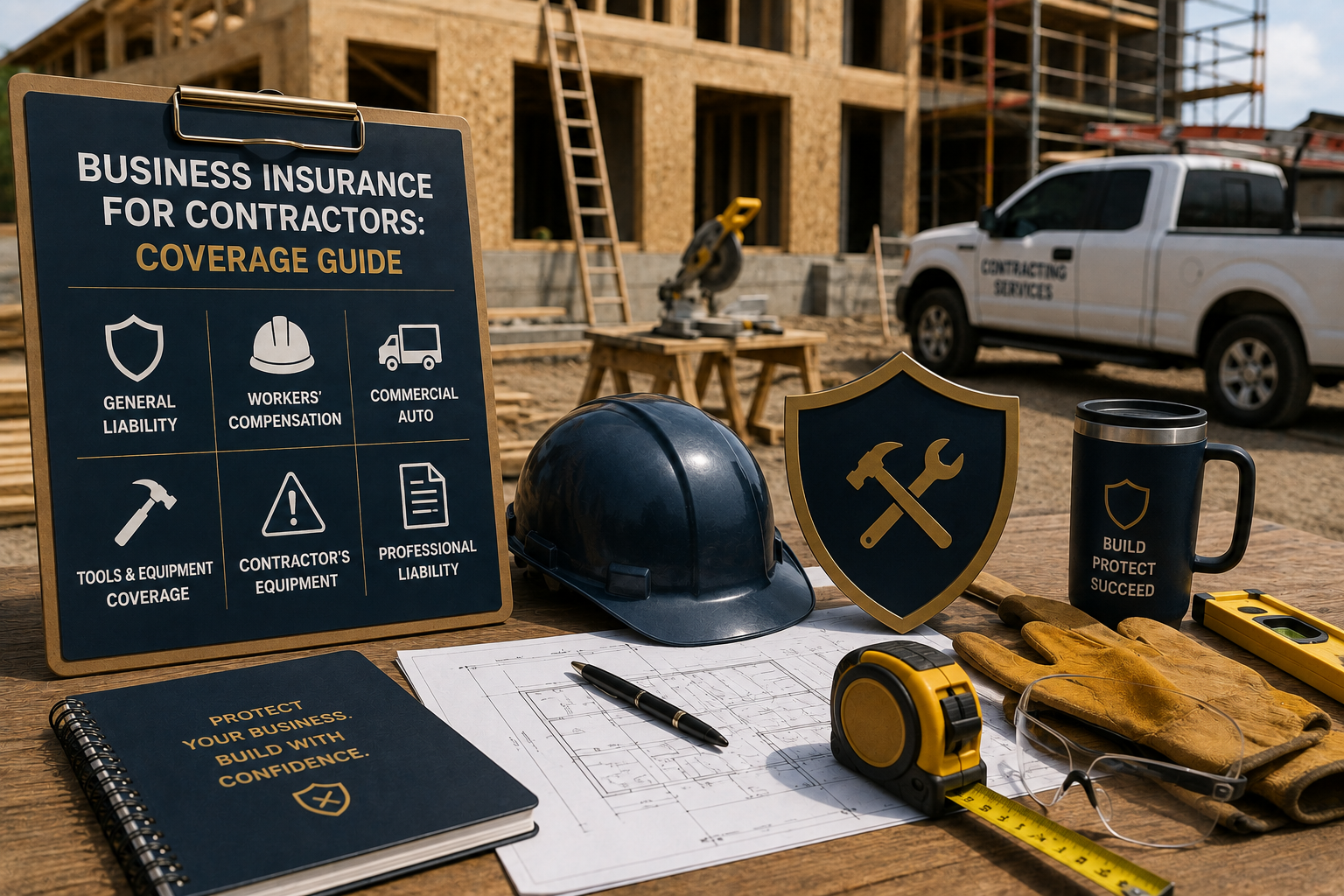
Contractors may need several types of business insurance to address jobsite injuries, damage to other people’s property, vehicle accidents, employee injuries, tools and equipment, professional mistakes, and other risks. The right combination depends on the contractor’s trade, employees, vehicles, property, projects, contracts, and state requirements. General liability is often a starting point, but it does not replace workers’ compensation, commercial auto, professional liability, or specialized property coverage.
Key Takeaways
- General liability is only one part of contractor insurance. It generally addresses covered third-party bodily injury, property damage, and certain personal and advertising injury claims.
- Employees, vehicles, and mobile equipment can require separate coverage. Workers’ compensation, commercial auto, and inland marine or contractor equipment coverage address different exposures.
- Requirements are not uniform nationwide. State law, licensing rules, project contracts, landlords, lenders, and clients may impose different insurance or bonding requirements.
- A Business Owners Policy may help some contractors, but it is not an all-in-one solution. A typical BOP combines property, general liability, and business income coverage while leaving important exposures separate.
- Policy details matter as much as the policy name. Limits, deductibles, exclusions, endorsements, covered locations, classifications, and who qualifies as an insured can materially affect a claim.
What Is Business Insurance for Contractors?
Business insurance for contractors is not usually one standardized policy. It is a collection of commercial insurance coverages selected to match the risks of a contracting business. A solo handyman using a personal pickup has a different risk profile from an electrical contractor with employees, service vans, expensive equipment, and multiple active jobsites.
Contractors can face both ordinary business risks and construction-specific exposures. A visitor might be injured near a work area, an employee could be hurt on the job, a company vehicle could cause an accident, tools could be stolen from a temporary location, or completed work could allegedly damage another part of a building. No single coverage should be assumed to address all of those events.
Contractor is a broad category. Insurance needs can differ substantially among general contractors, remodelers, electricians, plumbers, HVAC companies, roofers, painters, landscapers, carpenters, flooring installers, concrete contractors, and specialty trades.
Core Insurance Coverages Contractors Should Review
General Liability Insurance
Commercial general liability insurance generally helps address covered claims alleging that the contractor caused bodily injury or damage to someone else’s property. It may also cover certain personal and advertising injury claims and defense costs according to the policy terms.
For example, general liability may be relevant if a customer trips over materials left at a covered worksite or if covered contracting operations accidentally damage property belonging to the customer. Whether a specific incident is covered depends on the facts, policy language, exclusions, endorsements, limits, and other terms.
General liability should not be treated as insurance for every business problem. Employee injuries, auto accidents, professional errors, and damage to the contractor’s own tools generally involve other coverages.
Workers’ Compensation Insurance
Workers’ compensation generally provides benefits for employees who suffer qualifying work-related injuries or illnesses, subject to applicable law. Benefits can include medical care and wage-related or disability benefits under the relevant workers’ compensation system.
Requirements vary substantially by state. The U.S. Department of Labor directs private-sector employers to the workers’ compensation agency for the state in which the employee lives or works because state programs generally administer these requirements. Contractor-specific rules, employee thresholds, owner exemptions, and treatment of subcontractors can differ by jurisdiction.
Do not assume calling a worker an independent contractor settles the insurance question. Worker classification and workers’ compensation obligations depend on applicable law and the actual working relationship. Contractors should verify requirements with the appropriate state agency and qualified advisers.
Commercial Auto Insurance
Commercial auto insurance addresses vehicles used in business operations. Depending on the policy, selected coverages may include liability, collision, comprehensive or other-than-collision coverage, medical-related coverage, and uninsured or underinsured motorist protection where available or applicable.
Contractors should review commercial auto coverage when a business owns or leases trucks, vans, or other road vehicles. A personal auto policy should not automatically be assumed to cover regular contracting operations. Policy treatment of business use, company-owned vehicles, hired vehicles, and employees using personal vehicles can differ.
Tools, Equipment, and Inland Marine Coverage
Contractors frequently move tools, machinery, materials, and equipment between their shop, vehicles, temporary storage locations, and jobsites. Commercial property coverage tied primarily to a fixed premises may not provide the protection needed for property that regularly moves from place to place.
Inland marine coverage, including contractor equipment or installation-related forms, may be used for certain mobile equipment, property in transit, materials awaiting installation, or similar exposures. Covered property, theft restrictions, valuation provisions, limits, sublimits, and covered causes of loss should be reviewed carefully.
Commercial Property Insurance
Commercial property insurance generally protects covered business property against covered causes of loss. Depending on the policy and insured property, this may include a building, office contents, shop equipment, furniture, inventory, and other business personal property.
Contractors should verify where property is covered. Equipment stored at a permanent shop, carried in a truck, and left temporarily at a jobsite may not receive identical treatment under the same policy.
Business Income Insurance
Business income or business interruption insurance can help replace covered income losses and pay certain continuing expenses when operations are suspended because of an applicable covered event. It does not simply insure every decline in revenue.
Coverage commonly depends on a qualifying trigger, often involving covered physical property damage. Waiting periods, restoration periods, limits, exclusions, and the location where damage occurs can affect whether and how coverage applies.
Professional Liability Insurance
Professional liability, sometimes called errors and omissions insurance, addresses certain claims arising from professional services, mistakes, negligence, or failure to meet applicable professional standards, depending on the policy.
It can be particularly relevant when a contractor performs design, consulting, engineering-related, project management, inspection, or other professional services. General liability and professional liability are different coverages and should not be treated as interchangeable.
Builders Risk and Installation Coverage
Builders risk insurance generally addresses covered property involved in a building project while construction is underway. Depending on the form and project arrangement, interests of an owner, contractor, or other parties may be insured. Installation coverage may address materials or equipment while awaiting installation, during transit, or during installation under applicable policy terms.
Responsibility for obtaining builders risk coverage can be allocated by the construction contract. Contractors should not assume that the property owner or general contractor has purchased sufficient coverage for their interests.
Umbrella or Excess Liability Insurance
Commercial umbrella or excess liability insurance may provide additional limits above specified underlying liability policies. Contractors with larger projects, significant vehicle exposure, contractual limit requirements, or substantial liability risk may want to review whether additional limits are appropriate.
An umbrella or excess policy should be reviewed alongside the underlying policies because covered claims, exclusions, attachment points, required underlying limits, and other provisions can differ.
Contractor Insurance Coverage Comparison
| Coverage | Typical Purpose | Important Limitation |
|---|---|---|
| General liability | Covered third-party injury and property damage claims | Does not replace workers’ compensation, auto, or professional liability coverage |
| Workers’ compensation | Qualifying employee work injuries and illnesses | Requirements and eligibility vary by state |
| Commercial auto | Covered business vehicle accidents and selected physical damage risks | Personal auto coverage should not be assumed to cover business operations |
| Inland marine or equipment | Certain mobile tools, equipment, property in transit, or installation exposures | Covered property, theft conditions, territory, and valuation vary by form |
| Professional liability | Certain claims involving professional errors or services | Not a substitute for general liability |
| Builders risk | Covered property during construction | Who purchases it and whose interests are covered depend on the contract and policy |
Can Contractors Use a Business Owners Policy?
A Business Owners Policy, commonly called a BOP, typically combines commercial property, general liability, and business income or business interruption coverage in one package. Some small contracting businesses may qualify for a BOP, depending on the insurer’s underwriting rules and the nature of the operations.
A BOP should not be confused with complete contractor coverage. It generally does not automatically replace workers’ compensation, commercial auto, professional liability, cyber insurance, flood insurance, or other specialized policies. Contractors may also need endorsements or separate policies for mobile equipment, installation exposures, or project-specific requirements.
What Contractor Insurance May Not Cover Automatically
Contractors should pay close attention to exclusions and gaps. Buying a policy labeled for contractors does not mean every construction-related loss is covered.
- Employee injuries: General liability generally does not substitute for workers’ compensation.
- Business vehicle accidents: General liability generally excludes automobile liability that should be addressed under appropriate auto coverage.
- Professional mistakes: Design, consulting, or other professional errors may require professional liability coverage.
- Flood: Standard commercial property coverage should not automatically be assumed to cover flooding.
- Faulty workmanship: Coverage for claims involving defective work can be complicated. A liability policy should not be assumed to pay simply to redo or improve the contractor’s own work.
- Pollution exposures: Pollution-related claims may be restricted or excluded under standard liability forms and may require specialized coverage.
- Cyber and data risks: Payment fraud, ransomware, data breaches, and other technology risks may require separate cyber coverage, whose terms can vary widely.
Insurance Requirements for Contractors
There is no single nationwide insurance package that every contractor must buy. Requirements can come from several different places, and they should be evaluated separately.
State Law
Workers’ compensation requirements vary by state, and vehicle insurance requirements also depend on applicable state law. Contractors should check the rules where they employ workers, register vehicles, and perform operations rather than relying on requirements from another jurisdiction.
Licensing Rules
A state or local licensing authority may impose insurance or bonding requirements on certain contractor classifications. Requirements can differ by trade and jurisdiction, so contractors should verify them with the relevant licensing authority.
Customer and General Contractor Contracts
A project contract may require specified types of insurance, minimum limits, additional insured status, evidence of coverage, or other risk-transfer provisions. Meeting a licensing requirement does not necessarily mean a contractor also satisfies a particular customer’s contract.
A certificate of insurance generally provides evidence of coverage but does not, by itself, replace or amend the policy. If a contract requires an additional insured endorsement or other policy change, contractors should confirm that the necessary endorsement has actually been issued.
Insurance vs. Surety Bonds for Contractors
A surety bond should not be treated as the same thing as liability insurance. A bond is generally a guarantee involving the contractor, the party requiring the bond, and the surety. Many public and private contracts may require bonds.
The U.S. Small Business Administration identifies several types of contract surety bonds, including bid, payment, performance, and ancillary bonds. A bid bond supports obligations related to a contractor’s bid, a payment bond addresses payment to suppliers and subcontractors, and a performance bond addresses completion of the contract according to its terms.
Insurance and bonding can both be required. Carrying a general liability policy does not automatically satisfy a performance bond requirement, and obtaining a surety bond does not replace liability, property, auto, or workers’ compensation insurance.
What Affects the Cost of Contractor Insurance?
There is no reliable single premium that applies to every contractor. Insurers evaluate the characteristics of the business and the coverage being purchased. Relevant factors may include:
- The contractor’s trade and exact operations.
- Annual payroll, receipts, or other exposure measures used for underwriting.
- Number and type of employees.
- Use of subcontractors.
- Project size, location, and type of work performed.
- Vehicles, drivers, and driving history.
- Value and type of tools, machinery, and other property.
- Claims history.
- Requested policy limits and deductibles.
- Additional endorsements, project requirements, and specialized exposures.
Two contractors with similar revenue can receive substantially different quotes if their trades, employees, vehicle use, subcontractor practices, claims histories, limits, and project types are different. Comparing only the premium can therefore produce a misleading comparison.
How to Compare Contractor Insurance Quotes
1. Describe Your Operations Accurately
Tell the insurer or licensed agent what work the business actually performs. A contractor that expands from painting into roofing, excavation, electrical work, design services, or another activity should not assume the existing policy automatically treats the new exposure the same way.
2. Compare Coverage, Not Just Premium
Review the policy limits, deductibles, covered operations, exclusions, endorsements, property valuation provisions, and coverage territory. A lower-priced quote may provide materially different protection.
3. Match Coverage to Contracts
Review upcoming contracts before binding coverage. Look for required policy types, limits, additional insured provisions, auto requirements, workers’ compensation requirements, or bonding obligations. Insurance professionals and legal counsel can help interpret contractual requirements when necessary.
4. Review Subcontractor Procedures
A contractor that regularly hires subcontractors should discuss that practice with the insurer. Underwriting, audits, contractual risk transfer, certificates of insurance, and additional insured requirements can all be affected by subcontractor use.
5. Check Tools and Property Away From the Shop
Identify where expensive property is stored overnight and how it moves between jobs. Ask specifically how the policy treats theft from vehicles, temporary jobsites, property in transit, rented equipment, newly acquired equipment, and materials awaiting installation.
6. Revisit Coverage as the Business Changes
Hiring employees, buying vehicles, acquiring equipment, moving into a shop, entering a new trade, working in a new state, or taking on larger contracts can change the business’s insurance needs. Waiting until renewal may create an avoidable coverage problem.
Contractor Insurance Review Checklist
Before purchasing or renewing coverage, a contractor may want to review the following items with a licensed insurance professional:
- Every trade and service the company performs.
- States and locations where the company performs work.
- Employee count and applicable workers’ compensation requirements.
- Company-owned, hired, rented, and employee-owned vehicles used for business.
- Tools, machinery, equipment, materials, and property in transit.
- Use of subcontractors and insurance requirements imposed on them.
- Customer contracts and additional insured requirements.
- Design, consulting, or professional services that could create errors-and-omissions exposure.
- Project-specific builders risk or installation coverage.
- Current limits, deductibles, exclusions, endorsements, and policy renewal dates.
Frequently Asked Questions
The Bottom Line
Business insurance for contractors usually consists of several coordinated coverages rather than one universal policy. General liability may address core third-party liability exposures, while workers’ compensation, commercial auto, tools and equipment coverage, professional liability, builders risk, and other policies address different risks.
The biggest mistake is assuming that a policy name or certificate means every jobsite exposure is covered. Coverage can depend on classifications, insured operations, exclusions, endorsements, limits, deductibles, locations, subcontractor arrangements, and the exact facts of a claim.
Before buying or renewing coverage, contractors should compare policy terms against their actual operations, state requirements, vehicles, employees, equipment, subcontractor practices, and customer contracts. A licensed commercial insurance professional can help identify gaps, but the policy itself controls coverage.
Sources
- National Association of Insurance Commissioners, Small Business Insurance, accessed August 2026.
- National Association of Insurance Commissioners, Business Interruption and Business Owner Policy, last updated June 25, 2026.
- National Association of Insurance Commissioners, Glossary of Insurance Terms, accessed August 2026.
- U.S. Small Business Administration, Launch Your Business — Get Business Insurance, accessed August 2026.
- U.S. Small Business Administration, Surety Bonds, accessed August 2026.
- U.S. Department of Labor, State Workers’ Compensation Officials, accessed August 2026.