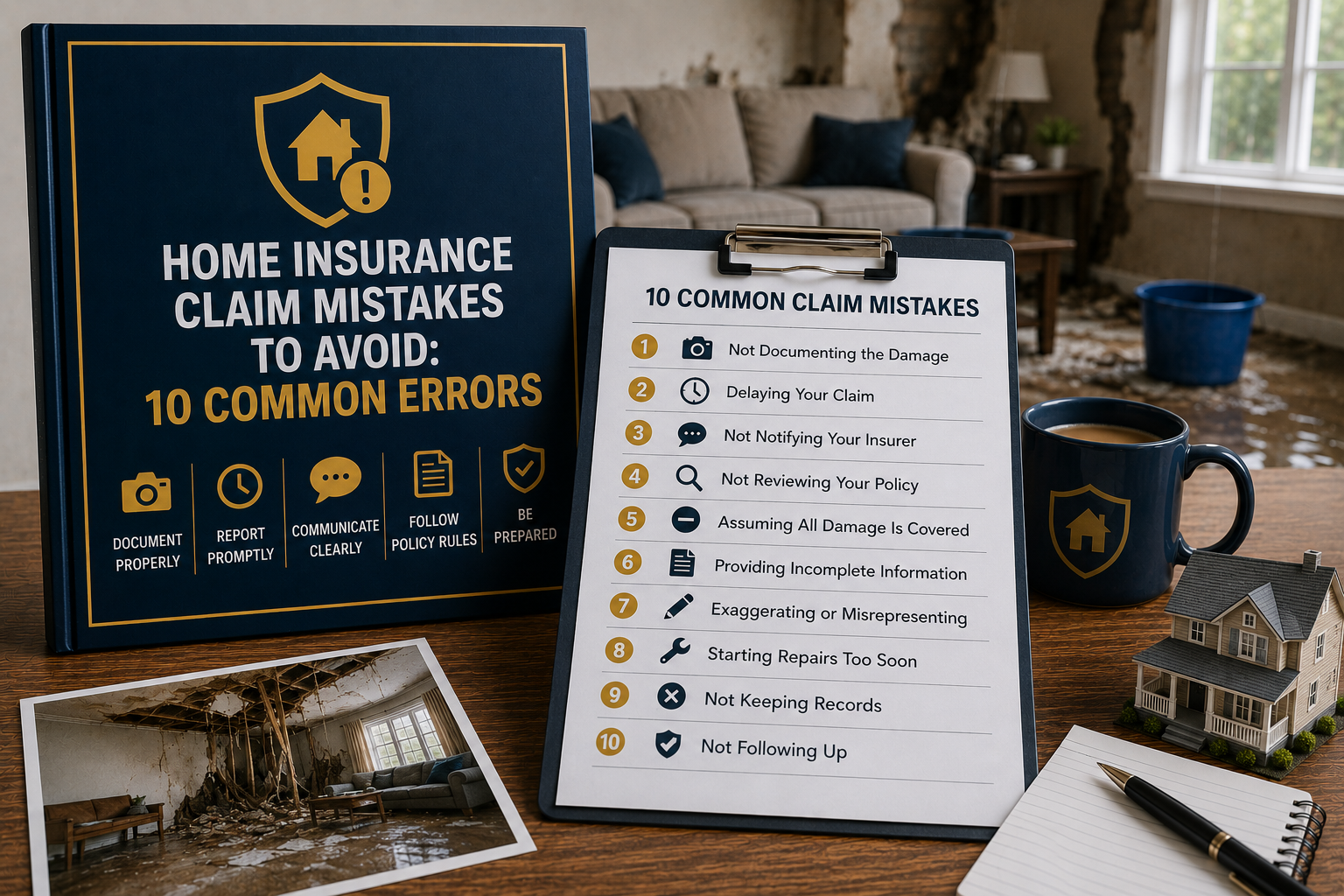
Common home insurance claim mistakes include waiting too long to notify the insurer, failing to photograph damage, throwing away damaged property before inspection, making permanent repairs too soon, losing receipts, and assuming every type of damage is covered. Homeowners should protect the property from further loss, document conditions carefully, keep records, understand deductibles and settlement terms, and follow the insurer’s instructions. Exact duties, deadlines, and coverage vary by policy and state.
Key Takeaways
- Report a loss promptly. Claim-reporting deadlines and duties vary, so contact your insurer or agent as soon as reasonably possible after discovering significant damage.
- Document before cleaning up. Photos, videos, damaged-property lists, receipts, and other records can help establish what was damaged and what it may cost to repair or replace.
- Prevent additional damage without rushing into permanent repairs. Reasonable temporary measures may be necessary, but insurers generally should have an opportunity to inspect significant damage.
- Know what the policy actually covers. Deductibles, exclusions, limits, replacement-cost provisions, actual cash value, and special deductibles can materially change a claim payment.
- Review the settlement instead of assuming the first estimate is automatically final. Ask questions about omitted damage, depreciation, estimates, and procedures for supplemental damage when appropriate.
Why Home Insurance Claim Mistakes Matter
A homeowners insurance claim often begins when the homeowner is already dealing with a stressful event such as a fire, storm, burst pipe, theft, or other property loss. It is easy to focus entirely on cleanup and repairs while overlooking the documentation and policy requirements that affect the insurance claim.
The homeowner’s responsibilities are not identical under every policy. Notice requirements, proof-of-loss provisions, deductibles, covered causes of loss, repair procedures, valuation methods, and claim deadlines can differ by insurer and state. Major disasters can also trigger special state rules or extensions that do not apply to ordinary claims.
Still, insurance regulators consistently recommend several practical habits: report damage promptly, document the loss, prevent additional damage, save receipts, preserve damaged property when practical, cooperate with the adjuster, and carefully review the claim settlement.
| Common Mistake | Why It Can Cause Problems | Better Approach |
|---|---|---|
| Waiting to report damage | Policies and state rules may impose notice or claim-filing requirements | Notify the insurer promptly and ask what documentation is required |
| Cleaning up before documenting | Evidence of the extent and cause of damage may be lost | Photograph and video conditions when safe before major cleanup |
| Making permanent repairs immediately | The insurer may lose an opportunity to inspect the original damage | Make reasonable temporary repairs and coordinate permanent work with the insurer |
| Discarding damaged belongings | The adjuster may need to inspect or document them | Keep damaged property when safe and practical unless instructed otherwise |
| Losing receipts and expense records | It may become harder to substantiate repair, replacement, or additional living expenses | Create one claim file for receipts, estimates, correspondence, and photos |
Mistake 1: Waiting Too Long to Notify the Insurance Company
One of the simplest mistakes is postponing contact with the insurer while trying to determine the full cost of the damage yourself. The NAIC advises homeowners who decide to make a claim to notify the insurance company right away, while noting that the amount of time available to report a claim can vary by state.
Prompt notice gives the insurer an opportunity to explain the claims process, assign an adjuster, request documents, and inspect the property. It can also help clarify what temporary repairs should be made before an inspection.
Do not assume that every policy has the same filing deadline. Some states or policies have specific time requirements, and disaster-related rules can differ. If significant damage has occurred, check the policy and contact the insurer or licensed agent promptly.
Useful first contact information: Have the policyholder’s name, policy number if available, property address, contact information, approximate date of loss, and a basic description of what happened. Ask what the insurer needs next rather than assuming a particular form or procedure applies.
Mistake 2: Failing to Photograph and Document the Damage
Documentation helps show what the property looked like after the loss and before substantial cleanup or repair. The NAIC and state insurance regulators recommend taking photographs or videos and preparing a list of damaged property.
For structural damage, photograph both close-up details and wider views that show where the damage occurred. For personal belongings, document individual items when possible. Model numbers, brands, purchase records, prior photographs, appraisals, and receipts may help establish what you owned and its value.
- Photograph exterior and interior damage from multiple angles when it is safe to do so.
- Create a written list of damaged or destroyed belongings.
- Include model numbers, brands, ages, and purchase information when available.
- Save contractor estimates, inspection reports, invoices, and repair records.
- Back up important claim photographs and documents somewhere other than the damaged property.
If belongings were completely destroyed and no inventory exists, the California Department of Insurance suggests using memory, previous photographs, purchase records, and similar information to reconstruct a list. Lack of a pre-loss inventory does not mean you should give up on documenting the claim.
Mistake 3: Throwing Away Damaged Property Too Soon
Damaged furniture, electronics, roofing materials, flooring, appliances, and other property can feel like debris after a loss. However, disposing of everything immediately can make the claim more difficult because the adjuster may need to inspect damaged items.
Texas and California insurance regulators advise consumers not to discard damaged property before the insurer has had an opportunity to inspect it or has given permission to dispose of it.
Safety comes first. Food, contaminated materials, hazardous debris, or items that create an immediate health or safety problem may need to be removed. In that situation, photograph and document the items as thoroughly as reasonably possible and contact the insurer for instructions.
Safety exception: Do not keep damaged property merely for insurance purposes if doing so creates an unsafe condition. Document what you can and ask the insurer how to preserve evidence when hazardous materials must be removed quickly.
Mistake 4: Making Permanent Repairs Before the Damage Is Inspected
After a storm or other loss, homeowners naturally want the house returned to normal immediately. The problem is that major permanent repairs can alter or remove evidence before the adjuster sees the damage.
State insurance regulators commonly advise homeowners to make necessary temporary repairs to protect the property but avoid extensive permanent work until the insurer has inspected the loss or given appropriate instructions.
For example, temporarily covering a roof opening after a storm is different from immediately replacing the entire roof. Boarding a broken window is different from completing all window replacement before the adjuster has documented the damage.
If emergency conditions require more substantial work, document the original damage and repairs carefully and communicate with the insurer. The exact claim duties are determined by the policy and applicable law.
Mistake 5: Failing to Prevent Additional Damage
Waiting for an adjuster does not generally mean leaving the property exposed to additional damage. Homeowners policies commonly impose duties after a loss, and regulators advise taking reasonable temporary measures to protect damaged property.
Reasonable measures might include covering a damaged roof, securing a broken door, boarding a broken window, or taking appropriate steps to address continuing water intrusion when it is safe to do so.
The California Department of Insurance warns that homeowners policies may not cover ensuing damage when reasonable steps were not taken to protect the property from subsequent damage. Exact policy language controls, so homeowners should notify the insurer and ask what immediate mitigation is expected.
Keep the balance in mind: Protect the home from additional loss, but do not unnecessarily erase evidence of the original damage. Photograph first when practical, make reasonable temporary repairs, save receipts, and coordinate significant permanent repairs with the insurer.
Mistake 6: Losing Receipts for Repairs and Living Expenses
Receipts can become important in several parts of a homeowners claim. Regulators advise keeping receipts for materials purchased for temporary repairs and for other covered claim-related expenses.
If a covered loss makes the home uninhabitable, loss-of-use or additional living expense coverage may reimburse certain increases in necessary living expenses, subject to the policy’s limits and terms. This is not generally a blank check for all spending while you are displaced.
Keep bills and receipts for potentially relevant expenses such as temporary housing, eligible additional food costs, storage, relocation, or additional transportation. Ask the insurer which expenses qualify and what documentation it requires.
Receipts can also matter under replacement-cost coverage for personal property because some policies initially pay an amount reflecting depreciation and provide additional reimbursement after the property is actually replaced, subject to policy conditions and deadlines.
Mistake 7: Assuming Every Type of Water Damage Is Covered
One of the most important homeowners insurance distinctions involves water. Different causes of water damage can receive very different treatment under an insurance policy.
For example, certain sudden and accidental water damage from plumbing may be covered under a homeowners policy, subject to exclusions and the facts of the loss. Flooding from surface water, overflowing rivers, storm surge, or similar external flooding generally requires separate flood insurance rather than a standard homeowners policy.
The National Flood Insurance Program states that most homeowners insurance does not cover flood damage. Other water-related losses, including sewer or drain backup, may also depend on the policy and any applicable endorsement.
Do not describe the claim simply as “water damage” and assume the source is irrelevant. The cause and path of the water can be central to determining whether the policy applies. Preserve evidence and accurately explain what happened.
Mistake 8: Ignoring the Deductible and Claim Settlement Method
Knowing that a loss is covered is only part of understanding what the insurer may pay. Deductibles, limits, depreciation, replacement-cost provisions, actual cash value, and special settlement terms can all affect the payment.
The NAIC recommends checking the deductible when deciding how to handle property damage. Depending on the policy, a homeowner may have different deductibles for different types of losses. Some policies in certain markets may use percentage-based deductibles for specified wind, hurricane, or other catastrophe-related losses.
Replacement Cost vs. Actual Cash Value
Replacement-cost and actual-cash-value settlement methods can produce different claim payments. Actual cash value generally reflects depreciation, while replacement-cost coverage may provide reimbursement based on the cost to repair or replace covered property without the same depreciation deduction, subject to policy limits and conditions.
A policy may require actual repair or replacement before all available replacement-cost benefits are paid. Review the adjuster’s estimate and ask how depreciation was calculated, whether any depreciation is recoverable, and what deadlines or documentation apply.
Mistake 9: Accepting or Rejecting a Settlement Without Reviewing the Details
An adjuster’s estimate should be reviewed rather than treated as a number that requires no explanation. The Texas Department of Insurance advises homeowners to ask how the adjuster calculated repair or replacement costs and to discuss differences when contractor estimates are higher than the insurance company’s settlement offer.
Compare the estimate with the damage you documented. Check quantities, materials, rooms, damaged belongings, depreciation, deductibles, and other claim components. If you believe something was missed, provide supporting information and ask the adjuster to explain the insurer’s position.
Additional damage can sometimes be discovered during repairs. The procedure for requesting supplemental payment depends on the insurer, policy, and state. Notify the insurer promptly rather than assuming previously hidden damage is automatically included in the original estimate.
Disagreement does not automatically mean the claim was handled incorrectly. Differences can result from measurements, scope of work, pricing, coverage interpretation, depreciation, or newly discovered damage. Ask for a written explanation and use the policy’s available dispute procedures when appropriate.
Mistake 10: Rushing Into a Contractor Agreement
Large storms and disasters can bring contractors and repair companies into affected neighborhoods quickly. Some are established local businesses; others may pressure homeowners to sign agreements before the scope of the damage or insurance coverage is clear.
The NAIC advises consumers not to feel rushed into contractor decisions. Before signing, understand the work being authorized, the price, payment schedule, cancellation terms, and whether the document assigns or transfers any rights. Contractor licensing and insurance requirements vary by state and trade.
- Get a written description of the work and materials.
- Understand the total price and payment schedule before signing.
- Verify licensing or registration when required by state or local law.
- Avoid assuming a contractor can guarantee what an insurer will pay.
- Ask questions about any provision that transfers insurance benefits, claim rights, or control over communications.
Other Claim Mistakes Worth Avoiding
Failing to Keep a Claim Communication Log
Keep track of the claim number, adjuster’s contact information, important conversations, inspection dates, documents submitted, estimates received, and payments issued. Saving emails and letters can help everyone understand what has already been requested or discussed.
Forgetting Small Personal Property Items
After a major loss, people naturally remember furniture and electronics first. Smaller household items can also contribute substantially to a contents claim. Insurance regulators recommend making a detailed room-by-room inventory that includes clothing, kitchen items, tools, sports equipment, decorations, linens, and other belongings.
Not Asking About Additional Living Expenses
If a covered loss makes the residence uninhabitable, ask whether the policy’s loss-of-use coverage applies. Coverage generally addresses qualifying increases in living expenses rather than every ordinary household expense. Limits, time restrictions, covered causes of loss, and documentation requirements apply.
Assuming the Mortgage Company Has Nothing to Do With the Claim
When a home has a mortgage, a structural claim payment may include the mortgage lender as a payee because the lender has a financial interest in the property. Procedures for releasing repair funds vary. If the insurer issues a joint check, contact the mortgage servicer promptly to learn its process rather than assuming the insurer made a mistake.
A Practical Home Insurance Claim Checklist
The appropriate actions depend on the type and severity of the loss, but this checklist can help organize the early stages of a typical property claim:
- Prioritize safety. Do not enter a dangerous structure or attempt repairs that put you at risk.
- Document the loss. Take photographs and videos before significant cleanup when practical.
- Contact the insurer. Report significant covered damage promptly and ask about next steps.
- Prevent additional damage. Make reasonable temporary repairs when necessary and safe.
- Save damaged property. Preserve items for inspection when safe and practical.
- Keep receipts. Save documentation for temporary repairs, replacements, and potentially covered additional living expenses.
- Create a contents inventory. List damaged belongings with identifying and purchase information when available.
- Review the policy. Check deductibles, applicable limits, exclusions, endorsements, and settlement provisions.
- Attend the inspection when practical. Point out all known damaged areas and provide supporting records.
- Review the settlement carefully. Ask questions about anything you do not understand and promptly report additional damage discovered later.
Frequently Asked Questions
The Bottom Line
A successful home insurance claim is not simply a matter of reporting damage and waiting for a check. Homeowners generally need to document the loss, protect the property from additional damage, preserve relevant evidence, keep receipts, cooperate with the claim investigation, and understand how the policy calculates payment.
The biggest risk is assuming that all policies, losses, and claim procedures work the same way. Coverage depends on the cause of damage, policy form, deductible, limits, exclusions, endorsements, valuation method, state law, and exact facts of the claim. Flood damage is a particularly important example because most standard homeowners policies do not cover it.
Before making major repairs or accepting a settlement you do not understand, review your policy and the insurer’s estimate, keep a complete claim file, and ask for clarification about disputed or missing items. Prompt, accurate documentation can make the process easier to evaluate and reduce avoidable claim problems.
Sources
- National Association of Insurance Commissioners, What You Need to Know When Filing a Homeowners Claim, April 20, 2022.
- California Department of Insurance, Residential Property Claims Guide, revised February 28, 2025.
- Texas Department of Insurance, Home Insurance Guide, accessed August 2026.
- Texas Department of Insurance, Tips for Filing a Claim With Your Insurance Company, accessed August 2026.
- National Flood Insurance Program, Flood Insurance Eligibility and Homeowners Coverage Guidance, accessed August 2026.