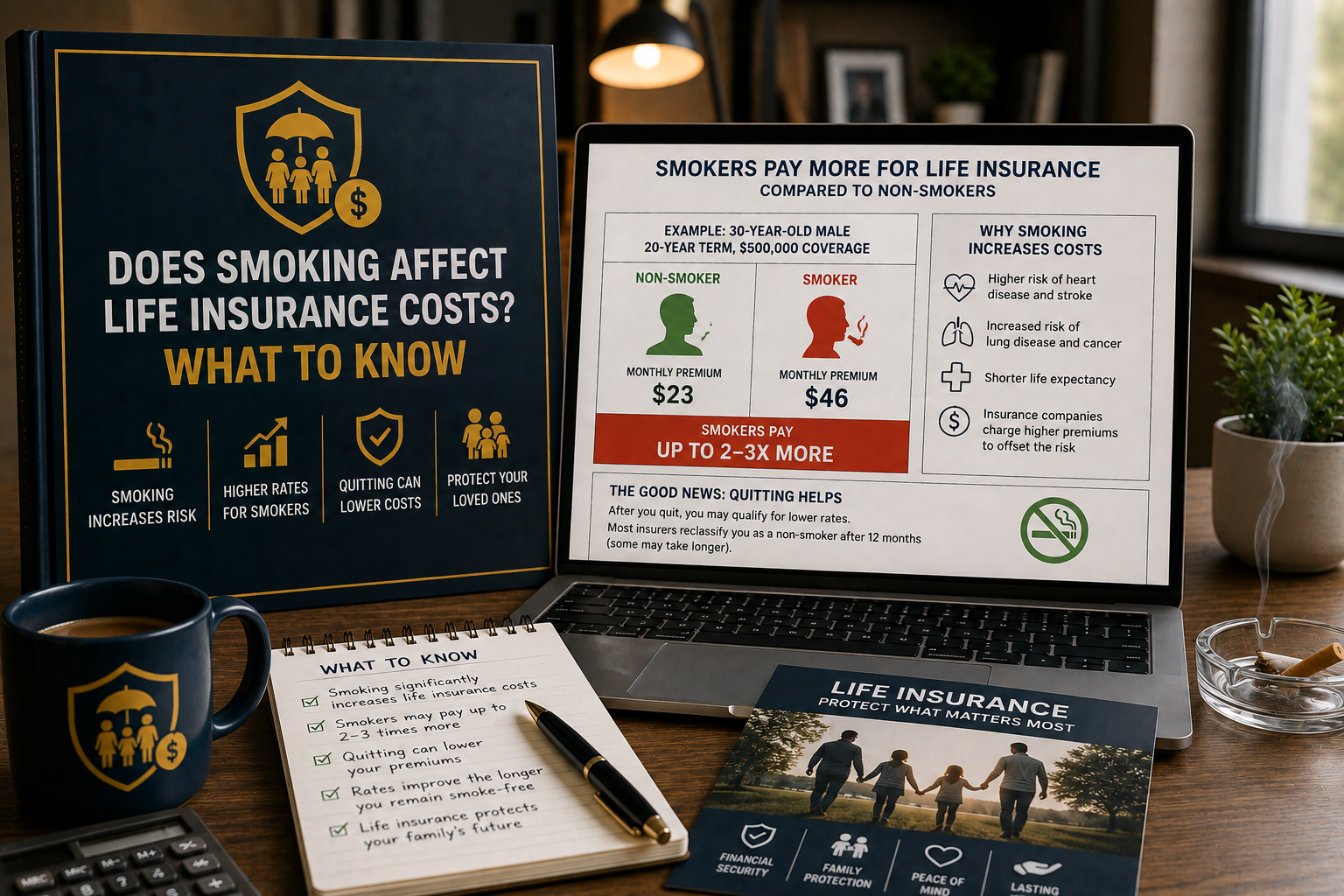
Yes. Smoking can increase the cost of individually underwritten life insurance because insurers commonly consider smoking and other health habits when evaluating an applicant’s risk and setting premiums. The size of the difference is not universal: it depends on the insurer, policy, age, health, amount of coverage, underwriting method, and how that company defines tobacco or nicotine use. Quitting may eventually improve your classification, but each insurer sets its own eligibility rules.
Key Takeaways
- Smoking can increase life insurance premiums. State insurance regulators identify smoking as a health or lifestyle factor insurers may consider during individual life insurance underwriting.
- There is no single nationwide smoker surcharge. Insurers use their own underwriting guidelines and risk classes, so the price difference can vary substantially.
- “Smoker” and “tobacco user” do not always mean exactly the same thing across companies. Cigarettes, cigars, vaping, smokeless tobacco, and other nicotine use may be treated differently depending on the insurer.
- Quitting can potentially improve future rates. However, insurers set their own rules for how long an applicant must be tobacco- or nicotine-free before qualifying for a different underwriting class.
- Answer application questions accurately. Do not describe yourself as a nonsmoker merely to obtain a lower quote if your actual use falls within the insurer’s questions or definition.
Why Smoking Can Increase Life Insurance Costs
Life insurance underwriting is the process an insurer uses to evaluate an applicant and determine the basis on which it is willing to provide coverage. The New York State Department of Financial Services identifies health and health habits, including smoking, among the common factors insurers may use when determining what to charge for individually underwritten life insurance.
Washington’s Office of the Insurance Commissioner similarly advises consumers that health history and life choices such as smoking play a key role in determining life insurance costs. In risk-based pricing, applicants associated with greater expected mortality risk generally do not receive the same pricing as otherwise similar applicants assigned to more favorable risk classes.
That does not mean every smoker pays a fixed percentage more. Life insurers can differ in how they classify tobacco use, which risk classes they offer, what medical evidence they request, and how they price applicants with otherwise favorable health profiles.
Practical point: Two smokers of the same age seeking the same death benefit can receive different offers from different insurers. Comparing equivalent policies can therefore be particularly important when tobacco or nicotine use is part of the underwriting decision.
How Life Insurance Companies Classify Smokers
Life insurance applicants are commonly placed into underwriting or risk classes. The names differ among insurers. A company may distinguish between nonsmoker and tobacco-user classes and may offer more than one level within broader preferred or standard classifications.
Smoking status is only one component of the decision. Other factors can include age, medical history, current health, family health history, occupation, hazardous hobbies, the amount and type of insurance requested, and other information permitted under applicable law.
| Underwriting Factor | Why It May Matter | Important Limitation |
|---|---|---|
| Smoking or tobacco use | May affect the risk class and premium offered | Definitions and pricing vary by insurer |
| Age | Life insurance generally becomes more expensive as age increases | Age interacts with other underwriting factors |
| Health history | Can influence risk classification and insurability | Insurers do not necessarily evaluate every condition identically |
| Occupation and hobbies | Hazardous activities can affect underwriting | Treatment depends on the activity and insurer |
| Policy type and amount | More coverage or different policy structures can change premiums | Compare equivalent benefits when comparing quotes |
How Much More Does Life Insurance Cost for Smokers?
There is no single reliable nationwide percentage or dollar amount that applies to all smokers. Quoting one universal smoker surcharge would be misleading because life insurance premiums depend on the applicant, insurer, underwriting class, product, death benefit, policy duration, and other factors.
The more useful approach is to compare quotes based on your actual tobacco status. An insurer that is competitive for a nonsmoker is not necessarily the company that will make the most favorable offer to someone who smokes cigarettes or uses another nicotine or tobacco product.
If you receive quotes through an agent or online marketplace, make sure each quote uses the same age, death benefit, policy term, tobacco status, and general health information. Otherwise, the premiums may not be comparable.
Avoid quote shortcuts: Selecting “nonsmoker” on an online quote merely to see a cheaper price does not mean you will qualify for that price after underwriting. The final offer may depend on the application, health information, underwriting records, and medical evidence requested by the insurer.
What Counts as Smoking for Life Insurance?
There is no universal life insurance definition under which every company classifies every nicotine or tobacco product identically. The wording of the application and the insurer’s underwriting guidelines matter.
An application may ask about cigarettes specifically or may ask more broadly about tobacco, nicotine, vaping, cigars, pipes, smokeless products, or other forms of use. Frequency can also matter. Someone who smokes cigarettes every day should not assume the application treats them the same as someone who occasionally uses a different product, but neither person should assume they qualify as a nonsmoker without checking the insurer’s definition.
| Type of Use | What to Do on an Application |
|---|---|
| Cigarettes | Answer the insurer’s questions about current and prior use accurately, including frequency when requested |
| Cigars or pipes | Do not assume occasional use automatically qualifies for nonsmoker pricing; insurer guidelines vary |
| Vaping or e-cigarettes | Disclose use when asked about vaping, nicotine, tobacco, or related products and ask how the company classifies it |
| Smokeless tobacco | Answer tobacco-use questions accurately; classification can differ from cigarette underwriting |
| Nicotine or cessation products | Read the wording carefully and disclose use if the application asks about nicotine or relevant medications or products |
If a question seems ambiguous, ask the insurer or licensed agent how it should be answered rather than guessing. The application itself and the insurer’s underwriting requirements determine what information is being requested.
Can Life Insurance Companies Test for Smoking?
Life insurance underwriting can involve medical information from several sources. The NAIC explains that traditional life insurance underwriting has historically included medical examinations and fluid testing such as blood, urine, or saliva. The exact tests requested vary by insurer, applicant, product, and underwriting method.
Some applicants may qualify for accelerated underwriting, in which the insurer does not require a traditional physical exam and instead evaluates application information along with permitted external data sources and analytical tools. Other policies use simplified underwriting with fewer medical requirements.
A no-exam application should not be interpreted as permission to omit smoking or nicotine use. Health and tobacco questions may still be part of the application even when no blood or urine sample is collected.
No medical exam does not mean no underwriting. Accelerated and simplified underwriting can still use health questions and other permitted information to determine eligibility and premium classification.
Why You Should Not Hide Smoking on a Life Insurance Application
Providing accurate application information matters. The NAIC advises consumers not to sign a life insurance application until they have reviewed it carefully and confirmed that the answers are complete and accurate. Washington’s insurance regulator likewise warns consumers to provide health information honestly and accurately.
If an insurer asks about smoking, tobacco, nicotine, or prior use, answer according to the wording of the question. Do not assume that the company cannot verify the information because an exam is not required.
Materially inaccurate information can create serious underwriting or policy issues. The consequences depend on state law, the policy, when the discrepancy is discovered, and the facts involved. A lower quote obtained through an inaccurate application is therefore not a legitimate savings strategy.
Can Quitting Smoking Lower Life Insurance Costs?
Quitting can potentially improve the underwriting class available to you, but there is no single nationwide period after which every former smoker automatically receives nonsmoker rates.
Each insurer can establish its own underwriting requirements for prior tobacco or nicotine use, subject to applicable insurance law. A company may ask when you last used a product, what you used, how frequently you used it, and whether any other medical factors affect your classification.
If you have recently quit, compare insurers rather than assuming every company will treat your history identically. Ask specifically when you could become eligible for the company’s nonsmoker or more favorable class.
What If You Already Have a Policy?
If you quit after purchasing coverage, ask the insurer whether it offers a process for reconsidering or re-underwriting tobacco status. Some insurers may permit a later change in classification under certain circumstances, while others may handle the situation differently. Do not assume an existing premium will automatically decrease simply because you have stopped smoking.
Before replacing an existing life insurance policy solely to obtain a new tobacco classification, compare the old and new policies carefully. Age, current health, surrender charges, new contestability provisions where applicable, policy guarantees, and other differences can affect whether replacement makes financial sense.
Does Smoking Affect Term and Permanent Life Insurance?
Smoking can affect underwriting for both term and permanent individual life insurance when the product uses health-based risk classification. The impact should not be confused with the underlying differences between the policy types.
Term Life Insurance
Term insurance provides a death benefit for a specified coverage period, subject to the policy terms. Because tobacco status can affect the underwriting class, two otherwise similar applicants can receive different term premiums based partly on smoking history.
Permanent Life Insurance
Permanent life insurance is designed to remain in force beyond a fixed term when applicable premium and policy requirements are satisfied. Depending on the product, it may include cash-value features. Tobacco-related underwriting can still affect the pricing or risk class used when the policy is issued.
Compare like with like. A smoker’s term quote and a smoker’s permanent-policy quote are not directly comparable because the products provide different structures and benefits. Compare competing insurers within the same policy category, death benefit, and general coverage design.
Does No-Exam Life Insurance Avoid Smoker Rates?
Not necessarily. Life insurance can be offered through different levels of underwriting, including full underwriting, simplified underwriting, accelerated underwriting, and guaranteed-issue approaches. The New York State Department of Financial Services notes that the underwriting method affects the premium rates charged.
A policy that does not require a traditional medical examination may still ask about tobacco and nicotine use. Simplified underwriting can reduce medical requirements without eliminating health questions. Accelerated underwriting can evaluate applicants through other permitted information sources instead of relying entirely on a physical examination.
Guaranteed-issue products operate differently because individual health underwriting may be limited or absent, depending on the product. Their pricing, benefits, eligibility, and policy provisions should be compared separately rather than assuming they are automatically a cheaper alternative for a smoker.
How Smokers Can Shop for Life Insurance
1. Compare Several Insurers
Insurers use different underwriting guidelines, so one company’s smoker classification may be more favorable for your circumstances than another’s. Obtain quotes for comparable policy types and benefits.
2. Describe Tobacco and Nicotine Use Accurately
Be prepared to explain the product used, frequency, and when you last used it if the application asks. Accurate information helps prevent quotes based on a risk class for which you do not qualify.
3. Ask How Former Smokers Are Classified
If you have quit, tell the agent or insurer the correct last-use date and ask when the company’s underwriting rules might make you eligible for a different class.
4. Compare the Final Offer, Not Just the Initial Quote
An online estimate may assume a particular risk class. The policy actually offered after underwriting may differ. Review the final premium, death benefit, duration, guarantees, riders, exclusions, and other policy features before accepting coverage.
5. Buy the Amount and Type of Coverage You Actually Need
A high smoker premium can tempt applicants to focus only on the cheapest possible policy. First determine the financial need the insurance is intended to address, then compare realistic coverage options you can afford to maintain.
Frequently Asked Questions
The Bottom Line
Smoking can affect life insurance costs because tobacco use is one of the health and lifestyle factors insurers may consider when underwriting individually issued coverage. A smoker can still qualify for life insurance, but the premium and risk class may differ from those offered to an otherwise similar nonsmoker.
The biggest limitation is that there is no universal smoker definition, surcharge, or post-quitting waiting period that applies to every company. Cigarettes, vaping, cigars, smokeless tobacco, and other nicotine use can be treated differently by different insurers and products.
Compare several insurers using accurate information, review the final underwriting offer rather than only an initial quote, and ask exactly how the company classifies your current or past tobacco use. If you quit after purchasing coverage, ask whether the insurer offers a process for reconsidering your tobacco classification before replacing an existing policy.
Sources
- National Association of Insurance Commissioners, Life Insurance, accessed August 2026.
- National Association of Insurance Commissioners, Accelerated Underwriting, updated April 7, 2026.
- New York State Department of Financial Services, Consumer Life Insurance FAQ, accessed August 2026.
- Washington State Office of the Insurance Commissioner, Learn How Life Insurance Works, accessed August 2026.