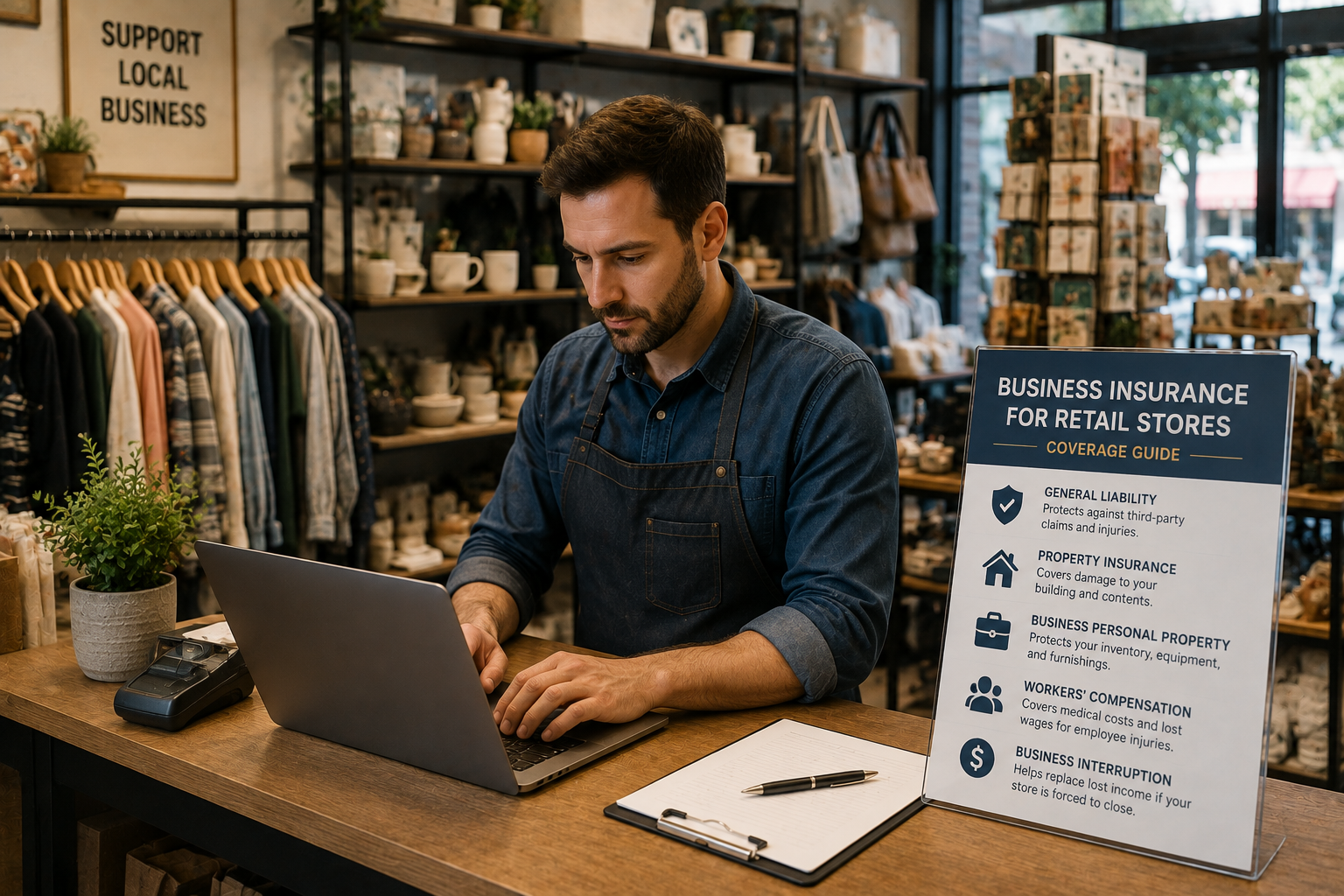
Retail businesses commonly need insurance for customer injuries, damage to inventory and equipment, interruptions after covered property losses, employee injuries, product-related liability, and other operational risks. A business owners policy can combine several core coverages, but retailers may also need separate workers’ compensation, commercial auto, cyber, flood, crime, or other specialized insurance depending on their operations, state requirements, contracts, and exposures.
Key Takeaways
- A business owners policy can provide a useful foundation. A BOP typically combines property, liability, and business interruption or business income coverage for eligible small businesses.
- Retail inventory creates a major property exposure. Commercial property insurance can protect covered inventory, equipment, furniture, fixtures, and other insured business property.
- Customer and product claims create different liability risks. Retailers should review both general liability and product-related liability exposures.
- A BOP does not replace every policy a retailer may need. Workers’ compensation, commercial auto, cyber, flood, and other specialized coverage may need to be purchased separately.
- Coverage should change as the store changes. New locations, employees, products, inventory, vehicles, delivery services, or online sales can create new insurance needs.
What Is Retail Business Insurance?
Retail business insurance is not a single standardized policy. It is usually a combination of commercial insurance policies and endorsements selected to address the risks of operating a store, selling products, employing workers, owning business property, interacting with customers, and potentially conducting online or delivery operations.
The appropriate combination can vary substantially. A small clothing boutique may have different exposures from a grocery store, electronics retailer, furniture store, jewelry shop, convenience store, sporting-goods retailer, or business that combines a storefront with e-commerce and delivery operations.
Coverage depends on the insurer, policy form, limits, deductibles, exclusions, endorsements, insured locations, property values, products sold, state law, and facts of a particular claim. Retail owners should therefore avoid assuming that two policies with similar names provide identical protection.
Start with the business itself. The right insurance program should reflect what the retailer sells, where property is located, how customers interact with the business, whether employees or vehicles are involved, and what financial losses the business could not comfortably absorb on its own.
Core Insurance Coverages for Retail Businesses
General Liability Insurance
General liability insurance addresses several common third-party risks faced by retailers. It generally can respond to covered claims alleging bodily injury, third-party property damage, and certain personal or advertising injuries. Coverage can also include legal defense according to the policy terms.
A familiar retail example is a customer who alleges an injury after slipping and falling inside a store. Another example might involve the business accidentally damaging someone else’s property. Whether a particular incident is covered depends on the facts, exclusions, limits, and other policy provisions.
Commercial Property Insurance
Retailers can have substantial amounts invested in physical property. Commercial property insurance generally protects covered business property against covered causes of loss. Depending on the policy, insured property may include:
- Inventory held for sale.
- Shelving and product displays.
- Furniture and fixtures.
- Computers and point-of-sale equipment.
- Other insured business equipment and personal property.
- The building itself when the retailer owns and insures it.
NAIC consumer guidance also cautions businesses that lease space not to rely on the landlord’s policy to insure the tenant’s business property. Retailers should review the lease and their own commercial property coverage to understand which party is responsible for buildings, tenant improvements, inventory, equipment, and other property.
Business Income or Business Interruption Coverage
Physical damage can create two separate financial problems: repairing the damaged property and surviving while the business cannot operate normally. Business income insurance, also called business interruption insurance, can address covered income losses and certain continuing expenses when an applicable covered event causes the required property damage and suspends operations.
Coverage may address qualifying expenses such as rent or lease obligations, relocation costs, wages, taxes, or loan payments depending on the policy. It should not be described as insurance against every decrease in sales. A qualifying coverage trigger is generally required, and waiting periods, restoration periods, limits, exclusions, and other conditions can apply.
Illustrative example: If a covered fire damages a retail store and the business must close during repairs, commercial property insurance may address covered physical damage while applicable business income coverage may help with qualifying income loss and continuing expenses. This example is illustrative only; actual coverage depends on the policy and claim facts.
Product Liability Insurance
Retailers can face claims involving products they sell. The U.S. Small Business Administration identifies product liability insurance as relevant to businesses that manufacture, wholesale, distribute, or retail products. It can protect against certain financial losses when an allegedly defective product causes injury or bodily harm, subject to the policy’s terms.
Retail owners should tell the insurer accurately what products they sell and how the business operates. Product exposures can vary significantly, and the protection available under general liability or separate product-related coverage should be reviewed rather than assumed.
Retail Business Insurance at a Glance
| Coverage | Retail Exposure It May Address | Key Point to Review |
|---|---|---|
| General liability | Covered customer injuries, third-party property damage, and certain personal or advertising injuries | Limits, exclusions, and scope of products-related protection |
| Commercial property | Covered damage to inventory, equipment, fixtures, furniture, and other insured property | Property limits, valuation, deductibles, covered causes of loss, and exclusions |
| Business income | Qualifying income loss after an applicable covered event interrupts operations | Coverage trigger, waiting period, restoration period, and limits |
| Product liability | Certain claims alleging that a product sold by the retailer caused injury | Products sold, exclusions, and policy structure |
| Workers’ compensation | Covered work-related employee injuries or occupational disease | State-specific requirements and eligibility rules |
| Commercial auto | Business vehicle liability and applicable physical-damage exposures | Vehicle ownership, use, drivers, limits, and state requirements |
| Cyber insurance | Certain cyber incidents, data breaches, response costs, and liability exposures | Cyber policies are highly customized and can differ substantially |
Can a Retail Store Use a Business Owners Policy?
Many eligible small businesses can purchase a business owners policy, commonly called a BOP. NAIC guidance describes a BOP as a package that typically includes commercial property, general liability, and business interruption or business income insurance.
For an eligible retailer, packaging these coverages can simplify the insurance program. However, eligibility and terms depend on the insurer, business size, operations, property, products, location, and underwriting requirements.
A standard BOP generally should not be assumed to replace:
- Workers’ compensation insurance.
- Commercial auto insurance.
- Professional liability insurance.
- Cyber insurance.
- Employment practices liability insurance.
- Flood insurance or other specialized property coverage.
Workers’ Compensation for Retail Employees
Retail employees can be injured while stocking shelves, lifting merchandise, unloading shipments, using equipment, cleaning floors, or performing other job duties. Workers’ compensation generally provides applicable benefits for covered work-related injuries or occupational diseases.
For most private-sector employees, workers’ compensation systems are administered at the state level rather than through one uniform federal program. Requirements, exemptions, covered employers, and benefits can therefore vary significantly. A retailer with employees should verify the current rules in each state where workers are employed.
Commercial Auto Insurance for Retailers
A retailer that owns or uses business vehicles may need commercial auto coverage. Examples include stores that deliver customer purchases, move inventory between locations, make supply runs, or operate company-owned vans or trucks.
NAIC small-business guidance treats vehicle-related claims separately from general business liability and advises businesses that own vehicles to obtain commercial vehicle coverage. Retailers whose employees use personal, rented, or non-owned vehicles for business purposes should also discuss those exposures with their insurer or licensed insurance professional.
Commercial auto and personal auto insurance should not be treated as interchangeable. Appropriate coverage depends on vehicle ownership, use, insured drivers, policy wording, and state law.
Cyber Insurance for Retail Businesses
Retail businesses can depend heavily on computers, payment systems, e-commerce platforms, employee records, customer information, and outside technology providers. A cyberattack or data breach can therefore create operational, notification, restoration, legal, and other financial exposures.
NAIC guidance notes that most commercial property and general liability policies do not cover cyber risks and describes cyber policies as highly customized. Retailers considering cyber insurance should review exactly which first-party and third-party events are covered, applicable deductibles or retentions, sublimits, exclusions, security requirements, reporting obligations, and coverage for outside vendors.
Cyber insurance is not standardized. A retailer should not assume that a policy covering one type of data breach also covers every ransomware event, payment-system incident, business interruption loss, or third-party technology failure.
Flood Insurance and Other Property Gaps
Retail businesses should not assume that standard commercial property insurance or a BOP covers flooding. NAIC guidance on business interruption also distinguishes flood from the types of property losses commonly covered by standard business interruption protection.
Separate flood insurance may be available through private insurers or, for eligible property, through the National Flood Insurance Program. FEMA’s NFIP guidance recognizes retail space as a type of commercial occupancy for applicable non-residential buildings.
Other causes of loss or property exposures may also require separate coverage or endorsements. Retail owners should review exclusions and coverage for the specific location rather than assuming every natural disaster or property event is insured.
Crime and Employee Theft Coverage
Retail operations can involve cash, merchandise, refunds, gift cards, payment systems, and employee access to valuable property. NAIC small-business guidance identifies crime insurance as a form of protection against risks such as burglary, theft, malicious damage, and employee embezzlement.
Crime coverage varies by form. A standard property policy should not automatically be assumed to cover every theft or dishonest act. Retailers concerned about employee dishonesty, money and securities, forgery, computer fraud, or similar exposures should review the applicable policy definitions, limits, exclusions, and conditions.
What Affects the Cost of Retail Business Insurance?
There is no single national premium that accurately represents every retail business. Insurance costs depend on the individual business, coverage selected, insurer, state, and underwriting factors.
Factors that may influence the price or availability of coverage include:
- The type of retail operation and products sold.
- The physical location and property exposures.
- The value and type of inventory and equipment.
- Number of employees and applicable payroll exposures.
- Business vehicles and delivery activities.
- Coverage limits, deductibles, endorsements, and optional coverages.
- Other underwriting characteristics relevant to the insurer and policy.
NAIC guidance notes that business interruption costs can depend on factors such as industry, number of employees, coverage amount, and location. It also advises businesses to reassess insurance as operations change. The SBA likewise recommends comparing coverage terms and prices rather than relying on a single quote.
How to Choose Retail Business Insurance
1. Identify the Property You Need to Protect
Create an accurate inventory of merchandise, furniture, fixtures, computers, signs, tenant improvements, and other business property. NAIC guidance recommends assessing business property values before buying coverage and periodically afterward.
2. Review Customer and Product Risks
Consider customer traffic, products sold, demonstrations, installations, deliveries, and other activities that could create liability. Make sure the insurer receives an accurate description of the operation.
3. Read the Commercial Lease
A lease can assign insurance responsibilities and impose requirements involving liability limits, property coverage, or other insurance provisions. Compare the lease obligations with the policies being purchased.
4. Estimate the Consequences of a Shutdown
Consider how the business would handle rent, payroll, loan payments, taxes, lost sales, and relocation expenses if a covered property loss forced the store to close. Then review the business income policy’s trigger, waiting period, limits, and restoration provisions.
5. Identify Coverage That Must Be Purchased Separately
Check whether the business has employees, vehicles, significant cyber exposure, flood exposure, employee-theft risks, professional services, or other activities not adequately addressed by the core property and general liability package.
6. Compare Terms as Well as Premium
A lower-priced policy can provide less protection. Compare limits, deductibles, covered property, covered causes of loss, exclusions, endorsements, sublimits, valuation methods, business income provisions, and other material terms.
Common Retail Insurance Mistakes
Assuming the Landlord Insures the Store’s Property
A landlord’s building policy generally should not be assumed to protect the retailer’s inventory, furniture, equipment, or liability exposures. Review the lease and obtain appropriate tenant coverage.
Treating a BOP as Complete Protection
A BOP can provide important core protection but does not eliminate the need to evaluate workers’ compensation, commercial auto, cyber, flood, crime, and other specialized exposures.
Underestimating Inventory Values
Inventory levels can change over time or seasonally. Property values should be reviewed periodically so policy limits continue to reflect the business’s actual exposure, subject to available coverage and policy terms.
Ignoring Business Income Limits
Property repairs are only part of recovering from a major loss. Retailers should understand how their business income coverage responds, which expenses may qualify, when coverage begins, and how long applicable protection can continue.
Failing to Update the Insurer
Opening another location, adding a delivery service, selling new product categories, purchasing vehicles, hiring workers, or expanding inventory can materially change the risk. The SBA recommends reassessing business insurance as the company grows.
Retail Business Insurance Review Checklist
- Confirm all business locations are accurately listed or otherwise insured as required.
- Update inventory, equipment, furniture, and fixture values.
- Review general liability and product-related exposures.
- Check business income limits, triggers, waiting periods, and restoration provisions.
- Verify workers’ compensation obligations under applicable state rules.
- Review business-owned and other commercial vehicle exposures.
- Assess cyber, payment-system, and customer-data risks.
- Check flood and other property exclusions applicable to the location.
- Review crime and employee-dishonesty exposures where relevant.
- Compare policy limits, deductibles, endorsements, exclusions, and contractual requirements before renewal.
Frequently Asked Questions
The Bottom Line
Business insurance for retail businesses is usually a combination of protection for customer liability, physical property, inventory, business interruptions, employees, products, vehicles, cyber risks, and other exposures. For many eligible small retailers, a BOP can provide a practical foundation by combining general liability, commercial property, and business income coverage.
The major limitation is that one package does not cover every risk. Workers’ compensation, commercial auto, cyber, flood, crime, employment-related liability, and specialized product exposures may require additional policies or endorsements. Before buying or renewing insurance, review the store’s current property values, products, locations, employees, vehicles, contracts, policy limits, deductibles, exclusions, and endorsements.
Sources
- National Association of Insurance Commissioners, Small Business, accessed August 2026.
- National Association of Insurance Commissioners, Business Interruption and Business Owner Policy, last updated June 25, 2026.
- U.S. Small Business Administration, Get business insurance, last updated April 8, 2024.
- U.S. Department of Labor, Workers’ Compensation, accessed August 2026.
- National Association of Insurance Commissioners, Cybersecurity, last updated May 9, 2024.
- Federal Emergency Management Agency, National Flood Insurance Program Flood Insurance Manual, April 2024.