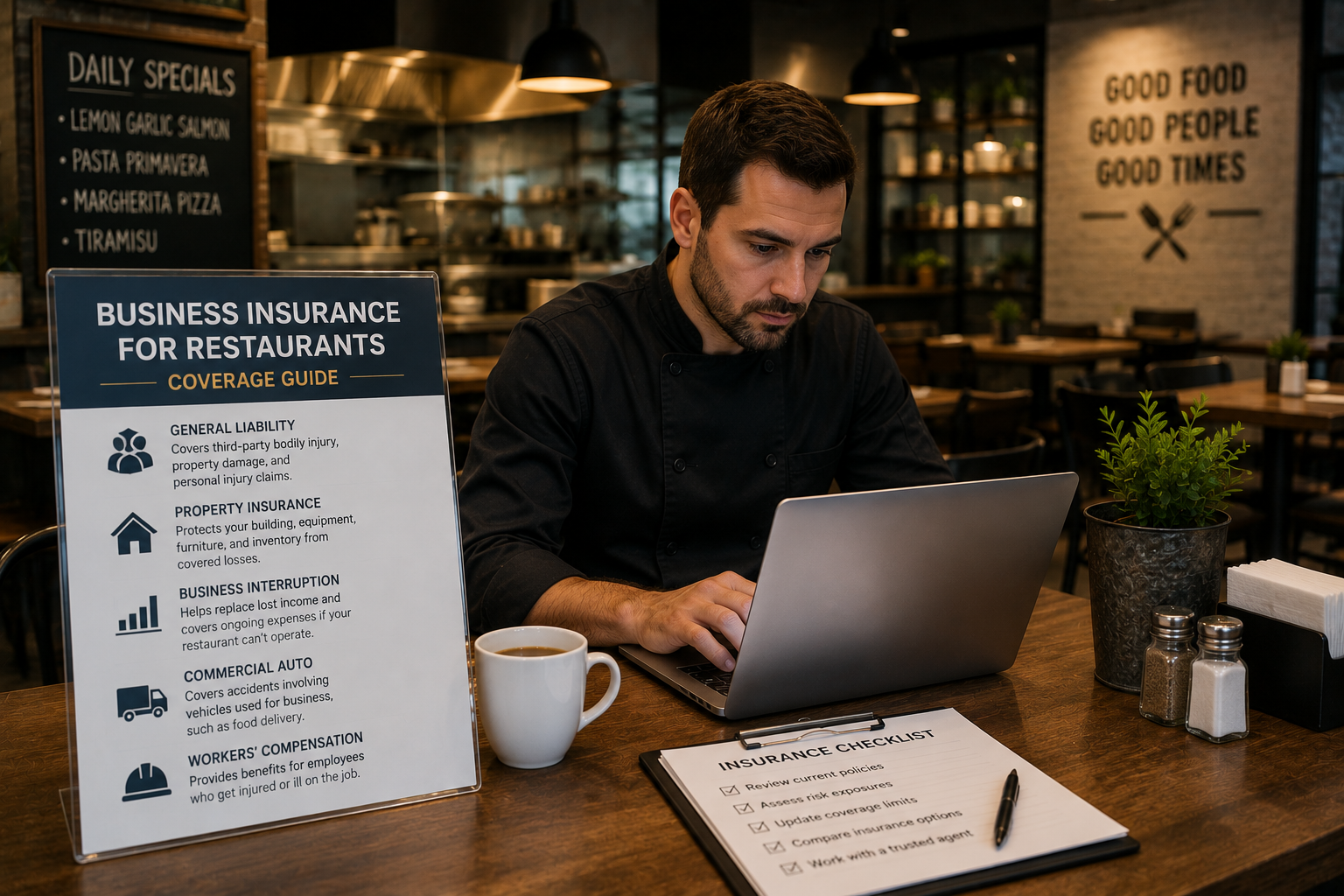
Restaurant business insurance is usually a combination of policies protecting against risks such as customer injuries, property damage, kitchen fires, covered shutdowns, employee injuries, vehicle accidents, alcohol-related liability, and certain cyber losses. A Business Owners Policy can provide a useful foundation by packaging property, liability, and business income coverage, but restaurants often need additional policies or endorsements based on their employees, vehicles, alcohol sales, property, delivery operations, location, and contractual requirements.
Key Takeaways
- General liability, commercial property, and business income coverage are common building blocks of a restaurant insurance program.
- A Business Owners Policy, or BOP, typically packages property, liability, and business interruption coverage but generally does not replace commercial auto or workers’ compensation insurance.
- Restaurants that sell or serve alcohol should specifically review liquor liability coverage rather than assuming every alcohol-related claim is covered elsewhere.
- Business income insurance generally requires an applicable covered trigger and does not insure every decline in restaurant revenue.
- Workers’ compensation requirements vary by state, while leases, lenders, franchisors, and other contracts can create additional insurance requirements.
What Is Business Insurance for Restaurants?
Business insurance for restaurants is not one standardized policy. It is a collection of commercial insurance coverages selected to address the property, liability, employee, vehicle, interruption, and other risks of a particular food-service business.
A small coffee shop can have different exposures from a full-service restaurant, bar and grill, catering operation, food truck, bakery, fast-casual chain, or fine-dining establishment. Cooking methods, alcohol sales, delivery operations, customer volume, employees, leased premises, owned buildings, refrigerated inventory, outdoor dining, catering events, and online ordering can all affect what coverage should be considered.
Insurance does not eliminate these risks. Instead, it can transfer specified financial risks to an insurer, subject to the applicable policy form, limits, deductibles, exclusions, endorsements, conditions, valuation provisions, and facts of a claim.
Core Restaurant Insurance Coverages
General Liability Insurance
Commercial general liability insurance generally protects a business against covered claims involving third-party bodily injury, third-party property damage, and certain personal and advertising injuries. It can also provide a legal defense for covered claims according to the policy terms.
For a restaurant, potential liability claims may include a customer slipping on a wet floor, a patron being injured by damaged furniture, or an allegation that a product sold by the restaurant caused bodily injury. Whether a particular incident is covered depends on the allegations, policy provisions, exclusions, limits, and facts.
Important: General liability should not be treated as a substitute for workers’ compensation or commercial auto insurance. Those exposures generally require separate consideration.
Commercial Property Insurance
Commercial property insurance can protect insured physical property against covered causes of loss. Depending on the policy and ownership arrangements, restaurant property can include the building, kitchen equipment, refrigeration equipment, furniture, inventory, computers, point-of-sale equipment, supplies, signs, and other business personal property.
A restaurant leasing its premises should not assume the landlord’s property insurance protects the restaurant’s own equipment, furniture, inventory, or tenant improvements. NAIC guidance specifically advises business tenants to review their leases and not rely on a landlord to insure the tenant’s business property.
Valuation is also important. Commercial property may be insured using replacement cost, actual cash value, or another policy-specified method. Owners should understand the valuation basis before a loss rather than discovering it during a claim.
Business Income Insurance
Business income insurance, also called business interruption coverage, can help with qualifying lost income and certain continuing expenses when operations are suspended because of an applicable covered event. NAIC guidance explains that this coverage commonly operates when a covered event such as a fire causes physical property damage and forces the business to suspend operations.
For a restaurant, this can matter after a serious kitchen fire or another covered property loss makes the premises unusable while repairs are completed. Depending on the policy, qualifying expenses can include certain continuing fixed expenses and lost income during the covered restoration period.
Business income insurance should not be described as protection against every revenue decline. Coverage normally depends on an applicable trigger and can be subject to waiting periods, time limits, exclusions, policy limits, financial-record requirements, and restoration-period provisions.
Business Owners Policy
A Business Owners Policy generally combines business property, liability, and business interruption coverage into a package for qualifying small businesses. A BOP can simplify insurance administration and may be customized for particular types of businesses.
A restaurant should not assume that a BOP automatically covers every risk created by its operation. NAIC consumer guidance notes that a BOP typically does not include commercial auto or workers’ compensation. Cyber, employment practices, liquor liability, flood, and other specialized exposures should also be reviewed separately according to the business and policy.
| Coverage | Restaurant Risk It May Address | Key Limitation to Review |
|---|---|---|
| General liability | Covered customer injury, property damage, and certain products-related claims | Does not replace workers’ compensation or commercial auto coverage |
| Commercial property | Covered damage to insured equipment, furniture, inventory, and buildings | Only insured property and covered causes of loss are protected |
| Business income | Qualifying income loss and continuing expenses after a covered interruption | An applicable covered trigger generally must occur |
| Workers’ compensation | Qualifying work-related employee injuries and illnesses | Employer requirements and benefits are state-specific |
| Liquor liability | Certain bodily injury or property damage liability arising from an intoxicated person | Policy terms and state alcohol-liability laws can significantly affect exposure |
| Commercial auto | Covered vehicle liability and physical damage involving insured business vehicles | Personal auto insurance should not be assumed to cover restaurant business use |
| Cyber insurance | Certain cyber incidents, data breaches, and related losses | Coverage varies widely by insurer and policy |
Additional Coverage Restaurants May Need
Workers’ Compensation Insurance
Restaurant employees can face work-related risks such as burns, cuts, slips, strains, and lifting injuries. Workers’ compensation generally provides benefits for qualifying job-related injuries or occupational illnesses according to applicable state law.
Workers’ compensation is primarily administered through state systems for private-sector employees. The U.S. Department of Labor directs private employers and workers to the applicable state workers’ compensation program, so a restaurant should verify requirements in every state where it has employees.
Liquor Liability Insurance
Restaurants that sell or serve alcoholic beverages should review liquor liability as a distinct exposure. The NAIC defines liquor liability as coverage for an entity involved in selling or serving alcoholic beverages when bodily injury or property damage arises from an intoxicated person.
The restaurant’s exposure can depend on state law, how alcohol is sold or served, the allegations in a claim, and the policy language. Owners should not assume that the presence of general liability insurance automatically resolves every liquor-related liability issue.
Commercial Auto Insurance
Restaurants that own or lease vehicles for food delivery, catering, supply runs, or other business purposes should evaluate commercial auto insurance separately from general liability.
NAIC guidance emphasizes that personal and commercial vehicle insurance have important distinctions and that business-owned or business-used vehicles may require commercial coverage. If employees use their own cars or the restaurant rents vehicles, hired and non-owned auto exposures may also need discussion with an insurer or licensed agent.
Equipment Breakdown and Spoilage Coverage
Restaurants rely heavily on refrigeration, freezers, cooking equipment, HVAC systems, and electrical equipment. Standard property insurance should not be assumed to cover every mechanical or electrical breakdown.
Depending on the insurer, equipment breakdown or spoilage protection may be available through separate coverage or endorsements. Owners should ask what happens if a refrigeration system fails, a covered power interruption affects perishable inventory, or a mechanical breakdown damages insured equipment. Triggers, deductibles, exclusions, waiting periods, and sublimits can differ.
Cyber Insurance
Restaurants may rely on point-of-sale systems, online ordering, reservations, loyalty programs, employee records, and third-party technology vendors. Cyber insurance can address certain losses resulting from covered cyber incidents, but cyber policies vary widely and should not be treated as standardized products.
A restaurant considering cyber coverage should review the policy’s treatment of data breaches, ransomware, social engineering, business interruption, vendor incidents, breach-response expenses, liability claims, retentions, exclusions, and cybersecurity conditions.
Employment Practices Liability Insurance
Employment practices liability insurance can address certain covered employment-related allegations, such as wrongful termination, discrimination, or harassment, depending on the policy. NAIC guidance notes that ordinary commercial general liability should not be assumed to cover employment practices claims.
Commercial Umbrella or Excess Liability
Commercial umbrella or excess liability coverage can provide additional limits above specified underlying liability policies. Restaurants with significant assets, contractual requirements, alcohol exposure, high customer volume, or other substantial liability risks may want to evaluate additional limits.
An umbrella should not be assumed to cover every exclusion or gap in underlying insurance. Which underlying policies qualify, where the excess coverage attaches, and which exclusions apply depend on the contract.
What Restaurant Insurance May Not Automatically Cover
Broad policy names can create a false sense that every restaurant loss is covered. Important exclusions and gaps should be reviewed before a claim occurs.
- Flood: Standard commercial property insurance should not be assumed to cover flood damage. The National Flood Insurance Program offers commercial flood coverage for eligible building and contents exposures.
- Earth movement: Earthquake and related earth-movement losses can require separate coverage or endorsements.
- Every mechanical failure: Property coverage does not necessarily insure internal mechanical or electrical breakdown.
- Every spoilage event: Coverage for spoiled food may depend on the cause of loss and any spoilage, utility-services, or equipment-breakdown provisions.
- Employee injuries: Workers’ compensation should be evaluated separately from customer-facing general liability.
- Business vehicle losses: General liability is not a substitute for commercial auto insurance.
- Every alcohol-related claim: Restaurants serving alcohol should review liquor liability and applicable state requirements specifically.
- Every drop in sales: Business income coverage generally requires an applicable covered cause or other policy trigger.
Flood coverage deserves separate attention. NFIP guidance explains that commercial flood insurance can protect eligible business buildings and contents, while financial losses from business interruption are not covered by the NFIP commercial building or personal property coverage. A restaurant should therefore review flood property and business-income risks separately.
How Restaurant Insurance Works: A Hypothetical Example
Assume a hypothetical restaurant experiences a covered kitchen fire. The fire damages cooking equipment, smoke damages furniture and inventory, and the restaurant must close temporarily for covered repairs.
Commercial property coverage may respond to covered physical damage to insured equipment, furniture, inventory, and other property. Applicable business income coverage may respond to qualifying lost income and continuing expenses during the covered restoration period.
If a customer were also injured during the event and alleged that the restaurant was legally responsible, general liability coverage could potentially become relevant to that separate claim.
This example is hypothetical and illustrative only. It is not a statement that every kitchen fire or resulting expense is covered. Actual claim payments depend on the cause of loss, insured property, limits, deductibles, exclusions, endorsements, valuation method, business income provisions, and other policy terms.
What Affects the Cost of Restaurant Insurance?
There is no reliable single nationwide premium that applies to every restaurant. Pricing depends on the restaurant, insurer, state, coverage package, limits, deductibles, underwriting information, and other risk characteristics.
Factors that may affect premiums include:
- The type of restaurant and cooking operations.
- Annual sales and payroll.
- The number and type of employees.
- Property values and equipment costs.
- The location and characteristics of the building.
- Whether alcohol is sold or served.
- Delivery, catering, or vehicle operations.
- Claims history.
- Coverage limits and deductibles.
- Optional endorsements and specialized coverages.
- Risk-control information considered by the insurer.
The SBA recommends assessing the business’s risks, using a reputable licensed insurance professional, comparing offers, and reassessing insurance as operations change. Price should be compared alongside coverage terms and benefits rather than in isolation.
How Much Restaurant Insurance Do You Need?
There is no universal liability or property limit appropriate for every restaurant. The amount of coverage should reflect the particular business’s property, assets, contractual obligations, income exposure, employees, vehicles, alcohol operations, and ability to absorb an uninsured loss.
Review Property Values
Create an inventory of property you expect the policy to insure. Consider cooking equipment, refrigeration, furniture, point-of-sale systems, inventory, improvements, signs, computers, and other business property. Update values after remodeling or purchasing major equipment.
Estimate Business Income Exposure
Consider how long a serious covered loss could interrupt operations. Repairing a restaurant can involve construction, equipment replacement, inspections, permitting, and other delays. Review both the amount of business income protection and the applicable restoration-period provisions.
Review Liability Exposure
Customer volume, alcohol service, delivery activity, catering, events, and contractual requirements can influence liability needs. Restaurants with significant assets may also want to evaluate whether excess or umbrella limits are appropriate.
Read the Lease and Other Contracts
Leases, loans, franchise agreements, vendor agreements, delivery contracts, and event agreements may require particular policy types, limits, certificates of insurance, or additional-insured status. Insurance purchased without reviewing those agreements may fail to satisfy contractual requirements.
How to Compare Restaurant Insurance Quotes
1. Compare the Same Operations
Provide accurate information about what the restaurant actually does. Disclose delivery, catering, alcohol sales, entertainment, outdoor dining, food trucks, multiple locations, and other material operations so quotes are based on comparable exposures.
2. Compare Limits and Deductibles
A quote can appear cheaper because it carries lower limits, higher deductibles, or narrower coverage. Compare liability limits, property values, business income protection, deductibles, and sublimits side by side.
3. Compare Exclusions and Endorsements
Ask how each proposal treats liquor liability, spoilage, equipment breakdown, utility interruption, cyber incidents, employment claims, flood, business vehicles, and other important restaurant exposures. Coverage names alone do not reveal all policy differences.
4. Confirm Contract Requirements
Match each quote against the restaurant’s lease, lender requirements, franchise agreement, and other contracts. If another party requires additional-insured status or a particular limit, confirm that the policy and endorsement actually satisfy the requirement.
5. Review the Insurer and Agent
The SBA recommends using a reputable licensed insurance professional. Restaurant owners can also use their state insurance regulator to check licensing information and obtain consumer assistance where appropriate.
Restaurant Insurance Review Checklist
- Confirm every business entity and location that needs to be insured.
- Inventory kitchen equipment, refrigeration, furniture, technology, inventory, signs, and tenant improvements.
- Review general liability and relevant products-related coverage.
- Check property limits, valuation provisions, deductibles, and sublimits.
- Review business income triggers, limits, waiting periods, and restoration-period provisions.
- Verify state workers’ compensation requirements.
- Review liquor liability if alcohol is sold, served, or furnished.
- Identify owned, rented, hired, and employee-owned vehicles used for restaurant business.
- Ask how equipment breakdown and refrigerated food spoilage are handled.
- Evaluate cyber and employment practices risks.
- Review flood exposure separately from standard commercial property coverage.
- Read leases, franchise agreements, loan documents, and vendor contracts for insurance requirements.
- Keep current records of business property and important financial information for potential claims.
- Reassess insurance when the restaurant adds locations, employees, vehicles, delivery service, alcohol sales, new equipment, or other significant operations.
Frequently Asked Questions
The Bottom Line
Business insurance for restaurants is generally a coordinated group of policies rather than one all-purpose contract. General liability, commercial property, and business income coverage can form the foundation, while workers’ compensation, liquor liability, commercial auto, equipment breakdown, spoilage, cyber, employment practices, flood, and excess liability may address additional exposures.
The main limitation is that the name of a policy does not guarantee coverage for every restaurant loss. A delivery accident, flood, equipment failure, alcohol-related lawsuit, employee injury, cyber event, or prolonged shutdown may require a particular coverage, endorsement, or trigger.
Before buying or renewing insurance, review the restaurant’s actual operations, property values, employees, vehicles, alcohol service, contracts, limits, deductibles, exclusions, and endorsements. Comparing coverage details across multiple quotes is generally more useful than choosing a policy based on premium alone.
Sources
- National Association of Insurance Commissioners, Business Interruption and Business Owner Policy, last updated June 25, 2026.
- National Association of Insurance Commissioners, Small Business Insurance, accessed August 2026.
- National Association of Insurance Commissioners, Glossary of Insurance Terms, accessed August 2026.
- U.S. Small Business Administration, Get business insurance, last updated April 8, 2024.
- U.S. Department of Labor, State Workers’ Compensation Officials, accessed August 2026.
- National Flood Insurance Program, Protecting Businesses with Flood Insurance, November 2024.