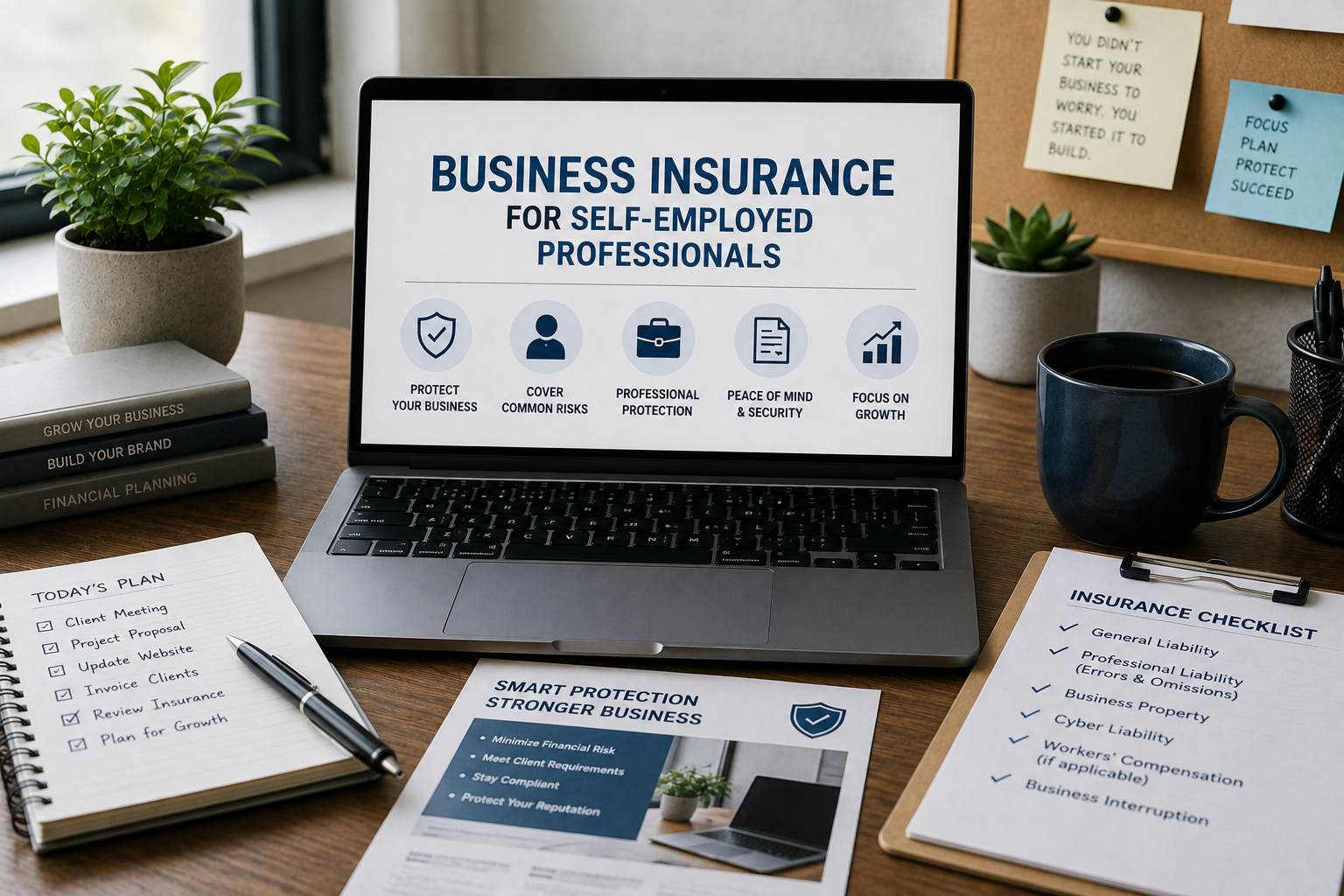
Self-employed professionals face business risks even when they work alone, operate from home, and have no employees. Consultants, accountants, designers, technology professionals, coaches, photographers, healthcare professionals, real estate professionals, and other independent service providers can face lawsuits, professional negligence claims, cyber incidents, damaged equipment, customer injuries, and vehicle losses. Business insurance helps transfer financial risks that could otherwise come directly from your business income, savings, or assets. The right combination depends on your profession, customers, contracts, property, data, vehicle use, location, and applicable state requirements.
Key Takeaways
- Self-employed professionals can need business insurance even when they have no employees or commercial office.
- Professional liability or errors and omissions insurance is often one of the most important coverages for people who sell professional expertise or services.
- General liability can address certain third-party bodily injury, property damage, and personal or advertising injury claims.
- A Business Owner’s Policy can combine general liability, commercial property, and business income coverage for qualifying businesses.
- Homeowners and renters insurance should not automatically be assumed to protect business equipment or business-related liability.
- Cyber insurance is worth evaluating if your business stores client information, credentials, payment information, confidential records, or depends heavily on technology.
- Personal auto insurance may not adequately cover significant business vehicle use.
- Some licensed professions have specialized professional liability requirements or expectations.
- Workers’ compensation requirements vary by state, occupation, employee status, and business structure.
- Client contracts, landlords, lenders, and professional organizations can require insurance even when no general law requires that exact policy for every self-employed person.
- Many ordinary business insurance premiums can generally be deductible business expenses when federal tax requirements are satisfied.
- Review insurance whenever your services, revenue, customers, employees, property, contracts, or business locations change.
What Is Business Insurance for Self-Employed Professionals?
Business insurance for self-employed professionals is not one specific policy. It is a combination of commercial insurance coverages selected to protect the risks created by operating your own professional practice or service business.
Depending on your work, insurance can help with covered losses involving:
- Professional mistakes.
- Allegations of negligence.
- Customer bodily injuries.
- Damage to customer property.
- Damaged or stolen business equipment.
- Business interruption after certain covered property losses.
- Cyberattacks and data breaches.
- Business vehicle accidents.
- Employment-related claims if you hire workers.
- Other risks specifically insured by your policies.
No business policy covers every possible loss. Limits, exclusions, deductibles, endorsements, definitions, and coverage triggers determine whether a particular claim is covered.
Do Self-Employed Professionals Really Need Business Insurance?
Not every self-employed professional needs every type of commercial insurance. However, working alone does not eliminate the possibility of a financially serious claim.
Consider whether you could comfortably pay if:
- A client alleges your professional advice caused a six-figure financial loss.
- A customer is seriously injured while visiting your office.
- You accidentally damage expensive equipment at a client location.
- Your laptop and professional equipment are stolen.
- A ransomware attack shuts down your business.
- Confidential customer information is exposed.
- Your vehicle causes an accident while being used for work.
- A fire prevents you from operating from your office for several weeks.
SBA guidance provides a practical rule: businesses should consider insuring against losses they would not be able to pay comfortably on their own.
What Insurance Do Self-Employed Professionals Need?
| Coverage | Main Risk Addressed |
|---|---|
| Professional liability / E&O | Professional errors, omissions, negligence, and certain financial-loss allegations. |
| General liability | Certain third-party bodily injury, property damage, and personal or advertising injury claims. |
| Commercial property | Covered damage or loss to equipment, furniture, inventory, and other insured business property. |
| Business Owner’s Policy | Packages qualifying property, general liability, and business income protection. |
| Cyber insurance | Data breaches, cyber incidents, recovery expenses, certain interruption losses, and third-party cyber liability. |
| Commercial auto | Business vehicle liability and optional physical damage. |
| Workers’ compensation | Qualifying work-related employee injuries and illnesses when required or elected. |
| Umbrella / excess liability | Additional liability limits above eligible underlying coverage. |
Professional Liability Insurance
Professional liability insurance is often the most important coverage to evaluate when your customers pay primarily for your expertise, advice, judgment, design, or professional services.
It is also frequently called errors and omissions insurance, or E&O.
Depending on the policy, it can address certain claims alleging:
- Professional negligence.
- Errors in professional work.
- Important omissions.
- Failure to provide contracted services.
- Failure to meet professional standards.
- Breach of professional duty.
- Financial losses allegedly caused by covered professional services.
Professional Liability Example
A self-employed technology consultant configures a system for a client. The client later alleges that an error in the consultant’s work caused a major operational loss and sues for damages. An applicable professional liability policy may help with covered defense costs and damages, subject to its limits, exclusions, deductible or retention, and other terms.
Who Should Consider Professional Liability Insurance?
Professional liability can be relevant to self-employed:
- Consultants.
- Accountants and bookkeepers.
- Technology professionals.
- Software developers.
- Graphic and web designers.
- Marketing professionals.
- Architects and engineers.
- Real estate professionals.
- Insurance professionals.
- Coaches and advisers.
- Healthcare professionals.
- Other businesses providing specialized professional services.
Certain regulated professions can have specialized malpractice or professional liability requirements. State law, licensing boards, client agreements, and professional associations should be checked when applicable.
Understand Claims-Made Professional Liability Coverage
Many professional liability policies are written on a claims-made basis.
Important provisions can include:
- Retroactive dates.
- Prior-acts coverage.
- When a claim must be reported.
- Extended reporting periods or “tail” coverage.
- Continuity when moving to another insurer.
Do not switch or cancel claims-made coverage based solely on price without checking whether work performed in prior years remains appropriately protected.
General Liability Insurance
Professional liability and general liability address different categories of risk.
General liability can help with certain claims involving:
- Third-party bodily injury.
- Third-party property damage.
- Certain personal injuries.
- Certain advertising injuries.
- Covered medical payments.
- Legal defense for covered liability lawsuits.
General Liability Example
A client visits a self-employed professional’s office, trips over equipment, suffers an injury, and seeks compensation. An applicable general liability policy may respond to the covered bodily injury claim.
General Liability vs. Professional Liability
| Coverage | Typical Type of Allegation |
|---|---|
| General liability | “Your business caused my physical injury or damaged my property.” |
| Professional liability | “Your professional advice, error, omission, or service caused me a financial loss.” |
A professional service business can need both because one policy generally should not be assumed to replace the other.
Business Owner’s Policy for Self-Employed Professionals
A Business Owner’s Policy, commonly called a BOP, packages several important commercial coverages together for eligible small businesses.
A typical BOP includes:
- General liability.
- Commercial property.
- Business income or business interruption coverage.
NAIC notes that a BOP can be a less costly option for many qualifying small businesses than purchasing comparable policies separately.
Eligibility varies by profession, revenue, property, business size, and insurer underwriting rules.
Professional liability is generally separate: A standard BOP should not automatically be assumed to cover claims arising from wrongful professional practices. E&O or another professional liability policy may still be needed.
Commercial Property Insurance
Professional businesses can depend heavily on equipment even when they own little inventory.
Business property can include:
- Computers.
- Monitors.
- Servers.
- Professional equipment.
- Cameras.
- Specialized tools.
- Office furniture.
- Business records.
- Inventory and supplies.
- Tenant improvements.
Commercial property insurance can help pay for covered damage or loss to insured property, subject to the policy’s causes of loss, valuation provisions, deductible, limits, exclusions, and sublimits.
Home-Based Business Insurance
Many self-employed professionals work from home, but personal home insurance should not be assumed to provide complete business protection.
NAIC warns that homeowners and renters insurance policies are rarely adequate for all of the unique risks of a home-based business.
Potential gaps can involve:
- Business equipment.
- Customer property.
- Business inventory.
- Customers visiting your home.
- Professional liability.
- Business interruption.
- Other commercial liability exposures.
Depending on the operation, options can include a personal-policy business endorsement, an in-home business policy, or a separate BOP.
Business Income Insurance
Self-employment often means that if the business stops operating, your income stops as well.
Business income coverage can help with certain lost income and continuing expenses when operations are suspended after a covered event that satisfies the policy’s requirements.
Depending on the policy, qualifying expenses can include:
- Lost business income.
- Rent.
- Loan payments.
- Payroll if you have employees.
- Taxes.
- Temporary operating expenses.
- Other continuing costs specified by the policy.
Not every income loss is covered: A slow business period, loss of a major client, or general economic downturn does not automatically qualify as a covered business interruption.
Cyber Insurance
A one-person professional practice can still have substantial cyber exposure.
You may store:
- Client contact information.
- Confidential documents.
- Financial information.
- Payment information.
- User credentials.
- Intellectual property.
- Healthcare or other regulated information where applicable.
FTC guidance divides cyber insurance broadly into first-party and third-party coverage.
| Cyber Coverage | Potentially Covered Costs |
|---|---|
| First-party | Forensic investigation, data recovery, customer notification, certain business interruption losses, crisis management, and cyberextortion or fraud expenses. |
| Third-party | Certain claims, lawsuits, regulatory inquiries, defense costs, settlements, damages, and other covered liabilities. |
Cybersecurity Still Matters When You Have Cyber Insurance
Cyber insurance should complement cybersecurity rather than replace it.
Basic controls can include:
- Multi-factor authentication.
- Regular software updates.
- Protected backups.
- Strong password management.
- Access restrictions.
- Encryption where appropriate.
- Phishing awareness.
- Incident-response planning.
Insurers may also ask about specific cybersecurity controls during underwriting.
Commercial Auto Insurance
Self-employed professionals frequently use personal vehicles for client meetings, site visits, transporting equipment, or other work activities.
Personal auto coverage should not automatically be assumed to cover all commercial use.
Commercial auto deserves particular attention if you:
- Own a vehicle through the business.
- Drive frequently to client locations.
- Transport tools or equipment.
- Carry inventory.
- Make deliveries.
- Transport clients or passengers as part of the business.
- Allow employees or contractors to drive business vehicles.
Disclose actual use: Tell the insurer how the vehicle is used rather than assuming the title of the vehicle or your self-employed status determines coverage.
Workers’ Compensation for the Self-Employed
Workers’ compensation requirements are primarily determined at the state level for private-sector businesses.
A self-employed professional with no employees may be treated differently from an employer with a workforce, but owner exemptions and elective coverage vary by jurisdiction and business structure.
Certain customers and contractors may also require evidence of workers’ compensation coverage or proof of an applicable exemption before allowing a self-employed professional to perform work.
Verify state rules: The U.S. Department of Labor directs private-sector workers to the applicable state workers’ compensation authority because state systems govern most private employment.
What Happens When You Hire Your First Employee?
Hiring employees can change both your insurance needs and legal obligations.
You may need to review:
- Workers’ compensation.
- Employment practices liability.
- Employee driving exposures.
- Cybersecurity access controls.
- Business property limits.
- Payroll-based insurance estimates.
- Whether workers are correctly classified as employees or independent contractors.
The IRS emphasizes that a written contract alone does not determine whether a worker is an employee or independent contractor. The entire relationship and relevant control factors must be considered for federal tax purposes, and other laws can use different tests.
Does an LLC Replace Business Insurance?
No. An LLC and business insurance solve different problems.
An LLC can provide certain legal separation between business obligations and an owner’s personal assets when properly established and maintained, but the business itself can still experience lawsuits and financial losses.
An LLC does not itself pay:
- Legal defense expenses.
- Covered settlements.
- Property replacement costs.
- Cyber recovery costs.
- Commercial vehicle claims.
- Business interruption losses.
Business structure and insurance can therefore complement one another rather than serving as substitutes.
Can Clients Require You to Carry Insurance?
Yes. A policy can effectively become mandatory because of a contract even when it is not universally required by law for every self-employed professional.
Clients can require:
- General liability insurance.
- Professional liability.
- Cyber insurance.
- Commercial auto.
- Workers’ compensation.
- Umbrella or excess liability.
- Specified minimum limits.
- Additional insured status.
- Waiver of subrogation.
- Other contract-specific insurance provisions.
Review contracts before signing: Do not agree to insurance limits or endorsements without confirming that the requested terms are available under your policy.
What Is a Certificate of Insurance?
Clients may ask for a certificate of insurance, or COI, before you begin work.
A certificate generally summarizes information such as the insurer, policy dates, types of coverage, and limits.
A certificate itself generally does not replace or modify the policy. If a contract requires additional insured status or another endorsement, confirm that the appropriate policy endorsement has actually been issued.
Are Business Insurance Premiums Tax Deductible?
Many insurance premiums related to operating a business can generally qualify as deductible business expenses under federal tax rules when applicable requirements are satisfied.
IRS Publication 334 identifies examples including premiums for:
- Certain fire, theft, flood, or similar business insurance.
- Liability insurance.
- Malpractice insurance covering professional negligence.
- Qualifying workers’ compensation insurance.
- Certain business vehicle insurance.
- Business overhead insurance covering certain expenses during long periods of disability.
Tax treatment depends on the type of insurance, business structure, who benefits from the policy, and other circumstances. Keep records and use current IRS guidance or a qualified tax professional for your specific situation.
What About Health Insurance for the Self-Employed?
Health insurance is separate from commercial liability and property insurance, but it is an important part of financial planning when you do not receive employer-sponsored benefits.
Depending on eligibility and tax circumstances, a self-employed person may qualify for a federal self-employed health insurance deduction for certain medical, dental, vision, and qualified long-term care premiums.
Separate eligibility rules apply, including restrictions related to access to certain employer-subsidized plans.
Disability and Business Overhead Insurance
A self-employed professional often has another important risk: the business may depend almost entirely on that person’s ability to work.
Personal disability income coverage is generally designed to replace part of an individual’s income after a qualifying disability, while business overhead expense insurance can be structured to help pay certain ongoing business expenses when the insured professional is disabled.
Depending on the policy, business overhead expenses can include qualifying costs such as:
- Office rent.
- Utilities.
- Certain employee payroll.
- Accounting expenses.
- Other eligible recurring business overhead.
These policies serve different purposes, so review waiting periods, benefit periods, covered expenses, disability definitions, and tax treatment carefully.
How Much Business Insurance Does a Self-Employed Professional Need?
There is no single liability limit or insurance package that is correct for every professional.
Consider:
- Client contract requirements.
- Your profession.
- Size and complexity of client projects.
- Potential financial damage from a professional error.
- Value of business equipment.
- Amount and sensitivity of client data.
- Number of clients.
- Annual revenue.
- Vehicle use.
- Whether clients visit your premises.
- Employees or contractors.
- How much loss you could afford to retain personally or through the business.
Choosing a Business Insurance Deductible
A higher deductible or retention can reduce insurance premiums because you retain more of each loss.
Deductible Example
Suppose a hypothetical professional can choose between a $1,000 deductible and a $5,000 deductible.
The $5,000 option saves $600 per year in premiums.
You would be accepting an additional $4,000 of potential loss in exchange for $600 of annual savings. Whether that is worthwhile depends on your cash reserves, claim risk, and policy terms. This example is illustrative only.
Choose an amount you could fund without putting ordinary business operations or personal finances under severe pressure.
What Determines the Cost of Business Insurance?
Insurers can consider factors including:
- Profession.
- Services provided.
- Revenue.
- Client industries.
- Contract size.
- Business location.
- Business property values.
- Employees and payroll.
- Prior claims.
- Cybersecurity controls.
- Vehicle use.
- Requested limits.
- Deductibles or retentions.
- Insurer underwriting appetite.
Two professionals with similar revenue can therefore have very different insurance costs if their services create different potential claim severity.
How to Choose Business Insurance
- List every service you provide. Insurers need an accurate description of your professional activities.
- Identify catastrophic risks. Focus first on losses you could not comfortably fund yourself.
- Review client contracts. Identify required policies, limits, and endorsements.
- Evaluate professional liability. Ask what could happen financially if a client alleges your work was wrong.
- Inventory business property. Calculate what equipment would cost to replace.
- Review home-office exposure. Determine what your personal policy does and does not cover.
- Evaluate cyber risk. Consider the data you hold and how dependent you are on technology.
- Review vehicle use. Make sure your insurer understands your business driving.
- Check legal requirements. Professional licensing and workers’ compensation rules can vary by state.
- Compare multiple insurers. Compare terms and benefits as well as premium.
- Choose realistic deductibles. Keep enough cash available to fund them.
- Review the issued policy. Confirm your actual services and required endorsements are covered as intended.
How to Lower Insurance Costs Without Creating Major Gaps
Potential strategies include:
- Compare several insurers.
- Consider a BOP when eligible.
- Choose a higher but still affordable deductible.
- Maintain accurate revenue and payroll estimates.
- Use written client contracts and clear scopes of work.
- Maintain strong cybersecurity controls.
- Prevent recurring claims.
- Maintain professional equipment properly.
- Use safe driving practices.
- Remove property, vehicles, or other exposures you no longer have.
- Review coverage annually.
Avoid false savings: Eliminating professional liability or choosing limits below client requirements can make the premium cheaper while dramatically increasing the amount of risk you retain.
When Should You Review Your Insurance?
Review business insurance around renewal and sooner when your professional practice changes materially.
Review your coverage after:
- Adding a new professional service.
- Signing a substantially larger client.
- Increasing revenue significantly.
- Hiring employees.
- Using contractors.
- Buying expensive equipment.
- Moving into commercial premises.
- Starting to store sensitive client data.
- Adding vehicles.
- Working in another state.
- Experiencing a significant claim.
Common Insurance Mistakes Self-Employed Professionals Make
Assuming Working Alone Means There Is No Liability Risk
You can face a professional liability or general liability lawsuit even without employees.
Buying General Liability but Ignoring Professional Liability
General liability should not automatically be expected to cover financial losses allegedly caused by professional errors, omissions, or negligent advice.
Relying Entirely on Homeowners or Renters Insurance
Personal policies can provide limited business-property protection and may not address important business liability risks.
Ignoring Cyber Risk
A one-person business can still experience ransomware, phishing, data theft, account compromise, and vendor-related cyber incidents.
Ignoring Business Use of a Personal Vehicle
Significant business use should be disclosed to the insurer instead of assuming personal coverage will apply.
Choosing the Cheapest Professional Liability Quote
A lower premium can come with a narrower definition of professional services, higher retention, smaller limit, broader exclusions, or less favorable claims-made provisions.
Letting Claims-Made Coverage Lapse
A lapse or poorly structured replacement policy can create problems for claims involving services performed before the new policy began.
Signing Client Insurance Requirements Without Reviewing Them
Some contract requirements can be expensive, unavailable, or inconsistent with your existing policy. Review them before agreeing.
Failing to Update the Policy as the Practice Grows
A policy purchased when you worked alone from home may no longer fit after you hire employees, lease an office, sign larger clients, and add new professional services.
Frequently Asked Questions
The Bottom Line
Self-employed professionals should build insurance around the financial risks created by their actual professional work rather than assuming a one-person business has little exposure. For many professional service providers, professional liability is a central consideration because a client can allege that an error, omission, or negligent service caused a significant financial loss.
General liability can address different third-party injury and property damage risks, while a BOP can provide an efficient combination of liability, property, and business income coverage for eligible businesses. Cyber coverage can become increasingly important as professional practices depend on digital systems and confidential client information.
Working from home does not automatically make personal homeowners or renters insurance adequate for business risks, and using a personal vehicle for business should be disclosed to the auto insurer. Workers’ compensation and professional licensing requirements should be checked under the applicable state rules.
Finally, insurance needs change as a professional practice grows. Larger client contracts, higher revenue, employees, new services, expensive equipment, additional states, and increased cyber exposure can all change the appropriate combination of policies, limits, deductibles, and endorsements. Review your insurance regularly so your protection keeps pace with your business.
Sources
- U.S. Small Business Administration, Launch Your Business — Business Insurance Guidance, accessed August 2026.
- National Association of Insurance Commissioners, Small Business Insurance Consumer Guidance, accessed August 2026.
- National Association of Insurance Commissioners, Glossary of Insurance Terms — Errors and Omissions / Professional Liability, accessed August 2026.
- National Association of Insurance Commissioners, Medical Malpractice Insurance, last updated April 1, 2026.
- Federal Trade Commission, Cyber Insurance, accessed August 2026.
- Federal Trade Commission, Cybersecurity for Small Business, accessed August 2026.
- U.S. Department of Labor, State Workers’ Compensation Officials, accessed August 2026.
- Internal Revenue Service, Publication 334 (2025), Tax Guide for Small Business, accessed August 2026.
- Internal Revenue Service, Independent Contractor (Self-Employed) or Employee?, accessed August 2026.
- Internal Revenue Service, Instructions for Form 7206 (2025), Self-Employed Health Insurance Deduction, accessed August 2026.