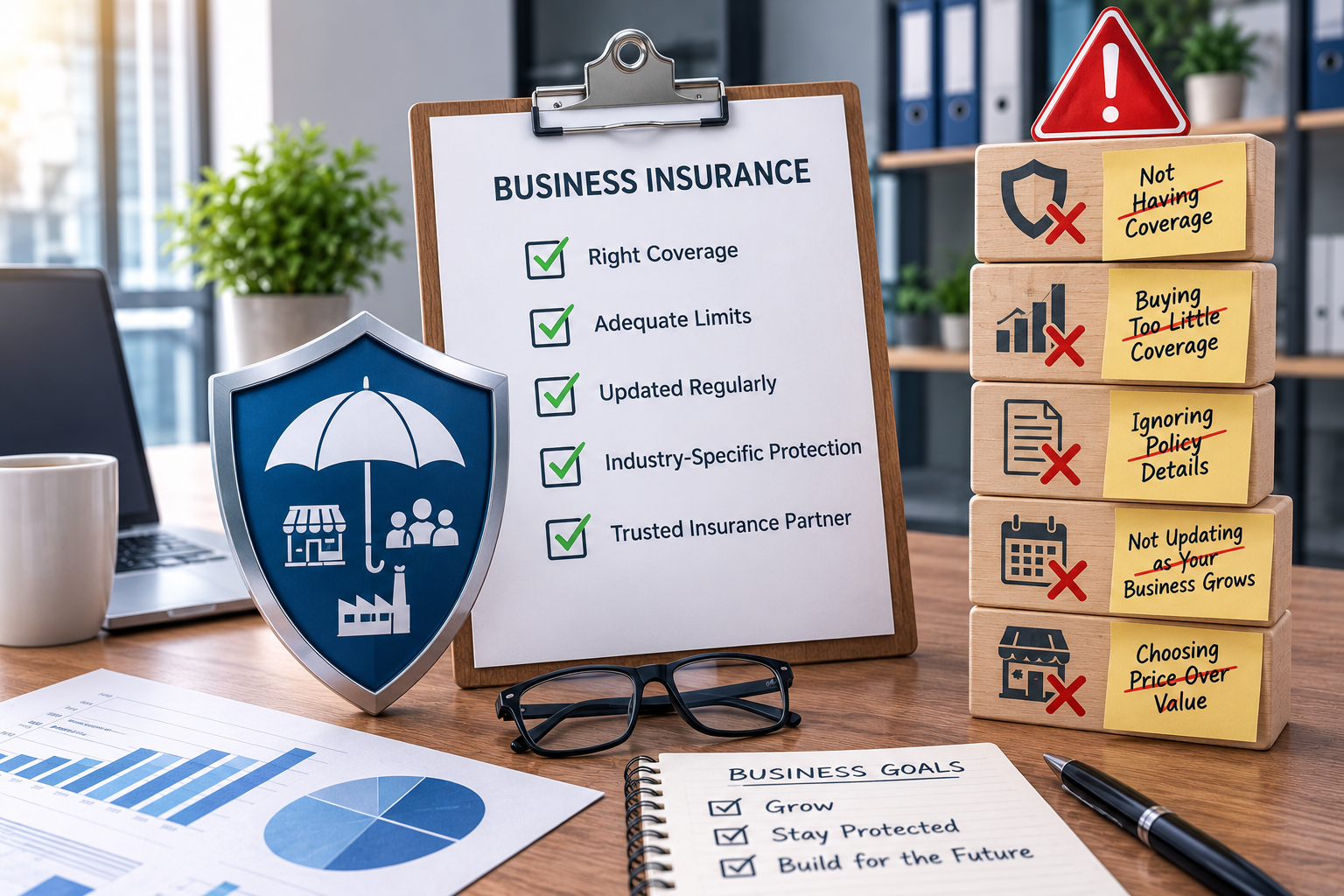
Common business insurance mistakes include buying coverage based only on price, choosing limits that no longer match the business, assuming one policy covers every risk, overlooking exclusions, and failing to update insurance as operations change. Avoiding these problems starts with understanding what each policy actually covers and regularly comparing that protection with the company’s current property, employees, vehicles, contracts, services, and liability exposures.
Key Takeaways
- The cheapest policy may not provide the limits, endorsements, or types of coverage a business actually needs.
- A business owner’s policy can package several important coverages, but it does not automatically cover every business exposure.
- Policy exclusions, deductibles, waiting periods, and coverage triggers can materially affect how a claim is handled.
- Insurance should be reviewed after major business changes and generally at least once a year.
- State laws and contractual requirements can create insurance obligations that vary by business and location.
Common Business Insurance Mistakes and Why They Matter
Business insurance is not one universal policy. A company’s insurance program may include general liability, commercial property, a business owner’s policy, workers’ compensation, commercial auto, professional liability, cyber coverage, product liability, or other policies depending on its operations.
That makes insurance mistakes easy to make. A policy can be active and premiums can be paid on time while important exposures remain uninsured, underinsured, or subject to limitations the owner did not anticipate.
| Common Mistake | Why It Can Be a Problem | What to Review |
|---|---|---|
| Buying on price alone | A lower premium can come with different limits, deductibles, exclusions, or coverage terms. | Compare coverage terms as well as premium. |
| Assuming a BOP covers everything | Important exposures may require separate policies or endorsements. | Workers’ compensation, commercial auto, professional liability, cyber, and other specialized risks. |
| Using outdated limits | Property values, inventory, revenue, payroll, and operations can change over time. | Current assets, revenue, payroll, contracts, and replacement needs. |
| Ignoring exclusions | A loss may fall outside the circumstances in which the policy responds. | Exclusions, endorsements, definitions, and coverage triggers. |
| Relying on personal insurance | Personal home or auto policies may limit or exclude business-related exposures. | Business property, business use of vehicles, and liability arising from operations. |
| Failing to update coverage | New employees, locations, products, services, or vehicles can create new exposures. | Review policies at renewal and after material business changes. |
Mistake 1: Choosing Business Insurance Based Only on Price
Premium matters, especially for a business managing a tight budget. But comparing policies only by their price can hide meaningful differences in protection. Two insurance quotes can look similar while providing different liability limits, property valuations, deductibles, endorsements, exclusions, or optional coverages.
The U.S. Small Business Administration recommends shopping around because insurance prices and benefits can vary. A useful comparison looks at both cost and what the business receives for that cost.
Compare policies side by side. Review coverage types, per-occurrence and aggregate limits where applicable, deductibles, exclusions, endorsements, covered locations, property values, and major conditions before deciding that one quote offers better value.
Mistake 2: Assuming One Policy Covers Every Business Risk
A business owner’s policy, commonly called a BOP, is designed to simplify insurance for eligible businesses. NAIC guidance describes a BOP as a package that typically includes property, business interruption or continuation, and liability insurance.
That package can cover several major exposures, but it should not be interpreted as every type of insurance a company could need. Depending on the operation, workers’ compensation, commercial auto, professional liability, cyber insurance, product liability, employment-related coverage, or umbrella or excess liability may need separate consideration.
Policy names are not enough. Determine which risks the business actually faces, then check whether each risk is addressed by the policies and endorsements in force.
Mistake 3: Carrying Coverage Limits That No Longer Fit the Business
A growing business can outgrow its insurance. New equipment, additional inventory, higher revenue, a larger payroll, more customers, or a second location can change the amount of financial exposure the company faces.
Property limits deserve particular attention. NAIC consumer guidance notes that a business property policy generally specifies a maximum amount the insurer will pay for a covered loss. If the business has substantially more property than when the limit was originally selected, the existing amount may no longer reflect its current needs.
Review More Than Property Values
Liability exposures can change too. A company that begins serving larger clients, signing contracts with higher insurance requirements, selling a new product, or performing work at customer locations may need to reconsider whether its existing liability limits are appropriate.
Mistake 4: Not Reading Exclusions, Deductibles, and Coverage Triggers
Knowing the coverage name does not tell you exactly when a policy will pay. Insurance contracts contain definitions, exclusions, limits, deductibles, conditions, and endorsements that determine how coverage applies to a particular claim.
Business interruption insurance is a useful example. This coverage generally responds to qualifying lost income and certain continuing expenses when operations are suspended because of a covered event under the applicable policy. The trigger, waiting period, exclusions, and duration of coverage matter.
NAIC guidance emphasizes that business interruption policies are not one-size-fits-all and that policy language is important when determining what is included or excluded. The same principle applies broadly across commercial insurance.
Mistake 5: Assuming Personal Insurance Covers Business Activities
This mistake is especially relevant to home-based businesses and owners who use personal vehicles for work. A homeowners, renters, or personal auto policy is designed primarily around personal exposures, not the full range of commercial activities.
NAIC guidance cautions that homeowners and renters policies are generally not adequate for the unique needs of a home-based business. Business property protection may be limited, and professional liability is not part of a standard homeowners or renters policy.
Vehicle use should also be disclosed accurately. Deliveries, transporting equipment, visiting job sites, or other business use can create insurance issues that should be reviewed with the insurer rather than assumed to fall under a personal auto policy.
Mistake 6: Overlooking Workers’ Compensation Requirements
Businesses with employees should not assume that workers’ compensation rules are identical nationwide. The U.S. Department of Labor explains that workers employed by private companies are generally covered through workers’ compensation systems overseen at the state level.
Requirements, exemptions, classifications, and procedures can therefore vary by state. Businesses operating across state lines or changing how they use employees and contractors should verify the applicable rules rather than relying on a general assumption.
State rules matter. Check the appropriate state workers’ compensation authority for current requirements affecting the business and its workforce.
Mistake 7: Ignoring Insurance Requirements in Contracts and Leases
A company’s insurance obligations do not come only from statutes. Commercial leases, financing agreements, vendor agreements, and customer contracts may specify particular types of insurance or minimum limits.
A contract may also contain requirements involving certificates of insurance or other insurance provisions. The exact effect of contractual language depends on the agreement, policy terms, and applicable law, so a business should avoid assuming that an existing policy automatically satisfies every contract it signs.
Mistake 8: Failing to Update Insurance as the Business Changes
Insurance purchased when a company opens may become outdated surprisingly quickly. NAIC guidance recommends reviewing business insurance policies annually and considering changes that can affect coverage or premiums.
A review is especially useful after changes such as:
- Hiring or reducing employees.
- Opening, closing, or moving a business location.
- Purchasing major equipment or substantially increasing inventory.
- Adding vehicles or changing how vehicles are used.
- Introducing new products or professional services.
- Entering new states or geographic markets.
- Signing a contract with new insurance requirements.
Mistake 9: Keeping Poor Records Before a Claim Happens
Claims are easier to explain when the business has organized records. Waiting until after property is damaged or operations are interrupted can make it harder to reconstruct what the company owned, what was lost, and which policies were in effect.
NAIC consumer guidance recommends documenting business assets and maintaining detailed records of insurance policies, premiums, losses, and recoveries. Depending on the business, useful documentation can include inventories, photographs, receipts, equipment records, policy documents, and financial records relevant to a potential business income claim.
A Practical Insurance Review Example
Consider a hypothetical small retailer that originally bought insurance when it had one location, three employees, no delivery service, and $50,000 of business property. Two years later, it has seven employees, twice as much inventory, a second location, and a company-owned delivery van. These numbers are illustrative only and are not national averages.
If the owner simply renews the original insurance without reviewing these changes, several issues could arise. Property limits may no longer reflect current assets, the second location needs to be addressed correctly, vehicle exposure has changed, payroll-related insurance information may need updating, and the business interruption exposure may be different.
The useful lesson is not that every growing company needs the same additional policies. It is that material operational changes should trigger an insurance review.
How to Avoid Business Insurance Mistakes
A structured review can catch many problems before they turn into claim disputes or unexpected out-of-pocket expenses.
- List your current exposures. Include property, employees, vehicles, products, professional services, technology, customer interactions, and potential interruptions.
- Check legal requirements. Insurance rules can vary by state and type of coverage, particularly for workers’ compensation and vehicle-related requirements.
- Review contracts. Check leases, financing agreements, and customer or vendor contracts for insurance provisions.
- Read policy terms. Pay attention to limits, deductibles, exclusions, endorsements, definitions, and coverage triggers.
- Compare competing quotes carefully. A lower premium is not automatically a better insurance package.
- Keep accurate records. Maintain current information about business assets and insurance policies.
- Review coverage regularly. Revisit policies at renewal and after significant changes to operations.
A licensed commercial insurance professional can help explain policy options, but the business owner should still understand the company’s operations and review the actual policy documents. Coverage ultimately depends on the contract, not a general description of the policy.
Frequently Asked Questions
The Bottom Line
Many business insurance mistakes come from treating coverage as a one-time purchase. The company changes, contracts change, asset values change, and new risks appear. Insurance that made sense when a business started may not match its current operations several years later.
Review the business’s risks, limits, deductibles, exclusions, endorsements, legal requirements, and contractual obligations regularly. Compare policies based on coverage as well as price, keep accurate records, and verify state-specific requirements with the appropriate regulator. The actual policy terms determine whether and how coverage applies to a particular loss.
Sources
- National Association of Insurance Commissioners, Small Business, accessed August 2026.
- National Association of Insurance Commissioners, Business Interruption and Business Owner Policy, updated June 25, 2026.
- U.S. Small Business Administration, Launch Your Business: Get Business Insurance, accessed August 2026.
- U.S. Department of Labor, Workers’ Compensation, accessed August 2026.