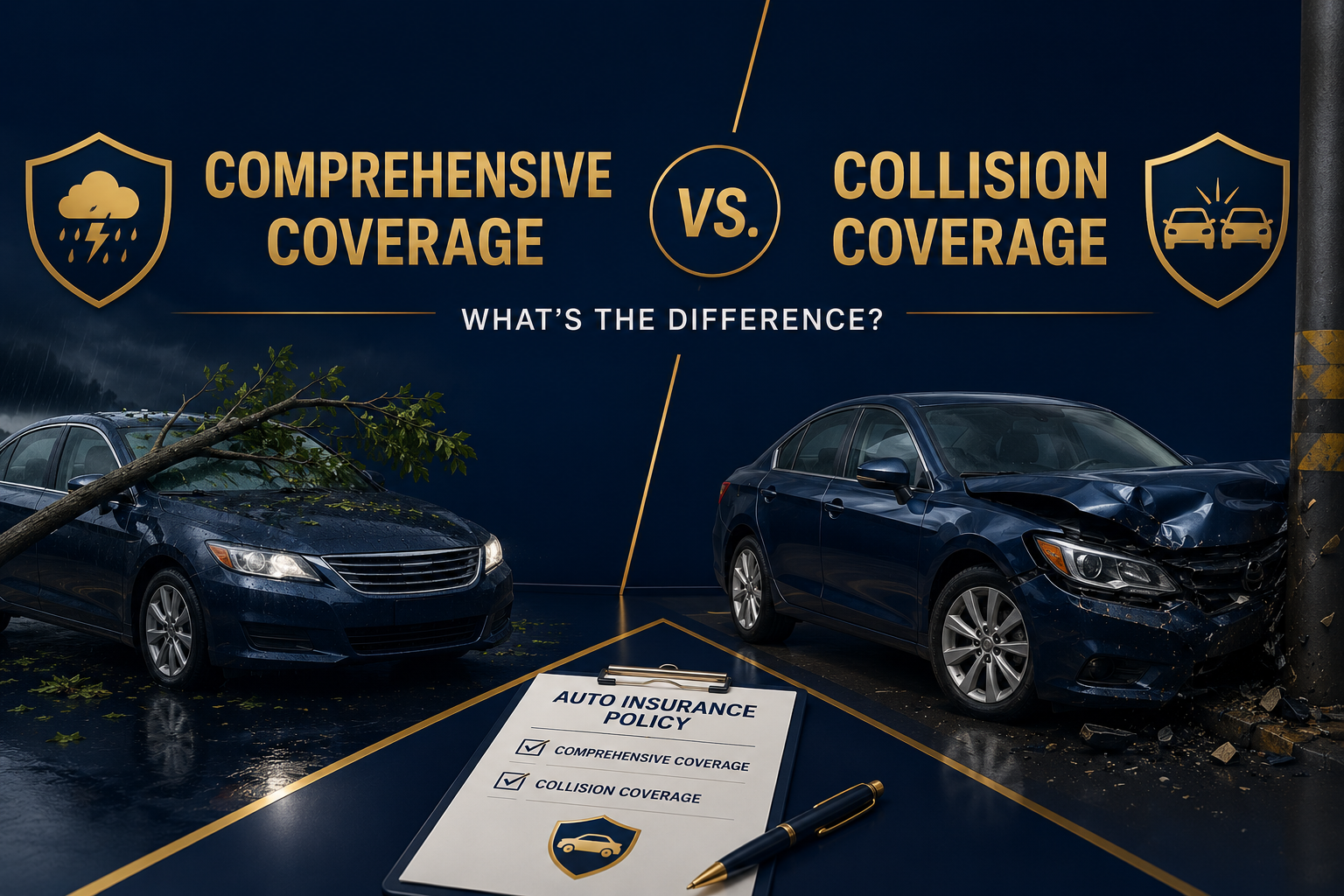
Comprehensive and collision insurance both help pay for damage to your own vehicle, but they cover different causes of loss. Collision generally covers damage from hitting another vehicle or object, as well as many rollover accidents. Comprehensive generally covers non-collision events such as theft, vandalism, hail, fire, flooding, falling objects, and animal impacts. Neither replaces liability insurance, and both commonly have deductibles that affect how much you receive after a covered claim.
Key Takeaways
- Collision coverage generally pays for covered damage to your car after a collision with another vehicle or object.
- Comprehensive coverage generally protects against covered non-collision losses such as theft, vandalism, weather, fire, flooding, falling objects, and animal impacts.
- Both coverages usually pay only up to the insured vehicle’s covered value, subject to the deductible and policy terms.
- States generally do not require comprehensive or collision coverage, but lenders and leasing companies can require them while a vehicle is financed or leased.
- Whether to keep both coverages on an older car depends on the vehicle’s value, premiums, deductibles, financing requirements, and your ability to replace the car yourself.
Comprehensive vs. Collision Coverage at a Glance
| Feature | Comprehensive | Collision |
|---|---|---|
| Primary purpose | Covers many non-collision losses to your insured vehicle. | Covers many crashes involving another vehicle or object. |
| Theft | Generally covered. | Generally not covered. |
| Hail or storm damage | Generally covered. | Generally not covered. |
| Animal impact | Generally covered. | Usually not treated as collision with another vehicle or object. |
| Hitting another car | Generally not covered by comprehensive. | Generally covered. |
| Hitting a tree or guardrail | Generally not covered by comprehensive. | Generally covered. |
| Deductible | Commonly applies, although glass treatment can vary. | Commonly applies. |
What Is Collision Coverage?
Collision coverage helps pay for covered physical damage to your insured vehicle when it collides with another vehicle or object.
It can generally apply whether or not you caused the crash, although another driver’s liability insurance may ultimately pay when that driver is responsible.
Typical collision claims can involve:
- Rear-ending another vehicle.
- Being involved in a multi-car crash.
- Hitting a tree.
- Hitting a fence or guardrail.
- Colliding with a building or other fixed object.
- Certain pothole-related vehicle damage.
- Rolling or overturning the vehicle.
Collision coverage protects your vehicle. It does not replace the liability coverage that pays eligible injuries or property damage you cause to other people.
What Is Comprehensive Coverage?
Comprehensive coverage protects your insured vehicle against many covered losses that are not traditional driving collisions.
It is sometimes informally described as “other than collision” coverage.
Common covered events can include:
- Vehicle theft.
- Vandalism.
- Fire.
- Hail.
- Windstorm damage.
- Flooding.
- Falling trees or branches.
- Other falling objects.
- Broken glass under applicable policy terms.
- Collision with an animal.
The exact list of covered and excluded causes depends on your insurance contract.
Collision Coverage Example
Suppose you lose control on a wet road and hit a guardrail.
Your vehicle suffers $8,000 of covered damage and your collision deductible is $1,000.
A simplified claim calculation would be:
$8,000 covered damage − $1,000 collision deductible = $7,000 simplified insurer payment
This assumes repairing the vehicle is appropriate and the entire $8,000 loss is otherwise covered.
If the vehicle is declared a total loss, the calculation generally focuses on the vehicle’s covered value rather than simply paying the repair estimate.
Comprehensive Coverage Example
Now suppose your parked vehicle is damaged by a severe hailstorm.
The covered repairs cost $6,000 and your comprehensive deductible is $500.
$6,000 covered hail damage − $500 comprehensive deductible = $5,500 simplified insurer payment
Again, the actual settlement depends on your policy, vehicle value, repairability, deductible, and other claim circumstances.
What Happens if You Hit a Deer?
Direct contact with a deer or another animal is generally treated as a comprehensive claim rather than a collision claim.
For example, if a deer suddenly enters the road and your vehicle hits it, comprehensive coverage would typically be the coverage reviewed for the physical damage to your car.
There is an important distinction if you avoid the animal but hit another object instead.
Suppose you swerve to avoid a deer and hit a tree without ever making contact with the animal. That damage would generally be treated as a collision claim because the vehicle collided with the tree.
Does Comprehensive Cover a Stolen Car?
Comprehensive coverage generally covers vehicle theft when the loss satisfies the policy.
If the vehicle is stolen and not recovered, the insurer can treat it as a total loss after completing the applicable claim investigation.
The settlement generally reflects the vehicle’s covered value, less the applicable comprehensive deductible.
If you owe more on the auto loan than the insurance settlement, comprehensive coverage generally does not automatically pay the remaining loan balance.
That is a separate risk commonly addressed through gap insurance or an eligible gap waiver.
Does Comprehensive Cover Flood Damage?
Comprehensive insurance generally covers qualifying vehicle damage from flooding.
Examples can include a vehicle damaged by:
- Flash flooding.
- Rising water.
- Storm surge.
- Heavy rainfall.
Coverage still depends on policy terms and claim circumstances.
For example, intentionally driving into clearly dangerous floodwaters can create additional claim issues depending on the facts and policy.
Does Comprehensive Cover Windshield Damage?
Glass damage is commonly handled under comprehensive coverage.
A cracked windshield caused by a flying rock, falling branch, or other covered event can potentially result in a comprehensive claim.
However, deductible rules can vary.
Depending on the insurer, policy, endorsement, and state law, you might have:
- Your normal comprehensive deductible.
- A separate glass deductible.
- Special windshield repair provisions.
- Full glass coverage with no deductible where purchased or otherwise applicable.
Check the glass provisions of your own policy rather than assuming every insurer handles windshield claims the same way.
Does Collision Cover Pothole Damage?
Damage caused by striking a pothole is generally treated as a collision-type loss.
For example, hitting a severe pothole could damage:
- Wheels.
- Tires when associated with a covered collision loss.
- Suspension components.
- Steering components.
- Other vehicle parts.
Whether filing a collision claim makes sense depends partly on the repair cost compared with your deductible.
If a covered repair costs $900 and your collision deductible is $1,000, there may be no collision payment under that simplified scenario.
What Happens in a Hit-and-Run?
If another driver damages your vehicle and leaves the scene, collision coverage can generally be used to repair your car if the loss is covered.
Other insurance may also be relevant depending on your state and policy.
For example, uninsured motorist property damage coverage may apply to certain hit-and-run losses in some jurisdictions, but eligibility, deductibles, identification requirements, and coverage availability vary by state.
Report a hit-and-run promptly to both law enforcement and your insurer according to applicable requirements.
What Comprehensive and Collision Do Not Cover
Neither coverage protects against every expense associated with owning a vehicle.
| Loss or Expense | Coverage Usually Needed |
|---|---|
| Injuries or damage you cause to other people | Liability insurance. |
| Your own medical expenses | PIP, medical payments, health insurance, or other applicable coverage. |
| Routine maintenance | Generally paid by the vehicle owner. |
| Mechanical breakdown | Warranty, service contract, mechanical breakdown insurance where available, or owner payment. |
| Loan balance above vehicle value | Gap coverage may apply. |
| Rental car while yours is repaired | Rental reimbursement coverage where purchased and applicable. |
Comprehensive and Collision vs. Liability Insurance
Liability insurance and physical damage insurance serve different purposes.
| Coverage | Whose Loss? | General Purpose |
|---|---|---|
| Liability | Primarily other people’s injuries or property. | Pays eligible damages you are legally responsible for causing. |
| Collision | Your insured vehicle. | Pays for qualifying collision damage. |
| Comprehensive | Your insured vehicle. | Pays for qualifying non-collision losses. |
Buying comprehensive and collision without sufficient liability insurance would leave a major financial risk because damage to your own car can be much smaller than a serious injury claim you cause to another person.
What Does “Full Coverage” Mean?
“Full coverage” is an informal insurance term rather than one standardized policy type.
It commonly refers to an auto policy that includes:
- Liability insurance.
- Collision coverage.
- Comprehensive coverage.
Depending on the state and selected policy, other coverages can also be required or added, including uninsured motorist coverage, underinsured motorist coverage, personal injury protection, or medical payments.
Even a policy marketed informally as “full coverage” does not cover every possible loss.
Are Comprehensive and Collision Required by Law?
States generally focus their compulsory auto insurance rules on liability or other forms of financial responsibility, not on comprehensive and collision coverage for your own vehicle.
However, a lender or leasing company can require both comprehensive and collision as a condition of financing or leasing a vehicle.
The reason is simple: the lender has a financial interest in the car.
If a financed vehicle is stolen, destroyed by hail, or totaled in a crash, the lender wants the collateral protecting the loan to be insured.
State insurance requirements vary, so drivers should verify current rules with their state Department of Insurance or motor vehicle agency when necessary.
What Happens if You Drop Coverage on a Financed Car?
If your loan or lease requires comprehensive and collision and you cancel them, you may violate your financing agreement.
A lender may take action permitted by the contract, which can include purchasing coverage to protect the lender’s interest and charging the borrower.
That lender-placed protection may not provide the same consumer protections or value as an ordinary personal auto policy.
Do not remove required physical damage coverage until the financing obligation no longer requires it.
How Do Comprehensive and Collision Deductibles Work?
Comprehensive and collision commonly have separate deductibles.
You might choose, for example:
- A $500 comprehensive deductible.
- A $1,000 collision deductible.
The deductible is generally subtracted from the eligible covered loss.
A higher deductible can lower the premium but increases the amount you must absorb after a claim.
| Covered Repair | Deductible | Simplified Payment |
|---|---|---|
| $5,000 | $250 | $4,750 |
| $5,000 | $500 | $4,500 |
| $5,000 | $1,000 | $4,000 |
These are simplified examples assuming the full repair cost is otherwise covered.
What Happens if Your Car Is Totaled?
When repairing a damaged vehicle is not economically reasonable under the insurer’s applicable total-loss methodology, the vehicle can be declared a total loss.
Comprehensive or collision coverage generally pays based on the insured vehicle’s covered value, subject to policy terms and the deductible.
Suppose a vehicle has a covered value of $20,000 immediately before a total-loss collision and the collision deductible is $1,000.
$20,000 covered vehicle value − $1,000 deductible = $19,000 simplified total-loss settlement
The actual settlement can also involve taxes, fees, salvage arrangements, lienholder interests, state rules, and policy provisions.
Comprehensive and Collision Usually Do Not Pay the Original Purchase Price
Drivers sometimes assume that totaling a recently purchased car means the insurer will automatically refund what they originally paid.
That is generally not how standard physical damage coverage works.
Vehicle values can decline after purchase, and the covered settlement is generally based on the vehicle’s value at or near the time of loss according to the policy and applicable state rules.
If your remaining loan is higher than that value, you can have negative equity.
Gap insurance is designed to address certain eligible differences between a total-loss settlement and an outstanding loan or lease balance.
How Much Do Comprehensive and Collision Coverage Cost?
There is no universal price because insurers evaluate many characteristics subject to state insurance law.
Pricing can be affected by:
- Vehicle value.
- Vehicle repair costs.
- Vehicle theft history.
- Driver and claims history.
- Location.
- Selected deductibles.
- Annual mileage or vehicle use.
- Available safety or anti-theft features.
- Other rating factors permitted by state law.
Comprehensive and collision should be compared separately because one can be substantially more expensive than the other for a particular vehicle or driver.
Should You Buy Both Comprehensive and Collision?
For many newer, valuable, financed, or leased vehicles, carrying both can make sense and may be contractually required.
Consider keeping both when:
- Your lender or lease requires them.
- Your vehicle has substantial current value.
- You could not comfortably replace the vehicle after a total loss.
- You depend heavily on the car for work or family transportation.
- Your area has meaningful theft, hail, flood, wildfire, or animal-strike exposure.
- Paying for major collision repairs yourself would create financial hardship.
Can You Buy Comprehensive Without Collision?
Insurer rules vary.
Some insurers can allow comprehensive coverage without collision in certain situations, while others package or restrict the options differently.
A driver with an older car might value comprehensive because theft, hail, fire, or glass losses remain concerning while deciding that collision coverage is no longer worth the additional premium.
Availability depends on the carrier and policy.
When Should You Consider Dropping Collision Coverage?
Collision coverage becomes less economically valuable as a vehicle depreciates because the maximum potential claim payment generally decreases with the vehicle’s value.
Consider:
- The vehicle’s current value.
- Your collision premium.
- Your collision deductible.
- How much the insurer could realistically pay after a total loss.
- Whether you could replace the car yourself.
- Whether a lender or lessor still requires the coverage.
Older Car Example
Suppose an older vehicle is worth approximately $4,000 and carries a $1,000 collision deductible.
The most a simplified total-loss collision claim might produce before other adjustments would be approximately:
$4,000 vehicle value − $1,000 deductible = $3,000 simplified maximum total-loss payment
That does not automatically mean collision should be dropped.
Compare that potential benefit with the annual premium and your ability to absorb a $4,000 vehicle loss yourself.
When Should You Consider Dropping Comprehensive Coverage?
The same value analysis can be used for comprehensive, but comprehensive can remain attractive on some older vehicles because its premium may be relatively modest while still protecting against theft, weather, fire, glass, and animal losses.
Before removing it, consider:
- Current vehicle value.
- Comprehensive premium.
- Deductible.
- Local theft rates.
- Hail and storm exposure.
- Flood or wildfire exposure.
- Animal-strike risk.
- Whether you could replace the vehicle yourself.
There is no universal vehicle age or dollar value at which comprehensive automatically stops making sense.
How to Choose a Deductible
The deductible affects both your premium and how useful the coverage will be for smaller claims.
A useful deductible should satisfy two conditions:
- It saves enough premium to justify taking on more financial risk.
- You can comfortably pay it immediately after an unexpected loss.
A $2,000 deductible may reduce premiums but provide little practical benefit on a low-value vehicle.
Conversely, paying substantially more every year for a very small deductible may not fit a driver who has adequate emergency savings.
Which Coverage Applies? Common Scenarios
| Scenario | Coverage Generally Reviewed |
|---|---|
| You rear-end another car. | Collision for your car; liability for eligible damage you caused to others. |
| Your car is stolen. | Comprehensive. |
| Hail damages your roof and hood. | Comprehensive. |
| You hit a deer. | Comprehensive. |
| You swerve around a deer and hit a tree. | Collision. |
| A tree branch falls onto your parked car. | Comprehensive. |
| You back into a concrete post. | Collision. |
| Floodwater damages your parked vehicle. | Comprehensive. |
How to Decide Which Coverage You Need
- Check your financing agreement. If the vehicle is financed or leased, determine whether both coverages are required.
- Estimate the vehicle’s current value. Physical damage coverage becomes less valuable as the vehicle depreciates.
- Check the separate premiums. Determine how much comprehensive and collision each cost rather than looking only at the total auto premium.
- Review deductibles. Compare the deductible with the vehicle’s value and your emergency savings.
- Consider your local risks. Theft, hail, flooding, wildfire, animal strikes, and traffic conditions can change the value of coverage.
- Consider your ability to replace the vehicle. If losing the car tomorrow would create a major financial problem, physical damage coverage may be particularly valuable.
- Reevaluate annually. The decision can change as the vehicle depreciates and the loan balance declines.
Common Comprehensive and Collision Mistakes
- Thinking comprehensive means everything is covered: Comprehensive is primarily non-collision physical damage protection, not unlimited auto insurance.
- Confusing collision with liability: Collision repairs your insured vehicle; liability addresses eligible damage you cause to others.
- Assuming a financed vehicle can have liability-only insurance: The lender or lessor can require physical damage coverage.
- Ignoring deductibles: A high deductible can make smaller claims economically irrelevant.
- Expecting the original purchase price after a total loss: Standard coverage generally focuses on the vehicle’s covered value at the time of loss.
- Keeping coverage forever without reviewing it: A depreciating car can eventually reach a point where collision or comprehensive is no longer worth its cost for a particular owner.
- Dropping coverage solely because the car is old: Your ability to replace the vehicle and the actual premium matter more than age alone.
Frequently Asked Questions
The Bottom Line
Collision coverage protects your insured vehicle primarily against crash-related damage, while comprehensive protects it against many non-collision events such as theft, vandalism, weather, fire, flooding, falling objects, and animal impacts.
Neither coverage replaces liability insurance, and neither automatically pays the amount you originally paid for the vehicle. Claims are subject to deductibles, policy limits, exclusions, and the vehicle’s covered value.
If your vehicle is financed or leased, carrying both may be required. If it is paid off, compare the vehicle’s current value with your comprehensive and collision premiums, deductibles, local risks, and ability to replace the vehicle yourself. As your car depreciates, review these coverages regularly rather than automatically keeping or dropping them based only on the vehicle’s age.
Sources
- National Association of Insurance Commissioners, Auto Insurance consumer guidance.
- National Association of Insurance Commissioners, Auto Insurance Shopping and Coverage resources.
- State Departments of Insurance for state-specific auto insurance rules, physical damage coverage guidance, and consumer protections.
- State motor vehicle agencies for applicable insurance and financial-responsibility requirements.