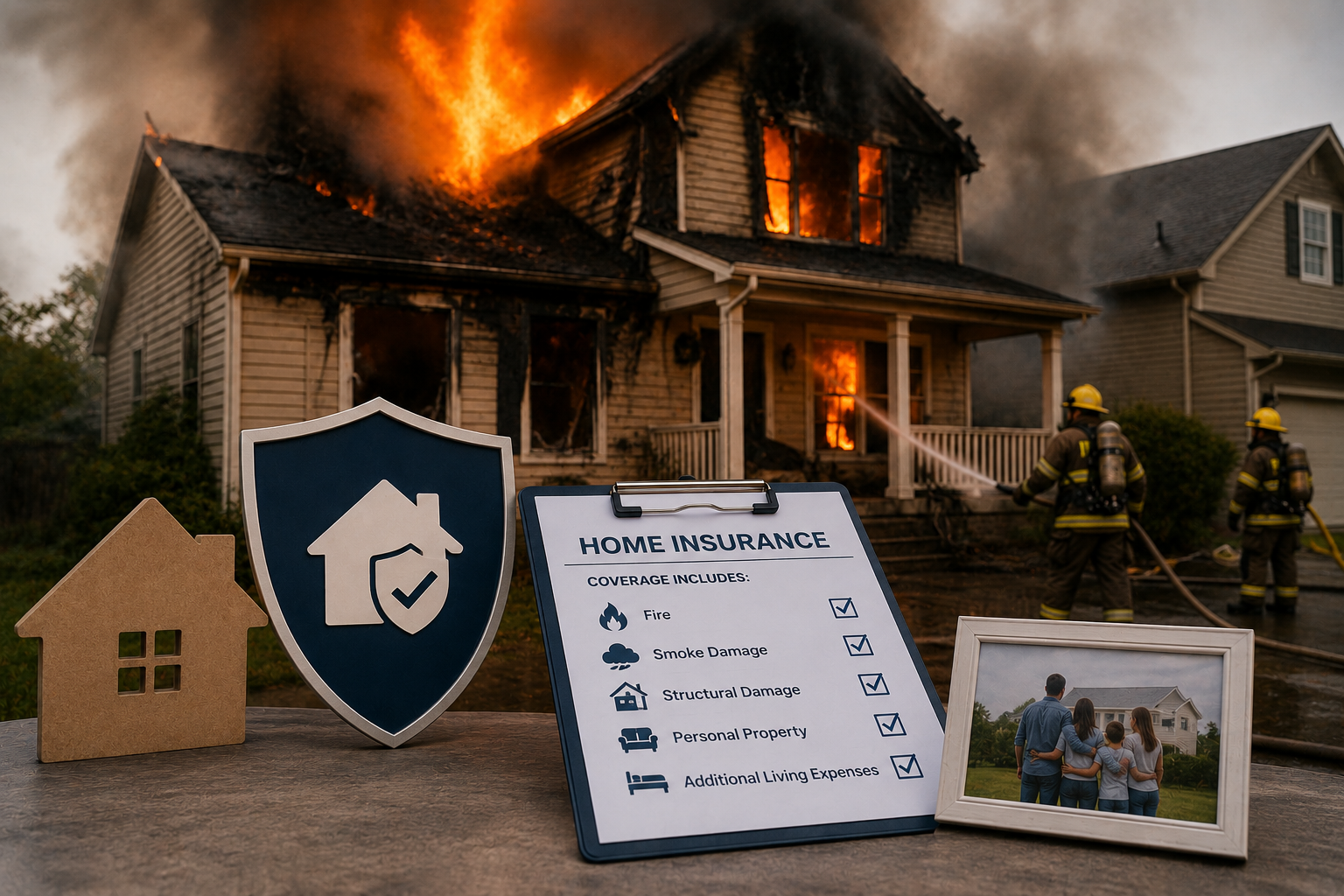
Homeowners insurance typically covers accidental fire damage to the house and other insured property when fire is a covered peril under the policy. Coverage can include repairs or rebuilding, damaged belongings, certain detached structures, smoke damage, and additional living expenses if the home becomes uninhabitable. Deductibles, coverage limits, exclusions, valuation provisions, and the cause of the fire can affect how much the insurer pays.
Key Takeaways
- Fire is commonly a covered peril under standard homeowners insurance policies.
- Dwelling coverage may pay to repair or rebuild the insured home after a covered fire, up to applicable policy limits.
- Personal property coverage can apply to belongings damaged or destroyed by flames, smoke, soot, or other covered fire-related damage.
- Loss-of-use or additional living expense coverage may help with extra housing and living costs when a covered fire makes the home uninhabitable.
- Coverage can be affected by deductibles, limits, exclusions, intentional-loss provisions, replacement-cost terms, and the facts surrounding the fire.
How Does Home Insurance Cover Fire Damage?
Fire is one of the most commonly covered causes of loss in homeowners insurance. The National Association of Insurance Commissioners identifies fire and lightning among the perils typically covered by homeowners policies.
A covered house fire can affect several sections of the policy at the same time. Dwelling coverage may apply to the structure, personal property coverage may apply to belongings, other structures coverage may protect qualifying detached structures, and loss-of-use coverage may help with additional living costs while repairs are completed.
Coverage still depends on the insurance contract. Policy limits, deductibles, exclusions, endorsements, valuation methods, and the cause and circumstances of the fire can affect a specific claim.
Which Parts of Home Insurance Can Apply After a Fire?
A fire claim is not necessarily paid from one single coverage limit. Different parts of a homeowners policy can address different portions of the loss.
| Coverage | What It May Cover After a Fire | What to Review |
|---|---|---|
| Dwelling | Qualifying repairs or rebuilding of the house and attached structures. | Dwelling limit, deductible, replacement-cost provisions, and building-code coverage. |
| Other structures | Covered detached garages, sheds, fences, and similar insured structures. | Separate limits, property eligibility, and business-use restrictions. |
| Personal property | Covered furniture, clothing, electronics, appliances, and other belongings damaged or destroyed by fire or smoke. | Personal property limit, special limits, and replacement cost versus actual cash value. |
| Loss of use | Certain additional living expenses when a covered fire makes the home uninhabitable. | Dollar limits, time limits, eligible expenses, and documentation requirements. |
Does Dwelling Coverage Pay to Rebuild After a Fire?
Dwelling coverage is the part of a homeowners policy designed to protect the house and attached structures. If a covered fire damages the roof, walls, floors, electrical systems, built-in appliances, attached garage, or other insured components, dwelling coverage may pay qualifying repair costs.
If the home is destroyed, the dwelling limit becomes especially important. NAIC guidance recommends having enough dwelling coverage to reflect the cost of rebuilding the insured home rather than relying solely on its real-estate market value.
Rebuilding expenses can also involve updated building codes. Depending on the policy, ordinance or law coverage may be needed for some additional costs required to bring damaged portions of the home into compliance with current codes.
Rebuilding cost and market value are not the same thing. Land value, local construction costs, labor, materials, debris removal, and building-code requirements can make the cost of rebuilding different from what the property would sell for.
Does Home Insurance Cover Smoke Damage?
Smoke damage is also commonly covered when it results from a covered fire. The Texas Department of Insurance states that most homeowners policies cover property damage caused by smoke from a fire.
Smoke can damage property far beyond the area directly touched by flames. Walls, ceilings, flooring, furniture, clothing, electronics, HVAC systems, and other belongings can require professional cleaning, repair, or replacement.
Soot and ash can also be part of a covered fire loss depending on the circumstances and policy. The insurer may use restoration professionals to determine which property can be cleaned and which property should be replaced.
Does Home Insurance Cover Belongings Damaged by Fire?
Personal property coverage can apply to qualifying belongings damaged or destroyed by a covered fire. This can include furniture, clothing, electronics, household appliances, kitchenware, and other insured possessions.
NAIC guidance identifies personal property coverage as the portion of homeowners insurance that pays the value of damaged or lost possessions. The amount available is subject to the personal property limit and any special limits applicable to particular categories of property.
Documentation can become important after a serious fire. Receipts, photographs, videos, model numbers, serial numbers, purchase records, appraisals, and a pre-loss home inventory can help establish what property you owned.
Replacement Cost vs. Actual Cash Value After a Fire
The valuation method in the policy can materially change the amount paid for damaged property.
Replacement Cost
Replacement cost coverage generally bases qualifying reimbursement on the cost to repair or replace covered property with property of similar kind and quality, subject to policy limits and settlement conditions.
Actual Cash Value
Actual cash value generally reflects depreciation. That means older property can produce a lower claim payment than the amount required to purchase a new equivalent item.
Some replacement-cost settlements are paid in stages, with an initial depreciated amount followed by additional reimbursement after repair or replacement requirements are satisfied. The policy’s loss-settlement provisions determine the process.
Does Home Insurance Pay for a Hotel After a Fire?
It can. If a covered fire makes your home uninhabitable, loss-of-use coverage can help pay qualifying additional living expenses while the home is repaired or rebuilt.
NAIC guidance explains that additional living expense coverage can help with temporary housing expenses that exceed your normal living costs. Depending on the circumstances and policy, qualifying costs may include a hotel or rental home, additional food expenses, furniture rental, relocation, storage, and certain transportation expenses.
The coverage does not necessarily pay every bill while you are displaced. Normal expenses that would have existed without the fire can remain your responsibility, and the policy may impose dollar or time limits.
Keep receipts while displaced. Hotel bills, temporary rent, additional meal expenses, transportation costs, storage charges, and other eligible expenses may need to be documented for reimbursement.
Does Home Insurance Cover Wildfire Damage?
Wildfire damage is generally treated as fire damage under a homeowners policy when fire is covered and no policy provision changes the result. Texas Department of Insurance guidance published in August 2026 states that homeowners insurance can pay to repair or replace a home or property damaged or destroyed by a fire, up to policy limits and subject to the deductible.
Insurance availability can be a separate issue in areas with significant wildfire exposure. Some homeowners may obtain coverage through residual-market or state-supported programs when standard-market insurance is difficult to obtain.
Specialized policies may provide a narrower set of protections than a traditional homeowners policy. For example, the California Department of Insurance explains that the California FAIR Plan’s basic coverage is more limited than a standard homeowners policy. Consumers using specialized programs should review what additional coverage may be necessary.
Does Home Insurance Cover a Detached Garage or Shed Damaged by Fire?
Other structures coverage can protect qualifying structures that are separate from the main house. Examples can include a detached garage, shed, fence, or similar insured structure.
Texas Department of Insurance guidance notes that most homeowners policies provide some coverage for fences and generally include protection for detached garages or storage sheds, although policy provisions and eligibility can vary.
Other structures typically have their own coverage limit, often connected to the dwelling limit. A structure used primarily for business or another excluded purpose may be treated differently.
What If the Fire Started Because of an Accident?
Homeowners insurance commonly covers accidental fires even when the accident began inside the home. Examples might include an accidental cooking fire or an accidental electrical fire, assuming the loss falls within the policy’s coverage and no exclusion changes the result.
Negligence and intentional acts are different concepts. A policy may cover some accidental losses even when human error contributed to the fire, while intentional-loss exclusions can apply when an insured deliberately causes the damage.
Claims involving suspected arson, fraud, or intentional conduct are highly fact-specific and can involve both policy language and state law. They should not be evaluated using a simple rule that applies to every household or jurisdiction.
When Might Fire Damage Not Be Covered?
Fire is broadly covered under many homeowners policies, but that does not mean every loss involving heat, smoke, or fire automatically results in full payment.
- The loss falls within an exclusion: Policy exclusions and endorsements can modify coverage.
- An insured intentionally caused the loss: Intentional-loss provisions can restrict or eliminate coverage depending on the policy and state law.
- The damage involves excluded property: Certain vehicles, business property, or other property may require separate insurance.
- The claim exceeds available limits: Insurance generally pays no more than applicable limits even when the cause of loss is covered.
- Coverage was not in force: A canceled, expired, or otherwise inactive policy cannot ordinarily respond as though coverage were active.
- The policy is more limited than a standard homeowners form: Specialized or restricted policies may cover a narrower range of property or expenses.
A covered fire does not guarantee every resulting expense is covered. Each damaged structure, belonging, living expense, and related cost must fit within the applicable policy provisions and limits.
How Does the Deductible Work on a Fire Claim?
The deductible is generally the portion of a covered property loss that the policyholder must absorb before the insurer’s payment is calculated.
Consider a hypothetical covered kitchen fire that causes $25,000 in qualifying property damage and a policy with a $2,000 applicable deductible. If the entire $25,000 qualifies for coverage and no other limitation changes the calculation, the insurer could generally pay $23,000. These numbers are illustrative only and are not national averages.
A major fire may involve several categories of loss, so the claim calculation can be more complicated than simply subtracting the deductible from one repair estimate. Policy limits, replacement-cost provisions, damaged contents, loss-of-use expenses, and other provisions can all affect the final settlement.
What Should You Do After a House Fire?
Safety comes before the insurance claim. Do not enter a fire-damaged home until appropriate authorities say it is safe.
- Contact the insurer promptly. Ask how to report the claim and what immediate documentation is needed.
- Document the damage when it is safe. Take photographs and videos of the structure and belongings before unnecessary disposal or permanent repairs.
- Prevent additional damage when possible. Follow insurer guidance regarding reasonable temporary measures to protect the property.
- Create an inventory of damaged belongings. Include descriptions, purchase information, model numbers, serial numbers, and estimated values where available.
- Keep receipts. Save documentation for hotels, temporary housing, meals, transportation, storage, emergency repairs, and other potentially reimbursable expenses.
- Review the policy. Identify dwelling, personal property, other structures, loss-of-use, deductible, and applicable endorsement provisions.
How to Review Your Fire Insurance Protection
Fire coverage is valuable only to the extent that the policy limits and terms reflect the property you are trying to protect. A periodic review can identify potential shortfalls before a major loss occurs.
- Review the dwelling limit. Compare it with a current estimate of what it could cost to rebuild the home.
- Check replacement-cost provisions. Understand how the house and personal property will be valued after a covered loss.
- Review personal property coverage. Make sure the limit reflects the belongings you actually own.
- Check other structures. Review protection for detached garages, sheds, fences, and similar property.
- Review additional living expense coverage. Consider how long rebuilding could take and what temporary housing might cost.
- Check ordinance or law coverage. Older homes may face additional costs when repairs must meet newer building codes.
- Maintain a home inventory. Photos, videos, receipts, serial numbers, and appraisals can make a major property claim easier to document.
Frequently Asked Questions
The Bottom Line
Homeowners insurance commonly covers accidental fire damage. Depending on the loss and policy, coverage can help repair or rebuild the house, replace or restore damaged belongings, repair qualifying detached structures, address smoke damage, and pay certain additional living expenses while the home is uninhabitable.
The strength of that protection depends on the policy you purchased. Review the dwelling limit, personal property coverage, replacement-cost terms, deductible, other structures coverage, loss-of-use limit, building-code protection, exclusions, and endorsements. A covered fire can create several different losses at once, and each must fit within the applicable policy terms.
Sources
- National Association of Insurance Commissioners, Homeowners Insurance, updated October 25, 2025.
- National Association of Insurance Commissioners, What Are Additional Living Expenses and How Can Insurance Help?, January 13, 2025.
- Texas Department of Insurance, Home Insurance Guide, updated 2026.
- Texas Department of Insurance, Texas Wildfires: Insurance Can Cover Home, Auto Damages, August 25, 2026.
- California Department of Insurance, Residential Insurance: Homeowners and Renters, accessed August 2026.