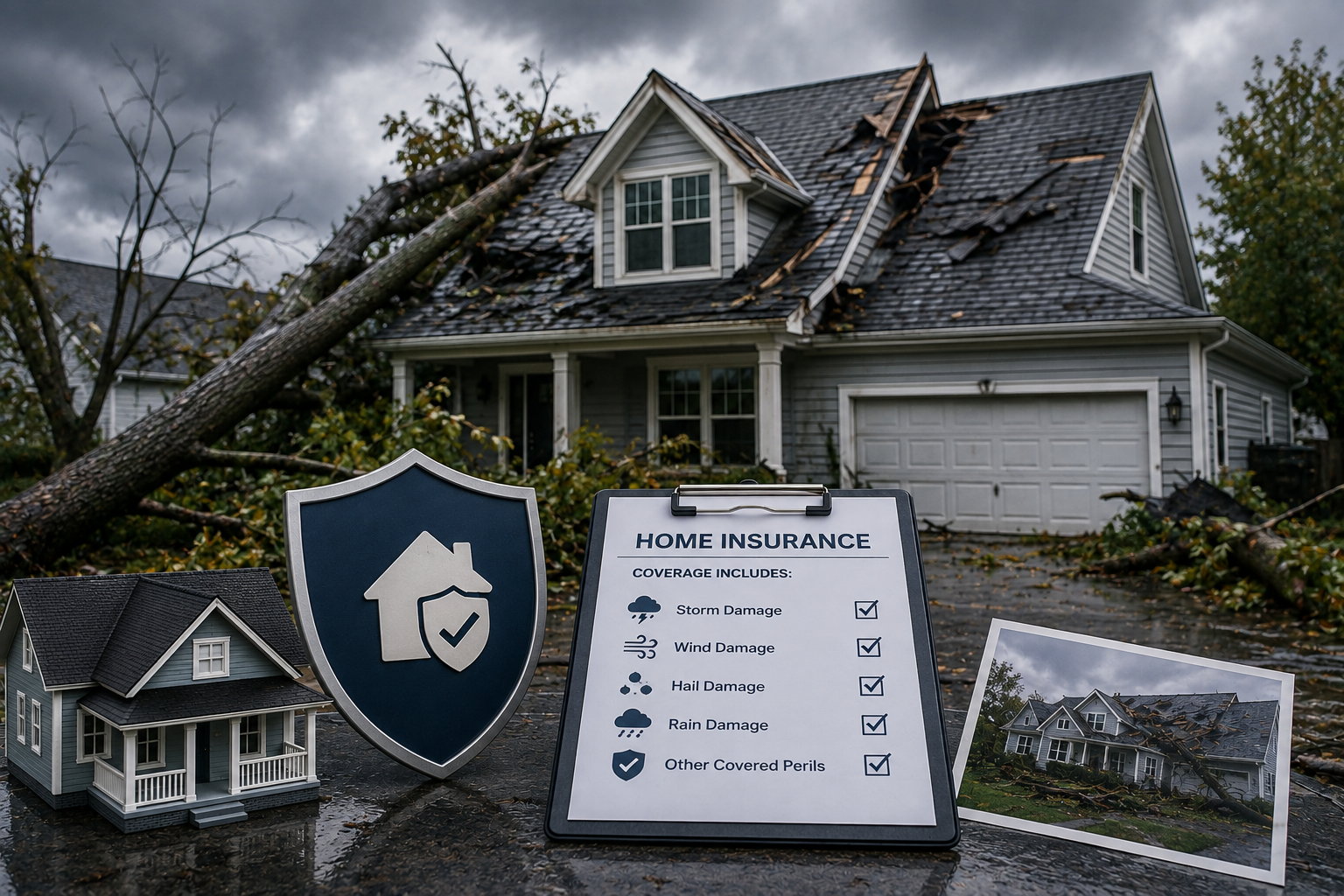
Home insurance commonly covers storm damage caused by wind, hail, lightning, falling objects, and certain rain damage when those causes of loss are covered by the policy. Flooding and storm surge are generally different: standard homeowners insurance usually does not cover them. Coverage also depends on your deductible, policy form, roof settlement provisions, exclusions, limits, and whether separate wind or flood insurance is required where you live.
Key Takeaways
- Homeowners insurance commonly covers windstorm, hail, and lightning damage, subject to policy terms.
- Rain entering through storm-created roof or wall damage may be covered, while flooding from rising surface water generally is not.
- Some coastal homeowners policies exclude wind and hail, requiring separate windstorm coverage.
- Wind, hail, hurricane, or named-storm claims may have a different deductible from other homeowners claims.
- Roof age, condition, replacement-cost provisions, actual cash value provisions, exclusions, and policy limits can substantially affect a storm claim payment.
What Types of Storm Damage Does Home Insurance Cover?
Homeowners insurance pays for damage caused by covered perils rather than simply covering every event described as a storm. The National Association of Insurance Commissioners identifies windstorm, hail, and lightning among causes of loss commonly covered by homeowners policies.
A single severe storm can create several different types of damage. Wind might remove shingles, hail might damage the roof and siding, a tree might fall onto the house, and rain might enter through the storm-created opening. At the same time, rising water from the same weather event could create flood damage that requires separate flood insurance.
| Storm Damage | Home Insurance May Cover It? | Important Detail |
|---|---|---|
| Wind damages the roof | Commonly covered. | Wind exclusions or special deductibles can apply, especially in coastal areas. |
| Hail damages shingles or siding | Commonly covered. | Roof age, condition, deductible, and settlement method can affect payment. |
| Lightning damages the home | Commonly covered. | The resulting fire or electrical damage must satisfy policy terms. |
| Tree falls onto the house | Often covered when caused by an insured peril. | Tree removal coverage can have separate requirements or limits. |
| Rain enters through storm damage | May be covered. | Coverage is stronger when a covered storm first creates an opening in the home. |
| Rising floodwater enters the home | Generally no under standard homeowners insurance. | Separate flood insurance is generally needed. |
Does Home Insurance Cover Wind Damage?
Windstorm damage is commonly included in homeowners insurance. A covered claim might involve shingles torn from a roof, siding damaged by high winds, a fence blown down, or a tree or branch driven into an insured structure.
However, wind coverage is not identical nationwide. NAIC guidance notes that coastal homeowners may need separate windstorm protection when wind and hail are excluded from a standard homeowners policy. State residual-market plans or specialized wind insurers may be available in some high-risk areas.
Texas provides a clear state-specific example. The Texas Department of Insurance explains that homeowners outside many coastal areas probably have wind and hail protection in their homeowners policy, while some coastal property owners need separate windstorm insurance. Other states use their own rules and insurance programs.
Check the declarations page before storm season. Do not assume wind coverage is included simply because you have homeowners insurance, particularly if the property is near a coast or other high-wind area.
Does Home Insurance Cover Hail Damage?
Hail is also commonly a covered peril. A hailstorm can damage shingles, metal roofing, siding, windows, gutters, skylights, outdoor equipment, and other insured property.
The Texas Department of Insurance states that homeowners with wind and hail coverage should generally be able to make a claim for qualifying hail damage. That does not mean every roof showing age or deterioration qualifies for replacement.
Insurance is intended to address covered storm damage, not routine maintenance or ordinary wear and tear. If an old roof already had deterioration before a hailstorm, the insurer may distinguish pre-existing wear from new covered damage.
How Does Storm Insurance Cover Roof Damage?
Roof claims are one area where reading the policy closely matters. A homeowners policy may cover wind or hail damage while still limiting how much it pays based on the roof’s age, condition, material, deductible, and loss-settlement provisions.
Some policies provide replacement-cost protection for qualifying roof damage. Others may settle an older roof on an actual cash value basis or use a roof payment schedule that reduces the amount available as the roof ages.
Texas Department of Insurance guidance issued in 2026 advises homeowners to ask specifically how the policy will pay for roof damage because some policies pay the full qualifying replacement cost while others pay less based on roof age and condition.
| Roof Provision | Potential Effect on a Claim |
|---|---|
| Replacement cost | May provide reimbursement based on qualifying replacement costs, subject to policy conditions and limits. |
| Actual cash value | Depreciation can reduce payment for an older roof. |
| Roof payment schedule | Available payment may decrease based on roof age or material. |
| Wind or hail deductible | The homeowner may owe more out of pocket than under the policy’s ordinary deductible. |
Does Home Insurance Cover Rain Damage?
Rain damage can be covered or excluded depending on how the water entered the home. The cause of loss is important.
Suppose high winds tear shingles from a roof and rain then enters through the new opening. A homeowners policy with applicable wind coverage may cover qualifying roof damage and resulting interior water damage.
The analysis is different if rain accumulates outside and flows across the ground into the home. Rising or surface water is generally treated as flooding, which standard homeowners insurance usually excludes.
Does Home Insurance Cover Flooding From a Storm?
Generally, no. Standard homeowners insurance typically excludes flood damage. NAIC and the National Flood Insurance Program both distinguish flood insurance from ordinary homeowners coverage.
Flood can include water rising from rivers, streams, heavy rainfall, storm runoff, or similar surface-water events. A separate flood insurance policy can provide building and contents protection subject to the flood policy’s own terms.
This distinction becomes particularly important during hurricanes and tropical storms. Wind damage may be covered under homeowners or separate windstorm insurance, while storm surge and other qualifying flood damage generally require flood insurance.
One storm can require more than one policy. After a hurricane, for example, homeowners, windstorm, and flood insurance may each respond to different portions of the damage depending on the causes of loss.
Does Home Insurance Cover Lightning Damage?
Lightning is commonly included as a covered peril under homeowners insurance. A direct strike can cause a fire, damage the roof or structure, or affect electrical systems and covered personal property.
Whether damage to appliances, computers, televisions, or other electronics qualifies depends on the cause of loss and policy. The insurer may ask for documentation showing that the damage resulted from the covered lightning event rather than ordinary mechanical or electrical failure.
Does Home Insurance Cover a Tree Falling During a Storm?
A homeowners policy may cover damage when a tree or large branch falls onto the house because of a covered storm. Texas Department of Insurance storm guidance lists roof damage caused by a tree hitting the home during a storm as an example of damage a homeowners policy may cover.
Tree removal is a separate question. Policies may provide limited removal coverage when the tree damages a covered structure or blocks certain access, while simply removing a fallen tree from an open yard may receive less or no coverage.
If a neighbor’s tree falls on your home because of a storm, your own homeowners insurance may still be the first relevant property coverage. Whether the neighbor is legally responsible depends on negligence and the specific facts, not merely ownership of the tree.
How Do Wind, Hail, and Hurricane Deductibles Work?
Storm claims do not always use the same deductible that applies to fire, theft, or other homeowners losses. Some policies have a separate windstorm, wind-and-hail, hurricane, or named-storm deductible.
NAIC guidance explains that hurricane, named-storm, and windstorm deductibles can have specific triggers determined by the insurance contract and applicable state law. The rules are not uniform across the country.
Some storm deductibles are expressed as a percentage rather than a flat dollar amount. If so, the amount can be substantially larger than a standard deductible because the percentage may be applied to the insured dwelling amount according to the policy.
Hypothetical Deductible Example
Consider a hypothetical home insured for $400,000 with a storm deductible equal to 2% of the applicable insured amount. A 2% calculation on $400,000 would equal $8,000. These figures are examples only and are not national averages or a statement that every percentage deductible is calculated the same way.
The example demonstrates why homeowners should check the declarations page before a storm occurs. A percentage deductible can create a much larger out-of-pocket obligation than a familiar flat-dollar deductible.
Will Home Insurance Pay for Temporary Housing After a Storm?
Loss-of-use or additional living expense coverage may help when covered storm damage makes the insured residence uninhabitable.
Qualifying expenses can include additional costs for temporary housing, meals, storage, or transportation, depending on the policy. The coverage is generally intended to address increases above normal living expenses rather than every expense the household incurs while displaced.
Coverage also depends on the cause that made the home uninhabitable. For example, loss-of-use benefits under the homeowners policy may apply after covered wind damage, while displacement caused solely by an excluded flood may need to be evaluated under different coverage.
When Might Storm Damage Not Be Covered?
A severe storm does not automatically make every resulting loss a covered homeowners claim. Common limitations to review include:
- Flood exclusions: Rising surface water and storm surge generally require separate flood insurance.
- Wind or hail exclusions: Certain coastal or high-risk policies may exclude these perils.
- Wear and tear: Insurance generally does not pay simply because an old roof or deteriorated siding reaches the end of its useful life.
- Maintenance problems: Long-term leaks, rot, deterioration, or neglected repairs can be treated differently from sudden storm damage.
- Insufficient limits: A covered storm can still produce repair costs exceeding available insurance.
- Special deductibles or endorsements: These can significantly change the amount payable after wind, hail, or hurricane damage.
Storm damage claims can involve multiple causes. Wind, rain, flooding, falling objects, and pre-existing deterioration may all be present after the same event, so coverage can depend on which cause produced each portion of the damage.
What Should You Do After Storm Damage?
Prioritize personal safety before inspecting or documenting damage. Stay away from downed electrical lines, unstable trees, standing water near electrical systems, damaged roofs, and structurally unsafe areas.
- Photograph and record the damage. Take clear pictures and videos of exterior and interior damage when it is safe.
- Notify the appropriate insurer. Depending on the cause, that could involve homeowners, windstorm, or flood insurance.
- Prevent additional damage. Reasonable temporary repairs such as covering a roof opening or broken window may be necessary.
- Keep receipts. Save receipts for temporary repairs and eligible additional living expenses.
- Avoid unnecessary permanent repairs before inspection. Give the insurer a reasonable opportunity to evaluate covered damage when practical.
- Review the policy. Check the deductible, wind and hail provisions, roof settlement terms, exclusions, and applicable limits.
Texas Department of Insurance storm guidance similarly recommends documenting damage, preventing additional loss, saving receipts, and reporting claims promptly.
How to Review Your Storm Coverage Before Severe Weather
The best time to discover a coverage gap is before a storm appears in the forecast. Review the policy periodically and after major changes to the home.
- Confirm wind and hail coverage. Do not assume it is included in coastal areas.
- Check every applicable deductible. Look for windstorm, hail, hurricane, and named-storm deductibles.
- Review the roof settlement method. Determine whether the roof is covered at replacement cost, actual cash value, or under another schedule.
- Check the dwelling limit. Compare it with current rebuilding costs rather than the home’s market price alone.
- Review other structures and personal property limits. Storms can damage much more than the main house.
- Evaluate flood insurance separately. Homeowners coverage generally does not replace flood insurance.
- Create a home inventory. Photographs, videos, receipts, serial numbers, and other records can help document a major claim.
Frequently Asked Questions
The Bottom Line
Home insurance commonly covers storm damage caused by wind, hail, lightning, falling objects, and certain rain damage. The protection can extend to the dwelling, qualifying detached structures, personal belongings, and additional living expenses when a covered storm makes the home uninhabitable.
Flood and storm surge generally require separate insurance, and some coastal homeowners also need separate windstorm coverage. Review your wind and hail protection, storm deductibles, roof settlement provisions, dwelling limit, flood insurance, exclusions, and endorsements before severe weather occurs. The actual policy and applicable state rules determine how a specific storm claim is handled.
Sources
- National Association of Insurance Commissioners, Homeowners Insurance, updated October 25, 2025.
- National Association of Insurance Commissioners, Flood Insurance, updated June 23, 2026.
- National Association of Insurance Commissioners, Hurricane Deductibles, accessed August 2026.
- Texas Department of Insurance, What Is Windstorm Insurance?, updated June 1, 2026.
- Texas Department of Insurance, What to Know About Insurance and Your Roof, March 2026.
- National Flood Insurance Program, Flood Insurance Basics, accessed August 2026.