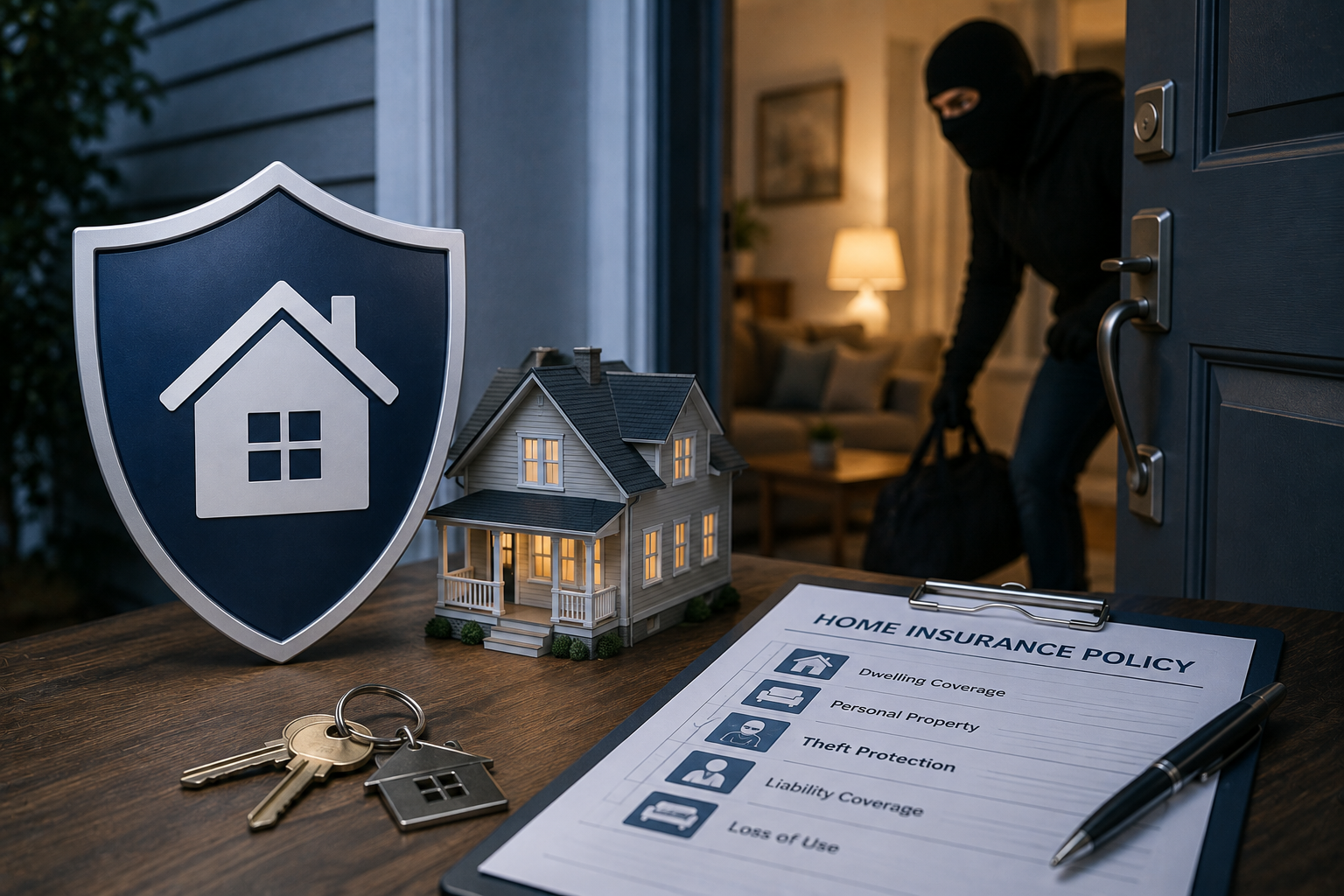
Homeowners insurance typically covers theft of personal belongings when theft is a covered peril under the policy. Coverage may apply to items stolen from your home and, depending on the policy, belongings stolen elsewhere. However, deductibles, personal property limits, valuation rules, and special limits for jewelry, firearms, collectibles, cash, and other valuables can substantially affect how much the insurer pays.
Key Takeaways
- Theft is commonly a covered peril under homeowners insurance, subject to the policy’s terms and exclusions.
- Personal property coverage generally pays for covered stolen belongings rather than the structure of the home itself.
- Jewelry, firearms, cash, silverware, collectibles, and other valuables may have special theft limits below your overall personal property limit.
- Some homeowners policies provide coverage for belongings stolen away from home, but off-premises limits and conditions can apply.
- The amount paid can depend on your deductible and whether personal property is insured on an actual cash value or replacement cost basis.
How Does Home Insurance Cover Theft?
Homeowners insurance generally protects personal property against specified covered causes of loss. The National Association of Insurance Commissioners identifies theft as a peril commonly included in homeowners coverage.
If someone breaks into your home and steals covered belongings, the personal property section of the policy may reimburse you for the qualifying loss. Payment remains subject to your deductible, personal property limit, special limits, exclusions, and the policy’s method of valuing the stolen property.
Not every homeowners policy covers property in exactly the same way. Some policy forms insure personal property only against listed or named perils, while broader forms can insure personal property against a wider range of losses except those specifically excluded. The policy contract determines whether a particular theft loss qualifies.
What Stolen Property Can Home Insurance Cover?
Personal property coverage generally applies to household belongings owned by you and, depending on the policy, qualifying family members who live with you.
Examples of belongings that may be covered after a qualifying theft include:
- Furniture and household furnishings.
- Televisions and personal electronics.
- Clothing and shoes.
- Personal computers and other qualifying electronics.
- Kitchen equipment and household goods.
- Sports equipment.
- Other covered personal belongings, subject to policy limits and exclusions.
| Theft Scenario | Home Insurance May Apply? | Important Consideration |
|---|---|---|
| Television stolen during a burglary | Generally, if theft is covered. | Personal property limit, deductible, and valuation method apply. |
| Jewelry stolen from the home | May be covered. | A special theft limit may substantially restrict payment. |
| Laptop stolen while traveling | May be covered. | Off-premises limits and business-use restrictions may apply. |
| Belongings stolen from a car | May be covered under personal property coverage. | The vehicle itself is not covered by homeowners insurance. |
| Cash stolen from the home | May have limited coverage. | Policies commonly impose a low special limit on money. |
| Your car is stolen | Generally no. | Vehicle theft is generally handled by comprehensive auto insurance. |
Special Limits Can Reduce Theft Coverage
Your overall personal property limit does not necessarily mean every type of property is insured up to that amount. Homeowners policies commonly contain lower limits for particular categories of belongings, especially when the loss involves theft.
Items that may be subject to special limits include:
- Jewelry and watches.
- Furs and precious stones.
- Firearms.
- Silverware and other valuable metalware.
- Cash and similar property.
- Antiques and collectibles.
- Property used for business purposes.
New York’s Department of Financial Services, for example, explains that standard policies commonly contain specific theft limits for categories such as jewelry, firearms, and silverware. Those dollar amounts are examples of one regulator’s description of common policy structures and should not be treated as nationwide limits.
Check valuables before a loss occurs. If the value of jewelry, art, collectibles, firearms, or another category exceeds your policy’s special limit, an endorsement, scheduled personal property coverage, or separate policy may provide broader protection.
Does Home Insurance Cover Theft Away From Home?
It can. Many homeowners policies provide some personal property protection away from the residence. That means covered belongings may remain insured while traveling, staying at a hotel, or in certain other locations.
NAIC consumer guidance notes that homeowners coverage can follow insured belongings away from home and may protect property stolen while traveling. The exact coverage remains policy-specific.
Off-premises limits can also be lower than the amount available for property located at the insured residence. New York’s Department of Financial Services, for example, describes a common policy structure in which off-premises personal property coverage is a percentage of the dwelling limit. Other insurers and states may use different provisions.
Does Home Insurance Cover Items Stolen From Your Car?
Personal belongings stolen from a vehicle may be covered under the personal property portion of a homeowners policy if the theft qualifies and the policy provides off-premises protection.
For example, a covered laptop or suitcase stolen during a vehicle break-in may fall under homeowners personal property coverage rather than auto insurance. Deductibles, special limits, business-use restrictions, and off-premises limits can still apply.
The vehicle itself is different. If your car is stolen, homeowners insurance generally does not pay to replace it. Comprehensive auto coverage is the coverage commonly used for vehicle theft.
Actual Cash Value vs. Replacement Cost After Theft
The way your personal property is valued can make a major difference in a theft settlement.
Actual Cash Value
Actual cash value generally accounts for depreciation. An older stolen item may therefore produce a lower claim payment than the amount required to purchase a new equivalent item.
Replacement Cost
Replacement cost coverage generally reimburses the cost of replacing covered property with property of similar kind and quality without the same deduction for depreciation, subject to the policy’s limits and settlement provisions.
Some replacement cost policies initially pay actual cash value and provide additional reimbursement after the item is replaced. Review the loss-settlement section of the policy to understand how your coverage works.
| Feature | Actual Cash Value | Replacement Cost |
|---|---|---|
| Depreciation | Generally considered. | Generally not deducted from the final qualifying replacement-cost amount. |
| Potential payment | Can be lower for older belongings. | Can more closely reflect the cost of purchasing a new comparable item. |
| Replacement requirement | Usually not required to establish the depreciated value. | The policy may require actual replacement before the full replacement-cost benefit is paid. |
How Does the Home Insurance Deductible Affect a Theft Claim?
A homeowners deductible is generally the amount you are responsible for before the insurer pays a covered property claim. The deductible can make smaller theft claims less practical to file.
Consider a hypothetical theft involving $5,000 of covered personal property and a $1,000 deductible. If the entire $5,000 qualifies for coverage and no special limits reduce the loss, the insurer could generally pay $4,000. These numbers are illustrative only and are not national averages.
Special property limits can change the calculation. If a large portion of the loss consists of jewelry or another category with a lower theft limit, the claim payment may be significantly less than the total value of everything stolen.
When Might a Theft Claim Not Be Fully Covered?
Several policy provisions can reduce or eliminate payment even when theft is generally a covered peril.
- Your deductible exceeds the covered loss: A small loss may result in little or no insurer payment.
- A special limit applies: Valuable categories may have lower maximum payments for theft.
- The property exceeds the overall personal property limit: The policy generally will not pay unlimited amounts.
- Business property restrictions apply: Homeowners policies commonly limit coverage for property used for business purposes.
- Off-premises limits apply: Property stolen away from home may be subject to different limits or conditions.
- The circumstances fall within an exclusion: Coverage always depends on the policy language and claim facts.
The word “theft” appearing in a policy does not guarantee full reimbursement for every stolen item. Coverage depends on who owned the property, where the theft occurred, the type of property, the applicable limit, the deductible, valuation provisions, exclusions, and other policy terms.
What Should You Do After a Home Theft?
The specific claim process depends on the insurer and state, but several steps can help document a theft claim.
- Report the theft to law enforcement. A police report may be important documentation for the insurance claim.
- Notify your insurer promptly. Claim reporting requirements and deadlines can vary.
- Create a list of stolen property. Include descriptions, approximate purchase dates, values, model numbers, and serial numbers where available.
- Gather proof of ownership. Receipts, photographs, videos, appraisals, bank statements, manuals, and prior home inventories may help establish what you owned.
- Document property damage. Photograph damaged doors, windows, locks, or other evidence of the break-in before permanent repairs when it is safe to do so.
- Review your policy. Check the deductible, personal property limit, special limits, endorsements, and valuation method.
NAIC recommends maintaining a home inventory because insurers may require documentation of the personal property involved in a claim. Keeping records before a theft can make it easier to demonstrate ownership and value afterward.
How to Review Your Theft Coverage Before You Need It
A few policy checks can reveal potential gaps before anything is stolen.
- Check your personal property limit. Compare it with the approximate value of everything you own.
- Review special theft limits. Pay particular attention to jewelry, firearms, cash, silverware, art, and collectibles.
- Confirm your valuation method. Determine whether your belongings are insured at actual cash value or replacement cost.
- Check off-premises coverage. Understand what happens if belongings are stolen while traveling or from a vehicle.
- Review business property limits. Home-based business equipment may have substantially different protection.
- Consider scheduling valuable items. An endorsement or separate personal articles policy may provide higher limits or broader protection.
- Create a home inventory. Keep photographs, serial numbers, receipts, and other records in a secure location.
Frequently Asked Questions
The Bottom Line
Homeowners insurance commonly covers theft of personal belongings when theft is an insured peril. Coverage may extend beyond the home, but the amount available depends on your personal property limit, deductible, off-premises provisions, valuation method, exclusions, and the circumstances of the theft.
Valuable items deserve extra attention because jewelry, firearms, cash, collectibles, silverware, and other categories may have special theft limits. Review your policy before a loss, consider scheduling high-value belongings when appropriate, and maintain a current home inventory so you can document what you owned if a theft occurs.
Sources
- National Association of Insurance Commissioners, Homeowners Insurance, updated October 25, 2025.
- National Association of Insurance Commissioners, What You Need to Know When Filing a Homeowners Claim, April 20, 2022.
- New York State Department of Financial Services, Homeowners Insurance: Basic Coverage and Adding Coverage, accessed August 2026.
- California Department of Insurance, Residential Insurance: Homeowners and Renters, accessed August 2026.