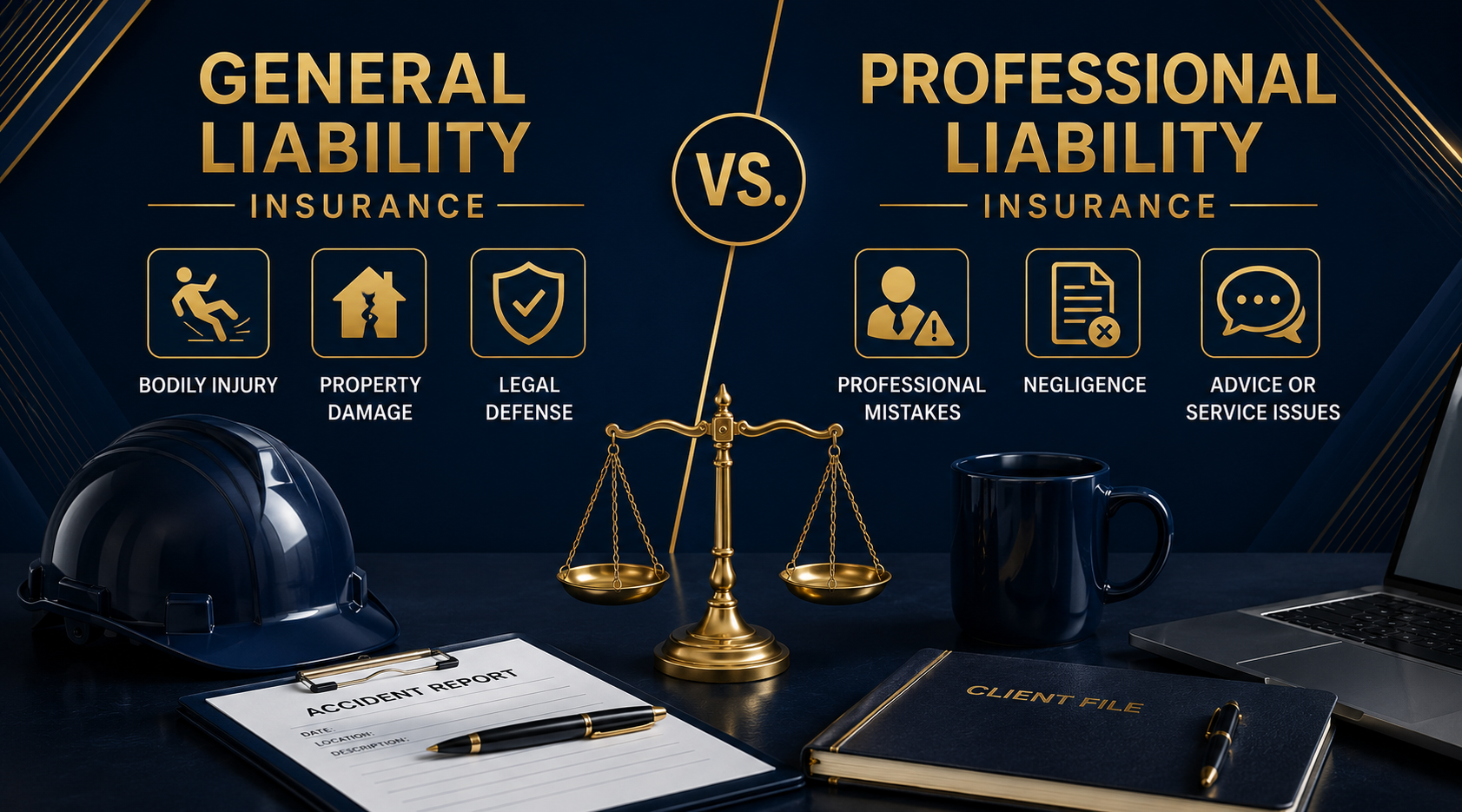
General liability and professional liability insurance protect businesses against different types of lawsuits. General liability generally covers certain third-party bodily injury, property damage, and personal or advertising injury claims. Professional liability generally covers claims alleging that your advice, services, errors, omissions, or negligence caused a client financial loss. Many service businesses need both because neither policy is a complete substitute for the other.
Key Takeaways
- General liability primarily addresses certain bodily injury, property damage, and personal or advertising injury claims involving third parties.
- Professional liability focuses on allegations involving professional mistakes, negligence, errors, omissions, or inadequate services.
- A consultant, accountant, technology company, designer, or other service business can face both general and professional liability claims.
- Professional liability is often written on a claims-made basis, while commercial general liability is commonly structured around occurrences.
- Choosing between the two is often the wrong question because many businesses have exposures that require both coverages.
General Liability vs. Professional Liability: What Is the Difference?
The simplest difference is the type of harm each policy is designed to address.
General liability insurance is mainly concerned with certain physical injuries, property damage, and specified personal or advertising injury claims involving people outside your business.
Professional liability insurance is mainly concerned with financial harm allegedly caused by your professional advice, services, mistakes, or failure to perform as expected.
| Feature | General Liability | Professional Liability |
|---|---|---|
| Primary risk | Third-party bodily injury, property damage, and certain personal or advertising injury claims. | Professional errors, omissions, negligence, advice, or service failures. |
| Typical claim | A customer slips in your office and is injured. | A client alleges your professional advice caused a financial loss. |
| Property damage | Can cover certain damage to another person’s property. | Generally not the primary focus. |
| Pure financial loss | Generally not the main purpose of the policy. | Can be a central exposure. |
| Common policy structure | Often occurrence-based. | Often claims-made. |
What Does General Liability Insurance Cover?
Commercial general liability insurance, commonly called CGL insurance, is one of the most common foundational business policies.
It can generally respond to certain claims involving:
- Bodily injury: A customer, visitor, vendor, or other third party is injured and alleges that your business is responsible.
- Property damage: Your business allegedly damages property belonging to another person or organization.
- Personal injury: Certain covered offenses such as libel, slander, or other policy-defined claims.
- Advertising injury: Certain covered claims related to advertising activities.
- Legal defense: Eligible defense costs for covered lawsuits.
General Liability Example
Suppose a client visits your office, trips over an unsecured electrical cable, suffers an injury, and files a lawsuit.
If the claim falls within your general liability policy, the insurer can potentially help pay eligible:
- Legal defense costs.
- Medical-related damages claimed by the injured party.
- Settlements.
- Court judgments.
The policy remains subject to applicable limits, exclusions, conditions, and other terms.
What Does Professional Liability Insurance Cover?
Professional liability insurance protects against a different category of risk: allegations involving your professional work.
Depending on the policy and profession, covered allegations can involve:
- Professional negligence.
- Errors.
- Omissions.
- Inaccurate advice.
- Failure to provide promised professional services.
- Certain missed deadlines.
- Certain unintentional misrepresentations.
- Other covered professional wrongful acts.
Professional liability is also commonly called errors and omissions insurance, or E&O, although terminology and policy forms vary by profession.
Professional Liability Example
Suppose a business consultant recommends a new operating system for a client.
The client later alleges that the recommendation was professionally negligent and caused a $300,000 financial loss.
If the allegation is covered, professional liability insurance may help pay eligible defense expenses, settlements, or judgments up to the applicable limit.
There does not need to be a physical injury or damaged building for a professional liability claim to become expensive.
Why Many Businesses Need Both Policies
A service business can face physical liability risks and professional liability risks at the same time.
Consider an accounting firm.
| Scenario | Coverage That May Apply |
|---|---|
| A client slips in the firm’s office and is injured. | General liability. |
| An employee accidentally damages property at a client’s office. | Potentially general liability, subject to policy terms. |
| A client alleges an accounting error caused a major financial loss. | Professional liability. |
Buying only general liability would leave the professional-services exposure potentially uninsured.
Buying only professional liability would leave ordinary premises and third-party property damage risks potentially uninsured.
Which Businesses Commonly Need General Liability?
General liability can be relevant to almost any business that interacts with customers, vendors, landlords, contractors, or the public.
Examples include:
- Retail stores.
- Restaurants.
- Contractors.
- Cleaning companies.
- Landscapers.
- Consultants.
- Technology companies.
- Photographers.
- Wholesalers.
- Home-based businesses.
Even an office-based business can face a slip-and-fall claim or accidentally damage property belonging to a third party.
Which Businesses Commonly Need Professional Liability?
Professional liability is particularly important when customers rely on your specialized knowledge, advice, analysis, designs, recommendations, or services.
Examples can include:
- Consultants.
- Accountants.
- Bookkeepers.
- Architects.
- Engineers.
- Technology service providers.
- Software developers.
- Marketing agencies.
- Designers.
- Real estate professionals.
- Insurance professionals.
- Other professional or advisory businesses.
General Liability vs. Professional Liability Claims
The easiest way to distinguish the policies is to look at what allegedly caused the loss.
| Claim Scenario | Likely Coverage to Review |
|---|---|
| Customer falls inside your store. | General liability. |
| Employee damages a client’s furniture while performing work. | General liability may apply, subject to exclusions and policy terms. |
| Client alleges your advice cost the company $500,000. | Professional liability. |
| Software implementation allegedly fails because of your professional error. | Technology E&O or professional liability. |
| A client alleges defamatory statements caused harm. | Potentially general liability personal and advertising injury coverage, depending on the facts and exclusions. |
What General Liability Does Not Replace
General liability does not provide complete business protection.
It generally should not be treated as a substitute for:
- Professional liability.
- Workers’ compensation.
- Commercial auto insurance.
- Commercial property insurance.
- Cyber insurance.
- Employment Practices Liability Insurance.
A company’s insurance program should address each major exposure separately rather than expecting one policy to solve every problem.
What Professional Liability Does Not Replace
Professional liability also has important limits.
It generally is not intended to replace coverage for:
- Customer slip-and-fall injuries.
- Ordinary third-party property damage.
- Work-related employee injuries.
- Damage to your own business property.
- Commercial vehicle accidents.
- Many employment-related lawsuits.
- Every cyber incident.
Some specialized professional liability policies can contain broader or overlapping protection, but coverage should never be assumed without reviewing the actual contract.
Occurrence vs. Claims-Made Coverage
One of the most important technical differences between these policies is how coverage is triggered over time.
Commercial general liability insurance is commonly written on an occurrence basis.
Professional liability insurance is commonly written on a claims-made basis.
| Policy Type | General Concept |
|---|---|
| Occurrence | Coverage generally focuses on whether the covered injury or damage occurred during the policy period, subject to the contract. |
| Claims-made | Coverage generally depends on when a claim is made or reported and whether the underlying act satisfies the policy’s retroactive-date requirements. |
This distinction can make professional liability coverage continuity especially important.
Why the Retroactive Date Matters
A claims-made professional liability policy can include a retroactive date.
A professional act occurring before that date may not qualify for coverage even if the client makes the claim while the current policy is active.
For example:
Retroactive date: January 1, 2023
Professional work performed: September 2024
Claim made: February 2026
The professional work occurred after the hypothetical retroactive date, so that timing requirement could potentially be satisfied, assuming all other policy requirements are met.
When changing professional liability insurers, preserving prior-acts protection can be critical.
Tail Coverage and Extended Reporting Periods
If a claims-made professional liability policy ends, an extended reporting period may allow certain claims involving prior covered work to be reported after the policy terminates.
This is often informally called tail coverage.
It can be particularly relevant when:
- A professional retires.
- A business closes.
- A company is sold.
- A claims-made policy is discontinued.
- A business changes coverage and cannot obtain full prior-acts protection.
An extended reporting period generally does not insure new professional work performed after coverage ends.
How Policy Limits Differ
Both policies use liability limits, but the structures can differ.
General Liability Limits
A commercial general liability policy can include:
- Each occurrence limit.
- General aggregate limit.
- Products-completed operations aggregate.
- Personal and advertising injury limit.
- Other separate limits or sublimits.
Professional Liability Limits
Professional liability commonly includes:
- Per-claim limit.
- Aggregate limit.
- Special sublimits for particular exposures.
The policy’s treatment of defense costs is particularly important for professional liability insurance.
Defense Costs Can Change the Comparison
Two policies with the same $1 million headline limit may provide materially different practical protection.
Some professional liability contracts include defense expenses within the policy limit.
Suppose a hypothetical professional liability policy has a $1 million limit and defense expenses reduce that amount.
If an eligible lawsuit generates $250,000 in defense expenses:
$1,000,000 policy limit − $250,000 defense costs = $750,000 potentially remaining for covered damages
A policy with defense outside the limit can operate differently.
This is why buyers should compare more than the headline limit and premium.
Do General Liability and Professional Liability Have Deductibles?
The answer varies by policy.
General liability policies may have deductibles or self-insured amounts for certain claims, although structures differ widely.
Professional liability policies commonly use a deductible or self-insured retention.
When comparing professional liability options, ask:
- Does the deductible apply to damages only?
- Does it also apply to defense costs?
- Who controls the defense before a retention is exhausted?
- Could the company comfortably pay the deductible after a claim?
General Liability vs. Professional Liability Exclusions
Both policies contain exclusions that can materially affect coverage.
| Exposure | General Liability | Professional Liability |
|---|---|---|
| Intentional misconduct | Commonly excluded or restricted. | Commonly excluded or restricted. |
| Employee injuries | Generally handled through workers’ compensation. | Generally outside ordinary professional liability. |
| Auto liability | Generally requires commercial auto coverage. | Generally outside coverage. |
| Professional errors | Generally not the purpose of CGL coverage. | Core exposure when covered. |
| Known prior circumstances | Policy-specific. | Can be especially important under claims-made coverage. |
What About Cyber Claims?
Cyber liability can overlap with professional liability in some industries, particularly technology.
For example, a technology E&O policy may address certain claims alleging that your technology services failed and caused a client loss.
A broader cyber policy can also provide first-party and third-party protection involving:
- Data breach response.
- Forensic investigation.
- Notification expenses.
- Cyber business interruption.
- Data restoration.
- Privacy liability.
- Network security claims.
Neither ordinary general liability nor ordinary professional liability should automatically be assumed to provide complete cyber protection.
Does a Business Owner’s Policy Include Both?
A Business Owner’s Policy, commonly called a BOP, typically combines general liability, commercial property, and business income coverage for eligible businesses.
Professional liability is generally a separate concern.
Some insurers may offer professional liability by endorsement or as a companion policy, but a business owner should not assume that purchasing a BOP automatically provides E&O protection.
A consultant with a BOP could therefore still need a separate professional liability policy.
How Much General Liability Coverage Do You Need?
There is no single appropriate limit for every company.
Factors include:
- Customer traffic.
- Work performed at customer locations.
- Products sold.
- Potential severity of bodily injury claims.
- Third-party property exposure.
- Commercial lease requirements.
- Customer contracts.
- Business assets.
A business with significant liability exposure may also consider commercial umbrella or excess liability coverage above qualifying underlying limits.
How Much Professional Liability Coverage Do You Need?
Professional liability limits should reflect how much financial harm your services could realistically cause a client.
Consider:
- Largest client engagement.
- Size of customers.
- Potential downstream consequences of an error.
- Contractual limits.
- Defense-cost structure.
- Industry expectations.
- Claims history.
The value of the project does not necessarily equal the size of the potential lawsuit.
A $50,000 consulting engagement could still lead to a much larger claim if the customer alleges the advice caused hundreds of thousands of dollars in financial losses.
A Practical Example: Business Needs Both Policies
Consider a hypothetical digital marketing agency with:
- A leased office.
- Regular client meetings.
- Employees who sometimes work at customer locations.
- Large advertising campaigns managed for clients.
- Contracts requiring liability insurance.
During one year, two unrelated claims occur.
Claim 1: Office Injury
A client visits the agency, slips on a wet floor, suffers a serious injury, and files a lawsuit.
This is primarily the type of exposure for which general liability would be reviewed.
Claim 2: Professional Service Dispute
Another client alleges that an error in the agency’s campaign strategy caused $400,000 in financial losses.
This is primarily the type of exposure for which professional liability would be reviewed.
The first policy cannot automatically replace the second because the losses arise from fundamentally different risks.
Which Policy Costs More?
There is no universal answer.
Premiums depend on the nature and severity of each company’s risks.
General Liability Pricing Factors
- Industry.
- Revenue.
- Payroll.
- Customer traffic.
- Location.
- Products and completed operations exposure.
- Limits.
- Claims history.
Professional Liability Pricing Factors
- Profession.
- Services provided.
- Revenue.
- Largest contracts.
- Client industries.
- Limits and retention.
- Claims history.
- Retroactive coverage.
A low-risk office business might pay relatively little for general liability but substantially more for professional liability if a professional mistake could create a multimillion-dollar client loss.
Is Either Policy Legally Required?
There is no single federal requirement forcing every U.S. business to carry general liability or professional liability insurance.
However, coverage can become necessary because of:
- State licensing requirements for certain professions.
- Local requirements.
- Customer contracts.
- Commercial leases.
- Government contracts.
- Lender or other contractual requirements.
Rules vary by profession and state. Businesses should verify applicable requirements with the relevant state insurance regulator, licensing board, and contractual counterparties.
How Contracts Affect the Coverage You Need
Client agreements frequently specify insurance requirements.
A contract can require:
- General liability limits.
- Professional liability limits.
- Additional insured status.
- A particular retroactive date.
- Coverage to remain in force for a specified period after work is completed.
- Certificates of Insurance.
Contract language can also create obligations broader than the insurance policy.
A company should therefore compare its contract provisions with actual policy coverage rather than assuming that insurance automatically covers every obligation it agrees to accept.
Can One Claim Trigger Both Policies?
Potentially, but overlapping claims can be complicated.
For example, a professional service could allegedly cause both physical property damage and a financial loss.
Which policy responds can depend on:
- The allegations in the claim.
- How professional services are defined.
- Professional-services exclusions in the general liability policy.
- Bodily injury or property damage exclusions in the professional liability policy.
- Any endorsements modifying the contracts.
Businesses should report potentially covered claims promptly to all insurers that may be relevant rather than trying to make the coverage determination themselves.
How to Decide Whether You Need Both
- Ask whether third parties can be physically injured. If customers or visitors interact with your business, general liability deserves consideration.
- Ask whether you can damage customer property. Work performed at client locations can create general liability exposure.
- Ask whether clients rely on your expertise. Advice, recommendations, designs, analysis, or specialized services can create professional liability exposure.
- Estimate potential financial harm. Consider how expensive a professional mistake could become for your largest clients.
- Review your contracts. Customers and landlords may require one or both policies.
- Review exclusions. Make sure important risks are not falling between policies.
- Check limits and defense structures. Two policies with similar premiums can provide materially different protection.
Common Mistakes When Comparing the Two
- Assuming general liability covers professional mistakes: Professional services can require separate E&O coverage.
- Assuming professional liability covers customer injuries: Premises liability generally belongs under general liability.
- Ignoring claims-made timing: A lapse or retroactive-date change can create a professional liability gap.
- Comparing limits without defense provisions: Defense costs can erode professional liability limits under some policies.
- Assuming a BOP automatically includes E&O: Professional liability may need to be purchased separately.
- Buying only what a contract requires: Contract limits can be lower than the company’s actual exposure.
- Ignoring cyber overlap: Technology companies should carefully coordinate professional liability and cyber coverage.
Frequently Asked Questions
The Bottom Line
General liability and professional liability insurance protect against different business risks. General liability generally handles certain third-party bodily injury, property damage, and personal or advertising injury claims, while professional liability generally addresses claims arising from professional advice, services, errors, omissions, or negligence.
For many service businesses, the decision is not general liability or professional liability. It is whether the company has enough of both to cover the risks it actually faces.
Review your customer interactions, professional services, contracts, potential lawsuit severity, policy limits, exclusions, deductibles or retentions, defense provisions, and claims-made requirements. The most effective insurance program coordinates the policies so a major physical liability claim or professional error does not create an avoidable coverage gap.
Sources
- U.S. Small Business Administration, Business Insurance guidance.
- National Association of Insurance Commissioners, Commercial Insurance and Small Business Insurance consumer resources.
- State Departments of Insurance for commercial insurance consumer guidance and state-specific requirements.
- Applicable state professional licensing boards for profession-specific liability insurance requirements.