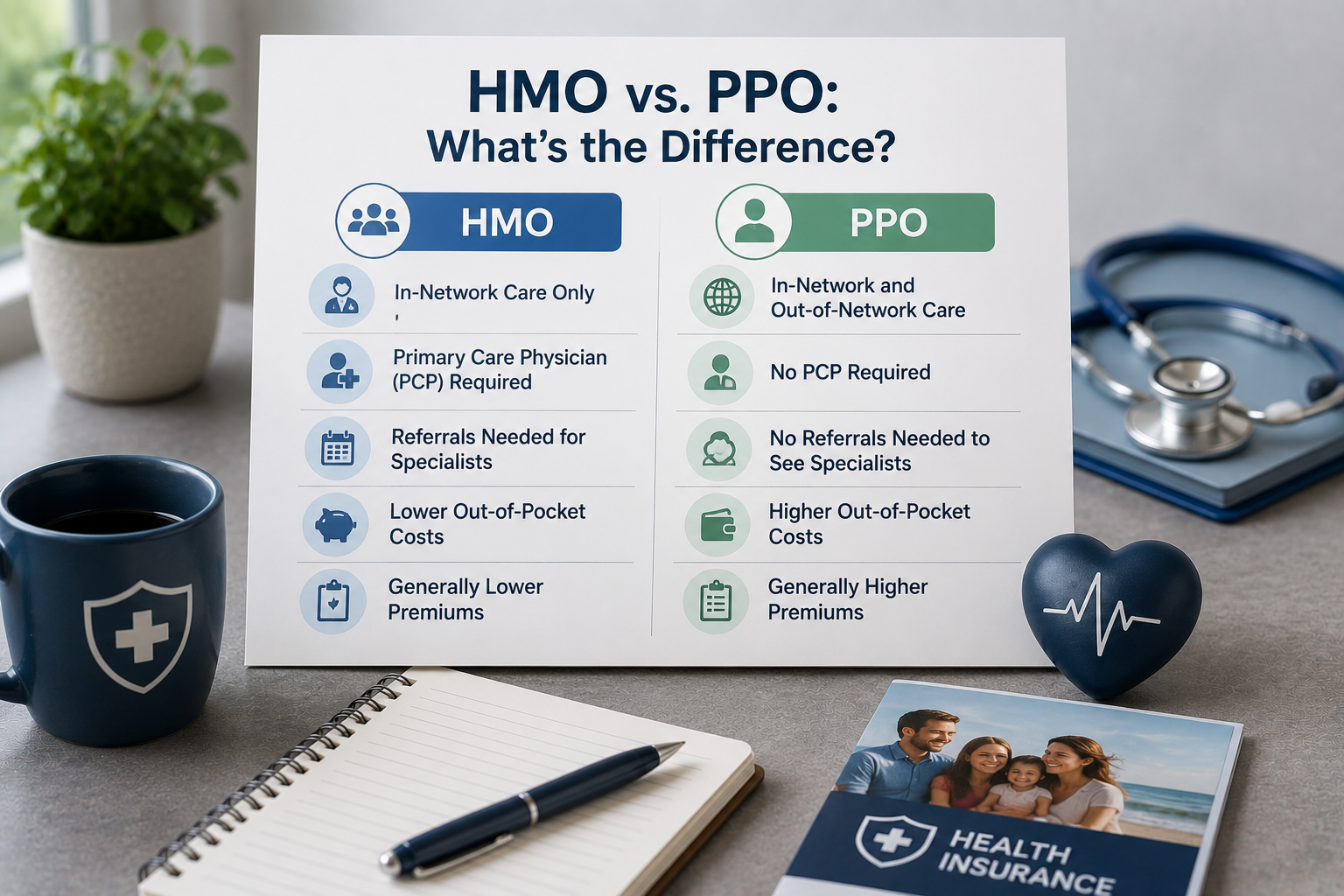
The main difference between an HMO and a PPO is how much flexibility you have to use doctors and hospitals outside the plan’s network. An HMO generally limits non-emergency coverage to in-network providers and may require referrals for specialist care. A PPO generally lets you see both in-network and out-of-network providers without a referral, although using out-of-network care usually costs more. Exact rules and costs depend on the specific health plan.
Key Takeaways
- HMOs generally provide non-emergency coverage through the plan’s network and usually do not cover ordinary out-of-network care.
- PPOs generally let members use out-of-network providers, but the member usually pays more.
- Many HMOs require a primary care doctor referral before certain specialist services, while PPOs generally allow specialist visits without referrals.
- Neither an HMO nor a PPO is automatically cheaper. Compare premiums, deductibles, copays, coinsurance, and out-of-pocket limits for the specific plans available to you.
- Your doctors, hospitals, prescriptions, geographic needs, and expected medical care can matter more than the HMO or PPO label by itself.
What Is an HMO?
HMO stands for Health Maintenance Organization. An HMO generally provides coverage through a defined network of doctors, hospitals, pharmacies, and other health care providers that work for or contract with the plan.
For ordinary non-emergency care, an HMO typically requires members to use providers within that network. HealthCare.gov notes that HMOs generally do not cover out-of-network care except in an emergency.
Some HMOs also require members to live or work within a particular service area. The network and service area therefore deserve close attention if you travel frequently, split time between multiple locations, or want to keep doctors who practice outside the plan’s network.
What Is a PPO?
PPO stands for Preferred Provider Organization. Like an HMO, a PPO contracts with doctors, hospitals, and other medical providers to create a network.
You generally pay less when you use providers participating in the PPO network. However, a PPO normally gives you the option to receive covered care from providers outside the network for an additional cost.
PPOs also generally allow members to see specialists without first obtaining a referral. That additional flexibility can be useful if you regularly see specialists, want access to doctors in several locations, or have providers you do not want to change.
HMO vs. PPO at a Glance
| Feature | HMO | PPO |
|---|---|---|
| Provider network | Generally relies heavily on an established network. | Uses a preferred network but generally allows out-of-network care. |
| Out-of-network coverage | Generally not covered except for emergencies and other situations required by applicable rules. | Generally available at a higher member cost. |
| Specialist referrals | Many HMOs require referrals for specialist care. | Generally does not require a referral. |
| Provider flexibility | Usually more limited. | Usually broader. |
| Best fit may depend on | Comfort using a defined network and coordinated care structure. | Preference for greater provider choice and out-of-network options. |
These are general characteristics rather than guarantees. Individual HMO and PPO contracts can differ, so the plan’s Summary of Benefits and Coverage and provider directory should control your decision.
The Biggest Difference: Provider Networks
The provider network is often the most important practical difference between an HMO and a PPO.
Both types of plans negotiate with participating doctors, hospitals, laboratories, pharmacies, and other providers. Using those contracted providers can reduce the cost of covered care because the plan has established negotiated rates.
The difference is what happens when you leave that network. An HMO generally provides little or no ordinary out-of-network coverage. A PPO generally continues to provide some coverage, but your deductible, coinsurance, or other financial responsibility may be higher.
Check the actual directory: Do not assume that a doctor accepts your plan merely because the doctor accepts insurance from the same company. Networks can differ among individual HMO and PPO products.
HMO vs. PPO Referral Requirements
Many HMOs use a primary care physician, or PCP, as the central point for coordinating a member’s medical care. HealthCare.gov notes that in many HMOs you need a referral from your primary care doctor before receiving care from another provider such as a specialist.
If your HMO requires a referral and you see a specialist without obtaining one when required, the plan may not pay for the service.
PPOs generally allow you to make an appointment with an in-network or out-of-network specialist without first obtaining a referral. However, prior authorization can still be required for certain procedures, treatments, medications, or services. A referral and prior authorization are not the same thing.
HMO vs. PPO Costs
Do not assume that every HMO costs less than every PPO. The plan type describes how the provider network generally operates; it does not by itself determine your total annual health care spending.
For each plan you are considering, compare:
- Monthly premium.
- Annual deductible.
- Primary care and specialist copays.
- Coinsurance for hospital care, imaging, and procedures.
- Prescription drug cost-sharing.
- In-network out-of-pocket maximum.
- Out-of-network deductible and cost-sharing if the plan provides those benefits.
A PPO with a higher premium could still be worthwhile to someone who places significant value on a broader provider network. An HMO with a narrower network could work well for someone whose preferred doctors and hospitals already participate and who does not need out-of-network care.
What Happens if You Go Out of Network?
With an HMO, ordinary out-of-network care generally is not covered unless an exception applies. Depending on the circumstances and plan rules, that can leave you responsible for the cost of non-emergency services received outside the network.
A PPO generally provides some out-of-network coverage, but that does not mean the cost will resemble in-network care. You may face a separate deductible, higher coinsurance, and other costs under the plan’s out-of-network benefit rules.
Federal protections also apply to certain emergency and surprise-billing situations, so emergency care should not be treated the same as voluntarily choosing an out-of-network provider for scheduled non-emergency treatment.
Which Is Better if You Travel Frequently?
A PPO may provide more flexibility for people who regularly spend time outside their home region because PPOs generally permit out-of-network care for an additional cost. However, PPO networks themselves can still be regional, and out-of-network benefits can be expensive.
An HMO may require you to live or work in its service area and usually limits ordinary coverage to its participating network. That can be less convenient for someone who routinely needs non-emergency medical care in several states or locations.
Before choosing based on travel alone, examine the plan’s actual network footprint, emergency coverage rules, urgent care options, telehealth benefits, and out-of-area provisions.
HMO vs. PPO for Specialist Care
The PPO structure may be attractive if you regularly see several specialists because you generally do not need a primary care referral before scheduling specialist appointments.
An HMO can still provide strong access to specialist care when the specialists you need participate in the network and the referral process works well for you. The important issue is not simply whether referrals exist, but whether the plan includes the specific specialists, medical groups, hospitals, and treatment facilities you expect to use.
HMO and PPO Are Not Metal Levels
If you are shopping through the Health Insurance Marketplace, do not confuse the plan’s network type with its metal category.
HMO and PPO describe how a plan’s provider network generally operates. Bronze, Silver, Gold, and Platinum describe how costs are divided between members and the insurance plan across a standard population.
Depending on what is offered in your area, HMO or PPO options can appear at different Marketplace metal levels. Compare both the network structure and the cost-sharing structure rather than assuming one label tells you everything about the plan.
How to Choose Between an HMO and PPO
Before enrolling, compare the plans using your actual health care needs rather than choosing based on the HMO or PPO label alone.
- Check your doctors. Confirm that your primary care doctor and specialists participate in the exact plan network.
- Check your hospitals. Make sure preferred hospitals, health systems, laboratories, imaging centers, and treatment facilities are included.
- Review referral rules. Decide whether coordinating specialist care through a primary care doctor would be convenient or restrictive for you.
- Consider out-of-network needs. A PPO may offer additional flexibility if you anticipate intentionally using providers outside the network.
- Check prescriptions. Review the formulary, pharmacy network, drug tiers, and any prior authorization requirements.
- Compare total costs. Consider premiums, deductibles, copays, coinsurance, and out-of-pocket limits together.
- Read the SBC. The Summary of Benefits and Coverage provides standardized information that can make side-by-side plan comparisons easier.
When an HMO May Make More Sense
An HMO may be worth considering when:
- Your preferred doctors and hospitals are already in the network.
- You are comfortable receiving most non-emergency care within one defined network.
- You do not expect to intentionally use out-of-network providers.
- You are comfortable having a primary care doctor coordinate referrals when the plan requires them.
- The HMO’s total premium and cost-sharing structure fits your budget and expected care.
When a PPO May Make More Sense
A PPO may be worth considering when:
- You want greater freedom to select doctors and specialists.
- You regularly see specialists and prefer not to obtain referrals.
- A doctor you want to keep is outside the network but the PPO provides out-of-network benefits.
- You frequently spend time in different geographic areas and the PPO’s network and out-of-network rules better match those needs.
- You are comfortable paying the plan’s premium and potentially higher costs associated with additional flexibility.
Common HMO vs. PPO Mistakes
- Assuming every HMO requires the same referrals: Requirements vary by plan.
- Assuming every PPO has a nationwide network: PPO network size and geographic reach vary.
- Assuming out-of-network PPO care is inexpensive: Separate deductibles and higher cost-sharing can apply.
- Checking the insurer instead of the exact network: A provider can participate in one plan from an insurer but not another.
- Ignoring prescription coverage: A strong doctor network does not guarantee that your medications are covered favorably.
- Choosing by plan type alone: The premium, deductible, copays, coinsurance, out-of-pocket maximum, and benefit rules also matter.
Frequently Asked Questions
The Bottom Line
The central HMO vs. PPO difference is provider flexibility. An HMO generally requires you to receive ordinary non-emergency care within its network and may require referrals for specialist treatment. A PPO generally gives you more freedom to see specialists and use out-of-network providers, although that flexibility can come with additional costs.
Neither structure is automatically better. An HMO can work well when your preferred providers are already in network and you are comfortable with its care-coordination rules. A PPO may be more attractive when provider choice, specialist access, travel, or out-of-network coverage is especially important to you.
Before enrolling, verify the exact provider network and prescription formulary, then compare premiums, deductibles, copays, coinsurance, out-of-pocket limits, referral requirements, and out-of-network benefits. The specific plan details matter more than the three-letter label alone.
Sources
- HealthCare.gov, Health Insurance Plan & Network Types: HMOs, PPOs, and More, accessed August 2026.
- HealthCare.gov, Health Maintenance Organization (HMO) — Glossary, accessed August 2026.
- HealthCare.gov, Preferred Provider Organization (PPO) — Glossary, accessed August 2026.
- HealthCare.gov, Referral — Glossary, accessed August 2026.
- Centers for Medicare & Medicaid Services, What You Should Know About Provider Networks, accessed August 2026.
- Centers for Medicare & Medicaid Services, Summary of Benefits & Coverage & Uniform Glossary, accessed August 2026.