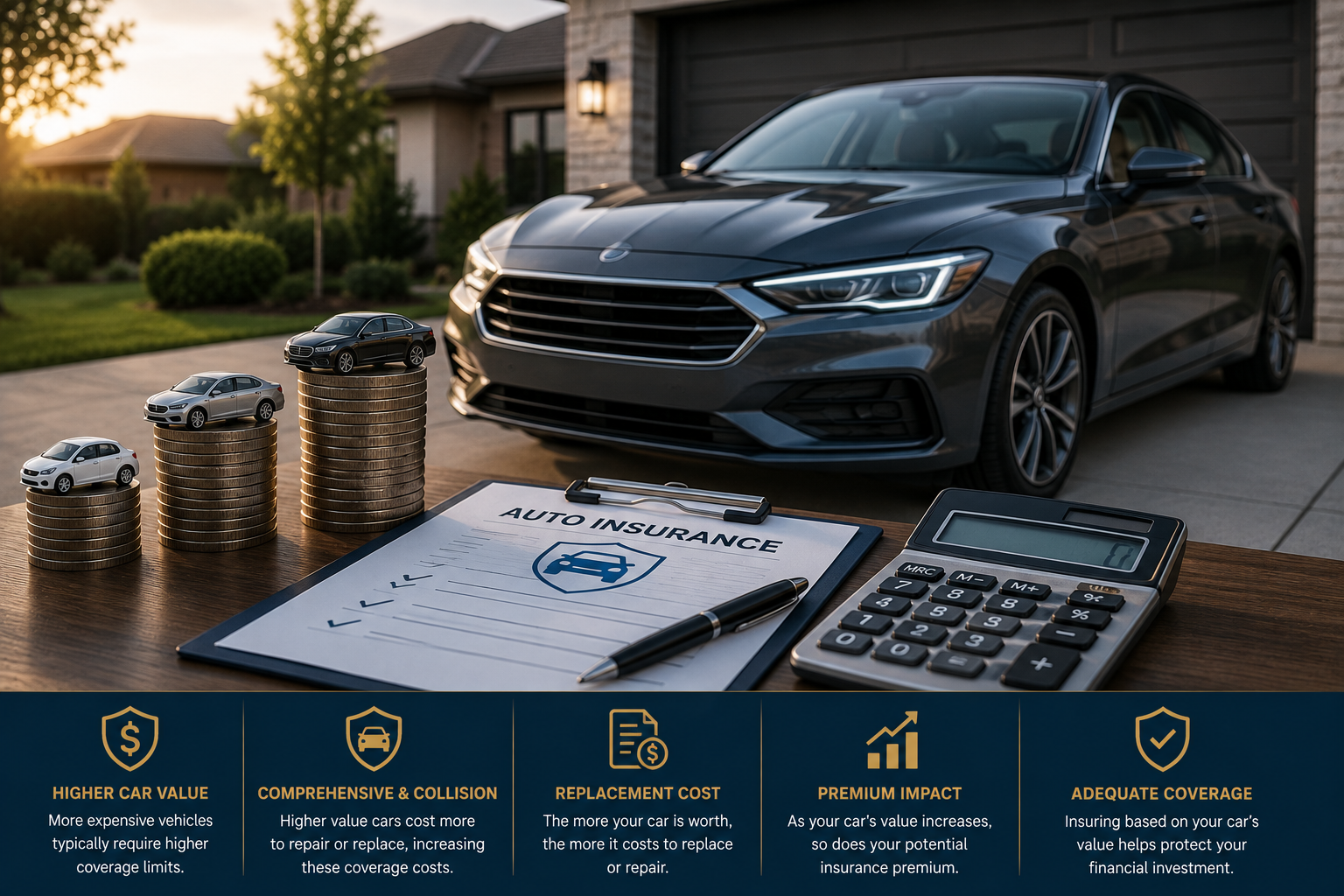
Your car’s value matters most for coverage that protects the vehicle itself. Collision and comprehensive claim payments are generally tied to the vehicle’s value and policy terms, so an older, lower-value car may eventually be worth less than the cost of carrying those optional coverages. Vehicle value also affects total-loss settlements and whether gap coverage may be useful when a financed vehicle is worth less than the outstanding loan balance.
Key Takeaways
- Collision and comprehensive coverage protect your own vehicle, and the amount payable after a total loss is generally limited by the vehicle’s value and policy terms.
- As a car loses value, it can make sense to reconsider collision or comprehensive coverage, especially when the deductible and premium are large relative to what the insurer could pay.
- Liability coverage is different: the value of your own car does not determine how much liability protection you may need for injuries or damage you cause to others.
- If you finance or lease a vehicle, your lender or lessor may require collision and comprehensive coverage even when state law does not.
- Gap coverage can address certain situations where a totaled vehicle is worth less than the amount still owed on the loan or lease, subject to the gap contract’s terms and exclusions.
Why Car Value Matters for Auto Insurance
A vehicle’s value can affect both insurance pricing and the usefulness of certain optional coverages. It also plays an important role when an insurer decides whether a damaged vehicle should be repaired or declared a total loss.
The effect is strongest with collision and comprehensive insurance because these coverages protect the insured vehicle itself. The National Association of Insurance Commissioners explains that collision covers damage to your vehicle from events such as a collision with another car or object, while comprehensive covers specified non-collision causes such as theft, fire, severe weather, vandalism, and similar losses.
Vehicle value is only one factor affecting an auto insurance premium. Insurers may also consider permitted factors such as the vehicle type, driving record, claims history, location, mileage, vehicle use, selected coverages, and deductibles. State laws determine which rating factors are permitted.
Value and insurance cost are not perfectly proportional. A car worth twice as much as another car does not necessarily cost twice as much to insure. Repair costs, theft experience, safety characteristics, claim frequency, driver information, location, coverage choices, and other rating factors can all affect the premium.
Which Auto Insurance Coverages Are Most Affected by Car Value?
| Coverage | Does Your Car’s Value Matter? | Why |
|---|---|---|
| Collision | Yes, significantly | Pays for covered damage to your vehicle, subject to the deductible, valuation, and policy terms |
| Comprehensive | Yes, significantly | Protects the insured vehicle against covered non-collision losses such as theft or weather damage |
| Liability | Not in the same way | Protects against covered injuries or property damage you cause to others, rather than damage to your own car |
| Gap coverage | Yes | Can address the difference between vehicle value and an eligible outstanding loan or lease balance |
| Medical or injury-related coverage | Generally not directly | PIP, medical payments, and similar coverage generally concern accident-related injuries rather than the value of the insured car |
How Car Value Affects Collision Coverage
Collision insurance generally pays for covered physical damage to your vehicle when it collides with another vehicle or object or is involved in another covered collision event. A deductible usually applies.
Collision coverage becomes increasingly important to evaluate as a vehicle depreciates. The amount an insurer can pay after a total loss is tied to what the vehicle was worth before the loss rather than what you originally paid for it or what a brand-new replacement costs.
For that reason, the potential benefit of carrying collision insurance generally declines as a car’s value falls. The premium does not necessarily decline at the same rate, so owners of older vehicles should periodically compare the cost of coverage with the financial protection it still provides.
The Deductible Matters More on a Low-Value Car
A deductible is the amount you are responsible for under the coverage before the insurer pays its portion of a covered loss. The deductible can become especially significant when the vehicle itself is not worth very much.
Hypothetical example: Assume a car has a hypothetical pre-loss value of $4,000 and a hypothetical $1,000 collision deductible. If the vehicle is totaled in a covered collision, the deductible represents a substantial portion of the amount at stake. These figures are illustrative only and are not national averages, recommended deductibles, or representations of a particular insurer’s settlement.
How Car Value Affects Comprehensive Coverage
Comprehensive coverage generally pays for covered damage to the insured vehicle from non-collision events. Examples can include theft, fire, vandalism, hail, severe weather, falling objects, and certain animal-related losses, depending on the policy.
Like collision, comprehensive generally has a deductible and is tied to the value of the insured vehicle. If an older vehicle is stolen and not recovered or is destroyed by a covered event, the insurer does not generally owe the cost of a brand-new equivalent vehicle simply because the insured needs another car.
Comprehensive can still be worthwhile on an older car, particularly when theft, hail, vandalism, animal strikes, or other covered losses are meaningful concerns. Collision and comprehensive should therefore be evaluated separately rather than automatically dropped together.
What Happens When Your Car Is Totaled?
Vehicle value becomes particularly important in a total-loss claim. An insurer generally compares the cost of repairing the vehicle with its pre-loss value and other applicable considerations. If repairing it is not economically reasonable under the insurer’s standards and applicable state rules, the vehicle may be declared a total loss.
The Texas Department of Insurance explains that if repair costs are about the same as or more than a car’s value, an insurer will likely consider it totaled, although some insurers may total a vehicle at a lower repair cost. Total-loss standards and state requirements can differ.
A lower-value car can therefore become a total loss after damage that would be repaired on a much more valuable vehicle. The same repair estimate represents a much larger percentage of the value of an older or heavily depreciated car.
How the Insurer Determines Value
For a total loss, an insurer may consider information about comparable vehicles and characteristics of your particular vehicle. Relevant factors can include make, model, model year, mileage, condition, options, equipment, and the local market, subject to state law and the insurer’s permitted valuation process.
A consumer price guide can be useful evidence, but it should not automatically be assumed to dictate the settlement. NAIC consumer guidance notes that a guide is only one reference and that a total-loss valuation can be based on what comparable used vehicles are worth in the relevant market.
If you disagree with the value:
- Ask the insurer how it calculated the vehicle’s value.
- Review the mileage, trim level, options, condition, and other vehicle details used in the valuation.
- Look for comparable vehicles for sale in your geographic area.
- Document factory options, custom equipment, or other relevant features that may have been omitted.
- Review your policy and state-specific claim procedures for any appraisal or dispute options that may apply.
What If You Owe More Than the Car Is Worth?
A standard auto insurance settlement is not generally based on your remaining loan balance. That can create a problem if the vehicle is totaled while you owe more than its value.
For example, a financed vehicle can depreciate more quickly than the borrower pays down the loan. If the car is totaled, collision or comprehensive coverage may resolve the covered vehicle loss based on the vehicle’s value while the borrower remains responsible for the remaining loan obligation.
How Gap Coverage Can Help
Guaranteed asset protection, commonly called gap coverage, is designed to address certain differences between what an eligible vehicle is worth and the amount still owed on the loan or lease after a covered total loss.
Gap products are not all identical. The Texas Department of Insurance notes that exclusions can affect payment, including provisions involving overdue payments, finance charges, warranty costs, prior damage, or deductibles. Some products sold by lenders or dealers may also be structured differently from insurance products.
Gap coverage does not make the car itself worth more. It addresses an eligible financial difference between vehicle value and the covered loan or lease obligation. Review the specific gap agreement for limits, exclusions, cancellation terms, and deductible treatment.
Does a More Expensive Car Always Cost More to Insure?
Not necessarily, although vehicle type and the expected cost to repair or replace a vehicle can influence insurance pricing. A higher-value vehicle creates more potential physical-damage exposure for an insurer, but the premium calculation can also reflect many other factors.
NAIC guidance identifies vehicle type, vehicle use, mileage, selected coverage, deductibles, driving history, claims history, location, and other permitted characteristics as factors that may affect premiums. Advanced components and specialized repairs can also make some vehicles expensive to insure even when their resale value is not exceptionally high.
That is why the purchase price alone is a poor predictor of the final insurance premium. Obtaining an insurance quote before buying a vehicle can help reveal the actual cost for the driver, location, vehicle, and coverage selections involved.
Does Car Value Affect Liability Coverage?
The value of your own car is much less important when deciding how much liability insurance to carry. Liability coverage protects against covered legal responsibility for injuries or property damage you cause to other people.
A driver operating a low-value car can still cause a serious accident involving expensive vehicles, substantial medical bills, or other major losses. Owning an inexpensive vehicle therefore does not mean liability exposure is inexpensive.
Liability insurance requirements vary by state. When selecting limits above any applicable legal minimum, drivers can consider their assets, financial exposure, and ability to absorb an uninsured liability claim rather than basing the decision on the value of their own vehicle.
Should You Drop Collision or Comprehensive on an Older Car?
There is no universal vehicle age or dollar value at which every driver should drop physical-damage coverage. The decision depends on what the vehicle is worth, what the coverage costs, the deductible, and whether you could comfortably repair or replace the vehicle yourself.
The NAIC advises consumers to consider reducing optional coverage on older vehicles when the vehicle has relatively little value. However, eliminating coverage means accepting more financial risk yourself.
Questions to Ask Before Dropping Coverage
- What is the vehicle realistically worth in its current condition?
- How much of my premium is attributable to collision and comprehensive coverage?
- What deductible applies to each coverage?
- Could I afford to replace the vehicle if it were destroyed or stolen tomorrow?
- How important is this vehicle to work, school, caregiving, or other essential transportation?
- Is the vehicle exposed to theft, hail, vandalism, animal strikes, or other comprehensive risks?
- Does a lender or leasing company still require collision and comprehensive coverage?
Financed and Leased Cars Are Different
Collision and comprehensive coverage generally are not required by state law simply because you own a vehicle, but lenders and lessors may require them as a condition of a loan or lease.
The lender has a financial interest in the vehicle and wants protection if the collateral is damaged or destroyed. Dropping required physical-damage coverage while a loan or lease is still in effect can therefore violate the finance or lease agreement.
Once the vehicle is paid off, the owner generally has more freedom to decide whether collision and comprehensive remain worthwhile, subject to applicable law and the policy.
Custom Equipment Can Complicate Vehicle Value
Aftermarket wheels, upgraded audio systems, accessibility equipment, performance modifications, custom paint, and other additions can make a vehicle more valuable to its owner. That does not necessarily mean a standard policy automatically provides full coverage for every modification.
California Department of Insurance consumer guidance notes that coverage for extra or custom equipment can be available. The amount and type of coverage vary by insurer, so owners of substantially modified vehicles should disclose the modifications and verify how they would be treated after a partial or total loss.
Keep receipts, photographs, installation records, and descriptions of expensive additions. Those records can also help identify errors or missing equipment in a total-loss valuation.
How to Estimate Whether Physical-Damage Coverage Still Makes Sense
Do not evaluate collision or comprehensive by comparing the annual premium with the vehicle’s value alone. The deductible and your ability to absorb a loss matter too.
1. Estimate the Vehicle’s Current Value
Look at comparable vehicles with similar model years, trims, mileage, options, and condition in your market. Treat online valuation tools as useful references rather than guarantees of a future insurance settlement.
2. Identify the Cost of Each Coverage
Ask your insurer or agent how much collision and comprehensive contribute to the overall premium. Do not assume the total policy premium would disappear if you removed these coverages because liability and other coverages remain.
3. Review the Deductible
Consider the deductible together with the potential settlement. A relatively large deductible reduces the protection available for smaller covered losses and affects the net amount received after a covered total loss.
4. Consider Your Ability to Self-Insure the Car
If losing the vehicle would create a serious financial problem, keeping physical-damage coverage may remain valuable even when the car is older. Someone with enough savings to replace the vehicle easily may evaluate the tradeoff differently.
5. Confirm Loan or Lease Requirements
Do not remove required collision or comprehensive coverage simply because the vehicle has depreciated. Review the finance or lease agreement first.
Car Value and Coverage Review Checklist
- Estimate the vehicle’s current market value using comparable vehicles and other reliable information.
- Check the collision deductible and comprehensive deductible separately.
- Find out how much you currently pay for collision and comprehensive coverage.
- Decide whether you could afford to repair or replace the vehicle without insurance.
- Verify lender or lease requirements before reducing physical-damage coverage.
- Compare your outstanding loan balance with the car’s estimated value and review gap coverage if a meaningful difference exists.
- Tell the insurer about significant custom equipment and confirm whether additional coverage is needed.
- Keep records showing the car’s options, condition, mileage, and significant improvements.
- Do not reduce liability limits merely because the car itself has little value.
- Review the policy again as the vehicle depreciates, the loan balance falls, or your financial circumstances change.
Frequently Asked Questions
The Bottom Line
Car value has its biggest effect on insurance that protects the vehicle itself. Collision and comprehensive coverage become less valuable in absolute dollars as a vehicle depreciates, and the vehicle’s pre-loss value plays a major role in determining whether it is repaired or declared a total loss.
The key limitation is that dropping physical-damage coverage transfers the financial risk back to you. A lower-value car can still be essential transportation, and lenders or lessors may require collision and comprehensive regardless of whether you personally think the coverage is worthwhile.
Review your vehicle’s current value alongside the premium, deductible, outstanding loan balance, gap protection, financing requirements, and your ability to replace the car yourself. Liability limits should be evaluated separately because the value of your own car does not determine the size of a liability claim you could cause.
Sources
- National Association of Insurance Commissioners, What Does Auto Insurance Cover?, June 11, 2026.
- National Association of Insurance Commissioners, Consumer Auto, accessed August 2026.
- National Association of Insurance Commissioners, Why Are My Insurance Premiums Increasing?, November 19, 2024.
- Texas Department of Insurance, My car was totaled! Now what?, last updated July 23, 2026.
- Texas Department of Insurance, Do you need gap insurance for your car? How does it work?, last updated October 14, 2024.
- California Department of Insurance, Automobile Insurance Text Version, accessed August 2026.