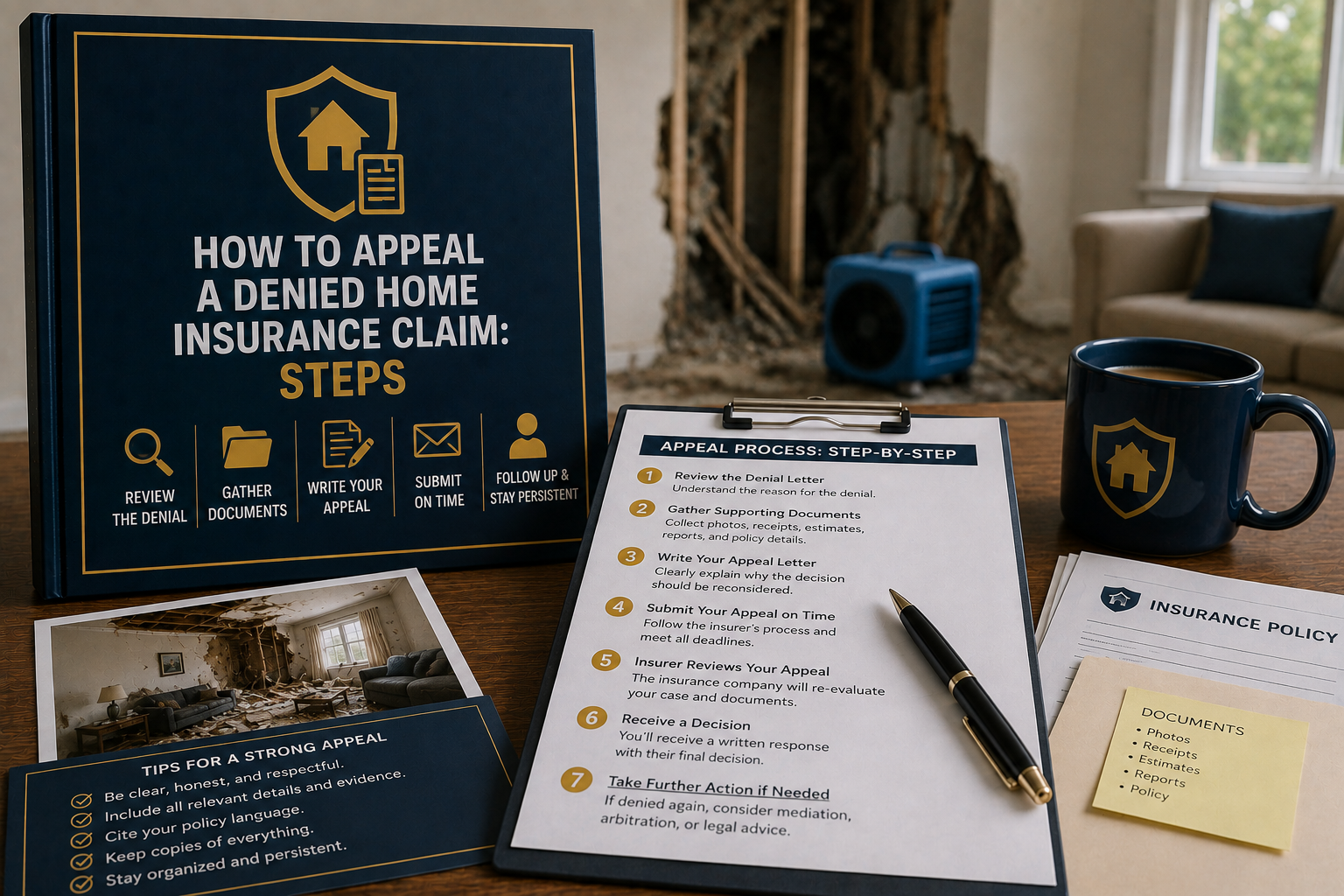
If your home insurance claim is denied, start by getting the denial in writing and matching the insurer’s explanation to the exact policy language. Gather evidence that addresses the stated reason and ask the insurer to reconsider or reinspect the claim. If the disagreement remains, options may include appraisal for an amount-of-loss dispute, a complaint to your state insurance department, or legal advice. Procedures and deadlines vary by policy and state.
Key Takeaways
- Get the insurer’s reasoning in writing. The denial letter should be the starting point for identifying the facts and policy provisions in dispute.
- Home insurance does not have one nationwide appeal procedure. Follow the instructions in your policy, denial correspondence, and applicable state rules.
- Build the dispute around evidence. Photos, videos, contractor estimates, receipts, inventories, maintenance records, and expert opinions can help address the insurer’s stated reason for denial.
- Appraisal and coverage disputes are different. Appraisal may help determine the amount of a covered property loss but generally should not be assumed to decide whether the policy covers the loss in the first place.
- Your state insurance department can help with certain disputes. State regulators accept consumer complaints and may review issues such as unfair denials, delays, or failure to follow insurance laws, but they generally do not replace a court in deciding every contractual dispute.
What Does a Home Insurance Claim Denial Mean?
A denied homeowners insurance claim means the insurer has decided that some or all of the requested payment is not owed under its interpretation of the policy and the facts of the loss. A denial may apply to the entire claim, one category of damage, one item, or a portion of the amount requested.
A complete coverage denial is different from an underpayment dispute. For example, an insurer might agree that storm damage is covered but disagree with the homeowner about the scope or cost of repairs. That is primarily an amount-of-loss dispute. In another situation, the insurer might say the damage resulted from an excluded cause rather than a covered peril. That is primarily a coverage dispute.
The distinction matters because different dispute-resolution tools may apply. A policy’s appraisal provision, for example, may be useful for disagreements about the amount of covered property damage but may not resolve a disagreement over whether coverage exists.
The word “appeal” can be misleading. Unlike certain types of health insurance, homeowners insurance does not operate under one standardized national internal-and-external appeals system. Your insurer may call the process reconsideration, claim review, supplemental review, reopening, reinspection, or another name.
Common Reasons Home Insurance Claims Are Denied
Before challenging a denial, determine exactly why the insurer made its decision. Possible reasons depend on the policy and circumstances and may include:
- The cause of loss is excluded. The insurer may determine that the event falls within an exclusion or is not among the causes of loss covered by the applicable policy form.
- The damage is attributed to deterioration or maintenance. Depending on the policy and facts, disputes can arise over whether damage resulted from a sudden covered event or conditions such as wear, deterioration, or inadequate maintenance.
- The loss is below the deductible. A covered loss can produce no payment if the covered amount does not exceed the applicable deductible.
- The insurer disputes the cause or timing of damage. This commonly becomes important when old and new damage are present in the same area.
- The insurer says policy conditions were not satisfied. Policies impose duties after a loss, which may include prompt notice, protecting property from additional damage, providing records, cooperating with an investigation, or submitting requested documentation.
- A particular property category has limited coverage. Limits, sublimits, valuation provisions, or exclusions may affect certain belongings or types of loss.
- The damage involves flooding. Standard homeowners insurance generally does not cover flood as defined under flood insurance programs and policy forms. Flood coverage may instead come from the National Flood Insurance Program or private flood insurance.
Do not assume the denial reason is correct simply because it appears in a letter. The relevant question is whether the insurer’s interpretation is supported by the policy language and the actual facts of the loss.
How to Appeal a Denied Home Insurance Claim
1. Get the Denial in Writing
If you have only received a verbal explanation, ask the insurer for its decision in writing. NAIC consumer guidance recommends asking for a written denial when an insurer denies part of a homeowners claim.
Read the letter carefully and identify:
- Which parts of the claim were denied.
- The factual reason given for the decision.
- Any policy provisions, exclusions, limits, or conditions cited.
- Whether the insurer is requesting additional information.
- Any instructions or deadlines for disputing the decision.
2. Read the Policy, Not Just the Declarations Page
The declarations page summarizes important information such as limits and deductibles, but it is not the entire insurance contract. Review the policy form and applicable endorsements as well.
Look for the section that corresponds to the denial, including:
- Covered causes of loss or insured-peril provisions.
- Exclusions.
- Duties after a loss.
- Loss-settlement and valuation provisions.
- Deductibles and special deductibles.
- Coverage limits and sublimits.
- Appraisal or other dispute provisions.
- Any endorsements that modify the standard policy form.
If you do not have a complete copy of the policy that was in force on the date of loss, request one from the insurer or agent.
3. Identify Exactly What You Disagree With
An effective challenge addresses the insurer’s actual reasoning. Saying only that the denial is unfair usually gives the insurer little new information to evaluate.
| Type of Dispute | Question to Address | Evidence That May Help |
|---|---|---|
| Cause of damage | Did a covered event cause the damage? | Photos, videos, inspection reports, contractor findings, weather records, or other relevant evidence. |
| Scope of damage | Did the adjuster’s estimate leave out covered repairs? | Detailed contractor estimates, measurements, photos, and inspection findings. |
| Value of damaged property | Was the property valued according to the policy? | Receipts, inventories, photographs, model information, replacement quotes, and applicable valuation terms. |
| Pre-existing damage | Was the disputed damage actually present before the reported loss? | Earlier photographs, maintenance records, inspections, invoices, and repair history. |
| Policy exclusion | Does the exclusion cited by the insurer apply to these facts? | The complete policy, endorsements, loss documentation, and professional analysis where appropriate. |
4. Gather Evidence Supporting Your Position
NAIC consumer guidance emphasizes documenting losses with photographs, videos, receipts, inventories, and other records. After a denial, the most useful evidence is evidence that directly addresses the reason the insurer gave.
Depending on the dispute, useful documentation may include:
- Photos and videos taken before and after the loss.
- Detailed estimates from qualified contractors.
- Invoices and receipts for prior maintenance or repairs.
- Receipts for temporary repairs made to prevent additional damage.
- A home inventory and proof of ownership for damaged personal property.
- Reports from engineers, roofers, plumbers, electricians, restoration professionals, or other qualified experts when their expertise is relevant.
- Reports or records that help establish when and how the event occurred.
- Emails, letters, and notes documenting communications with the insurer and adjusters.
Preserve evidence when practical. Document damage before permanent repairs and follow insurer instructions regarding inspection. Emergency measures may still be necessary to protect people and prevent additional property damage. Keep photographs and receipts for temporary work.
5. Ask the Insurer to Reconsider or Reinspect the Claim
Contact the claims department and explain specifically why you disagree. If the insurer overlooked information, a direct request for reconsideration may resolve the issue without a more formal dispute.
Put important requests in writing and include:
- Your name and claim number.
- The property address and date of loss.
- The part of the denial you dispute.
- Why you believe the decision does not match the facts or policy.
- Supporting documents organized by issue.
- A request for the specific action you want, such as reconsideration, reinspection, correction of an estimate, or payment of a covered item.
- A request for a written response.
Keep a copy of everything submitted. Maintain a claim log showing dates, names, telephone calls, emails, document submissions, inspections, and responses.
6. Request a Reinspection When New Evidence Supports It
A second inspection may be useful when important damage was not visible during the initial inspection, the original estimate omitted part of the damage, or a contractor or expert has identified information the adjuster did not consider.
A reinspection does not guarantee that the insurer will change its decision. Its value is that it gives the insurer an opportunity to evaluate additional evidence and a more complete description of the claimed damage.
Can Appraisal Help With a Denied Home Insurance Claim?
Possibly, but only for the right type of disagreement. Some homeowners policies contain an appraisal clause that can be invoked when the policyholder and insurer disagree about the amount of a property loss.
State regulator guidance, including guidance from the Texas Department of Insurance, distinguishes appraisal from a coverage determination. Appraisal can address how much property damage costs, but it should not generally be treated as the procedure for deciding whether an excluded or uncovered cause of loss is insured.
| Disagreement | Appraisal May Be Relevant? |
|---|---|
| Insurer and homeowner agree the storm damage is covered but disagree on repair cost. | Potentially, if the policy permits appraisal for the dispute. |
| Insurer says an excluded cause, not a covered event, produced the damage. | Appraisal generally should not be assumed to decide the coverage issue. |
| Insurer’s estimate omits disputed portions of repair work after coverage is accepted. | Potentially, depending on policy language and applicable state law. |
Appraisal procedures, costs, selection of appraisers, use of an umpire, and the effect of an appraisal award depend on the policy and state law. Read the appraisal provision before invoking it and consider professional advice if the amount involved is substantial.
How to File a Complaint With Your State Insurance Department
If direct efforts with the insurer do not resolve the issue, you can contact the insurance department or insurance regulator in your state. The NAIC states that state insurance departments can investigate consumer complaints involving matters such as unfair claim delays or denials, failure to honor a policy, lack of timely communication, or violations of state insurance laws.
The process varies by state. A complaint typically works best when you provide an organized record containing:
- Your policy and claim numbers.
- The insurer’s denial letter.
- A concise description of the dispute.
- Relevant policy provisions.
- Photos, estimates, reports, receipts, and other supporting documents.
- A timeline of communications and claim-handling events.
A regulator complaint is not the same as a lawsuit. A state insurance department can review whether a regulated insurer complied with insurance laws and policy obligations, but its authority and the relief it can provide vary. It may not be able to resolve every factual or contractual dispute in your favor.
Watch the Deadlines
Do not assume you have unlimited time to dispute a denial. Policies and state laws may contain deadlines related to reporting a loss, supplying requested information, submitting a proof of loss when applicable, invoking particular policy remedies, or filing a lawsuit.
Review the denial letter and policy promptly. If a legal deadline might apply, confirm the rule with your state insurance department or a qualified attorney. Also confirm whether the deadline continues to run while you pursue reconsideration, appraisal, a regulator complaint, or another dispute process rather than assuming one process automatically extends another.
Special Case: A Denied NFIP Flood Insurance Claim
A National Flood Insurance Program claim follows a different process from a standard homeowners insurance claim. If an NFIP flood insurer denies all or part of a claim, current FEMA guidance allows the policyholder to work with the adjuster and insurer or appeal the denial directly to FEMA.
FEMA currently states that an NFIP appeal must be submitted within 60 calendar days of the date on the denial letter. Supporting material can include the denial letter, photographs, and itemized contractor estimates. FEMA also states that an NFIP lawsuit generally must be filed within one year of the denial and that an appeal does not extend that one-year period.
Do not apply NFIP deadlines to an ordinary homeowners policy. The federal flood-insurance appeal procedure is specific to qualifying NFIP claims. Private homeowners and private flood policies can follow different rules.
Should You Hire a Public Adjuster or Attorney?
Public Adjuster
A public adjuster represents the policyholder in preparing and negotiating an insurance claim and generally charges a fee. NAIC consumer guidance notes that public adjuster rules differ by state; states that permit them may impose licensing and other requirements.
A public adjuster may be useful when the main dispute involves documenting the scope or value of a significant property loss. Before hiring one, verify licensing through the appropriate state regulator, understand the fee arrangement, and read the contract carefully.
Attorney
Legal advice may be appropriate when the dispute involves policy interpretation, a significant coverage denial, allegations about insurer conduct, a major financial loss, or an approaching lawsuit deadline. An attorney can explain legal rights and deadlines that an adjuster or regulator cannot decide for you.
Fees and representation agreements vary. Understand the attorney’s fee structure and scope of representation before signing an agreement.
What Makes a Strong Home Insurance Claim Appeal?
A strong request for reconsideration is organized around the insurer’s denial rather than emotion or general dissatisfaction. It gives the claim reviewer a clear reason to revisit the decision.
- Be specific. Identify exactly which part of the decision you dispute.
- Address the policy language. Explain why you believe the cited provision does not support the denial.
- Use relevant evidence. Include documentation that addresses the disputed cause, scope, value, or condition.
- Organize your records. Label estimates, photographs, invoices, reports, and correspondence clearly.
- State what you want. Request reconsideration, reinspection, correction of omitted damage, or another specific action.
- Preserve your timeline. Keep proof of submission and monitor all applicable policy and legal deadlines.
Mistakes to Avoid When Challenging a Denial
- Arguing before understanding the reason. Read the written denial and policy first.
- Submitting an estimate with no explanation. Show how the estimate relates to disputed damage and why it differs from the insurer’s evaluation.
- Discarding evidence too early. Document damaged property and follow insurer instructions before disposing of items when reasonably possible and safe.
- Making unnecessary permanent repairs before the insurer can evaluate disputed damage. Protect the property from additional loss, but preserve documentation and communicate with the insurer about inspection.
- Assuming appraisal resolves every denial. First determine whether your disagreement concerns coverage or the amount of loss.
- Ignoring correspondence. An insurer may request documents or cooperation required under the policy.
- Missing a deadline while negotiations continue. Keep track of policy, regulatory, and legal time limits independently.
Frequently Asked Questions
The Bottom Line
A denied home insurance claim is not necessarily the final word. Start with the written explanation, compare it with the complete policy, and identify the exact factual or coverage issue in dispute. Then submit evidence that directly addresses the insurer’s reasoning and request reconsideration or reinspection.
The most important limitation is that no single dispute process fits every denial. Appraisal may address the amount of a covered loss but not necessarily coverage, while state insurance regulators can review complaints without guaranteeing payment. NFIP flood claims have their own federal appeal rules.
Before choosing the next step, review the policy’s dispute provisions, applicable deadlines, supporting evidence, and the amount at stake. For significant coverage disputes or approaching legal deadlines, consider getting advice from your state insurance department or a qualified professional.
Sources
- National Association of Insurance Commissioners, What You Should Know About Settling a Homeowners Insurance Claim, accessed August 2026.
- National Association of Insurance Commissioners, What You Need to Know When Filing a Homeowners Claim, April 20, 2022.
- National Association of Insurance Commissioners, How Do I File a Complaint Against My Insurance Company?, March 10, 2026.
- National Association of Insurance Commissioners, A Consumer’s Guide to Home Insurance, accessed August 2026.
- Texas Department of Insurance, Why Would My Home Insurance Claim Be Denied or Not Paid?, last updated January 8, 2026.
- Texas Department of Insurance, Home Insurance Guide, last updated June 1, 2026.
- National Flood Insurance Program, Appeal a Claim, accessed August 2026.