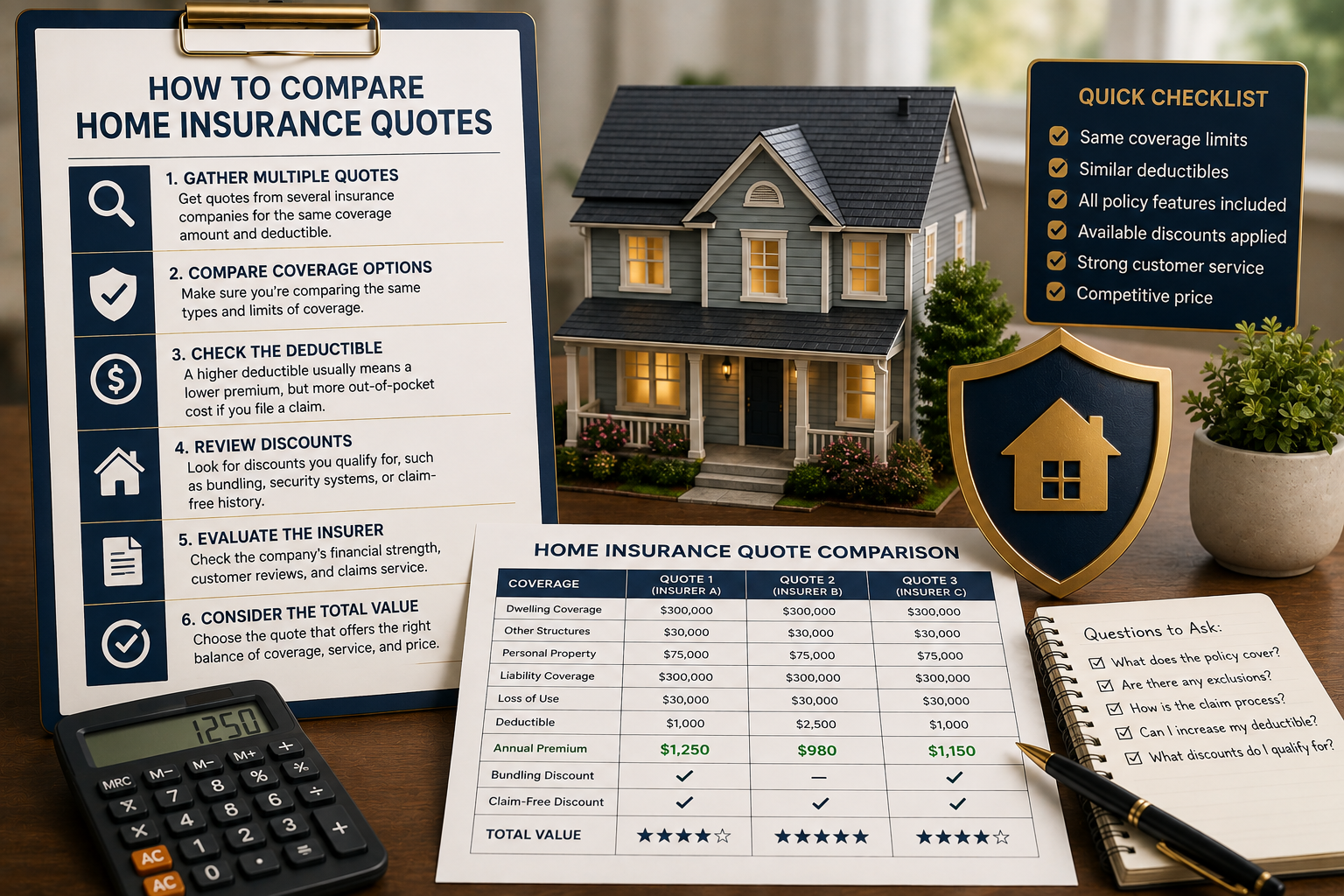
To compare home insurance quotes correctly, make sure every insurer is pricing similar dwelling limits, deductibles, personal property coverage, liability limits, settlement terms, and optional endorsements. Then compare the total premium, exclusions, discounts, and insurer details. The cheapest quote is not necessarily the best value if it has a larger deductible, narrower coverage, or weaker claim settlement terms.
Key Takeaways
- Ask each insurer to quote the same dwelling, personal property, liability, and other major coverage limits.
- Match deductibles carefully, including separate wind, hurricane, hail, or roof deductibles when applicable.
- Check whether property is covered at replacement cost or actual cash value because the difference can substantially affect a claim payment.
- Compare exclusions and optional endorsements, not just the list of basic coverages.
- Compare final premiums after discounts and verify that the insurer and agent are properly licensed in your state.
Why Comparing Home Insurance Quotes by Price Alone Can Mislead You
Two homeowners insurance quotes can have very different premiums because they are not actually offering the same protection.
One insurer might quote a lower dwelling limit, a larger deductible, actual cash value on certain property, or fewer optional coverages. Another might include broader replacement cost provisions, higher liability limits, or additional endorsements.
If you compare only the premium, the first policy can appear cheaper even though part of the difference comes from providing less protection.
The basic rule: standardize the coverage first, then compare the price. This gives you a much clearer picture of which insurer is actually offering better value.
Start With the Same Dwelling Coverage Limit
Dwelling coverage helps pay to repair or rebuild the insured structure after a covered loss, subject to policy terms and limits. Because it represents a major portion of the policy, different dwelling limits can make premiums difficult to compare.
The amount should generally be based on estimated reconstruction cost rather than the home’s real estate market value. Market value includes land and local housing conditions, while homeowners insurance focuses on the cost of repairing or rebuilding the structure.
If two insurers produce substantially different rebuilding estimates, ask why. Differences could result from square footage, construction type, finishes, local labor costs, building materials, or information about renovations.
Compare Replacement Cost and Actual Cash Value
One of the most important differences between home insurance quotes can be how damaged property is valued after a covered loss.
Replacement Cost
Replacement cost coverage generally focuses on the cost of repairing or replacing covered property with materials or property of similar kind and quality without deducting depreciation, subject to policy conditions and limits.
Actual Cash Value
Actual cash value generally accounts for depreciation when determining the value of damaged property. That can result in a smaller payment than replacement cost coverage for older property.
Do not assume the entire policy uses one settlement method. A policy may treat the dwelling, personal property, or roof differently. Ask specifically how each major category would be settled after a covered loss.
Match the Deductibles
A deductible is the portion of a covered property loss you generally pay before the insurer pays its applicable share. A larger deductible usually results in a lower premium because you retain more financial responsibility.
Suppose Quote A uses a $1,000 deductible and Quote B uses a $2,500 deductible. Quote B may appear cheaper partly because you would have to pay substantially more yourself after a covered claim.
Homeowners policies can also have more than one deductible. Depending on the state, insurer, and property location, you may encounter separate deductibles for wind, hail, hurricanes, named storms, or roofs.
- Compare the standard all-other-perils deductible.
- Check for percentage deductibles.
- Check for separate wind or hurricane deductibles.
- Check whether the roof has a separate deductible.
- Calculate what each percentage deductible would mean in actual dollars.
Compare Personal Property Coverage
Personal property coverage helps protect belongings such as furniture, clothing, electronics, and other covered possessions.
Compare both the total limit and the settlement basis. One policy might provide replacement cost for personal property while another uses actual cash value unless you purchase an endorsement.
Also check special limits for categories such as jewelry, collectibles, valuable artwork, certain electronics, or other high-value possessions. A large overall personal property limit does not necessarily mean every individual item is insured up to that full amount.
Compare Liability and Medical Payments Coverage
A homeowners policy typically includes personal liability protection in addition to property coverage. Liability coverage can help with qualifying claims if you are legally responsible for bodily injury or property damage to someone else.
When comparing quotes, make sure the liability limits match. A policy with substantially lower liability protection can appear cheaper while leaving you with greater financial exposure after a serious claim.
Also compare medical payments coverage and any exclusions or limitations relevant to your household and property.
Check Additional Living Expenses Coverage
Additional living expenses, also called loss-of-use coverage, can help with qualifying extra costs when a covered loss makes the home uninhabitable.
Compare the coverage limits and any time restrictions. The amount available under one policy may differ from another even when the dwelling limits look similar.
Compare Optional Endorsements
Two policies with similar basic coverage can still differ significantly because of optional endorsements.
Depending on the insurer, optional protection can include:
- Water backup: Coverage for qualifying sewer, drain, or sump-pump backup losses.
- Ordinance or law: Additional protection for qualifying increased rebuilding costs caused by building-code requirements.
- Equipment breakdown: Protection for certain qualifying failures of covered home equipment.
- Scheduled valuables: Additional coverage for jewelry, art, collectibles, or other valuable property.
- Extended replacement features: Additional dwelling protection above the stated limit under specified policy conditions.
Do not assume an endorsement included in your current policy will automatically appear in a competitor’s quote. Ask for it specifically if you want to preserve that protection.
Check What the Policy Does Not Cover
Exclusions can be just as important as coverage limits. Standard homeowners insurance does not automatically cover every type of property loss.
For example, standard homeowners policies generally do not provide ordinary flood or earthquake coverage. Separate insurance or additional coverage may be needed for those risks.
Other exclusions and limitations can differ by policy. Ask how water damage, mold, roofs, foundations, vacant properties, home businesses, certain animals, and other issues relevant to your household are treated.
A lower quote may reflect a meaningful coverage difference. If one policy is substantially cheaper, identify exactly what changed before assuming the insurer simply has a better rate.
Home Insurance Quote Comparison Checklist
| Item | What to Compare | Why It Matters |
|---|---|---|
| Dwelling coverage | Limit and reconstruction estimate. | Different limits can make premiums appear cheaper or more expensive. |
| Settlement method | Replacement cost vs. actual cash value. | Depreciation can substantially affect claim payments. |
| Deductibles | Standard and separate catastrophe deductibles. | Higher deductibles shift more loss cost to you. |
| Personal property | Limit, special sublimits, and settlement method. | Belongings may receive different protection under each policy. |
| Liability | Use the same liability limits. | Lower limits provide less financial protection. |
| Optional endorsements | Match optional protections you want. | One quote may omit valuable coverage included in another. |
| Exclusions | Review significant exclusions and restrictions. | Similar coverage names do not guarantee identical protection. |
| Final premium | Compare after applicable discounts. | This shows the actual price for the package being evaluated. |
Once these major items are aligned, differences in premium become much more meaningful. You can then decide whether one insurer offers better pricing for substantially similar protection.
A Practical Example of Comparing Two Quotes
Consider two hypothetical home insurance quotes. The numbers below are examples only and are not market averages.
| Feature | Quote A | Quote B |
|---|---|---|
| Hypothetical annual premium | $1,800 | $2,000 |
| Dwelling limit | $350,000 | $400,000 |
| Standard deductible | $2,500 | $1,000 |
| Personal property | Actual cash value | Replacement cost |
| Water backup endorsement | Not included | Included |
Quote A is $200 cheaper in this hypothetical example, but it also has a lower dwelling limit, a larger deductible, actual cash value personal property coverage, and no water-backup endorsement.
The useful next step is not to immediately choose Quote A. Ask the insurer to revise it using the same dwelling limit, deductible, personal property settlement method, and optional coverage as Quote B. Then compare the new premium.
Compare Discounts After Matching Coverage
Discounts can affect the final premium, but advertised discount percentages are not a good substitute for comparing total prices.
Depending on the insurer and state, discounts may be available for bundling home and auto policies, security systems, fire-protection devices, roof improvements, home renovations, or other qualifying characteristics.
Ask each insurer which discounts are already reflected in the quote and whether there are others for which you may qualify. Then compare the final premium for comparable coverage.
Check the Insurance Company, Not Just the Policy
Once you narrow down the quotes, consider the insurance company itself.
Verify that the insurer and agent are licensed in your state. Your state insurance department can provide licensing information and may offer additional consumer resources about insurance companies.
You can also compare claims-contact options, billing methods, policy-management tools, and other service features that matter to you.
Questions to Ask Before Choosing a Home Insurance Quote
- How was the dwelling coverage amount calculated?
- Is the dwelling covered at replacement cost?
- Is personal property covered at replacement cost or actual cash value?
- Are there separate wind, hail, hurricane, or roof deductibles?
- How would the roof be valued after a covered claim?
- What important losses are excluded?
- Does the quote include water-backup or ordinance-or-law coverage?
- What are the limits on jewelry and other valuable property?
- Which discounts are included?
- Is the insurer and agent licensed in my state?
Frequently Asked Questions
The Bottom Line
The best way to compare home insurance quotes is to make the policies as similar as possible before comparing premiums.
Match dwelling limits, deductibles, personal property coverage, liability limits, settlement methods, and important endorsements. Then review exclusions and discounts and compare the final price.
A slightly more expensive policy can sometimes provide substantially better protection. The goal is not simply to find the lowest quote, but to find a competitive price for coverage that would actually meet your needs after a serious loss.
Sources
- National Association of Insurance Commissioners, A Consumer’s Guide to Home Insurance, 2022.
- National Association of Insurance Commissioners, Consumer Shopping Tool for Homeowners Insurance, 2023.
- National Association of Insurance Commissioners, Consumer Homeowners Insurance Guidance, accessed August 2026.
- Texas Department of Insurance, How to Shop Smart for Home Insurance, accessed August 2026.