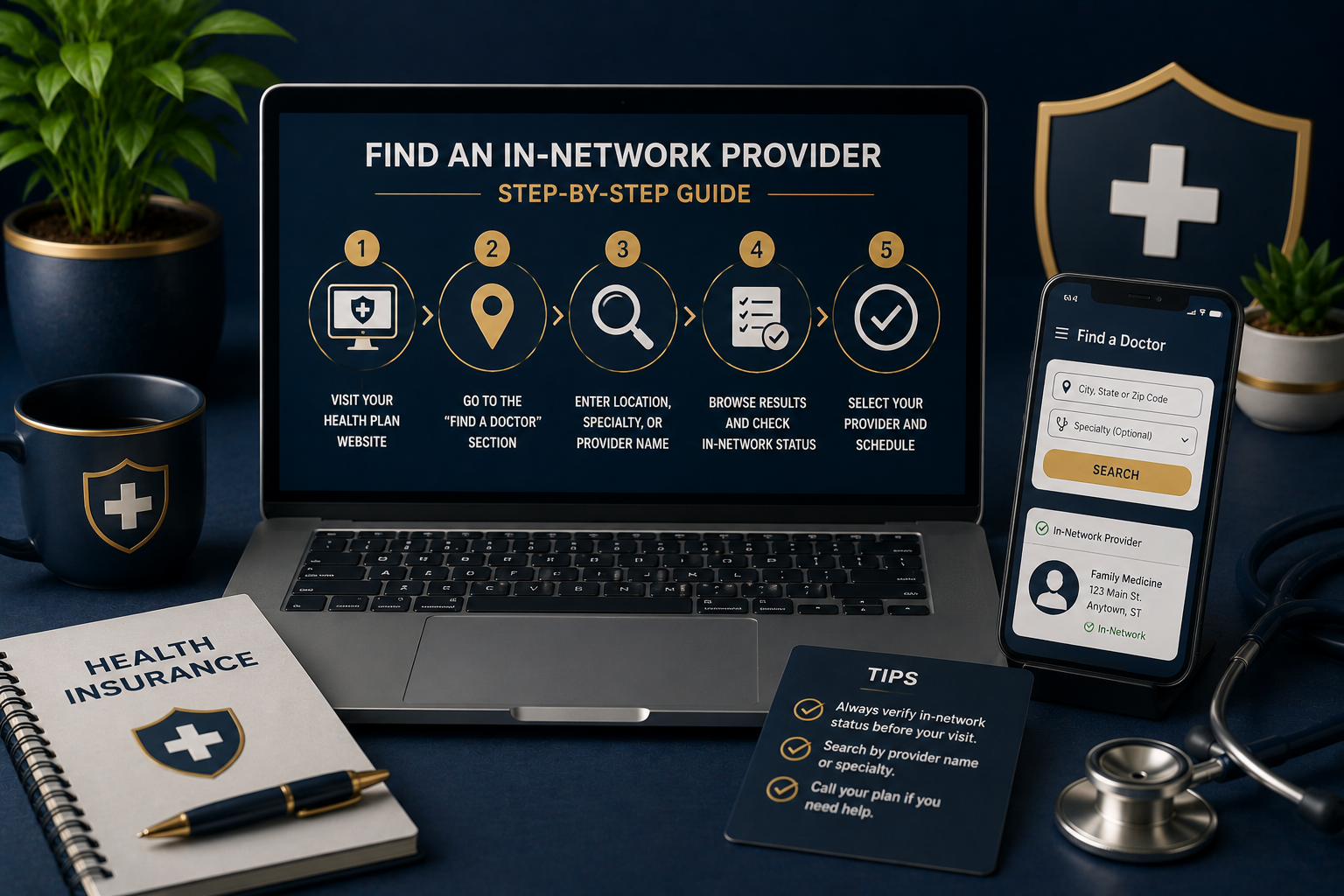
To find an in-network provider, start with your health plan’s current provider directory, search using your exact plan or network, and then confirm the provider’s status with your insurer and the provider’s office before receiving non-emergency care. Also verify that the provider is accepting new patients and check whether your plan requires a referral or prior authorization. Network participation can change, and provider directories are not always completely current.
Key Takeaways
- Use your exact health plan’s provider directory. A doctor who works with an insurance company may not participate in every network offered by that insurer.
- Double-check before receiving care. CMS advises consumers to use the plan directory and contact the health plan when network status is uncertain because directories can sometimes be out of date.
- Being in network does not guarantee every service is covered. Your plan may still impose deductibles, copays, coinsurance, prior authorization requirements, or benefit exclusions.
- Check the facility as well as the individual clinician. Hospitals, imaging centers, laboratories, and individual professionals can have different network arrangements.
- Plan type matters. HMOs, PPOs, EPOs, and POS plans handle networks and out-of-network care differently, and some plans require referrals for certain specialist care.
What Does In-Network Mean?
A health insurance network is the group of health care providers, facilities, and suppliers that have contracted with a health insurer or health plan to provide services. An in-network provider participates in the applicable network for your particular plan.
Using an in-network provider generally means lower out-of-pocket costs than using an out-of-network provider. Depending on the plan, non-emergency out-of-network care may cost substantially more or may not be covered at all.
Network status is specific to the plan, not merely the name of the insurance company. An insurer can offer multiple HMOs, PPOs, EPOs, employer plans, Marketplace plans, and other networks in the same area. A provider can participate in one and not another.
“We accept your insurance” is not always enough. When calling a medical office, give the exact plan or network shown on your insurance card and ask whether the specific provider is currently in network for that plan. A practice may accept patients insured by a company without participating in every plan that company offers.
How to Find an In-Network Provider
1. Identify Your Exact Health Plan
Start with your insurance card, member portal, Summary of Benefits and Coverage, or other plan documents. Look for the exact plan name and network information rather than searching only by insurance-company name.
Keeping your insurance card nearby can also help when you call the insurer or provider because the representative may need your member information to identify the correct network.
2. Search Your Health Plan’s Provider Directory
HealthCare.gov recommends using the health plan’s provider directory to find doctors, hospitals, and other providers that contract with the plan. You can generally access the directory through the insurer’s website or member portal or request assistance directly from the health plan.
Most directories allow searches using factors such as:
- Medical specialty.
- ZIP code or distance.
- Provider or practice name.
- Hospital or facility.
- Language or accessibility needs, when listed.
- Whether a provider is accepting new patients, when the directory supplies that information.
3. Call Your Health Plan to Confirm
If the directory is unclear, you cannot find the provider, or the planned service is expensive, call the member-services number on your insurance card. CMS specifically advises consumers to contact their health insurance company when they are unsure whether a provider is in network.
Ask about the specific provider at the specific practice location. A physician may work from several offices, hospitals, or medical groups, and network arrangements can differ.
4. Call the Provider’s Office
CMS recommends double-checking with the provider after identifying an in-network option. Ask whether the clinician is accepting new patients and whether the clinician currently participates in your exact health plan network.
Provide more detail than just the insurer’s brand name. If possible, read the exact plan or network name from your insurance card.
5. Verify Referral and Prior Authorization Requirements
Finding an in-network provider does not necessarily complete the coverage requirements. Some health plans require a referral from a primary care provider before certain specialist visits. HealthCare.gov notes that referrals are required for many HMO arrangements, and POS plans require a primary-care referral to see a specialist.
A plan may also require prior authorization before certain services, treatments, prescriptions, or equipment are covered. Prior authorization is separate from network status. HealthCare.gov also cautions that receiving prior authorization is not itself a promise that the plan will pay every cost.
6. Confirm Again Before Expensive or Scheduled Care
Provider networks can change. For scheduled surgery, imaging, therapy, or another potentially expensive service, consider confirming network status close to the date of service even if you checked when the appointment was originally scheduled.
Keep a record of whom you contacted, the date, and what you were told. If available, save a screenshot or copy of the provider-directory listing. This does not guarantee coverage, but it can provide useful documentation if a network-status dispute occurs later.
Provider Directory vs. Calling the Doctor: Which Should You Trust?
The safest approach is to use both sources and involve the health plan when anything is unclear. HealthCare.gov tells consumers to check their plan’s directory and call the insurer about specific providers. CMS also acknowledges that provider directories are not always accurate and advises contacting the health insurance company when network status is uncertain.
| Source | What It Can Tell You | Limitation |
|---|---|---|
| Health plan directory | Which providers the plan currently lists as participating | Directory information can sometimes be outdated |
| Health plan member services | Network status for your exact plan and questions about benefits or authorization | You need to provide enough information to identify the exact provider and service |
| Provider’s office | Whether the provider is accepting new patients and believes it participates in your plan | The office may participate with some networks from an insurer but not your exact one |
For an important scheduled service: confirm with both the plan and provider rather than relying solely on an old directory search or a general statement that the office “takes” your insurance.
Why Your Health Plan Type Matters
The financial consequences of using an out-of-network provider depend heavily on the type of health plan you have. HealthCare.gov describes several common Marketplace plan structures.
| Plan Type | Typical Network Approach | What to Check |
|---|---|---|
| HMO | Usually limits coverage to network providers except for emergency care | Network status and any required referral |
| EPO | Generally covers services only when network providers are used, except in an emergency | Confirm every planned provider and facility |
| PPO | Allows out-of-network care but generally at a higher cost | Compare in-network and out-of-network cost sharing |
| POS | Costs less with network providers and requires a primary-care referral for specialist care | Network status plus referral requirements |
These are general plan-type descriptions. Your actual benefits are governed by your specific policy or plan documents, so do not rely solely on the letters HMO, PPO, EPO, or POS when deciding whether a service will be covered.
An In-Network Provider Does Not Guarantee an In-Network Bill for Everything
For routine office visits, confirming the individual provider may be relatively straightforward. Hospital procedures and other facility-based care can involve multiple organizations and professionals.
For scheduled care, consider checking the network status of the facility and other separately billing providers when you have a choice. Depending on the service, this may include the surgeon, hospital, imaging center, laboratory, or other professionals involved in your care.
Federal No Surprises Act protections apply to many unexpected out-of-network bills involving most private health coverage, including most emergency services and certain out-of-network professional services connected with care at an in-network hospital, hospital outpatient department, or ambulatory surgical center. Those protections are important, but they do not make every form of out-of-network care subject to in-network pricing.
Emergency care is different. Do not delay necessary emergency treatment simply to search a provider directory. Federal protections restrict many out-of-network charges for emergency care under most private health plans, subject to applicable law and plan type.
What If the Provider Directory Is Wrong?
CMS warns that provider directories are not always accurate. A doctor may have recently joined or left a network, changed practice locations, stopped accepting new patients, or have information that has not yet been reflected in the directory.
If information conflicts, call the health plan and ask it to confirm the provider’s network status for your exact plan and date of service. Keep notes of the conversation and preserve relevant directory information when possible.
If you already received care and later learn that the claim was processed as out of network, review your Explanation of Benefits. CMS notes that an EOB identifies services and whether they were treated as in or out of network. Contact the plan if you believe the network designation is incorrect.
Depending on the circumstances, plan terms, and applicable law, you may have an appeal, complaint, or other review option. HealthCare.gov states that consumers can appeal certain health-plan decisions when a plan does not pay for care.
What to Ask Before Scheduling an Appointment
A few specific questions can reduce confusion before non-emergency care:
- Is this specific provider currently in network for my exact plan?
- Is this specific office or facility location in network?
- Is the provider accepting new patients?
- Do I need a referral before seeing this specialist?
- Does the planned service require prior authorization?
- Will a laboratory, imaging provider, facility, or other organization bill separately?
- What copay, deductible, or coinsurance applies to this type of in-network care?
The provider’s network status and your expected cost are related but separate questions. Even fully in-network care can require significant cost sharing if you have not met your deductible or the service carries coinsurance.
Common Mistakes When Looking for an In-Network Provider
Searching Only by Insurance Company Name
A provider might participate with an insurer but not your specific plan network. Always identify the exact plan or network.
Relying on an Old Provider List
Network participation changes. Use the current directory and confirm important appointments rather than relying on information saved from a prior plan year.
Assuming Your Regular Doctor Stayed In Network
A provider’s contract can change, and switching health plans can put a long-time doctor outside your new network. Check again after changing plans or at the beginning of a new plan year.
Forgetting About Referrals or Prior Authorization
An in-network specialist can still create a coverage problem if the plan requires a referral and you do not obtain one. Similarly, an in-network service may require prior authorization.
Assuming In-Network Care Is Free
In-network care generally receives the plan’s negotiated pricing and applicable in-network benefits, but you may still owe a deductible, copayment, or coinsurance. Coverage also depends on whether the service itself is a covered benefit.
Frequently Asked Questions
The Bottom Line
Finding an in-network provider starts with the directory for your exact health plan, not a generic internet search or the insurance company’s name alone. Confirm the clinician, practice location, and facility when relevant, and double-check with the plan if anything is unclear.
The biggest limitation is that network status does not determine every part of coverage. Your plan may still require a referral or prior authorization, and deductibles, copays, coinsurance, exclusions, and other benefit rules can still apply. Networks can also change over time.
For scheduled non-emergency care, verify network participation before the service, keep a record of important confirmations, and review your plan documents for the applicable cost-sharing and authorization rules. If the information from the provider and insurer conflicts, ask the health plan to clarify your exact network before proceeding.
Sources
- HealthCare.gov, Getting Regular Medical Care, accessed August 2026.
- HealthCare.gov, Health Insurance Plan & Network Types: HMOs, PPOs, and More, accessed August 2026.
- HealthCare.gov, Prior Authorization and Referral Glossary Guidance, accessed August 2026.
- Centers for Medicare & Medicaid Services, Action Plan: Not Sure if Provider Is In-Network, modified August 25, 2026.
- Centers for Medicare & Medicaid Services, Know Your Medical Bill of Rights, modified August 25, 2026.