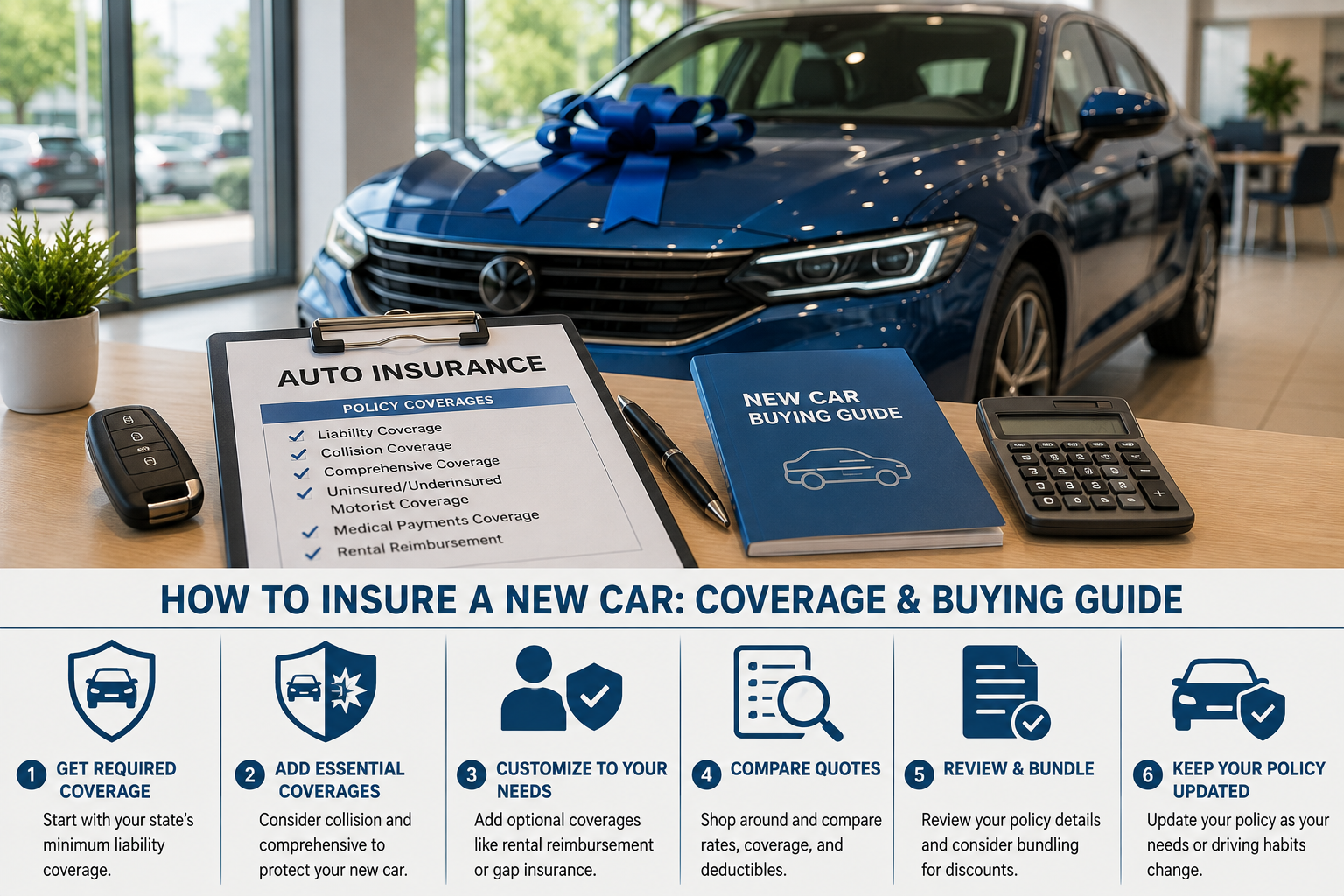
Insure a new car before you rely on it for driving. Contact your insurer with the vehicle identification number, purchase date, drivers, garaging address, and financing or leasing information, then confirm the coverage effective date. An existing policy may provide temporary coverage for a newly acquired vehicle under its terms, but notification periods and coverage conditions vary. Financed or leased cars also commonly require collision and comprehensive coverage beyond state minimums.
Key Takeaways
- Arrange coverage before driving the new car. Do not assume the dealership or your existing policy has automatically handled everything.
- Newly acquired vehicle provisions vary. Some existing policies provide temporary automatic coverage, but notification periods, eligible vehicles, and the coverage provided depend on the policy.
- State minimum insurance and lender requirements are different. State law generally focuses on liability and other required coverages, while lenders and leasing companies commonly require collision and comprehensive coverage.
- A new car can change your premium substantially. Vehicle value, repair costs, safety features, theft experience, drivers, location, limits, deductibles, and other rating factors can affect the price.
- Review optional protection rather than simply copying the old policy. Uninsured motorist coverage, medical-related coverage, rental reimbursement, roadside assistance, gap protection, and other options may deserve a fresh look.
When Should You Insure a New Car?
The safest approach is to arrange insurance before you take possession of the vehicle and drive it away. Most states require drivers to satisfy auto insurance or financial-responsibility requirements, although the exact required coverages and limits vary by state.
If you know which car you are buying, you can usually request a quote before completing the sale. Once you have the VIN and final purchase information, the insurer can generally finalize the vehicle addition or issue a new policy with the appropriate effective date, subject to its underwriting procedures.
If the car is financed or leased, the dealer or financing company may require acceptable evidence of insurance before releasing the vehicle. The lender or leasing company may also need to be identified on the policy according to its interest in the vehicle.
Do not rely on a supposed universal grace period. Newly acquired vehicle coverage is governed by the actual policy and applicable state rules. Notification periods can differ, and an additional vehicle may be treated differently from a vehicle that replaces one already insured.
How to Insure a New Car Step by Step
1. Get Insurance Quotes Before Buying
Insurance cost can differ substantially from one vehicle to another, so comparing premiums before signing the purchase agreement can prevent surprises. Get quotes for the specific year, make, model, trim, and expected use rather than assuming a similarly priced car will cost the same to insure.
When comparing quotes, use the same liability limits, deductibles, collision and comprehensive coverage, and optional coverages whenever possible. Otherwise, a cheaper quote may simply provide less protection.
2. Gather the Vehicle Information
The insurer will generally need enough information to identify and rate the vehicle accurately. Be prepared to provide information such as:
- Vehicle identification number.
- Year, make, model, and trim.
- Purchase or lease date.
- Primary driver and other household drivers where required.
- Garaging address.
- Expected annual mileage and vehicle use.
- Lender or leasing company information when applicable.
After the policy is issued or changed, review the declarations page to confirm that the year, make, model, VIN, listed drivers, limits, deductibles, and financing information are correct.
3. Decide Whether to Add the Car or Buy a New Policy
If you already have auto insurance, ask your insurer for the cost of adding the new vehicle. Adding it to the current policy may be convenient and may qualify the household for a multi-vehicle discount if the insurer offers one.
You are not necessarily limited to your current company. Buying a new car can be a useful time to compare insurers, especially if the new vehicle changes your premium significantly. If you switch companies, coordinate the effective dates so the old policy is not canceled before the new coverage actually begins.
4. Choose Liability and State-Required Coverages
Most states require drivers to carry a minimum level of auto insurance or otherwise satisfy financial-responsibility requirements. Required coverage can include bodily injury liability, property damage liability, uninsured or underinsured motorist coverage, personal injury protection, medical payments, or other protection depending on the state.
The legal minimum should not automatically be treated as the ideal liability limit. If you cause a serious accident and the covered damages exceed your policy limit, you may remain financially responsible for amounts the policy does not pay. Consider your assets, income, potential liability exposure, and budget when selecting limits.
5. Add Collision and Comprehensive When Appropriate
Collision coverage generally pays for covered physical damage to your insured car resulting from a collision with another vehicle or object, subject to the deductible and policy terms.
Comprehensive coverage generally addresses covered non-collision losses such as theft, fire, vandalism, weather events, falling objects, or animal impact, depending on the policy.
States generally do not require collision and comprehensive simply because you own a vehicle, but lenders and leasing companies commonly require physical damage protection while they have a financial interest in the car.
6. Confirm the Effective Date and Proof of Insurance
Do not assume that requesting a quote means coverage is active. Confirm that the insurer has bound or issued coverage and verify the effective date and time. NAIC consumer guidance cautions that not every website providing an insurance quote is able to make coverage effective immediately.
Obtain the appropriate evidence of insurance for your state and keep policy records. The dealer or lender may also request evidence showing that the new car is properly insured.
Does Your Current Policy Automatically Cover a New Car?
It might, but you should not assume that it does. Many personal auto policies contain newly acquired vehicle provisions that can provide automatic coverage for a limited period when an insured acquires another vehicle.
The details are important. Policies may distinguish between:
- A replacement vehicle: A new car replacing one already shown on the policy.
- An additional vehicle: A new car added to the household while the existing insured vehicles remain.
Automatic coverage may depend on whether all vehicles owned by the insured are covered by the company, whether the vehicle qualifies under the policy definition, what coverage was carried on existing vehicles, and whether the insurer receives notice within the required period.
California insurance-regulator guidance, for example, explains that most policies provide some automatic protection for newly acquired vehicles but that notification periods vary and can be shorter than 30 days. That illustrates why drivers should check their own contract rather than applying one state’s or insurer’s period nationally.
Contact the insurer promptly even if automatic coverage appears to apply. Adding the vehicle formally reduces uncertainty about the VIN, coverage selections, lender requirements, deductibles, and effective date.
What Coverage Should You Consider for a New Car?
| Coverage | General Purpose | Key Consideration |
|---|---|---|
| Bodily injury liability | Covered injuries to other people when you are legally responsible | Required limits vary by state; higher limits may be available |
| Property damage liability | Covered damage you cause to another person’s vehicle or property | State minimums may be lower than a serious accident’s total cost |
| Collision | Covered collision damage to your insured vehicle | Usually has a deductible; commonly required by lenders and lessors |
| Comprehensive | Covered non-collision losses such as theft, fire, vandalism, or weather | Usually has a deductible; commonly required by lenders and lessors |
| Uninsured or underinsured motorist | Certain losses involving drivers with no insurance or insufficient insurance | Requirements and available forms vary by state |
| PIP or medical payments | Certain medical-related costs after an accident | Availability and requirements depend on state law and policy |
| Rental reimbursement or roadside assistance | Specified transportation or roadside expenses under policy terms | Optional and subject to limits and covered-loss requirements |
Financing or Leasing a New Car
Financing changes the insurance decision because another party has a financial interest in the vehicle. NAIC and state insurance-regulator guidance note that lenders typically require collision and comprehensive coverage on financed vehicles.
A lease agreement can also impose requirements beyond the insurance that state law requires for ordinary drivers. The leasing company may require physical damage coverage, specified liability limits, deductible restrictions, or other terms. Review the actual lease agreement rather than assuming every leasing company uses the same standards.
If required coverage lapses, a lender may have contractual remedies and may purchase insurance protecting its interest and charge you for it. Such coverage should not be assumed to provide the same protection as a personal auto policy you select yourself.
Ask for the lender’s exact requirements before selecting deductibles. Choosing a very high collision or comprehensive deductible to lower the premium may conflict with financing or lease terms.
Do You Need Gap Protection on a New Car?
A standard auto policy’s physical damage settlement generally follows the applicable policy valuation terms; it should not be assumed to pay the entire remaining loan balance simply because that is what you owe.
That creates a potential gap when a vehicle is totaled and the amount owed on the loan or lease exceeds the applicable insurance settlement. Gap insurance or a contractual gap waiver may address some or all of that difference, subject to its own terms, limits, exclusions, and eligibility requirements.
Gap products are not necessarily identical. A product offered by an auto insurer can differ from a debt-cancellation or waiver product offered through a dealership or financing agreement. Compare the price, cancellation terms, covered amount, exclusions, and duration before buying.
Gap protection is not a substitute for collision and comprehensive coverage. It addresses a different financial risk and generally depends on the underlying total-loss situation and the terms of the particular gap product.
Gap Coverage vs. New Car Replacement Coverage
These products can sound similar but generally solve different problems. Gap protection focuses on a potential difference between an eligible insurance settlement and a covered loan or lease obligation. New car replacement coverage, where offered, is intended to modify how the insurer settles an eligible total loss on a relatively new vehicle.
| Feature | Main Purpose | Important Limitation |
|---|---|---|
| Gap protection | Addresses certain differences between a covered total-loss settlement and an eligible loan or lease balance | Terms, exclusions, maximum benefits, and covered loan amounts vary |
| New car replacement coverage | Can change the settlement basis for an eligible new vehicle after a covered total loss | Availability, vehicle-age limits, mileage conditions, and settlement terms vary by insurer |
Do not assume that either feature is automatically included in collision or comprehensive coverage. Read the endorsement or separate agreement to determine exactly what protection you are buying.
Why a New Car May Cost More to Insure
Buying a new car does not guarantee that your insurance premium will rise, but replacing an older vehicle with a newer or more expensive one can change the cost of physical damage coverage substantially.
Rating factors vary by insurer and state, but the vehicle can influence the expected cost of future claims. Relevant characteristics may include:
- Vehicle value.
- Repair and replacement-part costs.
- Safety equipment and technology.
- Theft experience.
- Performance characteristics.
- Claim experience associated with the vehicle model.
- The cost of repairing sensors, cameras, electronics, and other equipment after an accident.
Other rating factors can include the drivers, driving history, location, vehicle use, annual mileage, selected coverage, limits, deductibles, and other factors permitted under state law.
Choosing a Collision and Comprehensive Deductible
A deductible is the amount you are responsible for under the applicable coverage before the insurer pays the remaining covered loss, subject to the policy terms. Higher deductibles generally reduce the premium because you retain more of the initial loss.
For a new car, select a deductible you could realistically pay after an unexpected collision, theft, hailstorm, or other covered event. A lower premium does not help much if the deductible would make repairs financially difficult.
Hypothetical example: Suppose two otherwise identical quotes use different collision deductibles. One uses a hypothetical $500 deductible and the other a hypothetical $1,000 deductible. The higher-deductible option could cost less, but you would assume an additional hypothetical $500 of an eligible collision loss before insurance payment. These figures are illustrative only, not recommended deductibles, premiums, or national averages.
How to Compare New Car Insurance Quotes
Use the Same Liability Limits
A quote with lower liability limits may appear cheaper while exposing you to more uninsured financial risk. Keep the limits consistent when comparing companies.
Match the Deductibles
Compare collision and comprehensive quotes with the same deductibles. Otherwise, the difference in premium may reflect how much risk you are retaining rather than an insurer simply offering a better price.
Compare Optional Coverage Carefully
Check whether quotes include rental reimbursement, roadside assistance, gap coverage, new car replacement coverage, custom equipment protection, or other endorsements. Do not assume similarly named packages contain identical benefits.
Ask About Discounts
Available discounts vary by insurer and state. Depending on the company, possible savings may relate to multiple policies, multiple vehicles, vehicle safety features, driving behavior programs, payment methods, or other eligibility criteria.
Confirm the Insurer Is Licensed
NAIC consumer guidance recommends verifying that the insurer and agent are authorized to do business in your state. Your state insurance department can provide licensing information and consumer assistance.
Common Mistakes When Insuring a New Car
- Waiting until after leaving the dealership. Arrange and confirm coverage before relying on the vehicle for driving.
- Assuming an automatic grace period applies. Newly acquired vehicle provisions differ by policy.
- Buying only the legal minimum without reviewing liability exposure. Minimum limits may not cover the full cost of a severe accident.
- Ignoring lender or lease requirements. Physical damage coverage and deductible rules may be contractual requirements even when state law does not require them.
- Assuming “full coverage” is a standardized policy. Review the individual coverages, limits, deductibles, endorsements, and exclusions instead of relying on an informal label.
- Comparing premiums with different coverage. A lower quote may have lower limits or higher deductibles.
- Entering the wrong VIN or vehicle trim. Verify the declarations page after the car is added.
- Canceling the old policy too early when switching insurers. Confirm that the replacement policy is actually effective before ending previous coverage.
New Car Insurance Checklist
- Get insurance quotes for the exact vehicle before purchase when possible.
- Provide the correct VIN, garaging address, vehicle use, and driver information.
- Check state-required coverage.
- Review liability limits above the legal minimum where appropriate.
- Confirm lender or lease insurance requirements.
- Select collision and comprehensive deductibles you can afford.
- Evaluate uninsured motorist, medical-related, rental, roadside, gap, and other optional protection.
- Confirm the policy effective date before driving.
- Obtain the required proof of insurance.
- Review the declarations page after issuance for errors.
Frequently Asked Questions
The Bottom Line
Insuring a new car starts with making sure coverage is effective before you depend on the vehicle for driving. Provide accurate vehicle information, verify your state’s required coverage, and confirm any lender or leasing-company requirements.
The biggest mistake is assuming an existing policy automatically provides every coverage needed for a new vehicle. Newly acquired vehicle provisions have conditions and notification deadlines, and the collision or comprehensive protection carried on an older car may not match what a lender requires for the new one.
Before completing the purchase, compare quotes using consistent limits and deductibles, review optional protection such as gap coverage, and confirm the final effective date. After the policy is updated, check the declarations page to make sure the VIN, drivers, coverage, deductibles, and lender information are correct.
Sources
- National Association of Insurance Commissioners, Auto Insurance, last updated September 26, 2025.
- National Association of Insurance Commissioners, What Does Auto Insurance Cover?, June 11, 2026.
- National Association of Insurance Commissioners, Consumer Auto Insurance, accessed August 2026.
- National Association of Insurance Commissioners, Does Your Vehicle Have the Right Protection? Best Practices for Buying Auto Insurance, accessed August 2026.
- California Department of Insurance, Automobile Insurance Guide, accessed August 2026.
- California Department of Insurance, So You’ve Had an Accident, What’s Next?, accessed August 2026.