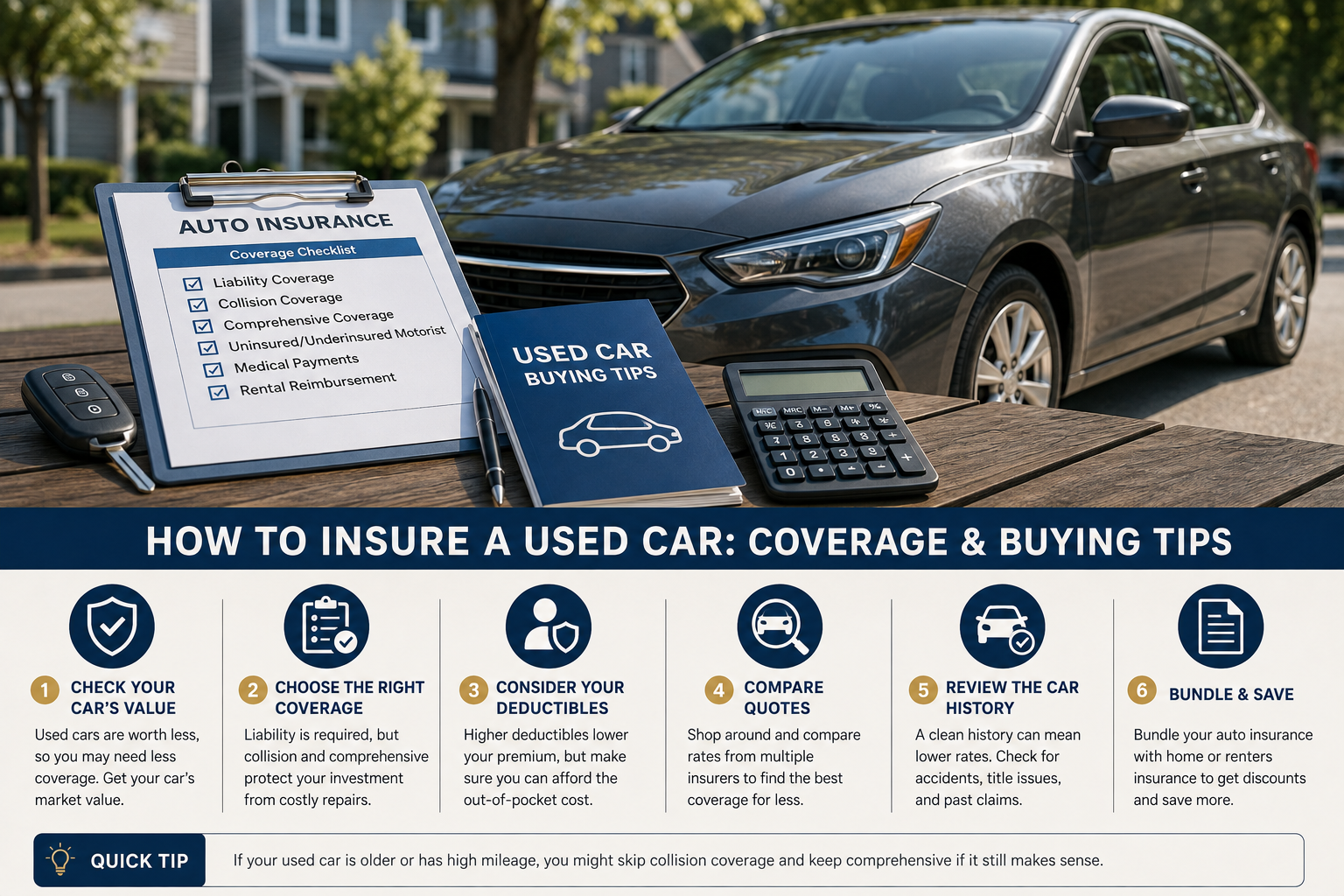
To insure a used car, gather the vehicle identification number and other vehicle details, compare quotes before you take possession, choose at least the coverage required by your state, and arrange for the policy to be effective before you drive the car. If you finance the purchase, your lender may also require collision and comprehensive coverage. For an older vehicle, compare the cost of optional physical-damage coverage with the car’s value and the amount of loss you could afford yourself.
Key Takeaways
- Arrange insurance before driving the used car. Most states require drivers to carry at least specified forms or amounts of auto insurance or otherwise meet financial-responsibility requirements.
- State requirements and lender requirements are different. Collision and comprehensive are generally optional under state insurance law, but a lender may require them when the vehicle is financed.
- An older car does not automatically mean liability-only coverage is best. Consider the vehicle’s value, deductible, premium, theft exposure, and whether you could afford to replace it yourself.
- Get quotes before buying when possible. Insurance costs can differ significantly among used vehicles and insurers.
- Do not assume an existing policy automatically covers a newly purchased car for a specific number of days. Newly acquired vehicle provisions vary by policy, insurer, coverage already carried, and applicable state rules.
What Insurance Do You Need for a Used Car?
A used vehicle generally uses the same categories of personal auto insurance as a new vehicle. Its age does not create a separate type of “used car insurance.” What changes is how much protection makes sense for the vehicle’s current value, whether it is financed, and how much financial risk you are willing to retain.
The NAIC explains that most states require drivers to carry at least a basic level of auto insurance. Exact requirements vary by state. Depending on where you live, required coverage may involve bodily injury liability, property damage liability, uninsured or underinsured motorist coverage, personal injury protection, medical payments coverage, or another state-specific combination.
State minimums are legal requirements, not necessarily recommended coverage amounts for every driver. A serious claim can exceed a low liability limit, leaving the at-fault driver potentially responsible for losses beyond what the policy pays.
| Coverage | What It Generally Does | Used-Car Consideration |
|---|---|---|
| Bodily injury liability | Helps pay covered injury claims against you after an at-fault accident | Vehicle age does not reduce your potential liability to other people |
| Property damage liability | Helps pay for covered damage you cause to another person’s vehicle or property | The value of your own used car does not determine how expensive another person’s property may be |
| Collision | Pays for covered collision damage to your vehicle, subject to the deductible and policy terms | Compare the premium and deductible with the car’s current value |
| Comprehensive | Generally covers specified non-collision losses such as theft, hail, fire, vandalism, flood, and animal impacts | Can still be valuable on an older vehicle with meaningful replacement value or theft exposure |
| Uninsured/underinsured motorist and medical-related coverages | Can address certain injuries or losses depending on the coverage and state | Availability and requirements vary significantly by state |
How to Insure a Used Car Before You Buy It
1. Get the Vehicle Information
Ask the seller or dealer for the vehicle identification number, commonly called the VIN. The insurer may also need the year, make, model, trim, ownership information, expected annual mileage, garaging address, primary driver, and how the car will be used.
Providing the exact VIN helps the insurer identify the specific vehicle rather than relying on a general estimate for a similar model.
2. Get Insurance Quotes Before Finalizing the Purchase
Insurance cost can vary among used vehicles. Factors such as repair costs, theft experience, vehicle characteristics, driver information, location, mileage, selected coverage, limits, and deductibles can influence the premium.
Getting a quote before committing to the purchase can help reveal whether a supposedly affordable used vehicle will be expensive to insure. When comparing insurers, provide the same driver, vehicle, limits, deductibles, and optional coverages so the quotes are reasonably comparable.
3. Decide Which Coverages You Want
Start with the coverage required where the vehicle will be insured. Then consider whether you want collision, comprehensive, higher liability limits, uninsured or underinsured motorist protection, medical-related coverage, rental reimbursement, roadside assistance, or other available options.
4. Tell the Insurer About Any Financing
If you finance the used car, provide the lender information requested by the insurer. The NAIC notes that the lender should be listed as a loss payee when there is an outstanding auto loan.
Lenders commonly require collision and comprehensive coverage to protect their financial interest in the vehicle. This is a contractual lender requirement rather than a general state-law requirement to carry those coverages.
5. Set the Correct Effective Date
Coordinate with the insurer so the coverage is effective when you take ownership or otherwise need the vehicle insured. Do not wait until after driving the car home to investigate whether coverage applies.
If you already have auto insurance, ask your insurer how its newly acquired vehicle provisions work. Do not rely on a generic statement that every company provides the same automatic grace period. The amount and duration of any automatic protection can depend on your policy and circumstances.
Do not assume dealer paperwork creates insurance coverage. Registration, financing, a temporary tag, and an auto insurance policy are separate matters. Confirm directly with the insurer that the vehicle and effective date are correct before driving.
Do You Need Collision and Comprehensive on a Used Car?
Collision and comprehensive are generally not legally required by states, according to NAIC guidance, although lenders may require them for financed vehicles. If you own the used car outright, the decision is usually a financial one rather than a lender requirement.
Collision Coverage
Collision coverage generally pays for covered physical damage to your vehicle caused by a collision with another car or object, subject to the deductible and policy terms. It can also apply to certain rollover or similar collision losses depending on the policy.
Comprehensive Coverage
Comprehensive generally addresses covered non-collision losses. NAIC guidance lists examples such as theft, hail, windstorm, flood, fire, vandalism, broken glass, and animal impacts.
When Dropping Physical-Damage Coverage May Be Worth Considering
As a used vehicle gets older and loses value, collision or comprehensive coverage may eventually provide less potential benefit relative to the premium and deductible. The NAIC specifically advises consumers with older cars to consider whether the cost of collision and comprehensive coverage still makes sense.
However, there is no universal vehicle age or dollar value at which everyone should drop these coverages. A low-value vehicle can still be essential transportation, and replacing it out of pocket could be difficult.
Useful decision question: If this car were stolen or totaled tomorrow and your policy provided no payment for your own vehicle, could you comfortably replace it? If not, keeping some form of physical-damage protection may still have value even on an older car.
How Deductibles Matter on an Older Car
Collision and comprehensive commonly include deductibles. A higher deductible can lower the premium, but it also increases the amount you must absorb when a covered claim occurs.
Deductible size becomes particularly important as a vehicle’s value falls. If a covered car is declared a total loss, the insurer generally determines the vehicle’s value according to the policy and applicable claim rules, and the deductible may reduce the payment.
Hypothetical example for illustration only: Suppose a used car has an insurer-determined covered-loss value of $6,000 and the applicable deductible is $1,000. A simplified hypothetical total-loss calculation could leave $5,000 before considering any other applicable policy or claim adjustments.
These figures are illustrative only. They are not national averages, recommended deductibles, recommended limits, or estimates of what any insurer would pay. Actual valuation and settlement depend on the policy, vehicle, state rules, deductible, and facts of the claim.
What Happens If a Used Car Is Totaled?
Older vehicles are more likely to reach the point where repair costs are high relative to the vehicle’s value. NAIC consumer guidance explains that when repairing an older car would cost more than the vehicle is worth, an insurer may declare it a total loss and pay based on what the vehicle was worth rather than repairing it, subject to policy terms and applicable state claim rules.
A total-loss payment is not generally based on what you originally paid for the car or what a replacement vehicle happens to cost at a particular dealership. Valuation rules, comparable vehicles, condition, mileage, options, deductibles, taxes or fees, and other factors can matter depending on the state and policy.
If you financed the vehicle, remember that an insurance settlement and the remaining loan balance are separate calculations. Depending on the circumstances, the amount owed to the lender can exceed the auto insurer’s covered total-loss payment.
Does Financing a Used Car Change the Insurance You Need?
Yes, financing can add contractual insurance requirements. Although collision and comprehensive generally are not required by state law, the NAIC explains that a lending institution may require them.
The lender has a financial interest in the vehicle until the loan is repaid. Your declarations page may identify the lender as a loss payee. If the vehicle suffers a covered physical loss, the lender’s interest may affect how claim payments are handled.
Read the financing agreement for required coverages and deductibles rather than assuming every lender has identical rules.
Common Used-Car Insurance Mistakes to Avoid
Buying the Car Before Checking the Insurance Price
Two similarly priced used cars can cost different amounts to insure. Ask for quotes before the purchase when possible so the premium becomes part of the ownership-cost comparison.
Assuming State Minimum Coverage Is Automatically Enough
A state minimum is a legal threshold, not a personalized recommendation. Consider your assets, income, driving exposure, and potential liability before choosing limits.
Dropping Collision and Comprehensive Only Because the Car Is Used
Used cars range from inexpensive older vehicles to nearly new vehicles worth substantial amounts. Base the decision on value, premium, deductible, financing, and your ability to absorb a loss rather than the label “used.”
Choosing a Deductible You Cannot Comfortably Pay
A high deductible can lower the premium, but the savings may not help if you cannot produce the deductible when the vehicle needs covered repairs.
Forgetting to Update the VIN or Lender Information
The NAIC recommends checking the year, make, model, VIN, and lienholder information shown on your policy. Incorrect vehicle information can create pricing or claim problems.
Assuming Automatic Coverage Without Checking Your Existing Policy
If you already insure another vehicle, your policy may contain provisions for a newly acquired auto, but the scope and timing can vary. Contact the insurer before taking possession and ask exactly what coverage applies and when the new vehicle must be reported.
How to Compare Used-Car Insurance Quotes
NAIC consumer guidance recommends shopping around and providing the same information to each insurer. Comparing premiums is useful only when the quotes represent reasonably similar protection.
- Use the same drivers and garaging address. Different driver or location information can change the rate.
- Use the exact same vehicle. Compare quotes using the correct VIN when available.
- Match liability limits. A cheaper quote may simply provide less liability protection.
- Match collision and comprehensive deductibles. Higher deductibles can reduce premiums.
- Compare optional coverages. Rental reimbursement, towing, roadside assistance, and other benefits can make otherwise similar quotes different.
- Check the insurer and agent. Your state insurance department can provide information about licensing and may offer other consumer resources.
Factors That Can Affect Used-Car Insurance Rates
Buying used does not automatically mean the insurance premium will be low. Insurers use multiple rating factors, subject to state law and their approved rating plans.
Depending on the insurer and state, relevant factors may include:
- Vehicle make, model, age, safety characteristics, theft experience, and repair costs.
- Drivers’ ages, experience, driving records, and claims histories where permitted.
- Garaging location and vehicle use.
- Annual mileage.
- Coverage limits and optional coverages.
- Collision and comprehensive deductibles.
- Other rating information allowed under applicable state law.
Because insurers weigh factors differently, shopping among multiple companies can produce different premiums for the same used car and driver.
Used-Car Insurance Checklist
- Get the exact VIN, year, make, model, and trim.
- Get insurance quotes before buying when possible.
- Confirm the minimum coverage requirements that apply in your state.
- Choose liability limits based on more than the legal minimum alone.
- Decide whether collision and comprehensive make financial sense.
- Check the lender’s requirements if the vehicle is financed.
- Choose deductibles you could realistically pay after a claim.
- Ask about uninsured or underinsured motorist, PIP, medical payments, and other state-specific coverage.
- Confirm the policy effective date before driving the car.
- Review the declarations page afterward for the correct VIN, vehicle, coverages, limits, deductibles, and lender information.
Frequently Asked Questions
The Bottom Line
Insuring a used car follows the same basic process as insuring another personal vehicle: identify the exact car, meet the coverage requirements that apply in your state, choose appropriate limits and optional coverages, and make sure the policy is active before you drive.
The main used-car decision is often whether collision and comprehensive still make financial sense. Vehicle age alone does not answer that question. Consider the car’s current value, deductible, premium, financing requirements, theft or damage exposure, and whether you could afford to replace it without insurance.
Before completing the purchase, compare equivalent quotes and confirm the effective date with the insurer. After the policy is issued, verify the VIN, vehicle description, garaging information, limits, deductibles, optional coverages, and lender information on the declarations page.
Sources
- National Association of Insurance Commissioners, Consumer Auto Insurance, accessed August 2026.
- National Association of Insurance Commissioners, Auto Insurance, last updated September 26, 2025.
- National Association of Insurance Commissioners, What Does Auto Insurance Cover?, June 11, 2026.
- National Association of Insurance Commissioners, Does Your Vehicle Have the Right Protection? Best Practices for Buying Auto Insurance, accessed August 2026.