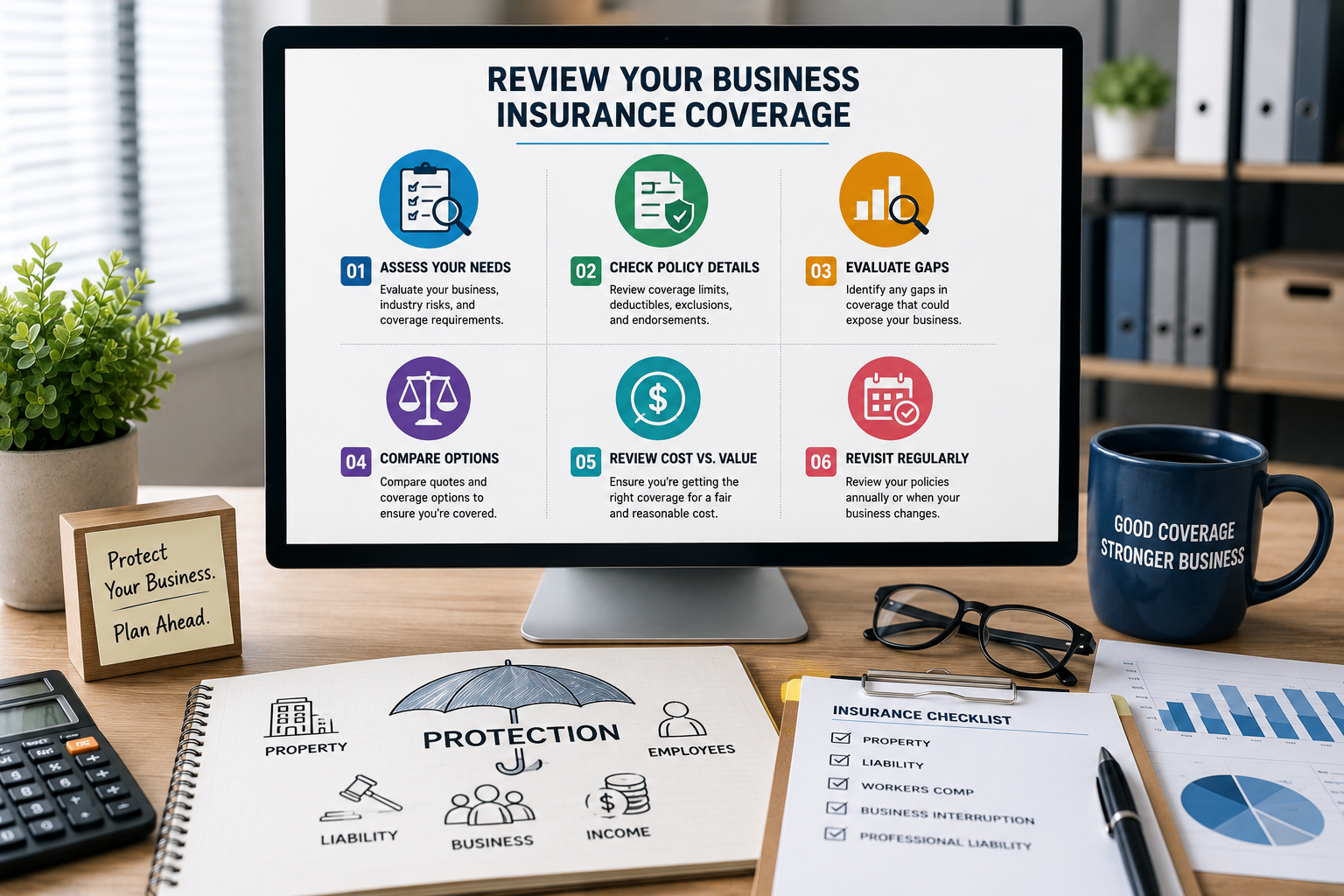
Reviewing your business insurance coverage means checking whether your policies still match what your company owns, does, and could lose. At least annually—and after significant changes—review your coverage types, limits, deductibles, exclusions, endorsements, insured locations, vehicles, employees, and contractual requirements. The goal is to identify gaps, outdated information, unnecessary overlap, or limits that no longer reflect the business.
Key Takeaways
- Review business insurance at renewal and after major changes to employees, locations, property, vehicles, products, services, or contracts.
- Check what each policy covers rather than relying only on the policy name or last year’s coverage choices.
- Compare limits, deductibles, exclusions, endorsements, and coverage triggers—not just premiums.
- Verify that business property values, payroll, revenue, locations, vehicles, and other policy information remain accurate.
- State insurance requirements and contractual obligations should be checked separately because they can vary by location and business activity.
When Should You Review Business Insurance Coverage?
An annual review is a useful baseline. NAIC consumer guidance specifically recommends reviewing business insurance policies annually and considering changes that may affect coverage or premiums.
Waiting for the renewal date is not always appropriate, however. A material change during the policy term can create a new exposure or make information on the existing policy outdated.
Business Changes That Can Trigger a Review
- Hiring employees or substantially changing payroll.
- Opening, closing, buying, or moving a business location.
- Buying major equipment or increasing inventory.
- Adding vehicles or changing how existing vehicles are used.
- Launching new products or professional services.
- Beginning operations in another state.
- Changing how customer or employee information is stored or processed.
- Signing a lease, loan agreement, or customer contract with new insurance requirements.
Step 1: Compare Your Current Operations With Your Policies
Start with the business as it operates today, not the company that existed when the policies were first purchased. Write down the locations you use, the property you own, the work employees perform, the products or services you provide, and the vehicles, technology, and customer interactions involved in daily operations.
Then compare those exposures with the insurance currently in force. SBA guidance recommends assessing the accidents, disasters, and lawsuits that could affect the company before selecting coverage. The same risk-based approach is useful during an annual review.
| Business Exposure | Coverage to Review | Questions to Ask |
|---|---|---|
| Customers or visitors | General liability | Do operations, locations, and liability limits still reflect current exposure? |
| Buildings, equipment, or inventory | Commercial property | Are property limits and insured locations still accurate? |
| Employees | Workers’ compensation and other employer-related coverage | Are employee counts, classifications, payroll, and state requirements current? |
| Professional services | Professional liability | Have services, contract values, or client expectations changed? |
| Business vehicles | Commercial auto | Are all vehicles, drivers, garaging locations, and uses described correctly? |
| Data and computer systems | Cyber insurance | Has the type or volume of sensitive data or technology dependence changed? |
Step 2: Review the Declarations and Policy Information
The declarations page or similar policy summary is a useful place to begin. Depending on the policy, it may identify the named insured, policy period, insured locations, vehicles, coverage limits, deductibles, classifications, and endorsements.
Check names and addresses carefully. A business that has changed its legal name, moved, opened another location, acquired a vehicle, or changed operations should make sure the insurer has accurate information.
Do not stop at the declarations page. It summarizes important policy information but does not contain every definition, exclusion, condition, or endorsement that can affect coverage.
Step 3: Check Coverage Limits and Deductibles
A coverage limit generally represents the maximum amount available under the policy or coverage, subject to the contract’s terms. NAIC guidance notes that business property policies generally state a limit of liability and that amounts above an applicable limit can remain the policyholder’s responsibility.
Compare existing limits with current exposures. Equipment purchases, inventory growth, building improvements, larger contracts, or increased customer activity may change how much coverage the business wants or needs.
Review Deductibles at the Same Time
A deductible shifts part of a covered loss to the business. A higher deductible may affect premium, but the company should be financially prepared to pay the deductible if a covered claim occurs.
Do not assume every coverage uses the same deductible structure. Review each applicable policy and endorsement separately.
Step 4: Read Exclusions, Conditions, and Endorsements
A policy’s coverage section is only part of the contract. Exclusions can remove coverage for specified risks, while conditions can establish obligations that affect how the policy operates.
Endorsements deserve particular attention. NAIC explains that an endorsement or rider can add, delete, exclude, or otherwise change coverage in an existing insurance contract. An endorsement may therefore materially change what the original policy form would have provided.
Pay attention to renewal changes. If the insurer adds or revises endorsements, compare them with the expiring policy rather than assuming the renewed policy is identical.
Step 5: Check Whether You Are Missing Important Coverage
A business can have several active policies and still have an exposure that is not addressed. The review should therefore ask not only whether current policies are adequate, but also whether the company has developed new risks that require another type of coverage.
For example, a company that once sold only physical products may begin offering professional consulting. Another business may begin making deliveries, storing more customer data, or operating from a second location. Each change can create insurance questions that were not relevant when the original policies were purchased.
Do Not Assume a BOP Covers Every Exposure
A business owner’s policy, or BOP, typically packages several common coverages, such as property, liability, and business interruption or continuation coverage. It does not automatically replace every other type of commercial insurance.
Depending on the business, separate consideration may be appropriate for workers’ compensation, commercial auto, professional liability, cyber insurance, product liability, umbrella or excess liability, and other specialized coverage.
Step 6: Verify Legal and Contractual Insurance Requirements
Business insurance requirements are not uniform nationwide. Workers’ compensation is a clear example: the U.S. Department of Labor explains that workers’ compensation for employees of private companies is generally overseen through state systems.
Requirements can also arise outside insurance statutes. Commercial leases, financing agreements, licenses, and customer contracts may specify certain policies or minimum limits. Those requirements can change when a business signs a new agreement or enters a new market.
If employees work in more than one state, verify requirements with the appropriate state workers’ compensation authorities rather than assuming the rules in the company’s home state apply everywhere.
Step 7: Review Business Interruption and Income Exposure
Property replacement is only part of the financial effect a serious loss can have. A business may also lose revenue or continue paying certain expenses while operations are suspended.
Review how business income or interruption coverage applies, including the types of losses that trigger coverage, applicable limits, waiting periods, and other policy conditions. The amount and structure of coverage that makes sense can change as revenue, locations, staffing, and recovery needs change.
Step 8: Compare Renewal Options, Not Just the Premium
Renewal is an opportunity to compare alternatives. SBA guidance recommends shopping around because business insurance prices and benefits can vary among offers.
For a meaningful comparison, try to compare substantially similar protection. A lower-priced policy may use different limits, deductibles, endorsements, or exclusions, so the lowest premium is not automatically the least expensive option after a loss.
Useful comparison points: policy limits, deductibles, exclusions, endorsements, covered locations, valuation methods, business income provisions, major conditions, and the insurer’s proposed premium.
A Hypothetical Business Insurance Review
Consider a hypothetical company that bought insurance when it operated from one leased office, had four employees, owned $30,000 of equipment, and did not use company vehicles. Two years later, it has nine employees, $75,000 of equipment, a second location, and a company-owned van. These figures are illustrative only and are not national averages.
An effective review would compare those changes with the current policies. The owner might need to verify property limits and locations, update employee and payroll information, examine workers’ compensation requirements, review commercial auto coverage, and reconsider how an interruption at either location could affect revenue.
The example does not mean every growing company needs the same changes. It illustrates why insurance should follow the business as the operation develops.
Business Insurance Review Checklist
Before renewal, work through a consistent checklist rather than relying on memory.
- Confirm the legal business name and insured entities.
- Verify all business locations and operations.
- Update property, equipment, and inventory information.
- Review revenue, payroll, employee counts, and job classifications where relevant.
- Check vehicles, drivers, and business vehicle use.
- Compare current limits and deductibles with today’s exposures.
- Read exclusions and all important endorsements.
- Review business income or interruption protection.
- Check contracts, leases, and state-specific insurance requirements.
- Look for new risks that existing policies may not address.
- Compare renewal terms with alternative insurance offers where appropriate.
- Keep updated records of policies, assets, premiums, and relevant insurance documents.
Frequently Asked Questions
The Bottom Line
A business insurance review should answer a straightforward question: do the policies you have today still match the business you operate today? Check current operations, property, employees, vehicles, contracts, limits, deductibles, exclusions, endorsements, and potential gaps rather than simply renewing last year’s coverage unchanged.
Review coverage annually and after significant business changes. Compare price alongside policy terms, verify state-specific requirements with the appropriate authorities, and read the actual insurance contracts before relying on coverage for a particular loss.
Sources
- National Association of Insurance Commissioners, Small Business, accessed August 2026.
- National Association of Insurance Commissioners, What Is an Insurance Endorsement or Rider?, accessed August 2026.
- U.S. Small Business Administration, Launch Your Business, accessed August 2026.
- U.S. Department of Labor, Workers’ Compensation, accessed August 2026.