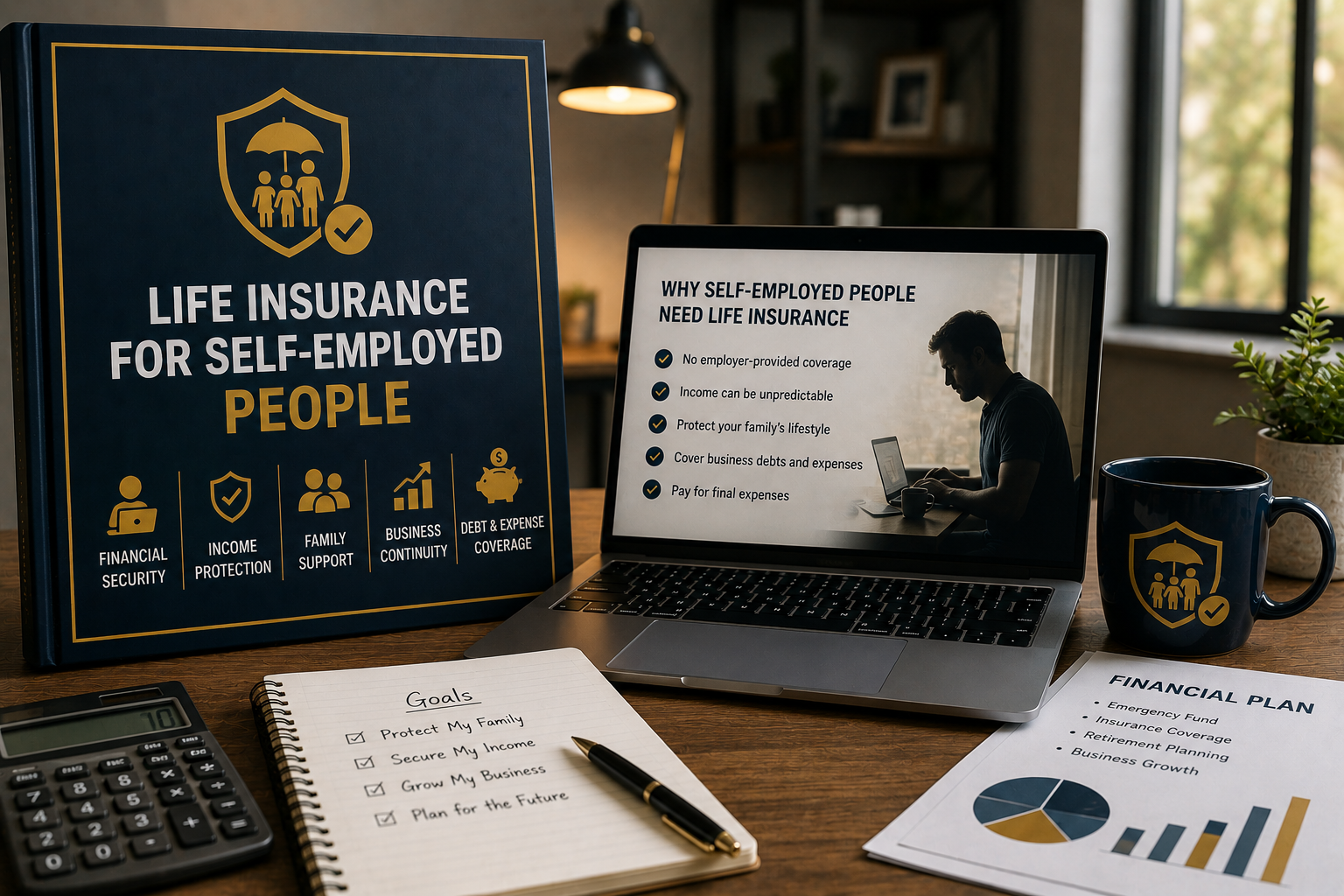
Life insurance can be especially important for self-employed people because one person’s death may affect both a household and a business at the same time. A freelancer, consultant, sole proprietor, contractor, professional, or small-business owner may need to replace personal income for family members while also addressing business debts, personal guarantees, ownership obligations, payroll, client relationships, or succession plans. The right coverage depends on who relies on you financially, how your business is structured, what obligations would remain after your death, and what other financial resources would be available.
Key Takeaways
- Self-employed people can need life insurance for both household and business obligations.
- Life insurance is especially important when a spouse, partner, children, parents, or other people depend on your income.
- Unlike many traditional employees, self-employed people generally do not automatically receive employer-sponsored group life insurance.
- Personal life insurance can help replace income, pay debts, cover final expenses, support children, and protect other financial goals.
- Business-related needs can include loans, leases, personal guarantees, payroll, ownership transfers, and business continuation.
- Key-person life insurance is owned by the business and pays the business when an insured person who is important to operations dies.
- Life insurance can sometimes be used to help fund a properly structured buy-sell agreement between business owners.
- Term life insurance generally provides lower-cost coverage for a specified period and normally does not build cash value.
- Permanent life insurance can remain in force longer and may build cash value, but premiums are generally higher.
- The appropriate coverage amount should account for personal obligations and business obligations separately to reduce the risk of double counting.
- Social Security survivor benefits may be available to eligible family members when self-employment earnings have been properly reported and taxed, but they are not a direct replacement for private life insurance.
- Personal life insurance death benefits are generally not subject to federal income tax when paid to beneficiaries because of the insured’s death, although exceptions can apply.
- Do not assume premiums for business-owned life insurance are deductible; federal tax law generally disallows deductions when the business is directly or indirectly the beneficiary.
- Business-owned and employer-owned life insurance can involve additional legal and tax rules.
- Beneficiary designations should be coordinated with wills, trusts, business agreements, and succession plans.
- Naming minor children directly can create administrative complications, so appropriate trust or custodial planning may be worth considering.
- Coverage should be reviewed after major changes in income, debt, family responsibilities, ownership, business value, or partnership structure.
- Do not cancel an existing life insurance policy until replacement coverage has been approved and is actually in force.
Do Self-Employed People Need Life Insurance?
Not every self-employed person needs the same amount of life insurance, and some may not need much coverage at all.
Life insurance becomes more important when your death would create a meaningful financial problem for someone else. Ask:
- Does a spouse or partner depend on my income?
- Do I have children?
- Do I financially support parents or other relatives?
- Would someone inherit a mortgage or other joint debt?
- Have I personally guaranteed business obligations?
- Would my business owe money after my death?
- Would the business need money to replace me or wind down operations?
- Do business partners depend on my work?
- Do I want to leave money for children, family, charity, or another beneficiary?
- Are my existing savings and other assets sufficient to meet these needs without insurance?
The fact that someone is self-employed does not itself create a life insurance need. The financial consequences of that person’s death do.
Why Self-Employment Can Create Additional Life Insurance Needs
A salaried employee’s death can interrupt household income. A self-employed person’s death can interrupt household income and the business that produces that income.
Possible consequences include:
- Immediate loss of household income.
- Loss of business revenue.
- Unfinished client obligations.
- Business debts becoming due.
- Personal guarantees being enforced.
- Payroll or contractor obligations.
- Rent or equipment lease obligations.
- Loss of an owner whose expertise drives the business.
- The need to sell or close the company quickly.
- A surviving family member inheriting a business they do not know how to operate.
Life insurance cannot solve every succession problem, but it can provide liquidity at a time when the family or business may urgently need cash.
Self-Employed Workers May Not Have Employer Life Insurance
Employees sometimes receive basic group life insurance through an employer. Someone working independently usually does not receive that benefit automatically.
That makes it important to evaluate individual coverage rather than assuming a workplace benefit exists.
Some self-employed people may have access to group coverage through a professional association, business organization, or company they own, but the terms, portability, amount, and underwriting can differ from individually owned insurance.
Personal Life Insurance vs. Business Life Insurance
| Purpose | Typical Owner / Beneficiary Structure | Possible Use |
|---|---|---|
| Personal income protection | Individual commonly owns policy; family or other chosen person is beneficiary. | Income replacement, mortgage, debts, education, final expenses. |
| Key-person protection | Business owns policy and is beneficiary. | Helps business absorb financial impact of losing a critical owner or employee. |
| Business succession | Ownership and beneficiary depend on the buy-sell structure. | Can provide funds associated with purchasing a deceased owner’s interest. |
These goals can require separate policies because the intended recipient and purpose of the money are different.
Replacing Your Income for Your Family
Income replacement is one of the most common reasons to buy personal life insurance.
For a self-employed person, use sustainable personal income rather than simply using gross business revenue.
Consider how much of the household budget depends on:
- Your salary or owner’s draw.
- Business distributions.
- Income that would stop if the business closed.
- Health insurance or benefits funded through the business.
- Retirement contributions funded from business earnings.
Avoid using gross sales as though all of that revenue were household income. Revenue may include money needed for inventory, payroll, taxes, contractors, rent, equipment, and other business expenses.
Business Debts and Personal Guarantees
Business debt does not always disappear when an owner dies.
Important obligations can include:
- Business loans.
- Lines of credit.
- Equipment financing.
- Commercial leases.
- Credit card balances.
- Supplier obligations.
- Taxes.
- Contractor or employee obligations.
- Personally guaranteed debts.
- Loans secured by personal or family assets.
Review loan agreements rather than assuming that forming an LLC or corporation eliminates every personal exposure.
Life Insurance for a Business Loan
A lender may sometimes require or request life insurance connected with a business loan, particularly when repayment depends heavily on an owner or key person.
The arrangement might involve a collateral assignment of an individual policy or another structure. The lender’s rights can be limited to the outstanding obligation, depending on the agreement.
Tax caution: IRS guidance generally does not allow a business deduction for life insurance premiums merely because the policy is used to obtain or protect a business loan when the taxpayer is directly or indirectly a beneficiary.
Key-Person Life Insurance
Key-person life insurance is purchased for the benefit of a business on the life of someone important to the company’s operations.
The business generally owns the policy, pays the premiums, and receives the death benefit when the insured key person dies, subject to applicable legal and tax requirements.
The money could potentially help the business:
- Replace lost revenue.
- Recruit and train a replacement.
- Maintain payroll.
- Continue making debt payments.
- Pay operating expenses during a transition.
- Reassure creditors or investors.
- Fund part of a business restructuring.
- Wind down operations in an orderly manner if continuation is not practical.
Illustrative Key-Person Example
A small consulting firm generates much of its revenue from one founding consultant. If that person dies, the business could lose clients and spend months recruiting a replacement.
A properly structured key-person policy could provide cash to the business during that transition. The amount and structure should reflect the actual financial impact rather than an arbitrary multiple.
Life Insurance and Buy-Sell Agreements
A business with two or more owners should consider what happens to an owner’s interest if that person dies.
A buy-sell agreement can establish who is permitted or required to purchase the deceased owner’s interest and how the transaction will work.
Life insurance can sometimes provide funds for that purchase.
Coordinate the documents: The policy ownership, beneficiary designation, business valuation method, buy-sell agreement, estate plan, and tax treatment should be designed to work together. A life insurance policy by itself does not create a complete succession plan.
Sole Proprietors May Have Different Risks
For a sole proprietor, the distinction between household finances and business finances can be less obvious than it is for a multi-owner corporation.
Questions to review include:
- Which business debts are legally personal obligations?
- What contracts would remain open?
- Could the business be sold?
- Would equipment or inventory need to be liquidated?
- Would family members inherit valuable business assets?
- Would customers need refunds or unfinished work completed?
- Would employees or contractors need final payments?
Personal life insurance can provide liquidity to survivors, while separate business planning can address obligations inside the business.
What if You Are Self-Employed but Have No Children?
Having no children can reduce a major life insurance need, but it does not automatically eliminate the need for coverage.
You may still want life insurance if:
- A spouse or partner depends on your income.
- You support parents or another family member.
- You share a mortgage.
- You have jointly obligated or personally guaranteed debt.
- Your business would face financial damage from your death.
- You have a business partner.
- You want to leave money to family, friends, or charity.
- You want specific funds available for final expenses.
How Much Life Insurance Does a Self-Employed Person Need?
Avoid choosing coverage only by multiplying income by an arbitrary number. A needs-based calculation can provide a clearer starting point.
Potential life insurance need = Household obligations + Business obligations intended to be insured − Existing resources available for those obligations
Household needs might include:
- Income replacement.
- Mortgage balance.
- Other household debt.
- Childcare.
- Education goals.
- Final expenses.
- Support for dependent parents.
Business needs might include:
- Outstanding business debt.
- Personal guarantees.
- Replacement costs for a key person.
- Business continuation expenses.
- Buy-sell funding.
- Orderly shutdown expenses.
Illustrative Coverage Calculation
Assume a self-employed consultant identifies the following personal needs:
- $450,000 for future family income.
- $250,000 remaining mortgage.
- $100,000 for education and other family goals.
- $25,000 for final expenses and short-term needs.
Total personal need = $825,000.
Assume $175,000 of savings and existing coverage is available for these same needs.
$825,000 − $175,000 = $650,000 illustrative remaining personal insurance need.
Business succession or key-person coverage would then be evaluated separately so that the same obligation is not counted twice. All amounts are hypothetical.
Avoid Double Counting Business and Personal Needs
Self-employed people can accidentally overstate insurance needs when the same obligation appears in more than one calculation.
For example, if a personal policy calculation already includes paying off a personally guaranteed business loan, do not automatically add the full loan again to another policy unless the second policy serves a separate legitimate purpose.
Separate each objective by identifying who needs the money and why.
Term Life Insurance for Self-Employed People
Term life insurance provides coverage for a specified period, such as 10, 20, or 30 years depending on the policy.
It generally offers lower initial premiums than permanent life insurance and normally does not build cash value.
Term coverage can work well for needs that have an identifiable end date, such as:
- Children becoming financially independent.
- A mortgage being paid off.
- A business loan being repaid.
- A partner buyout period.
- A business reaching a planned sale or succession date.
- Retirement assets becoming sufficient to support survivors.
Permanent Life Insurance for Self-Employed People
Permanent life insurance is designed to remain in force for a longer period as long as policy requirements are satisfied.
Permanent policies can build cash value and include whole life, universal life, and other designs. Premiums are generally higher than comparable term coverage because the policy provides longer-lasting insurance and additional features.
Permanent coverage may be considered when:
- A life insurance need is expected to remain indefinitely.
- The policy is part of long-term estate or business planning.
- A lifelong dependent needs financial support.
- Business succession planning requires longer-term coverage.
- The policyholder specifically values cash-value features and understands the costs and risks.
Term vs. Permanent Life Insurance
| Feature | Term Life | Permanent Life |
|---|---|---|
| Coverage period | Specified term. | Designed for long-term or lifetime coverage when policy requirements are met. |
| Initial cost | Generally lower. | Generally higher. |
| Cash value | Generally none. | May build cash value. |
| Common fit | Temporary income replacement, mortgage, children, temporary business obligations. | Long-term insurance needs, estate or succession planning, specialized financial goals. |
How Long Should Your Term Policy Last?
Match the term to the period during which the financial need is expected to exist.
For example:
- If your youngest child should be financially independent in 18 years, a roughly 20-year coverage period may be worth comparing.
- If a major business loan has 10 years remaining, a 10-year or longer policy may fit that obligation.
- If retirement savings should become sufficient in 25 years, income-replacement coverage might be needed until then.
The policy term does not need to match every obligation exactly. Some people layer multiple policies with different terms.
Layering Life Insurance Policies
A self-employed person may have several obligations that disappear at different times.
Illustrative Layering Example
A business owner might purchase:
- $500,000 of 20-year term coverage for family income replacement.
- $250,000 of 10-year term coverage associated with a temporary business obligation.
The shorter policy ends when the temporary need is expected to disappear, while the longer policy remains. The figures are hypothetical.
Social Security Survivor Benefits and Self-Employment
Self-employed workers can participate in Social Security when qualifying net self-employment income is properly reported and Social Security taxes are paid.
Eligible spouses, children, divorced spouses, or dependent parents may qualify for survivor benefits based on the deceased worker’s record.
Those benefits can be part of a survivor’s financial resources, but eligibility and payment amounts depend on the worker’s earnings history and the survivor’s circumstances.
Report self-employment income correctly: SSA states that self-employment earnings must be reported for them to count toward Social Security benefits. Underreporting earnings can therefore affect more than current taxes.
Who Should Be the Beneficiary?
The beneficiary is the person or organization designated to receive the policy’s death benefit.
Possible beneficiaries can include:
- A spouse.
- An unmarried partner.
- Adult children.
- Other relatives.
- A friend.
- A trust.
- A charity.
- A business.
- An institution with an appropriate insurable or financial interest.
The correct beneficiary depends on the purpose of the policy. Family income replacement usually has a different beneficiary than key-person coverage.
Primary and Contingent Beneficiaries
A primary beneficiary receives the death benefit if eligible when the insured dies.
A contingent beneficiary can receive the proceeds if the primary beneficiary dies before the insured or otherwise cannot receive the benefit.
Self-employed people should review both designations because an outdated beneficiary can undermine an otherwise carefully designed financial or succession plan.
Be Careful Naming Minor Children Directly
Insurance companies generally cannot simply hand a large life insurance payment directly to a young child.
A trust, custodial arrangement, or other estate-planning structure may provide a more controlled way to manage money intended for minor children.
The appropriate structure depends on state law and the family’s goals.
Should You Name Your Business as Beneficiary?
A business can be the appropriate beneficiary for a legitimate business-purpose policy such as key-person insurance.
That does not mean your business should automatically be the beneficiary of the personal policy intended to support your spouse or children.
Separate the intended purpose, owner, insured person, premium payer, and beneficiary before purchasing coverage.
Are Life Insurance Death Benefits Taxable?
For federal income tax purposes, life insurance proceeds received by a beneficiary because of the insured person’s death generally are not included in gross income.
Interest paid on the proceeds can be taxable, and transfers of policies for valuable consideration can create exceptions or additional rules.
Business-owned and employer-owned policies can involve additional federal requirements, so business owners should not assume the tax treatment of a personal family policy automatically applies to every commercial arrangement.
Can a Self-Employed Person Deduct Life Insurance Premiums?
Do not assume that life insurance premiums become a deductible business expense simply because the insured person is self-employed.
IRS guidance generally states that premiums cannot be deducted when the taxpayer or business is directly or indirectly a beneficiary of the policy.
The same guidance states that premiums on life insurance used to obtain or protect a business loan generally are not deductible when the applicable beneficiary rule is met.
Business-owned life insurance can involve additional tax reporting and notice requirements, so consult an appropriate tax professional when designing a commercial policy.
What Affects the Cost of Life Insurance?
Pricing can depend on factors including:
- Age.
- Health.
- Tobacco use.
- Occupation.
- Certain hazardous business activities.
- Risky hobbies.
- Coverage amount.
- Length of the policy term.
- Type of policy.
- Optional riders or features.
Being self-employed is not automatically a high-risk occupation. What you actually do matters. A freelance graphic designer and an independent roofing contractor can present very different underwriting risks.
Should You Buy Life Insurance While the Business Is Young?
Waiting until the business becomes large is not always the best approach.
Life insurance generally becomes more expensive as the insured person gets older, and a later health change can affect underwriting or insurability.
If financial dependents or important business obligations already exist, delaying simply because the company is still growing can leave an exposure uninsured.
Life Insurance and Uneven Self-Employment Income
Self-employed income can fluctuate from year to year.
Instead of calculating insurance from one unusually strong or weak year, consider a sustainable multi-year view of household income and business profitability.
Also choose premiums that remain affordable during slower business periods. A sophisticated policy provides little protection if cash-flow problems cause it to lapse.
Do Not Let the Policy Lapse During a Slow Business Period
A missed premium can eventually cause coverage to lapse depending on the policy and applicable grace-period rules.
Self-employed policyholders should build life insurance premiums into regular cash-flow planning rather than treating them as an optional expense only paid during profitable months.
Life Insurance Does Not Replace Disability Insurance
Life insurance primarily addresses the financial consequences of death.
A self-employed person may also face a serious financial problem if illness or injury prevents them from working while they are still alive.
Disability insurance is a separate form of protection and should be evaluated independently, particularly when the business depends heavily on the owner’s ability to work.
When Should You Review Your Coverage?
Review life insurance periodically and after changes such as:
- Marriage.
- Divorce.
- Birth or adoption of a child.
- Buying a home.
- Taking a major business loan.
- Personally guaranteeing debt.
- Starting a business partnership.
- Adding or removing an owner.
- Major business growth.
- Large changes in income.
- Selling part of the business.
- Changing the succession plan.
- Paying off major debts.
- Children becoming financially independent.
- Death of a beneficiary.
- Approaching retirement or a planned business exit.
Do Not Cancel an Existing Policy Too Early
If you are replacing an existing policy, do not cancel the old coverage simply because you submitted a new application.
The new insurer could change the rate, modify the offer, delay approval, or decline the application after underwriting.
Keep existing coverage in force until the replacement policy has been issued, accepted, and is effective.
Common Life Insurance Mistakes Self-Employed People Make
Assuming the Business Will Automatically Support the Family
A business that depends heavily on its owner can lose substantial value when that owner dies.
Using Gross Revenue as Personal Income
Business revenue and household income are not the same. Use realistic cash flow available to the family.
Ignoring Business Debt
Loans, leases, credit lines, and personal guarantees can create obligations that survive the owner.
Mixing Personal and Key-Person Coverage
Money intended to support a family and money intended to stabilize a business may require different policies and beneficiaries.
Having No Succession Plan
Life insurance can provide money, but it does not determine who owns, manages, sells, or closes the business.
Assuming Premiums Are Automatically Tax Deductible
Federal rules generally disallow deductions when the business is directly or indirectly the beneficiary.
Choosing Coverage the Business Cannot Sustain
Variable self-employment income makes affordability especially important. Coverage should remain manageable during slower periods.
Never Updating Beneficiaries
Marriage, divorce, death, ownership changes, and revised succession plans can make old beneficiary designations inappropriate.
Canceling Old Coverage Before New Coverage Is Active
A new application does not guarantee that the replacement policy will be issued on the expected terms.
Life Insurance Checklist for Self-Employed People
- Identify everyone who depends on your income.
- Calculate sustainable household income generated by your work.
- List mortgage and personal debts.
- Estimate final expenses.
- Estimate childcare and education needs.
- Identify dependent-parent or other family obligations.
- List business loans and lines of credit.
- Identify personally guaranteed debts.
- Review equipment and lease obligations.
- Determine whether your business could continue without you.
- Estimate the cost of replacing your role.
- Evaluate key-person insurance when appropriate.
- Review buy-sell planning if the company has multiple owners.
- Separate family coverage needs from business coverage needs.
- Subtract savings and existing insurance that are actually available for the same obligations.
- Compare term and permanent insurance.
- Choose a policy term that matches the expected duration of the need.
- Choose premiums that remain affordable during slow business periods.
- Select primary beneficiaries.
- Select contingent beneficiaries.
- Coordinate minor-child planning with an appropriate trust or custodial arrangement when necessary.
- Coordinate beneficiary designations with business agreements.
- Review federal and state tax consequences for business-owned coverage.
- Compare similar policies from multiple insurers.
- Check insurer financial strength and licensing.
- Keep existing coverage in force until replacement coverage is active.
- Review coverage whenever family, debt, income, ownership, or business circumstances materially change.
Frequently Asked Questions
The Bottom Line
Self-employed people should evaluate life insurance from two directions: what happens to the household and what happens to the business. A death can eliminate personal income while simultaneously damaging the company that generated that income.
Personal life insurance can help replace income, pay debts, cover final expenses, support children or other dependents, and protect long-term family goals. Term insurance can be a cost-effective way to cover temporary needs, while permanent insurance can address longer-lasting objectives when its additional cost and features make sense.
Business planning may require separate coverage. Key-person insurance can provide liquidity to a company after losing an important owner or employee, while life insurance can sometimes help fund a properly designed buy-sell arrangement or provide resources associated with business debt and succession.
Do not assume business-owned life insurance receives the same tax treatment as a simple personal policy. Ownership, beneficiaries, business purpose, premium deductions, employer-owned coverage rules, and succession documents can create additional tax and legal considerations.
The strongest approach is to identify each financial obligation, decide who would need money after your death, determine how long that need will exist, subtract existing resources, and then match each remaining risk to the appropriate coverage. As the business grows or your family changes, repeat the analysis so the life insurance continues to reflect the financial reality of both.
Sources
- National Association of Insurance Commissioners, Life Insurance consumer guidance, accessed August 2026.
- National Association of Insurance Commissioners, Insurance Topics: Life Insurance, current guidance accessed August 2026.
- National Association of Insurance Commissioners, What Type of Life Insurance Is Right for You?, September 6, 2023.
- National Association of Insurance Commissioners, Small Business Insurance, Key Person Life Insurance guidance, accessed August 2026.
- National Association of Insurance Commissioners, Life Insurance Buyer’s Guide, accessed August 2026.
- Texas Department of Insurance, Life Insurance Guide, current guidance accessed August 2026.
- Texas Department of Insurance, Do You Need Life Insurance?, updated December 12, 2025.
- Social Security Administration, Self-Employment and Social Security Earnings guidance, accessed August 2026.
- Social Security Administration, Survivor Benefits, accessed August 2026.
- Internal Revenue Service, Life Insurance & Disability Insurance Proceeds, accessed August 2026.
- Internal Revenue Service, Publication 334, Tax Guide for Small Business, 2025.