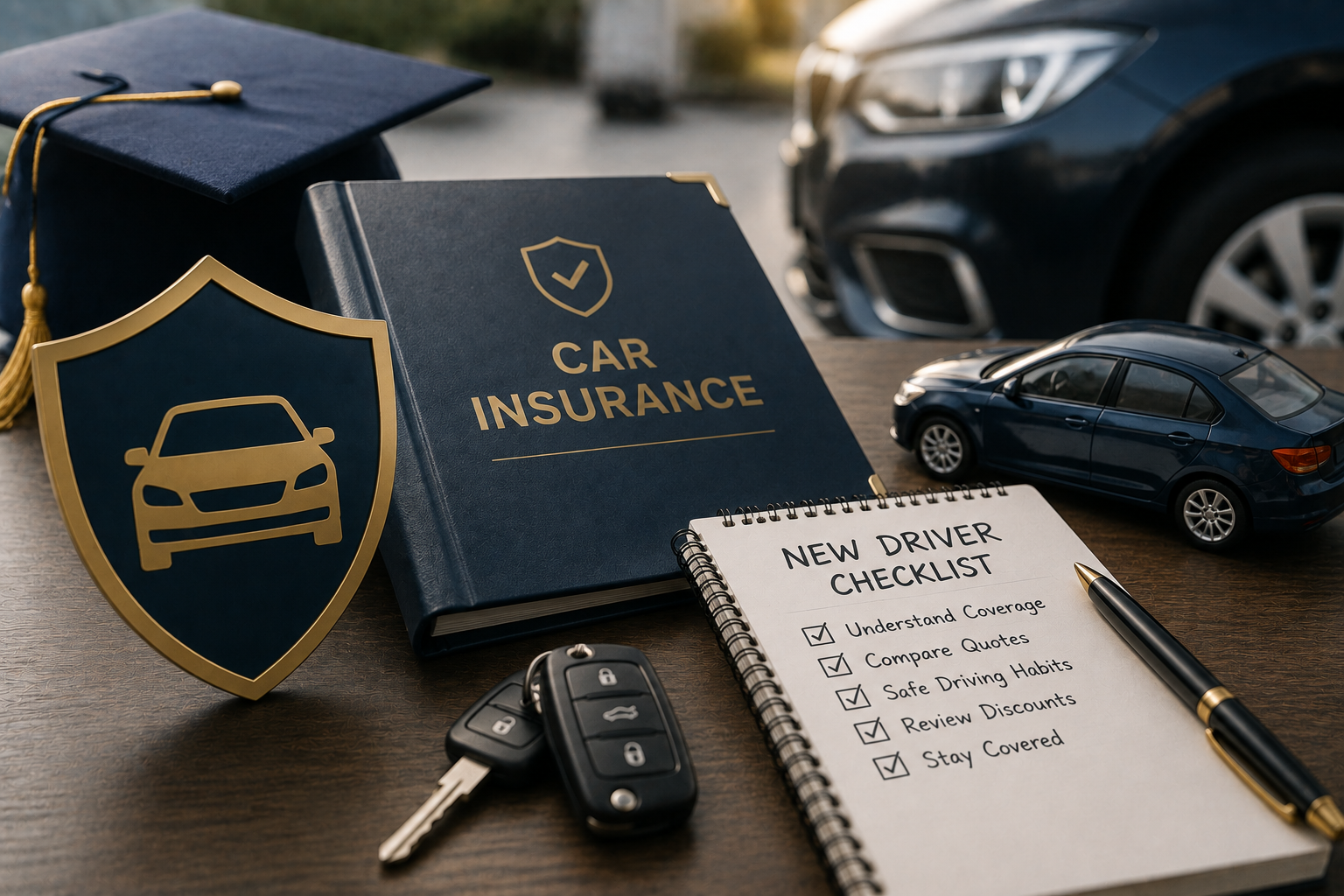
Car insurance for a new driver can be expensive and confusing because the driver has little or no established driving history. Whether the new driver is a teenager, a college student, or an adult getting licensed for the first time, the important questions are similar: what coverage is legally required, whether the driver should join an existing household policy or buy a separate policy, what protection the vehicle needs, and which discounts or policy choices can reduce the cost without creating dangerous coverage gaps.
Key Takeaways
- Most states require drivers or vehicle owners to carry minimum amounts of auto liability insurance or otherwise prove financial responsibility.
- State minimum liability limits should be viewed as legal minimums, not automatically as the amount of protection a driver actually needs.
- A new driver living in a household with existing insured vehicles may be able or required to be added to the household policy.
- Adding a young driver to a parent’s policy is often less expensive than purchasing a completely separate policy, although company and household circumstances vary.
- Drivers and household members should be disclosed accurately to the insurer.
- Liability coverage protects against injuries or property damage the insured driver causes to others, subject to policy limits.
- Collision coverage helps pay for damage to the insured vehicle from collisions.
- Comprehensive coverage generally protects against non-collision losses such as theft, fire, vandalism, hail, flood, or falling objects.
- Collision and comprehensive generally are not required by state liability laws, but lenders or leasing companies commonly require them.
- Uninsured/underinsured motorist, medical payments, and personal injury protection rules vary by state.
- Higher comprehensive or collision deductibles can reduce premiums but increase the amount you must pay after a covered loss.
- Good-student, driver-education, multi-car, telematics, and other discounts may be available, depending on the insurer and state.
- Usage-based or telematics programs may evaluate factors such as mileage, time of day, hard braking, or other driving behaviors.
- The vehicle assigned to a new driver can materially affect the premium.
- A modest vehicle with strong safety features can make more sense than a high-performance or unusually expensive vehicle for a new driver.
- New drivers should understand their state’s graduated driver licensing rules when applicable.
- Insurance prices can vary significantly between companies for the same driver and coverage.
- Compare quotes using identical liability limits, deductibles, vehicles, drivers, and optional coverage so the comparison is meaningful.
Why Is Car Insurance Expensive for New Drivers?
Insurance companies price auto coverage according to the risk they expect to insure, subject to state insurance laws.
A new driver has little driving history for the insurer to evaluate. For younger new drivers, lack of experience also corresponds with higher crash risk.
NHTSA identifies inexperience as a major reason novice teen drivers face higher crash risk, particularly during the first months of unsupervised driving.
Depending on the state and insurer, pricing can also be affected by factors such as:
- Age and driving experience.
- Driving record.
- Vehicle make, model, age, and safety characteristics.
- Where the vehicle is garaged.
- Annual mileage.
- How the vehicle is used.
- Coverage limits.
- Collision and comprehensive deductibles.
- Household drivers.
- Discount eligibility.
- Other rating factors permitted by applicable state law.
New Driver vs. Teen Driver
Not every new driver is a teenager.
Someone can obtain a first license at age 16, 22, 35, or later. An adult first-time driver may not face the same age-related rating considerations as a teenage driver, but the person still lacks an established driving record.
Teen drivers can also be subject to graduated driver licensing restrictions involving nighttime driving, passengers, supervised practice, or other conditions. Those rules vary by state.
Do New Drivers Need Car Insurance?
In most states, drivers or vehicle owners must satisfy financial responsibility requirements, commonly by carrying liability insurance.
Exactly when a newly licensed person must be listed on a particular policy depends on vehicle ownership, household circumstances, insurer rules, state law, and how often the person drives an insured vehicle.
Do not assume a new household driver can simply remain undisclosed because the person occasionally uses another family member’s car. Some insurers require all driving-age household members or regular drivers to be disclosed.
Tell the insurer about new drivers: Failing to disclose a household driver or providing inaccurate information can lead to additional premium charges, coverage disputes, claim problems, or nonrenewal depending on the circumstances and applicable policy rules.
Add the New Driver to a Family Policy or Buy a Separate Policy?
A young driver in a household commonly has two broad possibilities: being added to an existing family auto policy or obtaining a separate policy.
Texas Department of Insurance guidance notes that adding a young driver to an existing policy is usually cheaper than purchasing a separate policy, although actual results depend on the insurer, vehicles, household, coverage, and state.
| Option | Potential Considerations |
|---|---|
| Add to household policy | Can benefit from existing multi-car or bundled pricing and is often simpler for household vehicles. |
| Separate policy | May be appropriate when the driver owns a separate vehicle or household circumstances require separate insurance, but it can be more expensive for a young driver. |
Ask insurers to quote both structures when both are legitimately available.
Liability Insurance
Liability coverage protects against certain financial consequences when an insured driver is legally responsible for injuring someone or damaging another person’s property.
Bodily Injury Liability
This can help pay covered medical expenses, lost income, legal damages, and other amounts arising from injuries the insured driver causes to other people, subject to policy terms and limits.
Property Damage Liability
This helps pay for covered damage the insured driver causes to another person’s vehicle or other property.
State Minimum Liability Is Only a Minimum
State-required liability limits establish the minimum legal requirement, not necessarily the amount needed to protect a household from a serious accident.
A new driver can cause an accident involving multiple vehicles, serious injuries, or expensive property damage. If a covered claim exceeds the liability limit, the insurer generally does not pay beyond the applicable policy limit.
Compare higher liability limits rather than automatically selecting the lowest amount available.
Collision Coverage
Collision coverage helps pay for physical damage to the insured vehicle from a collision with another vehicle or object, subject to the deductible and policy terms.
It can be valuable for a new driver because an at-fault collision can damage the driver’s own vehicle even though liability coverage is designed primarily to protect against damage caused to others.
Comprehensive Coverage
Comprehensive coverage generally protects the insured vehicle from covered losses other than ordinary collisions.
Examples can include:
- Theft.
- Fire.
- Vandalism.
- Hail.
- Flood.
- Windstorm.
- Falling objects.
- Glass damage.
- Animal-related damage.
Actual covered causes of loss depend on the policy.
Financed and Leased Cars Usually Need Physical Damage Coverage
Collision and comprehensive coverage generally are not required by state liability laws, but lenders and leasing companies commonly require both when they have a financial interest in the vehicle.
A lender may also appear on the declarations page as a loss payee or lienholder.
Do not drop collision or comprehensive on a financed or leased vehicle without checking the contract.
What About an Older Car?
Once a vehicle is paid off, collision and comprehensive become a financial decision rather than a lender requirement in many situations.
Consider:
- The vehicle’s current value.
- The premium for collision and comprehensive.
- The deductible.
- How much you could afford to pay toward a replacement vehicle.
- Whether losing the vehicle would create significant transportation or financial problems.
There is no universal vehicle-age rule for dropping physical damage coverage.
Uninsured and Underinsured Motorist Coverage
Uninsured motorist and underinsured motorist coverage can help when another driver causes a covered accident but has no insurance or not enough liability coverage.
Availability, mandatory-offer rules, rejection requirements, and benefits vary by state.
PIP and Medical Payments Coverage
Some states require or offer personal injury protection, commonly called PIP, medical payments coverage, or related first-party injury benefits.
PIP can cover specified medical expenses and, depending on the state and policy, other losses such as lost wages. Medical payments coverage generally provides more limited medical-expense protection.
State rules determine what is required, optional, or available.
Understanding the Deductible
Collision and comprehensive commonly include deductibles.
A higher deductible often reduces the premium, but it also increases the amount you must absorb after a covered loss.
Illustrative Deductible Example
Assume a covered collision causes $4,000 of damage and the policy has a $1,000 collision deductible.
The insured would generally be responsible for the first $1,000.
The insurer could then pay up to $3,000 of the covered repair cost, subject to policy terms. The example is illustrative.
The Car a New Driver Uses Matters
The vehicle can materially affect what the insurer charges and how much financial risk the household assumes.
Before buying a vehicle for a new driver, consider:
- Purchase price.
- Repair costs.
- Theft risk.
- Safety features.
- Performance characteristics.
- Collision and comprehensive premium.
- Whether the vehicle will be financed.
NHTSA recommends that parents focus on safer vehicles rather than high-performance vehicles for teen drivers.
Get an insurance quote before buying the car: Two vehicles with similar purchase prices can produce very different premiums.
Good Student Discounts
Some insurers offer discounts to qualifying young drivers who maintain specified grades or academic performance.
Eligibility standards differ by insurer and state. Ask what documentation is required and how often it must be renewed.
Driver Education Discounts
Some companies provide discounts when a young driver completes an approved driver education or safety course.
Do not enroll in a course solely for insurance savings without confirming that the insurer recognizes the program.
Telematics and Usage-Based Insurance
Some insurers offer telematics or usage-based insurance programs that use a mobile app, plug-in device, or connected vehicle system to evaluate driving behavior.
Depending on the program, factors can include:
- Miles driven.
- Time of day.
- Hard braking.
- Acceleration.
- Speed-related behavior.
- Phone use or distracted-driving indicators.
- Other driving patterns.
Telematics can create discounts or affect pricing depending on the program. Ask how the insurer uses the data before enrolling.
Other Discounts to Ask About
- Multi-car discount.
- Auto and homeowners or renters bundle.
- Good student discount.
- Driver education discount.
- Telematics or safe-driving program.
- Low-mileage discount.
- Student-away-at-school discount.
- Anti-theft equipment.
- Vehicle safety equipment.
- Other insurer-specific discounts.
Discounts are not universally required or identical. Availability and savings depend on the company and applicable state rules.
Should a New Driver Raise the Deductible to Save Money?
Raising collision or comprehensive deductibles can reduce premium, but the driver or household should be able to pay the higher deductible immediately after a loss.
Illustrative Premium Tradeoff
Assume increasing a deductible from $500 to $1,000 reduces the annual premium by a hypothetical $180.
You save $180 per year but take on an additional $500 of potential out-of-pocket cost after a covered claim.
Whether that tradeoff makes sense depends on your emergency savings and risk tolerance. The figures are hypothetical.
Do New Drivers Need “Full Coverage”?
“Full coverage” is not a standardized insurance term.
People often use it informally to mean liability plus collision and comprehensive coverage, but policies can still contain deductibles, exclusions, limits, and optional protections that are not included.
Ask for the specific coverages and limits rather than requesting “full coverage” without further detail.
GAP Coverage for a Financed New Driver Vehicle
Collision and comprehensive generally pay based on the vehicle’s covered loss valuation, not automatically on the remaining loan balance.
If a financed vehicle is totaled while the loan balance is greater than the insurance settlement, the borrower can remain responsible for the difference.
Guaranteed Asset Protection, commonly called GAP, can help address that difference when applicable terms are satisfied. GAP products and rules vary.
Rental Reimbursement and Roadside Assistance
Optional coverage can sometimes be useful for a new driver who depends heavily on one vehicle.
Rental Reimbursement
This can help pay for temporary transportation when the insured vehicle is being repaired after a covered loss, subject to daily and total limits.
Roadside Assistance
Roadside coverage may provide towing, jump-starts, lockout assistance, or other services. Compare insurer coverage with auto-club or vehicle-manufacturer benefits to avoid unnecessary duplication.
A Driver Away at College
A student who moves away for school may still need to remain listed on the household auto policy depending on access to household vehicles, residence, vehicle ownership, insurer rules, and state requirements.
Some insurers offer discounts when a student attends school away from home and has limited access to the insured vehicles.
If a student takes a vehicle to another state, tell the insurer so garaging, registration, and policy requirements can be reviewed.
How to Lower Car Insurance Costs for a New Driver
- Shop with several insurers.
- Compare adding the driver to a family policy with a separate policy when both structures are available.
- Ask about good-student discounts.
- Ask about approved driver education discounts.
- Compare telematics programs.
- Ask about low-mileage pricing.
- Ask about multi-car discounts.
- Compare bundling auto with renters or homeowners insurance.
- Get insurance quotes before buying a vehicle.
- Avoid unnecessarily high-performance or unusually expensive vehicles.
- Compare higher deductibles only if the household can afford them.
- Review collision and comprehensive on older paid-off vehicles.
- Keep mileage and vehicle-use information accurate.
- Maintain a clean driving record.
- Re-shop periodically because insurers can price the same driver differently.
Do Not Reduce Liability Coverage Automatically to Save Money
Lowering liability limits can reduce premiums, but it also reduces the insurance protection available after a serious accident.
Before cutting liability coverage, compare the actual premium savings against the additional financial exposure the household would assume.
Safe Driving Matters Beyond Insurance Cost
Avoiding accidents and violations can help a new driver build a better driving record over time, but safe driving is more important than the insurance savings alone.
NHTSA emphasizes several major risks for novice teen drivers:
- Speeding.
- Distracted driving.
- Unsafe passenger situations.
- Impaired driving.
- Failure to use seat belts.
- Inexperience with complex driving situations.
Parents of teen drivers should also understand and enforce applicable graduated driver licensing restrictions.
What Information Do You Need for a Quote?
Insurers commonly ask for information such as:
- Driver’s name and license information.
- Date of birth.
- Driving history.
- Vehicle year, make, model, and VIN.
- Vehicle ownership or financing information.
- Garaging address.
- Estimated annual mileage.
- Vehicle use.
- Other household drivers.
- Desired liability limits.
- Collision and comprehensive deductibles.
- Optional coverages requested.
Use the same information when requesting competing quotes.
How to Compare New Driver Insurance Quotes
- Use identical liability limits.
- Use identical uninsured/underinsured motorist selections.
- Use the same collision deductible.
- Use the same comprehensive deductible.
- Include the same vehicles and drivers.
- Use the same mileage and vehicle-use information.
- Compare rental and roadside coverage consistently.
- Ask which discounts are included.
- Ask whether telematics savings are guaranteed or behavior-dependent.
- Review payment fees and installment charges.
- Check the insurer’s financial and complaint information through your state insurance department when available.
- Compare the final policy terms, not just the headline premium.
Common New Driver Insurance Mistakes
Failing to Tell the Insurer About a New Household Driver
Accurate driver information matters. Do not assume a newly licensed household member can remain undisclosed.
Buying State Minimum Coverage Without Comparing Higher Limits
The legal minimum may leave substantial financial exposure after a serious accident.
Buying a Car Before Checking the Insurance Premium
Insurance differences between vehicles can materially affect the true cost of ownership.
Assuming “Full Coverage” Covers Everything
Auto policies still contain exclusions, limits, deductibles, and optional coverages.
Choosing a Deductible You Cannot Afford
A lower premium is not useful if the deductible makes a claim financially unmanageable.
Dropping Collision on a Financed Car
The lender or lessor commonly requires collision and comprehensive while it has a financial interest in the vehicle.
Ignoring Available Discounts
Student, driver-training, telematics, multi-car, and other discounts may materially change the quote.
Comparing Unequal Quotes
A cheaper quote is not truly cheaper if it has lower liability limits, higher deductibles, or missing optional coverage.
New Driver Car Insurance Checklist
- Confirm the state’s insurance requirements.
- Tell the insurer about the new driver.
- Confirm whether the driver must be listed on an existing household policy.
- Compare family-policy and separate-policy options when appropriate.
- Compare liability limits above the state minimum.
- Review uninsured/underinsured motorist coverage.
- Review PIP or medical payments coverage.
- Determine whether collision is appropriate or required.
- Determine whether comprehensive is appropriate or required.
- Confirm lender or lease requirements.
- Choose deductibles the household can afford.
- Get insurance quotes before selecting a vehicle.
- Ask about student discounts.
- Ask about driver education discounts.
- Ask about telematics.
- Ask about multi-car and bundle discounts.
- Check student-away-at-school options if relevant.
- Review rental reimbursement and roadside assistance.
- Consider GAP if the vehicle is financed and the loan balance could exceed its value.
- Request several equivalent quotes.
- Review the declarations page after coverage begins.
- Update the policy when drivers, vehicles, addresses, mileage, or vehicle use change.
Frequently Asked Questions
The Bottom Line
New driver car insurance requires balancing legal requirements, financial protection, and affordability. The first priority is making sure the driver is properly disclosed and insured under the correct household or individual policy structure.
Liability coverage protects against covered injuries and property damage the driver causes to others. Collision and comprehensive protect the insured vehicle against different categories of loss and are commonly required when the vehicle is financed or leased.
New drivers should not assume the cheapest state-minimum policy is automatically the best choice. Liability limits, deductibles, uninsured motorist protection, vehicle value, financing requirements, and the household’s ability to absorb a major loss all matter.
There are also legitimate ways to reduce premiums. Shop multiple insurers, compare the cost of adding the driver to an existing policy, ask about student and driver-training discounts, consider telematics carefully, and get insurance quotes before selecting a vehicle.
Finally, the strongest long-term insurance strategy for a new driver is also the simplest: build experience safely. Avoiding crashes, speeding, distractions, and traffic violations helps protect the driver, passengers, other road users, and the driver’s future insurance record.
Sources
- National Association of Insurance Commissioners, Auto Insurance Topics, current guidance accessed August 2026.
- National Association of Insurance Commissioners, Consumer Auto Insurance Guide, accessed August 2026.
- National Association of Insurance Commissioners, Protect Yourself: Insuring a Teen Driver, accessed August 2026.
- National Association of Insurance Commissioners, What Does Auto Insurance Cover?, June 11, 2026.
- Texas Department of Insurance, Auto Insurance Guide, current guidance accessed August 2026.
- Texas Department of Insurance, Adding a Teen Driver to Your Insurance Policy?, accessed August 2026.
- California Department of Insurance, Automobile Insurance Guide, revised February 5, 2025.
- California Department of Insurance, Shopping for Automobile Insurance, accessed August 2026.
- National Highway Traffic Safety Administration, Teen Safe Driving: How Teens Can Be Safer Drivers, accessed August 2026.
- National Highway Traffic Safety Administration, Understanding the Problem: Young Drivers, accessed August 2026.