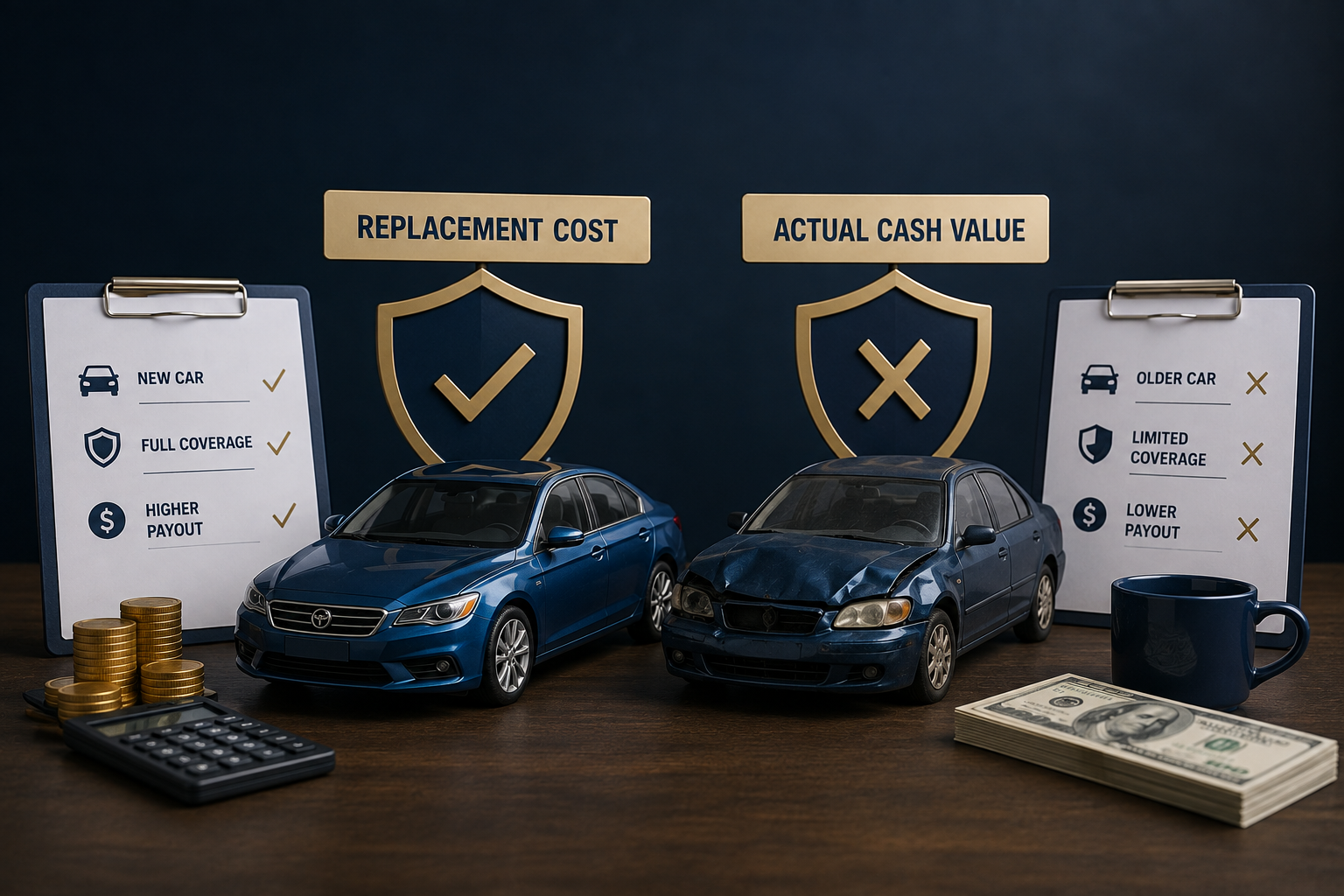
Replacement cost coverage generally pays to repair or replace covered property with property of similar kind and quality without subtracting depreciation. Actual cash value, or ACV, generally reflects the property’s depreciated value at the time of loss. That difference can significantly affect an insurance claim: replacement cost coverage may cost more, but ACV coverage can leave you paying more yourself when damaged or destroyed property needs to be replaced.
Key Takeaways
- Replacement cost generally does not deduct for depreciation when determining the covered replacement amount.
- Actual cash value generally reflects depreciation for age, condition, wear and tear, or other relevant factors.
- Replacement cost is not the same as a home’s real estate market value.
- Some replacement cost claims are initially paid at actual cash value, with additional recoverable depreciation paid after repair or replacement.
- Policy limits, deductibles, special limits, exclusions, and state rules can still restrict how much an insurer ultimately pays.
What Is Replacement Cost?
Replacement cost is generally the amount needed to repair or replace covered damaged property with property or materials of similar kind and quality without deducting for depreciation.
For personal property, that can mean replacing an older covered item with a comparable new item rather than receiving only the depreciated value of the item that was damaged or destroyed.
For a dwelling, replacement cost generally focuses on what it would take to repair or rebuild the damaged structure using materials of similar kind and quality. It does not simply use the price at which the property could be sold on the real estate market.
What Is Actual Cash Value?
Actual cash value generally represents the value of covered property after depreciation is taken into account. A common way to understand ACV is replacement cost minus depreciation, although the exact valuation method can depend on the policy, property, state law, and claim circumstances.
Depreciation reflects the loss of value associated with factors such as age, condition, wear and tear, and expected useful life.
Because ACV accounts for depreciation, an actual cash value settlement may not provide enough money to purchase a brand-new replacement for the damaged property.
Replacement Cost vs. Actual Cash Value at a Glance
| Feature | Replacement Cost | Actual Cash Value |
|---|---|---|
| Depreciation | Generally not deducted from the covered replacement amount. | Generally considered when determining value. |
| Potential Claim Payment | Usually higher when replacement is completed and policy conditions are satisfied. | Usually lower for older or depreciated property. |
| Premium | May cost more because the insurer takes on more replacement risk. | May cost less because claim payments can reflect depreciation. |
| Out-of-Pocket Risk | Generally lower for replacing covered property, subject to limits and deductibles. | Can be higher because the claim payment may not cover the full cost of a new replacement. |
| Best Understood As | Cost to replace covered property without a depreciation deduction. | Depreciated value of covered property at the time of loss. |
The central tradeoff is straightforward: replacement cost coverage generally provides stronger protection against the expense of replacing damaged property, while ACV coverage can leave a larger gap between the insurance payment and what a new replacement actually costs.
How Depreciation Changes an Actual Cash Value Claim
Depreciation is the key reason ACV and replacement cost claims can produce different payments.
An insurer evaluating depreciation may consider the property’s age, condition, expected useful life, wear and tear, and what a comparable replacement would cost. The exact calculation is not necessarily identical for every item, insurer, policy, or state.
Hypothetical ACV Example
Suppose a covered appliance would cost $2,000 to replace today. For this simplified example, assume the insurer determines that $800 of depreciation applies.
$2,000 replacement cost − $800 depreciation = $1,200 actual cash value.
If a $500 deductible applied to this simplified one-item claim, the potential ACV payment could be $700, assuming the loss is otherwise fully covered.
The hypothetical numbers above are only an illustration. Actual depreciation and settlement calculations depend on the property, policy terms, deductible, state rules, and insurer’s claim evaluation.
How a Replacement Cost Claim May Be Paid
Replacement cost coverage does not always mean the insurer immediately sends a check for the full cost of a brand-new replacement.
Many policies initially pay the actual cash value of damaged personal property or building repairs. After you repair or replace the covered property and satisfy the policy’s requirements, the insurer may pay additional amounts representing recoverable depreciation.
Using the Same $2,000 Example
Assume the covered item costs $2,000 to replace, the calculated ACV is $1,200, and a $500 deductible applies to the claim.
An initial payment might reflect the ACV after the deductible. If you then purchase a qualifying replacement and satisfy the policy conditions, additional recoverable depreciation may become payable.
The precise timing and amount depend on the policy and claim, so review the settlement documents before assuming all replacement cost benefits are paid upfront.
Replacement Cost Is Not the Same as Market Value
A home’s replacement cost and its real estate market value measure different things.
Replacement cost focuses on the expense of rebuilding or repairing the insured structure using materials of similar kind and quality. Market value reflects what a buyer may pay for the property and can be influenced by the land, neighborhood, local housing market, schools, supply and demand, and other real estate factors.
A home’s market value can therefore be higher or lower than its estimated reconstruction cost. Insuring a home based solely on its sale price can produce the wrong amount of dwelling coverage.
Replacement Cost for Your Home vs. Personal Property
The valuation method for your dwelling is not necessarily identical to the valuation method for everything inside it.
Dwelling Coverage
Replacement cost dwelling coverage generally focuses on repairing or rebuilding covered structural damage without a depreciation deduction, up to the limits and conditions of the policy.
Personal Property Coverage
Personal belongings may be insured at ACV or replacement cost depending on the policy and endorsements you purchased. Replacement cost personal property coverage can be particularly important for items that lose value quickly with age but remain expensive to replace new.
Do not assume that because the dwelling has replacement cost protection every belonging automatically receives replacement cost treatment. Review the personal property section of the policy separately.
Policy Limits Still Matter With Replacement Cost Coverage
Replacement cost coverage does not automatically mean unlimited coverage. Standard replacement cost protection is still generally subject to the coverage limits shown in the policy.
If reconstruction or replacement costs rise above your available limit, you can still have an uninsured gap unless another policy feature provides additional protection.
This becomes especially important after disasters or periods of rapidly rising construction costs, when labor and material expenses can exceed earlier estimates.
Extended and Guaranteed Replacement Cost
Some homeowners policies offer protection beyond standard replacement cost coverage.
Extended Replacement Cost
Extended replacement cost coverage can provide an additional amount above the dwelling limit, typically subject to a specified percentage or dollar cap stated by the policy.
Guaranteed Replacement Cost
Guaranteed replacement cost coverage is designed to provide broader protection when rebuilding costs exceed the stated dwelling limit, subject to the policy’s conditions and any applicable cap. This coverage is not available from every insurer or in every market.
The terminology can sound similar, so review the policy carefully instead of assuming standard, extended, and guaranteed replacement cost provide the same level of protection.
Special Limits Can Reduce What You Receive
Even replacement cost personal property coverage does not necessarily provide unlimited reimbursement for every possession.
Homeowners and renters policies can contain specific limits for categories of valuable property. Depending on the policy, items such as jewelry, art, collectibles, silverware, electronics, or other valuable belongings may have special limits or additional conditions.
If you own high-value property, review the applicable limits and ask whether additional scheduled or endorsed coverage is needed rather than assuming replacement cost coverage alone solves the issue.
Replacement Cost in Renters Insurance
The same basic ACV-versus-replacement-cost decision can apply to renters insurance personal property coverage.
An ACV renters policy can pay the depreciated value of covered belongings, which may be much less than the amount needed to replace clothing, furniture, electronics, appliances, and other possessions with comparable new items.
Replacement cost personal property coverage can reduce that replacement gap, although deductibles, policy limits, special limits, exclusions, and claim requirements still apply.
What About Auto Insurance?
Actual cash value also appears in auto insurance, especially when an insured vehicle is declared a total loss. Standard collision or comprehensive coverage generally does not promise to replace an older totaled vehicle with a brand-new version regardless of depreciation.
Some insurers offer new-car replacement or similar optional coverage that can change how certain qualifying total-loss claims are settled. Eligibility, vehicle-age restrictions, limits, and policy language vary by insurer and state.
For that reason, do not assume the replacement cost rules in a homeowners policy automatically apply to auto insurance.
Which Coverage Makes More Sense?
Replacement cost coverage generally provides stronger financial protection because depreciation does not reduce the covered replacement amount in the same way it does under ACV coverage. That can be valuable if replacing your home or belongings out of pocket would be difficult.
ACV coverage can sometimes cost less, but the lower premium comes with a larger potential replacement gap after a claim.
| Consideration | Replacement Cost May Fit Better If… | ACV May Be Considered If… |
|---|---|---|
| Replacing belongings | Buying new replacements yourself would create financial strain. | You are comfortable absorbing depreciation-related gaps. |
| Premium | You prioritize stronger claim protection over the lowest premium. | Lower upfront insurance cost is a greater priority and you understand the tradeoff. |
| Out-of-pocket risk | You want to reduce the financial gap caused by depreciation. | You have enough savings to replace property beyond an ACV settlement. |
The better option depends on the premium difference, property being insured, policy terms, your savings, and how much replacement risk you are willing to keep yourself.
Questions to Ask Before Choosing a Policy
- Is my dwelling insured at replacement cost or actual cash value?
- How are my personal belongings valued after a covered loss?
- Will the insurer initially pay ACV and hold back recoverable depreciation?
- What deadlines apply for repairing or replacing property?
- What deductible applies?
- Are there special limits on valuable belongings?
- Does my policy include extended or guaranteed replacement cost?
- What happens if rebuilding costs exceed my dwelling limit?
Frequently Asked Questions
The Bottom Line
Replacement cost and actual cash value describe two different ways an insurance policy can value damaged property. Replacement cost generally provides the amount needed for a comparable replacement without deducting depreciation, while ACV generally reduces the settlement to account for depreciation.
The difference can become substantial when older property is damaged or destroyed. A lower-premium ACV policy may leave you paying significantly more to replace your belongings or repair your home after a loss.
Before choosing coverage, check how both your dwelling and personal property are valued, whether depreciation is recoverable after replacement, what limits apply, and whether extended replacement cost protection is available.
Sources
- National Association of Insurance Commissioners, What’s the Difference Between Actual Cash Value Coverage and Replacement Cost Coverage?, January 2, 2025.
- National Association of Insurance Commissioners, Consumer Homeowners Insurance, accessed 2026.
- California Department of Insurance, Residential Property Claims Guide, accessed 2026.
- South Carolina Department of Insurance, Purchasing Home Insurance Knowledge, accessed 2026.