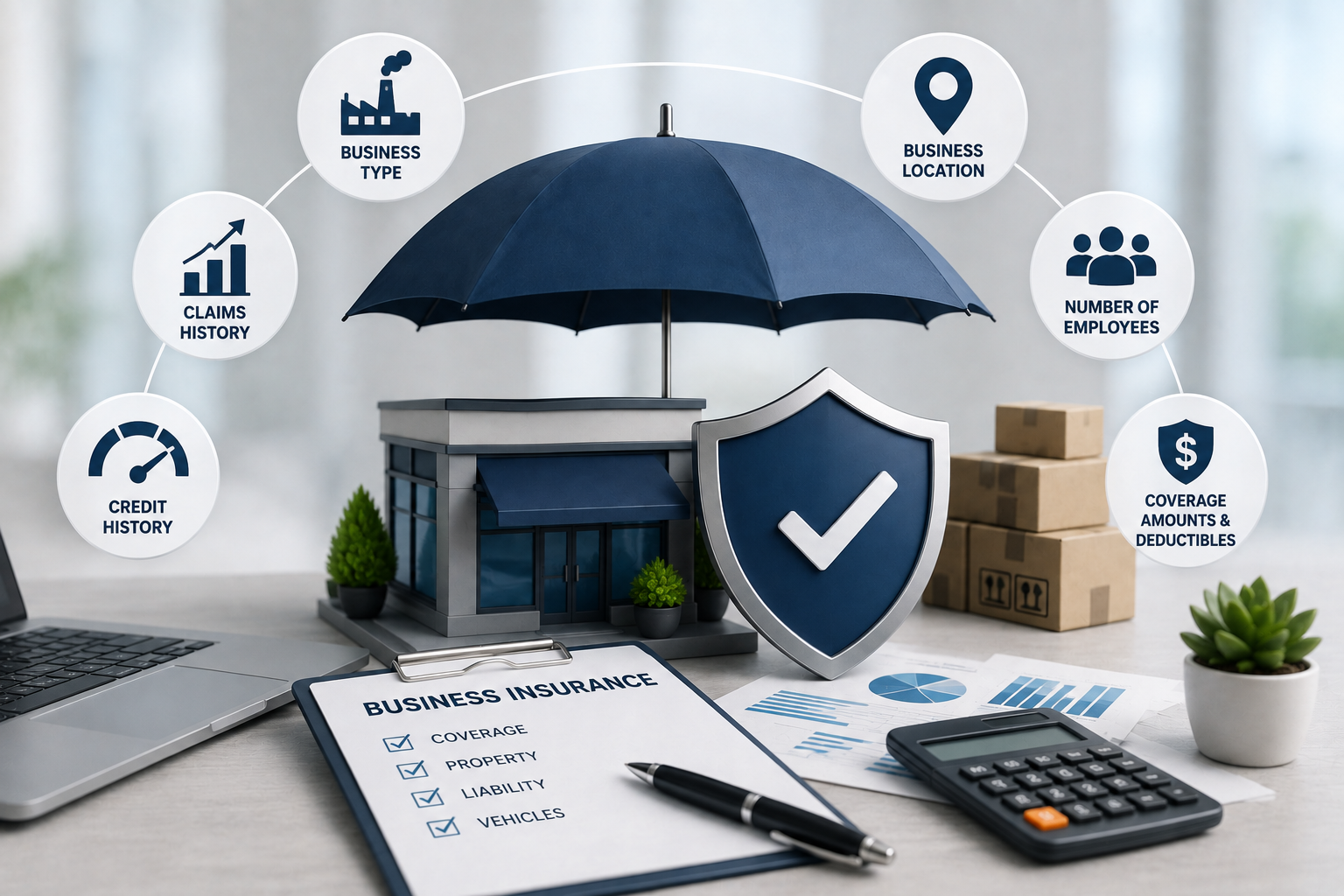
Business insurance premiums are primarily affected by how much financial risk an insurer expects your business to create. Important factors can include your industry, business activities, location, payroll or sales, number of employees, property characteristics, vehicles and drivers, previous claims, coverage limits, deductibles, and safety practices. The factors used vary by policy type, insurer, and state, which is why two businesses—or two insurers quoting the same business—can produce very different premiums.
Key Takeaways
- Higher-risk industries generally cost more to insure than businesses with lower physical or liability exposure.
- General liability premiums may use factors such as payroll, gross sales, or square footage, depending on the business classification.
- Commercial property premiums can reflect construction type, building size, fire protection, location, and the amount of property being insured.
- Previous claims and workplace safety experience can affect the way insurers evaluate your risk.
- Higher coverage limits usually increase premiums, while choosing a higher deductible can often reduce the premium by shifting more risk to the business.
How Are Business Insurance Premiums Calculated?
Commercial insurance pricing is based on risk, but there is no single formula used for every type of business insurance.
California Department of Insurance guidance explains that commercial policy rating factors vary depending on the line of insurance being purchased. A commercial property policy, for example, is rated differently from a general liability or commercial auto policy.
Insurers generally identify an exposure base—such as payroll, sales, square footage, property value, vehicles, or another measure—and apply rates and permitted rating adjustments to reflect the expected risk.
The basic idea: the more exposure your business creates and the more expensive the insurer expects future claims could be, the more your coverage may cost.
1. Your Industry and Type of Business
The kind of work your company performs is one of the most important business insurance rating factors.
NAIC guidance explains that liability premiums depend partly on the product or service provided and the perceived level of risk. A business involving construction, manufacturing, transportation, medical services, or hazardous work generally presents different claim possibilities from an office-based consulting business.
Insurers commonly assign businesses to classifications based on their operations. Those classifications help determine what types of losses similar businesses have historically produced and how serious those claims can become.
Higher-risk examples may include:
- Roofing and construction.
- Manufacturing.
- Commercial trucking.
- Businesses serving alcohol.
- Companies handling hazardous materials.
- Professional services with significant errors-and-omissions exposure.
The exact classification and premium impact depend on the insurer, state, and type of policy.
2. Your Business Location
Where your business operates can influence several types of commercial insurance.
New York Department of Financial Services identifies location as one of the factors that can affect small-business insurance premiums. NAIC guidance also notes that businesses in areas exposed to hurricanes, hail, windstorms, theft, heavy traffic, or other hazards can face different premiums.
For property insurance, an insurer may consider factors such as:
- Wildfire exposure.
- Hurricane or wind exposure.
- Hail or severe-weather patterns.
- Local fire protection.
- Crime or theft exposure.
- Other geographic hazards relevant to the property or operations.
A company’s location can also affect commercial auto exposure if vehicles operate in high-traffic or high-claim areas.
3. Payroll and Number of Employees
Payroll can be an important exposure measure for general liability and workers’ compensation insurance.
NAIC guidance notes that workers’ compensation premiums for a newer business can be based on broad factors such as payroll, number of employees, employee earnings, and the type of work employees perform.
For general liability, payroll may also serve as a rating exposure for certain business classifications.
As your company hires more workers or payroll rises, the amount of exposure being insured may increase. That can result in a higher premium even when the underlying rate does not change.
Growth can change your premium even without a claim. If payroll, staffing, equipment, locations, or operations grow substantially, your insurance exposure may grow with them.
4. Annual Revenue or Gross Sales
Gross sales can be an important rating exposure for general liability coverage.
A company selling substantially more products or serving substantially more customers may create more opportunities for liability claims than a smaller operation in the same classification.
NAIC guidance notes that liability premiums can be linked to estimated sales or payroll reported when the policy begins. If actual exposure is higher than estimated, a business can potentially owe additional premium after an audit or policy review, depending on the policy.
Use realistic estimates. Underestimating payroll or sales to obtain a lower initial premium can create problems when the insurer later verifies the actual exposure.
5. Your Claims History
Past claims can influence how an insurer evaluates the likelihood and potential severity of future claims.
NAIC small-business guidance states that a high past-claims history can increase insurance costs. For established businesses, workplace safety history can also contribute to workers’ compensation pricing.
The effect of a claim depends on factors such as:
- The type of claim.
- How frequently claims occur.
- How severe prior losses were.
- Whether the same problem continues to occur.
- What corrective or loss-control measures the business has implemented.
Not every claim automatically produces a specific premium increase. Insurers, policy types, state rules, and individual circumstances differ.
6. Coverage Limits
The amount of insurance protection you purchase affects the insurer’s potential financial responsibility.
All else being equal, choosing higher liability limits or insuring more property generally increases the amount the insurer could have to pay after a covered loss. That additional protection can increase the premium.
New York Department of Financial Services specifically identifies the scope and amount of insurance purchased as factors that influence small-business premiums.
Do not reduce limits solely to save premium. A cheaper policy can become extremely expensive if the business suffers a loss that exceeds the protection it purchased.
7. Your Deductible
A deductible is the amount the policyholder must generally absorb before applicable insurance coverage begins paying a covered claim.
California Department of Insurance guidance explains that the deductible selected can be included in commercial insurance rating and that choosing a higher deductible can lower the rate because the business is accepting more of the risk itself.
| Deductible Choice | Typical Premium Effect | Business Trade-Off |
|---|---|---|
| Lower deductible | Can result in a higher premium. | Less out-of-pocket exposure on applicable claims. |
| Higher deductible | Can reduce the premium. | Business must be able to absorb more of a covered loss. |
The deductible should therefore fit the company’s cash flow and ability to absorb an unexpected loss, not simply the goal of obtaining the cheapest premium.
8. The Property You Own or Occupy
Commercial property premiums can be strongly influenced by the building and property being insured.
California Department of Insurance identifies commercial building rating factors such as:
- Square footage.
- Type of construction.
- Whether the building has sprinklers.
- Fire protection classification.
New York insurance guidance similarly notes factors such as the age and type of building, building use, location, and local fire protection.
The value of equipment, inventory, furniture, and other property can also influence how much insurance is needed.
9. Fire, Security, and Other Safety Features
Risk-control measures can affect how an insurer evaluates the business.
NAIC encourages small-business owners to reduce risk through measures such as maintaining buildings, installing fire and security systems, keeping work areas safe, training employees, and maintaining appropriate records.
Depending on the insurer and type of policy, risk controls can include:
- Automatic sprinkler systems.
- Smoke and fire alarms.
- Security alarms and access controls.
- Employee safety training.
- Vehicle safety programs.
- Documented workplace inspection programs.
- Procedures designed to prevent recurring losses.
NAIC notes that businesses with strong, documented safety practices may be evaluated as lower risks for some forms of coverage.
10. Business Vehicles and Drivers
Businesses that own, lease, or use vehicles create an additional set of insurance exposures.
NAIC guidance identifies factors relevant to business auto insurance including the vehicles being driven, how they are used, where the business operates, driver records, claims history, mileage, chosen coverage, and deductibles.
A company using one passenger vehicle for occasional local errands creates a different exposure from a company operating a fleet of trucks that travels long distances or transports equipment, passengers, or goods.
Driver quality matters. NAIC recommends maintaining good driving records and requiring employees who operate business vehicles to do the same.
11. How Your Vehicles Are Used
Commercial auto pricing is not based only on the number of vehicles.
Insurers can also evaluate how those vehicles are used. Relevant questions may include:
- How many miles are driven?
- Are vehicles used locally or across long distances?
- Do employees drive them?
- Are passengers transported?
- Are products or equipment transported?
- Does the business transport hazardous or unusually valuable materials?
Greater mileage and more demanding business use can create more opportunities for an insured loss.
12. Business Interruption Exposure
Business interruption insurance can help replace qualifying income and cover certain ongoing expenses when covered property damage interrupts operations.
NAIC states that the cost of business interruption insurance can depend on factors including the industry, number of employees, amount of coverage, and physical location.
A business that could reopen quickly after a loss may create a different interruption exposure from a company that depends on highly specialized equipment or a unique location that could take months to replace.
13. The Types of Coverage You Purchase
Business insurance is not one policy. Companies can need several different forms of protection depending on their activities.
Common coverages can include:
- General liability.
- Commercial property.
- Business interruption.
- Commercial auto.
- Workers’ compensation.
- Professional liability.
- Product liability.
- Cyber liability.
- Umbrella or excess liability.
Adding coverage usually increases the total premium, but removing important protection simply to reduce price can leave a major uninsured exposure.
14. Whether You Qualify for a Business Owner’s Policy
Some small businesses qualify for a business owner’s policy, commonly called a BOP.
A BOP commonly packages property, liability, and business interruption or continuation coverage. NAIC and SBA consumer guidance note that bundling qualifying coverage into a BOP can sometimes cost less than purchasing comparable policies separately.
Not every company qualifies. Businesses with unusual, hazardous, or highly specialized risks may need customized commercial coverage instead.
Business Insurance Premium Factors at a Glance
| Factor | Coverage It May Affect | Why It Matters |
|---|---|---|
| Industry | Most commercial lines | Different operations create different claim frequency and severity. |
| Payroll | Workers’ compensation and some liability policies | Can serve as the exposure base used to calculate premium. |
| Gross sales | General or product liability | Greater sales can mean greater exposure to customers and products. |
| Location | Property, auto, interruption and other lines | Weather, fire, traffic, theft, and other hazards vary geographically. |
| Claims history | Multiple commercial lines | Past losses can influence expected future risk. |
| Coverage limits | Most lines | Higher limits increase potential insurer responsibility. |
| Deductible | Property, auto and other applicable lines | Higher deductibles generally shift more risk to the business. |
| Building characteristics | Commercial property | Construction, size, sprinklers, and fire protection affect property risk. |
| Vehicles and drivers | Commercial auto | Vehicle type, use, mileage, drivers, and records affect accident exposure. |
| Safety practices | Multiple lines | Loss-control measures can reduce the likelihood or severity of claims. |
Why Can Your Premium Change at an Insurance Audit?
Some commercial insurance premiums are initially based on estimated exposure.
For example, a policy may begin using estimated payroll or sales. After the policy period, the insurer may verify the actual figures and recalculate the applicable premium according to the contract.
Hypothetical example: a contractor buys liability coverage based on projected annual payroll of $400,000.
Business grows faster than expected and actual payroll reaches $550,000.
If payroll is a rating exposure under that policy, the insurer may calculate an additional premium based on the higher actual exposure.
The figures are hypothetical. Audit practices and rating bases depend on the policy and insurer.
A Practical Business Insurance Example
Consider two hypothetical businesses requesting insurance. They have similar annual revenue but very different risk profiles.
| Factor | Business A | Business B |
|---|---|---|
| Operations | Office-based marketing company | Roofing contractor |
| Work environment | Primarily office work | Employees work at heights and customer locations |
| Vehicles | No company fleet | Several work trucks |
| Property | Computers and office furniture | Tools, equipment, materials, and vehicles |
| Expected insurance risk | Relatively lower physical injury exposure | Greater worker injury, liability, property, and commercial auto exposure |
Even with similar revenue, the roofing company could reasonably face higher premiums for several types of coverage because the operations create different potential losses.
The example illustrates why revenue alone cannot predict business insurance cost.
How to Lower Business Insurance Premiums
You cannot control every rating factor, but businesses can often improve how efficiently they purchase and manage insurance.
- Shop around: SBA and New York insurance guidance both recommend comparing coverage, terms, and prices because commercial insurance premiums can vary among insurers.
- Improve safety: maintain documented workplace, fire, security, and driver-safety procedures.
- Review deductibles: consider whether you can safely absorb a larger deductible in exchange for a lower premium.
- Review classifications: make sure the insurer has accurate information about what your employees and business actually do.
- Keep payroll and sales estimates accurate: this can reduce surprises at audit.
- Consider a BOP: eligible small businesses may be able to package major coverages economically.
- Manage drivers: check driving records, provide training, and maintain business vehicles.
- Review insurance annually: update coverage when employees, inventory, equipment, locations, products, or operations change.
Do Not Compare Business Insurance by Price Alone
The cheapest quote does not necessarily provide equivalent protection.
One quote may have a lower liability limit, higher deductible, narrower definition of covered property, additional exclusions, or fewer endorsements than another.
SBA guidance recommends comparing terms and prices rather than price alone. The appropriate policy should address losses your company could not comfortably absorb itself.
Compare equivalent coverage. Match limits, deductibles, covered locations, business classifications, endorsements, vehicles, property values, and major exclusions before deciding which quote is actually cheaper.
Frequently Asked Questions
The Bottom Line
Business insurance premiums reflect the risk your company presents and the amount of financial responsibility you transfer to the insurer. That means pricing can change based on industry, operations, location, payroll, sales, claims history, property, vehicles, employees, limits, deductibles, and safety practices.
Different policies also use different rating exposures. General liability may rely on sales, payroll, or square footage. Workers’ compensation can be tied to payroll and job classifications. Property coverage can consider construction, fire protection, building size, location, and insured values. Commercial auto pricing can reflect vehicles, drivers, mileage, use, claims, location, limits, and deductibles.
Because commercial pricing varies by insurer and state, the best approach is to keep business information accurate, manage preventable risks, review coverage as the company changes, and compare equivalent quotes rather than automatically choosing the lowest premium.
Sources
- National Association of Insurance Commissioners, Small Business Insurance Consumer Guidance, accessed August 2026.
- National Association of Insurance Commissioners, Business Interruption and Business Owner Policy, updated 2026.
- National Association of Insurance Commissioners, Auto Insurance, updated September 2025.
- California Department of Insurance, Commercial Insurance Guide, accessed August 2026.
- New York State Department of Financial Services, Information for Small Businesses, accessed August 2026.
- U.S. Small Business Administration, Get Business Insurance, updated April 2024.