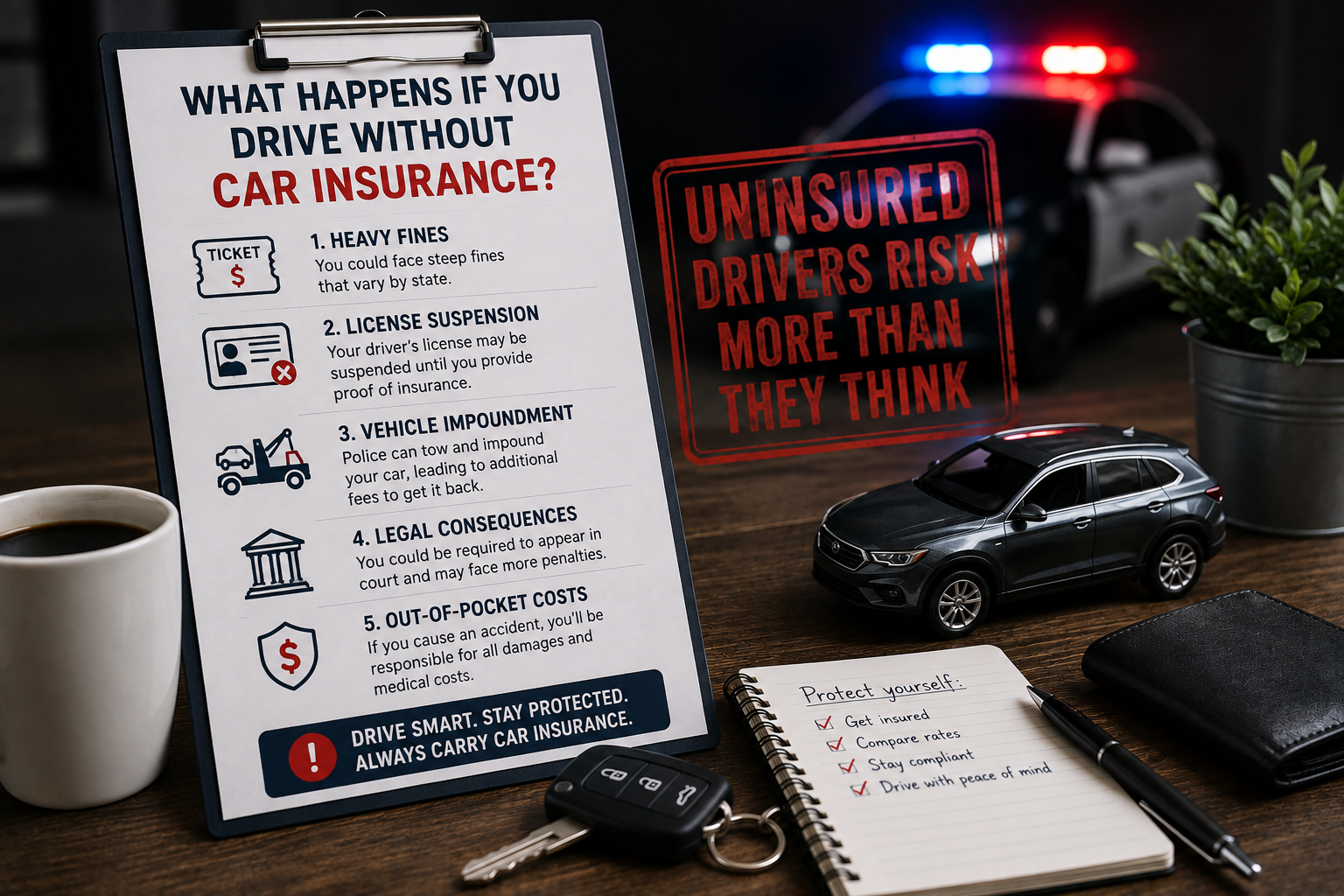
Driving without required car insurance can result in fines, license or registration suspension, vehicle impoundment, reinstatement costs, and other state-specific penalties. If you cause a crash while uninsured, you can also become personally responsible for injuries and property damage that liability insurance otherwise might have covered. The consequences vary substantially by state and become much more serious when an uninsured driver is involved in an accident.
Key Takeaways
- Most states require drivers to maintain auto liability insurance or otherwise satisfy financial responsibility requirements.
- Driving uninsured can lead to tickets, fines, license or registration penalties, vehicle impoundment, and reinstatement requirements depending on state law.
- An uninsured at-fault driver can be personally responsible for another person’s medical bills, vehicle damage, lost income, and other legally recoverable damages.
- Penalties can become substantially more serious after an uninsured crash or repeated insurance violations.
- A lapse can also make obtaining future coverage more complicated or expensive, depending on the insurer, state, and circumstances.
Is It Illegal to Drive Without Car Insurance?
In most of the United States, drivers must carry auto liability insurance or meet another legally permitted financial responsibility requirement before driving.
The exact rules vary by state. Minimum liability limits, acceptable alternatives to insurance, proof requirements, penalties, and enforcement procedures are established under state law rather than one nationwide auto insurance law.
That distinction matters because driving without insurance can produce very different consequences depending on where the vehicle is registered and where the violation occurs.
Important: Liability insurance required by state law is different from optional collision and comprehensive coverage. A paid-off vehicle may not legally need collision or comprehensive, but that does not eliminate applicable liability insurance or financial responsibility requirements.
What Can Happen If Police Stop You Without Insurance?
If a law enforcement officer determines that you are operating a vehicle without required insurance or financial responsibility, the immediate consequences depend on state law and your driving history.
Potential consequences can include:
- A traffic citation.
- Fines or court costs.
- Driver’s license suspension or revocation.
- Vehicle registration suspension or revocation.
- Vehicle impoundment in some circumstances.
- Reinstatement fees.
- A requirement to provide proof of future financial responsibility.
- More severe consequences for repeated violations.
Do not assume that simply purchasing insurance after receiving a ticket automatically eliminates the violation. New coverage generally protects you prospectively rather than changing the fact that you were uninsured when the violation occurred.
Examples of State Penalties for Driving Uninsured
There is no single national penalty for driving without auto insurance. The examples below illustrate why state-specific rules matter.
| State Example | Possible Consequences |
|---|---|
| Texas | Texas Department of Insurance guidance says a driver stopped without required coverage will likely receive a ticket, and a court could impose a fine of up to $350. A subsequent violation can involve a fine of up to $1,000 and driver’s license suspension. |
| New York | New York DMV states that driving without insurance can result in a traffic court fine of up to $1,500, and uninsured crashes can lead to license and registration revocation for at least one year plus an additional DMV civil penalty. |
| California | California requires drivers to maintain evidence of financial responsibility. Certain uninsured crashes can lead to suspension of driving privileges, and proof of insurance can be required for reinstatement. |
These examples should not be used as a substitute for checking the current rules in your own state. Penalties can change and can depend on whether the violation involved a crash, prior offenses, vehicle registration status, and other circumstances.
What Happens If You Cause an Accident Without Insurance?
The financial consequences can become much more serious if you cause an accident while uninsured.
Auto liability insurance normally helps pay covered damages you legally owe to other people, up to the applicable policy limits. Without that insurance, there may be no insurer standing between you and the financial claim.
Depending on the accident, you could become personally responsible for qualifying damages such as:
- Repairs to another person’s vehicle.
- Replacement of a totaled vehicle.
- Damage to buildings, fences, signs, or other property.
- Ambulance and emergency medical costs.
- Hospital and physician expenses.
- Rehabilitation expenses.
- Lost income where legally recoverable.
- Other injury-related damages recognized under applicable law.
- Legal expenses associated with defending a claim.
A serious injury claim can greatly exceed the value of the vehicle that caused the accident. This is why driving an inexpensive car does not mean you have little liability risk.
Hypothetical Accident Example
Suppose an uninsured driver causes an accident resulting in a hypothetical $18,000 of damage to another vehicle and $32,000 of qualifying injury-related damages.
$18,000 property damage + $32,000 injury damages = $50,000 potential liability.
Without applicable liability insurance or another source of payment, the uninsured driver could face personal financial exposure for covered legal obligations. This example is illustrative only and is not a typical or average accident amount.
What If the Other Driver Has Uninsured Motorist Coverage?
The other driver’s uninsured motorist coverage may provide protection to that insured person when an at-fault driver has no insurance, depending on the coverage purchased and state law.
That does not necessarily eliminate the uninsured driver’s potential liability. An insurer that pays its policyholder may have rights under applicable law and policy provisions to pursue recovery from the person responsible for the loss.
In other words, another driver’s insurance should not be treated as a substitute for carrying the insurance or financial responsibility required of you.
What If You Are Hit While You Are Uninsured?
Being uninsured does not automatically mean you caused an accident. If another driver is legally responsible for the crash, that driver’s liability insurance may be relevant to your property damage or injuries, subject to state law and the circumstances of the claim.
However, you can still face separate penalties for operating an uninsured vehicle even when another driver caused the collision.
State law can also affect what an uninsured driver may recover after an accident, so the fact that another motorist was at fault does not eliminate the importance of checking local rules.
Can Your License or Registration Be Suspended?
Yes, depending on the state and circumstances. Insurance enforcement can affect the vehicle’s registration, the driver’s license, or both.
Some states receive insurance cancellation and coverage information electronically from insurers. That means an insurance lapse can potentially create administrative consequences even if you are never personally stopped by police.
New York, for example, requires continuous liability coverage while a vehicle remains registered and can suspend registration after a lapse. California can suspend vehicle registration when required insurance information is not maintained or reported as required.
Can Your Car Be Impounded?
Vehicle impoundment can be a potential consequence in some jurisdictions and circumstances.
If a vehicle is impounded, the financial impact can extend beyond the original insurance violation. Towing charges, storage charges, administrative requirements, proof of insurance, and other release conditions can add to the cost.
The exact authority to tow or impound an uninsured vehicle depends on local and state law.
What Is an Insurance Lapse?
An insurance lapse is a period during which required coverage is not in force.
A lapse can occur because:
- You cancel a policy before replacement coverage starts.
- The insurer cancels the policy for nonpayment.
- You forget a renewal payment.
- You mistakenly believe coverage continues after selling or changing vehicles.
- You allow coverage to expire while the vehicle remains registered.
Even a short lapse can matter in states that require continuous coverage on registered vehicles. New York DMV specifically warns that any period in which a registered vehicle lacks required liability coverage can create an insurance lapse.
Do not intentionally create a gap when switching insurers: Put the replacement policy in force before the old policy terminates and confirm both effective dates in writing.
Does an Insurance Lapse Make Future Coverage More Expensive?
A prior lapse can affect future insurance availability or pricing depending on the insurer, state rules, length of the lapse, driving history, and other underwriting or rating factors that are legally permitted.
The effect is not identical for every driver or every state. However, maintaining continuous required coverage avoids both the legal risks of driving uninsured and the potential complications of reentering the insurance market after a lapse.
What Is SR-22 or Proof of Financial Responsibility?
After certain violations or uninsured incidents, some states can require a driver to provide special proof that required financial responsibility is being maintained.
An SR-22 is one commonly recognized form of proof in states that use it. It is generally not a separate type of auto insurance policy. Instead, an insurer files evidence with the state showing that the driver has qualifying coverage.
Requirements, filing periods, terminology, eligibility, and costs vary by state. California, for example, can require proof of insurance following certain financial-responsibility suspensions.
What If You Cannot Afford Car Insurance?
If insurance has become unaffordable, driving uninsured is generally a much riskier solution than reducing legitimate insurance costs or temporarily stopping use of the vehicle according to state rules.
Potential ways to reduce cost include:
- Comparing quotes from multiple insurers using equivalent coverage.
- Reviewing available discounts.
- Choosing a higher physical damage deductible if you can afford it after a claim.
- Reconsidering collision or comprehensive on a paid-off low-value vehicle when appropriate.
- Removing optional coverage that no longer provides enough value.
- Updating annual mileage or vehicle usage when it has legitimately changed.
- Investigating state-sponsored or low-cost insurance programs where available.
California, for example, operates a low-cost automobile insurance program for qualifying drivers. Assistance programs and eligibility vary by state.
What If You Are Not Going to Drive the Car?
If a vehicle will not be used, do not simply cancel insurance while leaving everything else unchanged. Some states require insurance to remain active as long as the vehicle remains registered.
Your state may offer a process for surrendering plates, canceling or suspending registration, filing non-use status, or otherwise documenting that the vehicle will not be operated on public roads.
California, for example, provides non-use procedures for vehicles that will not be operated or parked on public roadways, while New York instructs vehicle owners to surrender registration and plates before required liability coverage ends when applicable.
What to Do If Your Insurance Has Already Lapsed
- Do not continue driving uninsured. Continuing to operate the vehicle can expose you to additional violations and financial risk.
- Contact the insurer immediately. Ask whether reinstatement is available or whether a new policy is required.
- Check your registration status. Your state may have received notice of the lapse and may require separate action.
- Obtain valid coverage before driving again. Confirm the exact effective date rather than assuming payment creates immediate coverage.
- Complete any reinstatement requirements. This can involve fees, proof of insurance, or other state-specific procedures.
- Keep documentation. Save proof of coverage and any confirmation that your license or registration is valid.
Do not rely only on an insurance card: If your state has suspended your registration or driving privilege, purchasing a new policy may not by itself restore your legal ability to drive. Complete any separate DMV reinstatement requirements.
Common Mistakes About Driving Without Insurance
Assuming You Have a Grace Period After Cancellation
Do not assume you can legally drive for several days after a policy ends. Coverage and state registration requirements can apply continuously.
Thinking an Old Car Does Not Need Insurance
Vehicle value can affect whether collision or comprehensive makes sense, but it does not eliminate liability requirements or the potential damage you can cause to other people.
Believing Another Driver’s Insurance Protects You From Penalties
Another person’s insurance may be relevant to an accident claim, but it generally does not excuse your separate obligation to maintain required insurance or financial responsibility.
Canceling Insurance Before Dealing With Registration
If you plan to stop driving a vehicle, check your state’s plate, registration, or non-use requirements before canceling required liability coverage.
Assuming Buying Insurance Erases an Earlier Violation
Obtaining insurance after being cited or after an uninsured accident can be necessary, but it does not generally make the prior uninsured period disappear.
Frequently Asked Questions
The Bottom Line
Driving without required car insurance can expose you to both legal penalties and potentially much larger personal financial losses. Depending on the state, consequences can include tickets, fines, vehicle registration penalties, license suspension or revocation, impoundment, and requirements to provide future proof of financial responsibility.
The risk becomes substantially more serious if you cause a crash. Without applicable liability insurance, you can become personally responsible for covered property damage and injuries that otherwise might have been paid by an insurer.
If your coverage has lapsed, stop driving until valid insurance or another legally accepted form of financial responsibility is in place and confirm that any license or registration suspension has also been cleared. If cost is the problem, compare insurers, discounts, deductibles, optional coverages, and any state low-cost programs before choosing to drive uninsured.
Sources
- National Association of Insurance Commissioners, Uninsured Motorists, updated July 30, 2025.
- Texas Department of Insurance, Auto Insurance FAQ, accessed August 2026.
- New York State Department of Motor Vehicles, Auto Liability Insurance and Insurance Lapses, accessed August 2026.
- California Department of Motor Vehicles, Financial Responsibility and Insurance Requirements, accessed August 2026.
- California Department of Motor Vehicles, California Driver’s Handbook: Financial Responsibility, Insurance Requirements, and Collisions, accessed August 2026.