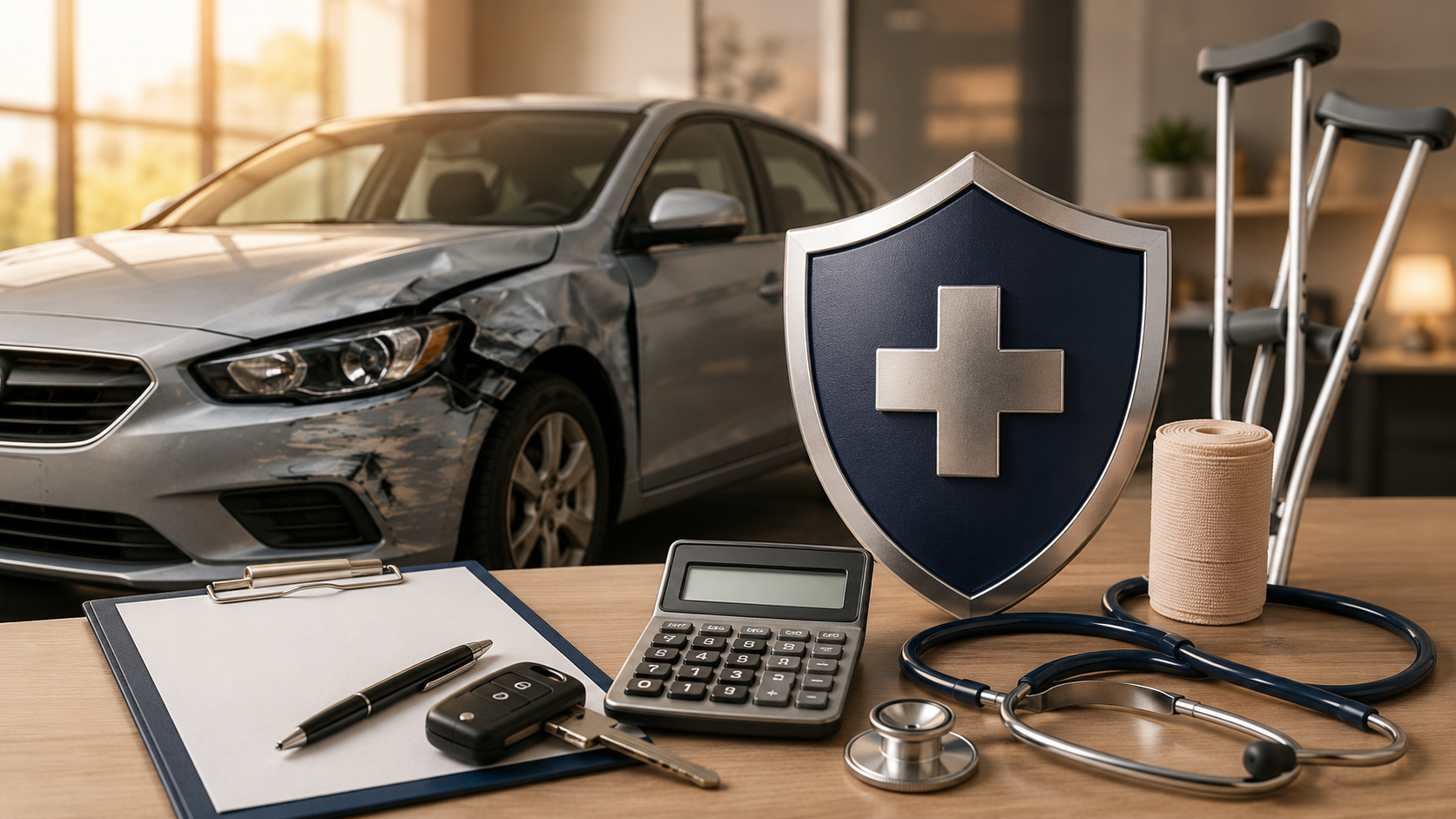
Personal injury protection, commonly called PIP, is auto insurance coverage that can pay certain expenses when you or other covered people are injured in a car accident, often regardless of who caused the crash. Depending on state law and the policy, PIP may cover medical expenses, lost income, rehabilitation, replacement services, or funeral expenses. Requirements, benefits, limits, and eligibility vary significantly by state.
Key Takeaways
- PIP is designed to cover certain accident-related injury expenses without making payment depend entirely on who caused the crash.
- Depending on the state and policy, benefits may include medical costs, lost wages, rehabilitation, replacement services, and funeral expenses.
- PIP does not pay to repair your vehicle or another person’s vehicle.
- PIP requirements, available limits, deductibles, covered people, and claim procedures vary by state.
- PIP is different from bodily injury liability, medical payments coverage, collision coverage, and health insurance.
How Does Personal Injury Protection Work?
PIP is primarily concerned with injuries rather than vehicle damage. In states with no-fault auto insurance systems, an injured person may receive certain economic-loss benefits through the applicable auto insurer without first establishing that another driver caused the accident.
NAIC defines personal injury protection as automobile coverage available in states with no-fault laws or other auto insurance reform systems for treatment of injuries to the insured and passengers. Some states require PIP, while others may make it available under different rules.
The exact insurer responsible for a claim, the people who qualify for benefits, and the expenses that are payable depend on state law and the policy. For that reason, PIP should not be treated as identical nationwide.
What Does PIP Insurance Cover?
PIP benefits focus on economic losses resulting from covered auto injuries. The categories available to a particular policyholder depend on the state and policy form.
Medical Expenses
PIP may pay qualifying medical expenses resulting from injuries sustained in a covered auto accident. Depending on applicable rules, this can include treatment by doctors, hospitals, and other medical providers subject to policy limits and other requirements.
Lost Income
Some PIP systems provide benefits for a portion of income lost because an accident-related injury prevents a covered person from working. Benefit amounts, percentages, waiting periods, and duration can vary.
Rehabilitation and Replacement Services
Depending on state law, PIP may provide benefits for qualifying rehabilitation or services that an injured person can no longer perform because of the accident. Examples can include certain necessary household services, subject to the rules governing the coverage.
Funeral or Survivor Benefits
Some PIP coverage includes funeral expenses or other survivor-related benefits when a covered auto accident results in death. The available benefits and limits depend on state requirements and the applicable policy.
| Expense or Loss | May PIP Cover It? | Important Limitation |
|---|---|---|
| Medical treatment | Generally, for qualifying accident-related injuries. | Subject to state rules, policy limits, eligibility, and covered expenses. |
| Lost wages | May be covered. | Benefit amounts and duration can be limited. |
| Rehabilitation | May be covered. | Coverage depends on state law and the policy. |
| Funeral expenses | May be covered. | Available benefits and limits vary. |
| Damage to your car | No | Vehicle damage is addressed by other auto insurance coverages. |
| Damage to another person’s car | No | Property damage liability or other applicable coverage handles property damage. |
Who Does Personal Injury Protection Cover?
The people protected by PIP depend heavily on state law. Coverage can apply to the policyholder and passengers, and some state systems extend protection to additional people in specified circumstances.
For example, New York’s no-fault system provides basic PIP benefits to qualifying drivers and passengers injured in the insured vehicle and can also provide benefits to pedestrians injured by that vehicle. That is an example of one state’s rules, not a nationwide standard.
Household members, passengers, pedestrians, cyclists, or occupants of other vehicles can be treated differently depending on the jurisdiction and circumstances. Check the policy and your state insurance regulator’s guidance for the rules that apply to you.
Is Personal Injury Protection Required?
There is no single nationwide PIP requirement. Some states require drivers to carry PIP, some operate under different no-fault or choice systems, and other states may make PIP optional or use medical payments coverage instead.
NAIC notes that PIP is associated with no-fault laws and other auto insurance reform systems. State rules can determine whether coverage is mandatory, optional, rejectable, or unavailable in a particular form.
Check current state requirements. Auto insurance laws change, and rules governing mandatory coverage, minimum benefits, deductibles, and claim procedures are state-specific. Your state Department of Insurance or other auto insurance regulator is the appropriate source for current requirements.
PIP vs. Medical Payments Coverage
PIP and medical payments coverage, often called MedPay, can both help with accident-related medical expenses, but they are not interchangeable.
PIP can be broader because, depending on state rules, it may include benefits for lost income, rehabilitation, replacement services, or funeral expenses in addition to medical treatment. Medical payments coverage is generally more focused on qualifying medical and funeral expenses.
| Feature | PIP | Medical Payments Coverage |
|---|---|---|
| Medical expenses | Generally can cover qualifying expenses. | Generally can cover qualifying expenses. |
| Lost income | May be included depending on state law. | Generally not a standard MedPay benefit. |
| Requirement | May be required under applicable state law. | Availability and requirements vary by state. |
| Fault | Designed to provide qualifying benefits without depending entirely on fault. | Also generally applies to covered medical expenses without determining fault first. |
PIP vs. Bodily Injury Liability Coverage
PIP and bodily injury liability address different exposures. PIP generally focuses on qualifying injury-related expenses for you and other people covered under the applicable PIP rules.
Bodily injury liability generally protects you against covered claims for injuries you cause to other people when you are legally responsible for an accident. Liability coverage can also provide a defense against covered lawsuits, subject to the policy.
A no-fault system does not necessarily eliminate liability claims altogether. State law may preserve the right to pursue an at-fault driver when specified injury or economic-loss thresholds are met.
Does PIP Cover Damage to Your Vehicle?
No. PIP is injury-related coverage. It is not designed to repair your vehicle after a crash.
Damage to your own car may be covered by collision coverage if the loss falls within that policy’s terms. Damage you cause to another person’s vehicle or property is generally handled through property damage liability coverage, subject to applicable state law and policy limits.
Think of the coverages separately: PIP addresses certain injury-related economic losses; collision addresses covered physical damage to your vehicle; liability insurance addresses covered losses you are legally responsible for causing to others.
How Does PIP Work With Health Insurance?
The coordination between PIP and health insurance varies by state and policy. One plan may be required to pay before another, and some auto insurance systems allow or require choices that affect how medical benefits coordinate.
Do not assume that having health insurance makes PIP unnecessary. PIP may address expenses that health insurance typically does not, such as qualifying wage loss or replacement services. Conversely, PIP benefits may be limited, so additional medical costs may need to be handled through other available coverage.
PIP Limits, Deductibles, and Claim Rules
PIP benefits are not unlimited. Policies and state law may establish benefit limits, deductibles, percentages of expenses that are payable, time limits for treatment or claims, and documentation requirements.
Claim deadlines deserve particular attention. Some jurisdictions impose specific deadlines for notifying the insurer or providing supporting documents. Missing a required deadline can affect benefits depending on state law and the circumstances.
After an accident involving injuries, review the PIP section of your auto policy and your state regulator’s current claim guidance promptly. Do not assume claim procedures or deadlines are the same in every state.
A Hypothetical PIP Example
Consider a hypothetical driver who is injured in a covered accident and incurs $8,000 in qualifying medical expenses while also missing several weeks of work. These figures are illustrative only and are not national averages or a description of any particular state’s benefits.
If the driver’s policy includes applicable PIP coverage, it may pay qualifying medical expenses and some lost income without requiring the driver to prove that another motorist caused the crash. The actual payment would depend on the state’s PIP rules, the policy limit, deductible, eligible expenses, wage-loss provisions, and other policy terms.
The example also illustrates why simply knowing that a policy contains PIP is not enough. The amount and scope of available benefits matter.
How to Review Personal Injury Protection Coverage
If PIP is available or required where you live, review the coverage alongside the rest of your auto insurance rather than evaluating it in isolation.
- Check your state’s rules. Determine whether PIP is required, optional, or subject to other choices.
- Review your limit. Understand the maximum benefits available under the coverage.
- Check the deductible. Determine what portion of a qualifying loss you may need to pay before benefits apply.
- Identify covered benefits. Look for medical expenses, wage loss, rehabilitation, replacement services, funeral expenses, or other benefits available under your policy.
- Understand who is covered. Review how the policy treats household members, passengers, pedestrians, and other people.
- Check coordination rules. Find out how PIP interacts with health insurance and other available coverage.
- Review claim requirements. Pay attention to notice deadlines, documentation, treatment requirements, and other conditions.
Frequently Asked Questions
The Bottom Line
Personal injury protection is auto insurance coverage designed to pay certain accident-related injury expenses, often without requiring a determination of fault first. Depending on the state, PIP can include medical costs, lost income, rehabilitation, replacement services, funeral expenses, and other specified benefits.
The most important details are state-specific. Check whether PIP is required or optional where you live, who qualifies for benefits, the available limits and deductibles, how it coordinates with health insurance, and what claim deadlines apply. Your declarations page and policy documents should be reviewed together with current guidance from your state insurance regulator.
Sources
- National Association of Insurance Commissioners, What Does Auto Insurance Cover?, updated June 11, 2026.
- National Association of Insurance Commissioners, Glossary of Insurance Terms, accessed August 2026.
- New York State Department of Financial Services, Auto Insurance Information for Consumers, accessed August 2026.