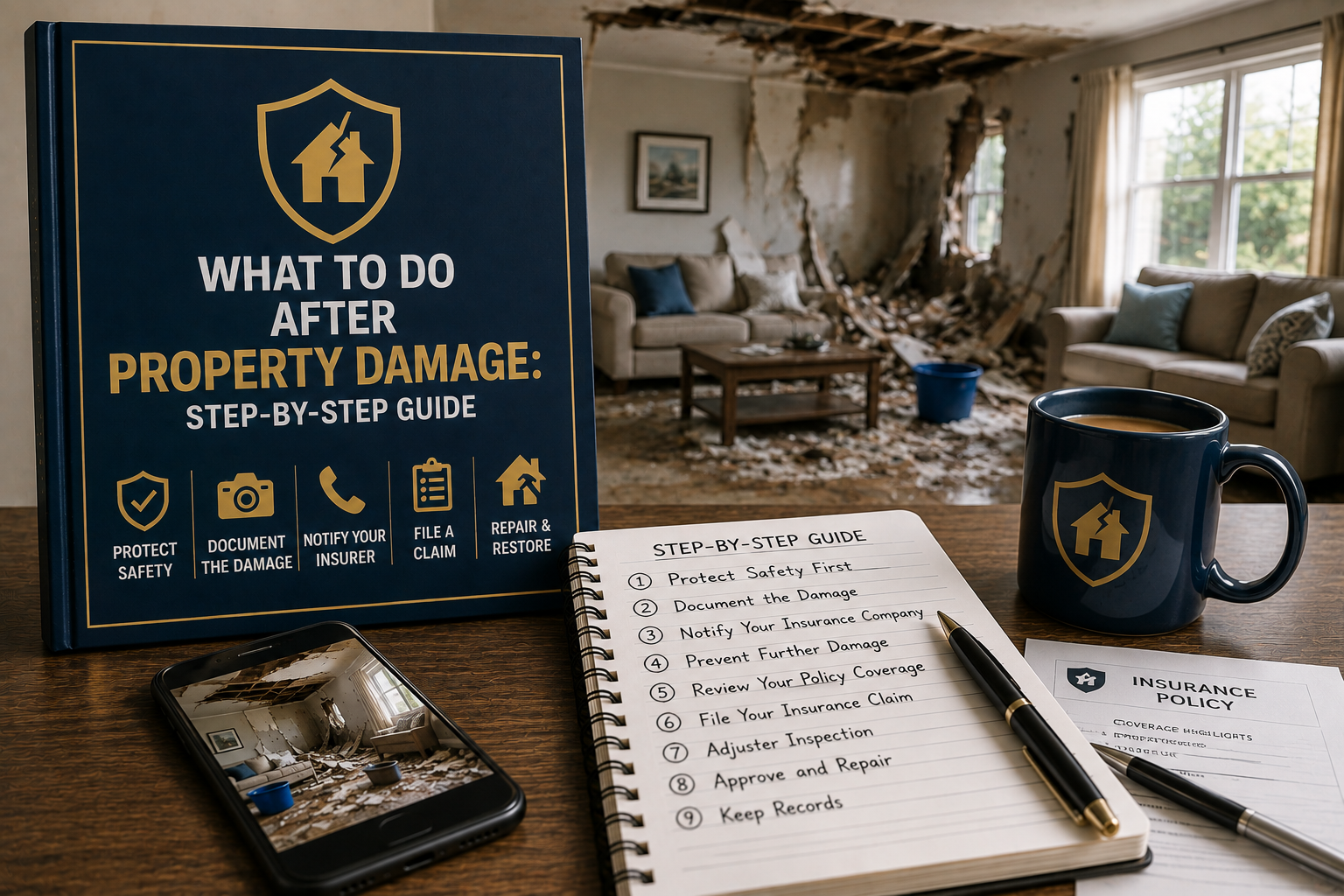
After property damage, your first priorities are safety, preventing additional damage, documenting the loss, and contacting the appropriate insurance company. Whether the damage comes from fire, wind, a burst pipe, theft, a fallen tree, or another event, the steps you take during the first hours and days can affect both your recovery and your insurance claim. This guide focuses primarily on damage to a home, rental unit, or personal property. Flood, earthquake, auto, and other specialized losses may involve separate insurance policies and claim procedures.
Key Takeaways
- Do not enter or remain in damaged property if fire, structural collapse, gas, electricity, floodwater, contamination, or another hazard makes it unsafe.
- Follow instructions from firefighters, police, utility companies, emergency management officials, and other authorities.
- Take extensive photos and videos before cleaning up or moving damaged property when it is safe to do so.
- Create a detailed list of damaged or destroyed belongings.
- Save damaged items for the adjuster when practical unless they create a health or safety hazard or authorities require disposal.
- Take reasonable temporary steps to prevent additional damage, such as covering a damaged roof or boarding broken windows.
- Keep receipts for tarps, plywood, cleanup supplies, emergency services, temporary repairs, and other claim-related expenses.
- Contact the appropriate insurer promptly when you decide to file a claim.
- Ask what coverage applies, what deductible applies, what documentation is required, and what you should do before making repairs.
- Do not make extensive permanent repairs before the insurer has had a reasonable opportunity to inspect the damage unless immediate action is necessary for safety.
- Homeowners insurance generally does not cover ordinary flooding from rising surface water; a separate flood policy may be needed.
- Earthquake and certain earth movement losses also commonly require separate coverage or endorsements.
- If the home is uninhabitable because of a covered loss, additional living expenses coverage may help with increased temporary living costs.
- Keep a claim diary showing phone calls, emails, adjuster visits, contractor estimates, payments, and important deadlines.
- Review the adjuster’s estimate carefully instead of assuming the first estimate includes every damaged item.
- Get written contractor estimates when actual repair costs appear higher than the insurance estimate.
- Verify contractor licenses, insurance, references, and written terms before signing a repair agreement.
- Be cautious with contractors who demand large upfront payments or pressure you to sign immediately.
- Understand any assignment-of-benefits document before signing because it can transfer important claim rights to a contractor.
- If a claim is denied or underpaid, ask for the insurer’s reasoning and relevant policy provisions in writing.
- State insurance departments can provide consumer assistance when policyholders cannot resolve certain claim disputes directly with an insurer.
1. Make Safety the First Priority
Property can be repaired or replaced. Your first responsibility after a serious loss is protecting people from additional injury.
Possible hazards after property damage include:
- Fire or smoldering materials.
- Structural instability.
- Damaged electrical systems.
- Gas leaks.
- Standing or contaminated water.
- Downed power lines.
- Broken glass.
- Unstable ceilings, walls, trees, or roofing.
- Smoke, chemicals, sewage, or mold contamination.
- Animals, insects, or other hazards displaced by a disaster.
If authorities have evacuated the area, do not return simply to photograph damage. Wait until the appropriate officials say it is safe.
2. Contact Emergency Services or Utilities When Necessary
The insurance company is not always the first call.
Depending on what happened, you may first need to contact:
- 911 or local emergency services.
- The fire department.
- Police.
- The gas utility.
- The electric utility.
- A water utility or emergency plumber.
- Local emergency management authorities.
- A qualified structural or environmental professional.
If the damage involves burglary, vandalism, arson, or another crime, report it to law enforcement and keep the report or incident number for your insurance records.
3. Document the Damage Before Cleanup
Strong documentation can make it easier to explain and support the loss.
When conditions are safe, photograph or record video of:
- The exterior of the property.
- Roof, siding, windows, doors, and structural damage.
- Every damaged room.
- Floors, ceilings, drywall, cabinets, and built-in fixtures.
- Water lines or high-water marks.
- Damaged furniture.
- Appliances.
- Electronics.
- Clothing and household belongings.
- Damaged trees, fences, sheds, or other structures.
- Debris associated with the loss.
- Serial numbers, labels, model numbers, and other identifying information.
Take wide photographs showing the overall room and close-up photographs showing specific damage. More context can make later discussions with the adjuster easier.
4. Create a Damaged Property Inventory
A personal property claim can involve dozens or hundreds of individual items.
For each damaged or destroyed item, record as much information as possible:
- Item description.
- Brand.
- Model.
- Serial number.
- Approximate purchase date.
- Original purchase price if known.
- Estimated replacement price.
- Receipt or invoice if available.
- Photograph or video.
- Any appraisal for valuable property.
If the property was completely destroyed and you do not have receipts, use previous photographs, online purchase histories, credit card records, email receipts, manufacturer information, and memory to reconstruct the inventory as accurately as possible.
5. Do Not Throw Everything Away Immediately
An insurer may want an opportunity to inspect damaged property.
When safe and practical, keep damaged belongings until the insurer says they can be discarded.
There are important exceptions. Spoiled food, sewage-contaminated materials, dangerous chemicals, badly mold-contaminated items, or other health hazards may need immediate disposal.
Before disposal, photograph the item thoroughly when safe. For some flood losses, preserving small samples of carpet, flooring, drywall, curtains, or similar material may help document what was damaged.
6. Prevent Further Damage
Home insurance policies generally require policyholders to take reasonable steps to protect damaged property from additional loss.
Depending on the situation, reasonable temporary measures can include:
- Placing a tarp over a damaged roof.
- Boarding broken windows or doors.
- Removing standing water when it can be done safely.
- Turning off water when a plumbing leak is occurring.
- Moving undamaged property away from water.
- Separating damaged property from undamaged property.
- Using temporary fencing or barriers.
- Hiring an emergency mitigation company when professional help is necessary.
Do not put yourself in danger to perform mitigation. A damaged roof, electrical system, structural component, or contaminated property may require a professional.
7. Keep Every Receipt
Reasonable emergency expenses related to a covered loss may be reimbursable under the policy, but documentation matters.
Save receipts for items such as:
- Tarps.
- Plywood.
- Plastic sheeting.
- Emergency plumbing.
- Water extraction.
- Temporary electrical work.
- Locks and temporary security.
- Cleanup supplies.
- Professional mitigation services.
- Temporary storage.
- Hotel or temporary housing.
- Additional transportation.
- Other increased living expenses when applicable.
Document expense → Save receipt → Record why it was necessary → Submit it under the appropriate claim coverage
8. Contact the Appropriate Insurance Company
Once immediate safety needs are under control, contact the insurer that may cover the damaged property.
Most insurance policies impose duties after a loss, and reporting deadlines can vary.
Be ready to provide:
- Policyholder name.
- Policy number if available.
- Property address.
- Current contact information.
- Date and approximate time of loss.
- What happened.
- Areas of the property affected.
- Emergency repairs already performed.
- Police or fire report information when relevant.
- Whether the property is currently habitable.
9. Understand Which Policy Applies
Different causes of property damage can involve different insurance policies.
| Type of Damage | Insurance to Review |
|---|---|
| Fire or smoke | Homeowners, renters, condo, landlord, or commercial property coverage depending on the property. |
| Wind or hail | Property policy, subject to exclusions and applicable wind/hail deductibles. |
| Burst pipe or sudden plumbing loss | Property policy, subject to water-damage provisions and exclusions. |
| Rising floodwater | Separate flood insurance may be required. |
| Earthquake | Separate earthquake policy or endorsement may be required. |
| Vehicle damage | Auto insurance, commonly comprehensive or collision depending on the cause. |
| Business property | Commercial property or business insurance may be needed rather than relying on personal homeowners coverage. |
Flood Damage Is Different
Standard homeowners and renters insurance generally do not cover flooding caused by rising surface water.
If you have National Flood Insurance Program or private flood coverage, contact that insurer separately and follow its claim requirements.
Flood documentation can include:
- Photos and videos of high-water marks.
- Structural damage.
- Damaged personal property.
- Appliance make, model, and serial numbers.
- Receipts and purchase documentation.
- Repair estimates.
- Samples of damaged building materials when appropriate.
Flood policies can also have specific documentation and proof-of-loss deadlines, so follow the insurer’s instructions carefully.
10. Check Your Deductible Before Filing a Small Claim
A deductible is the portion of a covered loss that the policyholder is responsible for before insurance pays according to the policy.
If the estimated repair cost is only slightly above the deductible, it can be worth asking the insurer or agent about coverage before deciding whether to formally file a claim.
Illustrative Deductible Example
Assume a covered loss causes $6,000 of insured damage and the applicable deductible is $1,500.
A simplified potential covered payment would be $6,000 − $1,500 = $4,500, before considering policy limits, depreciation, exclusions, repair estimates, and other claim provisions.
Some wind, hurricane, earthquake, or other catastrophe-related policies can use percentage deductibles rather than ordinary flat-dollar deductibles.
11. Ask the Insurer Important Questions
- What claim number has been assigned?
- What coverage may apply?
- What deductible applies?
- Is there a separate wind, hurricane, or other deductible?
- What documentation do you need from me?
- Should I keep damaged property for inspection?
- When will the adjuster contact me?
- Can I begin cleanup or temporary repairs?
- What should I do before permanent repairs begin?
- Does my policy provide additional living expenses?
- Can the company issue an advance payment if immediate funds are needed?
- How is personal property valued?
- Does replacement cost coverage apply?
- What deadlines apply to my claim?
- Who should I contact if additional damage is discovered later?
12. Work With the Insurance Adjuster
After a claim is reported, the insurer may assign an adjuster or another professional to evaluate the loss.
During the inspection:
- Walk through the damage with the adjuster when possible.
- Point out every affected room or area.
- Provide your photographs and videos.
- Provide the damaged-property inventory.
- Share contractor estimates if available.
- Ask how damaged materials are being measured.
- Ask how repair pricing is being calculated.
- Ask which items are depreciated.
- Write down unresolved issues for follow-up.
An adjuster’s estimate is important, but hidden or previously unidentified damage can emerge later during demolition or repairs. Report newly discovered damage promptly.
13. Avoid Extensive Permanent Repairs Too Early
Temporary mitigation and permanent reconstruction are different.
Temporary work is intended to prevent additional loss. Permanent work restores the property.
Unless safety requires immediate action, give the insurer an opportunity to inspect significant damage before walls, floors, roofing, cabinets, or other damaged materials are permanently removed or replaced.
14. Understand Additional Living Expenses
If a covered loss makes your home uninhabitable, homeowners or renters insurance may provide additional living expenses, often called ALE or loss of use coverage.
Depending on the policy and circumstances, qualifying increased expenses can include:
- Hotel or temporary rental housing.
- Increased meal costs.
- Temporary storage.
- Laundry costs.
- Furniture rental.
- Certain additional transportation expenses.
- Other increased living costs necessary to maintain the household’s normal standard of living, subject to policy terms.
ALE generally addresses the increase above normal living expenses rather than paying every household expense automatically.
Illustrative ALE Example
Assume a household normally spends $700 per month on groceries but spends $1,050 on food while displaced because access to a kitchen is limited.
The illustrative additional food expense is $1,050 − $700 = $350. Actual reimbursement depends on the policy, reasonableness of expenses, documentation, coverage limits, and the covered loss.
15. Review the Insurance Estimate Carefully
Do not assume the first estimate is necessarily the final amount required to repair all covered damage.
Compare the estimate against:
- Every damaged room.
- Measurements.
- Material quality.
- Labor quantities.
- Demolition.
- Debris removal.
- Drying or mitigation.
- Permits.
- Local contractor pricing.
- Matching concerns where applicable.
- Personal property.
- Any hidden damage found during repairs.
If your contractor’s estimate is higher, send the detailed estimate to the adjuster and ask the insurer to explain differences.
16. Understand Actual Cash Value vs. Replacement Cost
How a property claim is paid depends partly on the valuation provisions in your policy.
| Valuation Method | General Concept |
|---|---|
| Actual cash value | Generally reflects depreciation or the property’s value immediately before the loss, depending on policy terms and applicable law. |
| Replacement cost | Generally provides coverage based on repairing or replacing covered property without the same depreciation deduction, subject to policy requirements and limits. |
Replacement cost claims are sometimes paid in stages. An insurer may initially issue an actual-cash-value payment and release recoverable depreciation after repair or replacement requirements are satisfied.
17. Understand How Claim Payments May Be Issued
A major property claim may involve several separate payments instead of one final check.
Payments can relate separately to:
- Dwelling or structural repairs.
- Personal property.
- Additional living expenses.
- Emergency mitigation.
- Recoverable depreciation.
- Supplemental repair costs.
If a mortgage lender has a financial interest in the home, structural claim payments may include the lender or mortgage servicer as a payee. Ask the mortgage servicer how repair funds will be released.
18. Choose Contractors Carefully
Large storms, fires, and disasters often bring legitimate contractors into an area, but they can also attract dishonest operators.
Before hiring someone:
- Get several written estimates when practical.
- Verify any required contractor license.
- Ask for proof of insurance.
- Check recent references.
- Confirm the company has an established business address.
- Read the entire contract.
- Make sure materials and scope of work are written down.
- Understand who obtains permits.
- Confirm start and completion expectations.
- Use a written payment schedule.
- Keep receipts for payments.
- Avoid pressure to sign immediately.
Watch for Contractor and Disaster Scams
Warning signs can include:
- Unsolicited door-to-door sales immediately after a disaster.
- Pressure to sign a contract immediately.
- Large cash payments demanded upfront.
- A refusal to provide identification or licensing information.
- Claims that the contractor can guarantee what the insurer will pay.
- Requests that you sign documents you have not read.
- Promises to waive or improperly absorb insurance deductibles where prohibited.
- Paperwork that does not match verbal promises.
Verify anyone claiming to represent your insurer before giving them financial or personal information.
Be Careful With Assignment of Benefits
A contractor or mitigation company may ask you to sign an assignment of benefits or another document transferring certain insurance rights.
Depending on the document and applicable state law, it could give the contractor authority to communicate with the insurer, collect insurance proceeds, negotiate part of the claim, or exercise other rights.
Do not sign an assignment you do not fully understand. Ask the insurer or an appropriate professional how the document could affect your rights.
Keep a Claim Diary
A simple written timeline can become extremely useful during a complicated property claim.
Record:
- Claim number.
- Adjuster’s name and contact information.
- Date and time of every important call.
- Who you spoke with.
- What was discussed.
- Documents submitted.
- Inspection dates.
- Contractor estimates.
- Payments received.
- Outstanding questions.
- Deadlines or promised follow-up dates.
Save emails, letters, estimates, photographs, receipts, invoices, contracts, and claim forms in one organized digital or physical folder.
What if More Damage Is Found Later?
Not every problem is visible during the first inspection.
Additional issues can emerge when contractors begin work, including:
- Water behind walls.
- Wet insulation.
- Hidden roof damage.
- Structural damage.
- Damaged electrical components.
- Subfloor damage.
- Additional smoke or soot contamination.
Document additional damage before it is repaired and contact the adjuster promptly. A supplemental estimate or payment may be possible when the additional damage is covered.
What if the Insurance Estimate Is Too Low?
A difference between an insurance estimate and a contractor estimate does not automatically mean either side is wrong.
If you believe the estimate is insufficient:
- Review the insurer’s estimate line by line.
- Identify missing or incorrectly measured damage.
- Get detailed written contractor estimates.
- Send supporting photographs and documents to the adjuster.
- Ask the insurer to explain disputed pricing or coverage.
- Request reconsideration or a supplemental inspection when appropriate.
- Review any appraisal or dispute-resolution provisions in the policy.
What if the Claim Is Denied?
A denial does not necessarily end the discussion, but the next step should be understanding exactly why coverage was denied.
Ask for:
- The denial in writing.
- The policy language the insurer relied on.
- An explanation of the facts supporting the decision.
- Information about any reconsideration or appeal process.
- Instructions for submitting additional documentation.
If you still believe the claim is being handled incorrectly, your state insurance department may provide consumer assistance or accept complaints about insurers.
Public Adjusters
A public adjuster is generally an adjuster hired by the policyholder rather than the insurance company to assist with evaluating and negotiating a property claim.
Licensing requirements, fees, contracts, cancellation rights, and permitted activities vary by state.
Before hiring one, verify the person’s license with the state insurance regulator, understand the fee structure, and read the agreement carefully.
If the Damage Followed a Major Disaster
A widespread disaster can create additional recovery challenges because thousands of households may need adjusters, contractors, materials, temporary housing, and utility restoration at the same time.
After a declared disaster:
- Continue communicating with the insurance company.
- Check whether government disaster assistance is available.
- Contact your mortgage servicer if financial hardship affects mortgage payments.
- Keep insurance and disaster-assistance documentation separate and organized.
- Watch for disaster-related scams.
- Update your mailing address and contact information if you are displaced.
Government disaster assistance generally is not a substitute for insurance, and eligibility depends on the disaster and the applicant’s circumstances.
What Not to Do After Property Damage
- Do not enter an unsafe building simply to document damage.
- Do not ignore an active leak, damaged opening, or other condition that could cause more damage.
- Do not throw away all damaged property before documenting it.
- Do not make extensive permanent repairs before the insurer has had an opportunity to inspect the loss when inspection is reasonably possible.
- Do not assume every type of water damage is covered by homeowners insurance.
- Do not assume disaster assistance replaces insurance.
- Do not sign contractor agreements without reading them.
- Do not sign an assignment of benefits you do not understand.
- Do not exaggerate the value or amount of damaged property.
- Do not pay large amounts in cash without documentation.
- Do not discard insurance estimates, emails, receipts, or claim letters.
- Do not assume an initial claim payment is necessarily the only payment that can ever be made if covered additional damage is later documented.
Property Damage Claim Timeline
| Stage | Typical Actions |
|---|---|
| Immediately | Protect people, call emergency services, follow evacuation instructions, stop an active source of damage when safe. |
| Once safe | Photograph damage, make an inventory, protect undamaged property, perform reasonable temporary mitigation. |
| Claim begins | Contact insurer, obtain claim number, ask about coverage and deductible, provide required information. |
| Inspection | Meet adjuster, provide documentation, review affected areas, obtain contractor estimates. |
| Settlement and repairs | Review estimate, select contractor, complete covered repairs, submit supplemental documentation when necessary. |
| Claim completion | Keep final invoices, receipts, photographs, claim payments, warranties, and repair documentation. |
Property Damage Checklist
- Make sure everyone is safe.
- Follow evacuation or emergency instructions.
- Contact emergency services or utilities when necessary.
- Do not re-enter unsafe property.
- Photograph and video the damage.
- Document damaged belongings.
- Record serial and model numbers when possible.
- Save damaged items for inspection when safe.
- Take reasonable steps to prevent additional damage.
- Save all temporary-repair receipts.
- Contact the correct insurer.
- Confirm the claim number.
- Ask which deductible applies.
- Ask what documents the insurer needs.
- Notify separate flood, earthquake, or auto insurers when applicable.
- Keep a written claim diary.
- Meet the adjuster and point out all damage.
- Review the insurer’s estimate carefully.
- Obtain detailed contractor estimates.
- Verify contractors before hiring them.
- Avoid unnecessary permanent repairs before inspection.
- Track additional living expenses if displaced.
- Report newly discovered damage promptly.
- Ask for written explanations of disputed claim decisions.
- Contact the state insurance department if appropriate.
- Keep final repair records, warranties, receipts, photographs, and claim documents after the claim closes.
Frequently Asked Questions
The Bottom Line
After property damage, focus first on safety and then on preserving evidence of the loss. Do not enter dangerous property simply to inspect it. Once conditions are safe, take photographs and videos, create a list of damaged belongings, and preserve damaged materials when practical.
Take reasonable temporary steps to prevent additional damage, but avoid extensive permanent repairs until the insurer has had an opportunity to inspect the property when possible. Keep receipts for every temporary repair and emergency expense.
Contact the appropriate insurer promptly and confirm what policy applies. A homeowners policy may cover fire, wind, theft, and certain sudden water losses, but flooding, earthquake, and other events can require separate coverage.
During the claim, keep detailed records, review the adjuster’s estimate carefully, obtain contractor estimates, report additional damage promptly, and ask questions when the insurer’s calculations or coverage decisions are unclear.
Finally, be cautious about contractors and other people who appear immediately after a major loss. Verify credentials, get important promises in writing, understand every document before signing, and avoid giving control over your insurance claim to someone without understanding the consequences.
Sources
- National Association of Insurance Commissioners, What You Need to Know When Filing a Homeowners Claim, accessed August 2026.
- National Association of Insurance Commissioners, Navigating the Claims Process: Recover and Rebuild, accessed August 2026.
- National Association of Insurance Commissioners, What You Should Know About Settling a Homeowners Insurance Claim, accessed August 2026.
- Washington Office of the Insurance Commissioner, Steps to Take After Home Damage or a Loss, accessed August 2026.
- Washington Office of the Insurance Commissioner, Filing a Homeowner Insurance Claim, accessed August 2026.
- California Department of Insurance, Residential Property Claims Guide, accessed August 2026.
- California Department of Insurance, Claims and Loss Management After a Disaster, accessed August 2026.
- California Department of Insurance, Don’t Get Scammed After a Disaster, accessed August 2026.
- Texas Department of Insurance, Help After a Storm, accessed August 2026.
- Texas Department of Insurance, Tips for Filing a Claim With Your Insurance Company, accessed August 2026.
- National Flood Insurance Program, NFIP Claims Checklist for Policyholders, accessed August 2026.
- National Flood Insurance Program, Document Flood Damage, accessed August 2026.
- National Flood Insurance Program, Start a Claim, accessed August 2026.
- Consumer Financial Protection Bureau, What Should I Do After a Disaster to Protect My Finances and Property?, accessed August 2026.
- Consumer Financial Protection Bureau, How Can I Find and Work With Contractors to Rebuild After a Disaster?, accessed August 2026.
- Consumer Financial Protection Bureau, How Do I Avoid Scams and Fraud After a Disaster?, accessed August 2026.