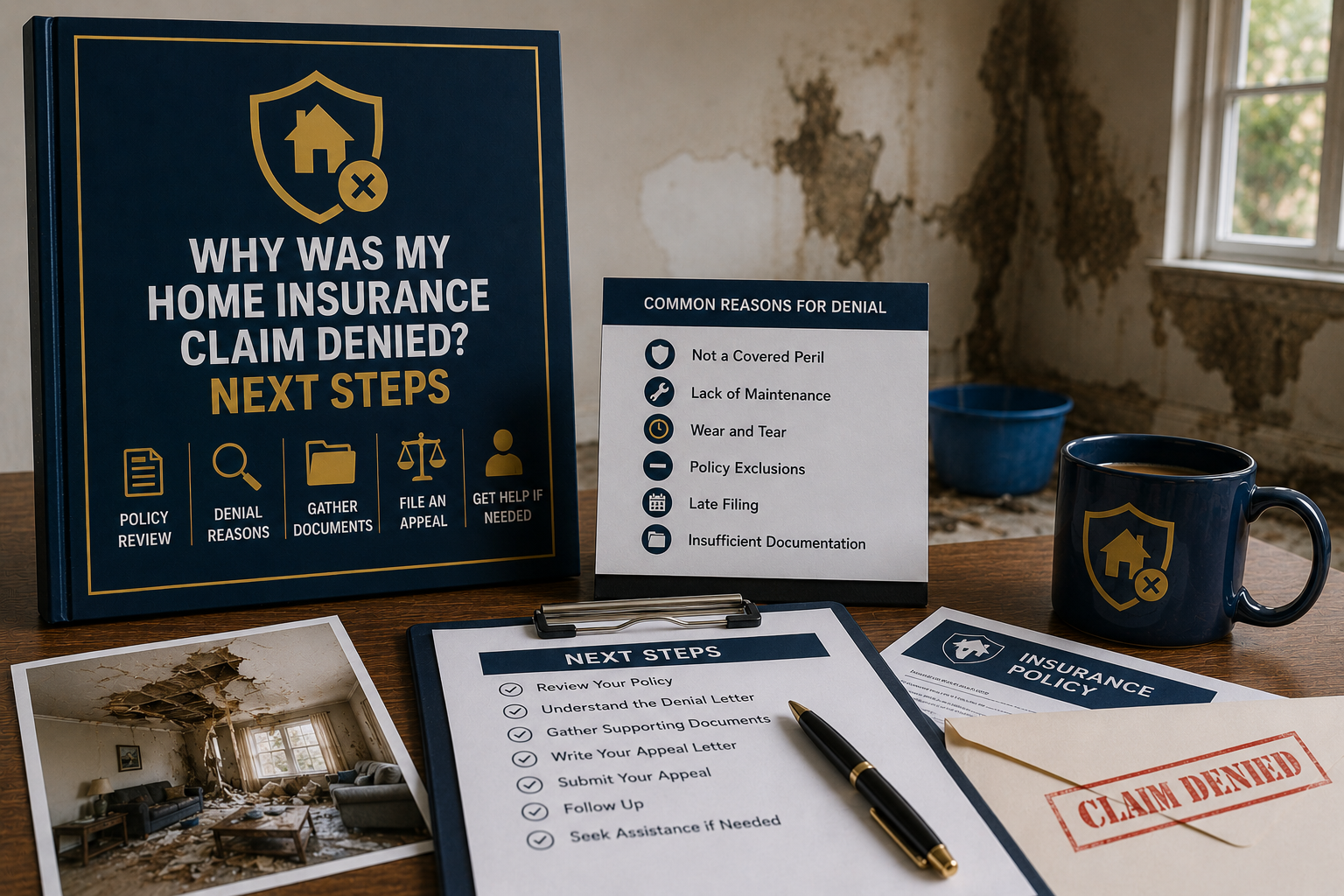
A home insurance claim may be denied because the cause of damage is excluded, the loss falls outside the policy’s coverage, the damage resulted from wear or maintenance issues, required claim conditions were not met, or the insurer determined the available evidence did not establish a covered loss. A denial is not always the final word. Ask for the reason in writing, compare it with your policy, gather supporting evidence, and challenge the decision when appropriate.
Key Takeaways
- A claim can be denied because the cause of loss is excluded, the damaged property is not insured, a policy condition applies, or the insurer disputes what caused the damage.
- Flooding is generally excluded from standard homeowners insurance, and earthquake damage is also commonly excluded unless separate or additional coverage applies.
- Wear and tear, deterioration, maintenance problems, and infestations are generally different from sudden covered losses and may not be insured.
- A payment below what you expected is not necessarily a claim denial; deductibles, policy limits, sublimits, depreciation, and valuation provisions can reduce the amount payable.
- If you disagree with a denial, request the insurer’s reasoning in writing, identify the policy language involved, provide supporting evidence, and contact your state insurance department if the dispute remains unresolved.
What Does It Mean When a Home Insurance Claim Is Denied?
A denied homeowners insurance claim generally means the insurer has determined that some or all of the requested payment is not owed under the policy based on its investigation, the facts of the loss, and the applicable policy language.
The reason matters. An insurer might conclude that the cause of loss is expressly excluded, that the damaged item does not fall within the applicable coverage, that a policy limit has already been reached, or that the evidence does not show that a covered event caused the damage.
Homeowners policies are contracts. Coverage depends on the specific policy form, endorsements, exclusions, limits, deductible, insured property, cause of loss, state law, and facts of the claim. Two homeowners with similar-looking damage can therefore receive different claim decisions.
Start with the denial letter: The NAIC recommends asking for a denial in writing when an insurer denies any part of a homeowners claim. The explanation can help you identify whether the disagreement involves coverage, causation, valuation, documentation, or another issue.
Common Reasons Home Insurance Claims Are Denied
The Cause of Damage Is Excluded
Every homeowners policy contains exclusions. An exclusion identifies losses, property, circumstances, or causes of damage the policy does not cover. The exact exclusions depend on the policy form and endorsements.
Flood is a major example. FEMA states that standard homeowners insurance does not cover flooding. A homeowner may need a separate flood insurance policy for qualifying flood losses.
Earthquake and other earth-movement losses are also commonly excluded from homeowners policies. Depending on the location and insurer, separate earthquake insurance or an endorsement may be available.
Water damage is especially fact-sensitive. A homeowners policy may treat sudden accidental water damage, flooding, repeated seepage, sewer or drain backup, and groundwater differently. Do not assume that every event described as “water damage” receives the same coverage treatment.
The Damage Is Considered Wear and Tear or Deterioration
Homeowners insurance is generally designed for covered accidental losses, not routine home maintenance. Damage attributed to age, deterioration, corrosion, rot, ordinary wear, or an unresolved maintenance issue may fall outside coverage depending on the policy.
Roof claims illustrate why causation matters. An insurer might cover qualifying storm damage to a roof while declining to pay for portions it determines failed because of long-term deterioration. The insurer’s position should be compared with inspection findings, photographs, repair history, weather information, and the actual policy terms.
The Problem Involves Mold, Pests, or Infestation
The NAIC notes that homeowners policies often exclude mold damage and typically do not cover damage caused by termites, rats, or other infestations. However, mold and related damage can involve complicated questions about what caused the condition and whether any limited coverage or endorsement applies.
For example, mold appearing after a covered sudden water loss may present a different coverage question from mold caused by long-term humidity or unrepaired leakage. The specific form, exclusion, endorsement, cause of loss, and timing matter.
The Property or Type of Loss Has Limited Coverage
A policy can cover a category of property but place a special limit on certain losses. Jewelry, collectibles, money, firearms, business property, and other categories may be subject to special limits depending on the policy.
That can result in a partial payment rather than a full denial. If valuable property exceeds ordinary policy limits, scheduled coverage or another endorsement may be needed before a loss occurs.
The Insurer Disputes What Caused the Damage
Some claims turn primarily on causation. The homeowner may believe a storm caused the damage, while the insurer’s adjuster concludes that deterioration, improper installation, a construction defect, or another excluded condition was responsible.
Evidence can be critical in that situation. Photographs taken before and after the loss, contractor findings, engineering reports, maintenance records, weather records, receipts, and other documentation may help establish what happened.
The Claim Does Not Exceed the Deductible
A deductible is the portion of a covered property loss the policyholder is responsible for under the policy. If covered damage does not exceed the applicable deductible, the insurer may issue no payment even though the event itself falls within coverage.
This situation should be distinguished from a coverage denial. The claim may be recognized as covered but produce no insurer payment because the covered amount falls within the deductible.
Illustrative example: Assume a hypothetical covered loss is valued at $1,800 and the applicable hypothetical deductible is $2,000. The insurer may issue no payment because the covered amount does not exceed the deductible. These numbers are illustrative only and are not national averages, recommended deductibles, or representations of any particular policy.
A Policy Condition Was Not Met
Homeowners policies contain conditions describing responsibilities after a loss. The NAIC notes that policy conditions explain what the insured is expected to do in the event of a claim.
Depending on the policy and state law, responsibilities may include promptly reporting the loss, protecting property from further damage, cooperating with the insurer’s investigation, providing requested records, preparing an inventory, or submitting a proof of loss when required.
The consequences of failing to satisfy a condition are highly fact- and state-specific. A late report, for example, should not automatically be described as producing the same result in every jurisdiction.
The Home or Property Was Used Differently Than the Policy Contemplated
Occupancy and use can affect coverage. A property that becomes vacant, is rented to others, undergoes major renovation, or is used extensively for business may present risks that are treated differently under the policy.
The NAIC also warns that business inventory and supplies kept at home may not have adequate protection under ordinary homeowners insurance. Homeowners running a business should discuss the activity with their insurer and determine whether additional business coverage is appropriate.
Denial vs. Underpayment: Know the Difference
Homeowners sometimes describe any disappointing settlement as a denial. In practice, several different claim outcomes are possible.
| Claim Outcome | What It Generally Means | What to Review |
|---|---|---|
| Full denial | The insurer says the claimed loss is not payable under the policy | Denial letter, cited exclusions, coverage provisions, endorsements, and evidence |
| Partial denial | Some damage or property is accepted while another portion is excluded or disputed | Which items or causes were accepted and which were rejected |
| Below-deductible claim | Covered damage may be less than the applicable deductible | Damage estimate and correct deductible |
| Underpayment dispute | The insurer accepts coverage but the parties disagree over the amount owed | Repair scope, estimates, valuation method, depreciation, limits, and deductibles |
| Sublimit or policy-limit issue | Coverage exists but payment is restricted by an applicable limit | Declarations, special limits, endorsements, and applicable coverage section |
How to Read Your Claim Denial Letter
Do not focus only on the sentence stating that payment is denied. Read the explanation closely and compare it with the complete policy that was in effect on the date of loss.
Look for:
- The insurer’s stated cause of loss.
- The policy provision or exclusion the insurer says applies.
- Whether the insurer denied the entire claim or only part of it.
- Any dispute concerning the damaged property, scope of repairs, or date of loss.
- Whether the insurer says additional documentation is missing.
- Any deadlines or procedures identified for requesting reconsideration or providing additional information.
- Information about contacting the state insurance regulator where required or provided.
Also review endorsements. The NAIC explains that endorsements can add coverage, exclude coverage, or modify an existing policy. An endorsement attached to your policy can therefore materially change language in the standard form.
What to Do If You Think the Denial Is Wrong
1. Get the Denial in Writing
If the reason has only been explained verbally, request a written explanation. The NAIC recommends asking for a denial in writing when any portion of a homeowners claim is denied.
2. Obtain the Complete Policy
Review the policy that was effective on the date of loss, including the declarations page, base policy form, endorsements, exclusions, definitions, conditions, deductibles, and limits. Do not rely solely on a coverage summary or insurance ID page.
3. Identify the Actual Point of Disagreement
Determine whether the dispute concerns the cause of loss, an exclusion, policy conditions, the scope of repairs, the value of damaged property, depreciation, or another issue. The evidence needed to challenge the decision depends on the disagreement.
4. Gather Supporting Evidence
Useful evidence may include:
- Photographs and videos taken before and after the loss.
- Contractor estimates and written findings.
- Receipts, invoices, and proof of ownership.
- Home inventories.
- Maintenance and repair records.
- Relevant weather information.
- Reports from qualified professionals when causation is disputed.
- Emails, letters, and a log of communications with the insurer.
5. Ask the Insurer to Reconsider
Contact the adjuster or claims representative and explain specifically why you disagree. Refer to relevant evidence and policy provisions rather than simply stating that the denial is unfair.
If additional evidence changes the facts available to the insurer, ask whether the claim can be reopened, supplemented, or reviewed under the company’s procedures. Procedures vary by insurer and jurisdiction.
6. Escalate the Dispute Within the Insurance Company
If the adjuster cannot resolve the disagreement, ask whether a supervisor or claims manager can review it. California’s Department of Insurance, for example, advises consumers who disagree with a property-claim settlement to raise concerns with the claims manager and provide supporting documentation.
7. Contact Your State Department of Insurance
If you tried to resolve the issue with the insurer and remain dissatisfied, you can contact your state’s department of insurance. The NAIC says state insurance departments can accept consumer complaints involving issues such as unfair claim denials, delays, failure to honor a policy, lack of timely communication, and possible violations of state insurance law.
A regulator can review whether the insurer followed applicable insurance laws and policy requirements, but a regulator does not necessarily decide every factual or contractual dispute in the homeowner’s favor.
Can an Appraisal Resolve a Denied Claim?
Some homeowners policies contain an appraisal provision for disagreements over the amount of loss. The NAIC suggests checking the policy for an appraisal clause when the homeowner and insurer disagree about claim value.
Appraisal should not automatically be treated as a process for deciding every coverage dispute. Whether appraisal can address a particular issue depends on the policy language, the nature of the disagreement, and applicable state law. A dispute over how much covered roof damage costs to repair can be different from a dispute over whether the roof damage was caused by an excluded condition.
When Might You Consider Outside Help?
Some disputes can be resolved directly with the adjuster once additional documents or estimates are provided. More complicated or high-value disputes may lead a homeowner to consider professional assistance.
Contractor or Other Qualified Expert
A contractor, engineer, roofer, plumber, electrician, or other qualified professional may be useful when the dispute involves the cause, extent, or cost of physical damage. The type of professional should match the issue in dispute.
Public Adjuster
A public adjuster represents the policyholder rather than the insurance company and generally charges a fee. Rules governing public adjusters vary by state. The NAIC notes that not all states allow public adjusters and that states permitting them may impose licensing and other requirements.
Attorney
Legal advice may be worth considering when a significant coverage dispute cannot be resolved, substantial money is at stake, or legal rights and deadlines are unclear. Insurance laws, contract interpretation, lawsuit deadlines, and available remedies vary by state, so generalized guidance should not replace advice about a specific dispute.
Common Mistakes After a Claim Denial
- Assuming the adjuster’s first decision cannot change: New evidence or a clearer explanation of the loss may justify further review.
- Reading only the declarations page: Coverage can be changed by definitions, exclusions, conditions, and endorsements elsewhere in the policy.
- Discarding damaged property too quickly: The insurer may need an opportunity to inspect damaged items. Emergency disposal may sometimes be necessary for safety, but document the condition carefully.
- Failing to prevent further damage: Policy conditions may require reasonable steps to protect property after a loss, such as temporary repairs when safe and appropriate.
- Relying on verbal conversations alone: Keep copies of letters and emails and maintain a record of calls, names, dates, and important statements.
- Confusing an estimate dispute with a coverage dispute: Different policy procedures may apply depending on what the parties actually disagree about.
- Ignoring deadlines: Policies and state laws can contain time-sensitive claim, notice, complaint, appraisal, or legal requirements. Verify deadlines applicable to your particular claim.
How to Build a Strong Claim File
Good documentation is useful both before and after a dispute. The NAIC recommends making a list of damaged property and taking photographs and videos when filing a homeowners claim.
A practical claim file can include:
- A complete copy of the policy and endorsements in effect on the date of loss.
- The claim number and contact information for the insurer and adjuster.
- Photos and videos of damaged areas and property.
- An itemized inventory of damaged personal property.
- Repair estimates and invoices.
- Receipts for reasonable emergency measures and covered additional expenses when applicable.
- Inspection reports and professional opinions.
- The insurer’s estimates, reports, payment explanations, and denial letters.
- A chronological communication log showing dates, names, and key discussions.
How to Reduce Claim Problems Before the Next Loss
A past denial can reveal gaps worth addressing before another loss occurs. It cannot create retroactive coverage for an already excluded event, but it can help identify areas to review at renewal.
- Read the exclusions and major endorsements instead of relying only on the policy’s coverage names.
- Check whether separate flood or earthquake protection is appropriate for your property.
- Review dwelling and personal-property limits after remodeling or major purchases.
- Understand whether property is settled at replacement cost, actual cash value, or another valuation method.
- Ask about special limits applying to jewelry, collectibles, business property, or other valuable items.
- Maintain the roof, plumbing, electrical system, drainage, and other major building components.
- Keep a current home inventory with photographs, receipts, or other proof of ownership where practical.
- Tell the insurer about material changes in occupancy, renovations, home-business activity, or other circumstances that could affect coverage.
Frequently Asked Questions
The Bottom Line
A home insurance claim can be denied for many reasons, including an excluded cause of loss, wear and tear, insufficient evidence of a covered event, a policy condition, or limitations affecting the damaged property. The denial should be evaluated against the complete policy and the actual facts rather than the policy’s general name or a brief coverage summary.
The most important distinction is whether the dispute concerns coverage or merely the amount of payment. Deductibles, depreciation, valuation provisions, limits, and repair estimates can reduce a settlement even when the insurer accepts that a covered loss occurred.
If the decision appears incorrect, obtain the written denial, identify the policy language involved, organize supporting documentation, and ask the insurer for another review. If the dispute remains unresolved, your state insurance department can explain its consumer complaint process and available regulatory assistance.
Sources
- National Association of Insurance Commissioners, What You Should Know About Settling a Homeowners Insurance Claim, accessed August 2026.
- National Association of Insurance Commissioners, Understanding Your Homeowners or Renter’s Policy, accessed August 2026.
- National Association of Insurance Commissioners, What You Need to Know When Filing a Homeowners Claim, April 20, 2022.
- National Association of Insurance Commissioners, How to File a Complaint, accessed August 2026.
- Federal Emergency Management Agency, Think You Don’t Need Flood Insurance? Think Again, August 19, 2019.
- California Department of Insurance, Residential Property Claims Guide, accessed August 2026.